
Months passed, and Camille’s life evolved into something far richer than she had imagined. Without the engagement tying her to the Sterlings, she poured her energy into her firm and philanthropic projects, becoming a force in business and in the lives of those who had been overlooked by society. Her influence extended beyond the boardroom: scholarships, mentorship programs, and investment in women-led startups flourished under her guidance.
Yet Camille’s journey wasn’t just about building wealth or influence—it was about rewriting the rules of family, loyalty, and respect. She hosted gatherings at her penthouse not to impress, but to create community: chosen family, friends, and protégés who shared her vision of empowerment and dignity. For the first time, Camille felt the warmth of belonging on her own terms, untainted by obligation or expectation.
Then came a quiet, unexpected moment of vindication. The Sterling family, struggling under the very pressures Camille had anticipated, reached out—not with apologies, but with recognition. Miles appeared at her office, humbled, and Beatrice herself extended a measured, respectful invitation to discuss a future partnership—not as a mother-in-law, but as a business associate. Camille listened, considered, and then smiled. She agreed, on one condition: it would be on her terms, without compromise of her values or dignity.
The collaboration that followed became a masterclass in mutual respect and professionalism. Camille led, they followed, and the world watched as the once-power-imbalanced Sterling empire regained footing under her guidance—but this time, Camille controlled the narrative. She had turned potential humiliation into triumph, demonstrating that true power was never about revenge—it was about self-possession.
On a crisp spring morning, Camille returned to the bridal salon—not for fittings, not for judgment, but to mentor a young woman from foster care preparing for her wedding. As she adjusted the hem of a gown, she whispered, “You deserve a seat at the table, always. Don’t let anyone make you forget it.”
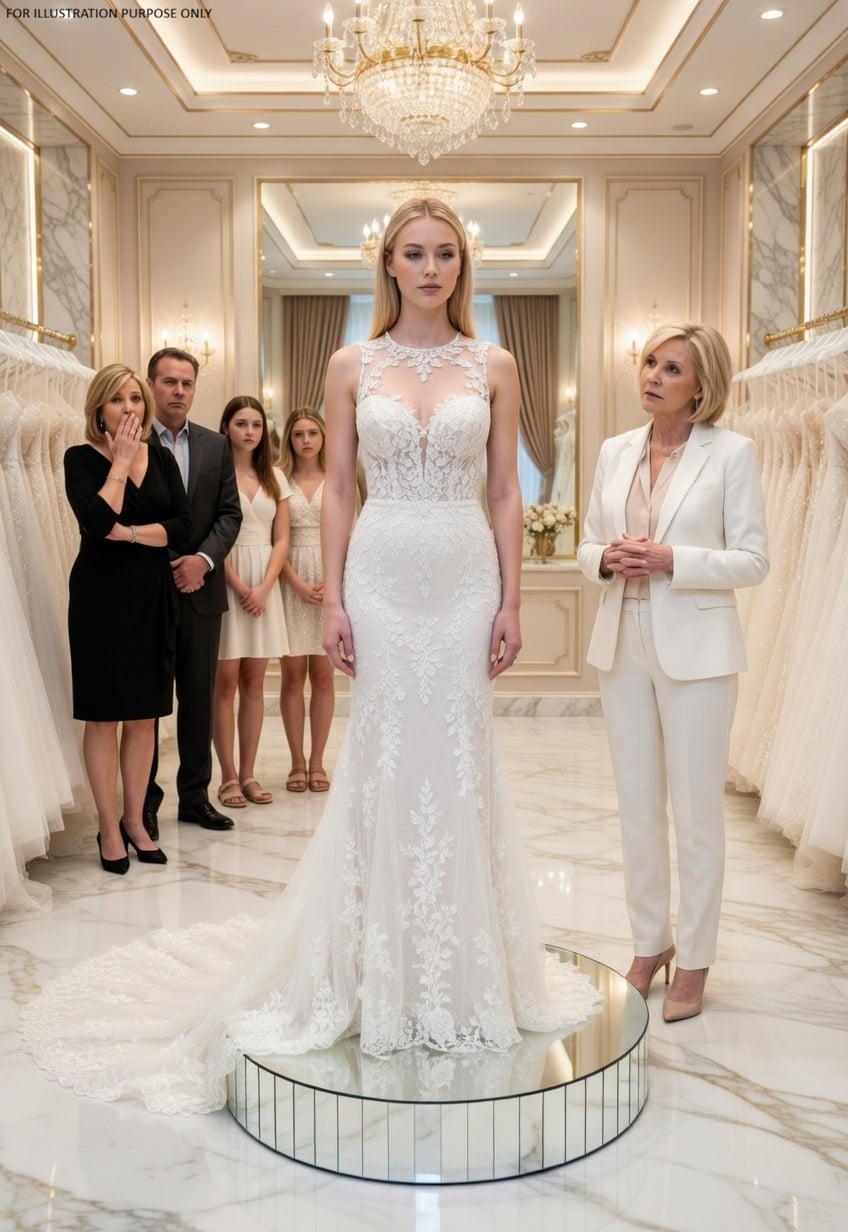
In that moment, surrounded by the soft shimmer of silk and lace, Camille realized she had finally completed the circle: she had claimed her identity, built her chosen family, and transformed past pain into a legacy of strength. She didn’t just walk away from a wedding—she walked into her own story, radiant, unshakable, and entirely free.At her bridal fitting in an exclusive boutique, Camille stood in a breathtaking $14,000 white gown when her fiancé’s mother, Beatrice Sterling, shattered the moment with a cruel remark: white was for women who had a “real family” waiting at the end of the aisle. The room fell silent, eyes filled with pity, but the deepest wound came from her fiancé, Miles, who said nothing. In that instant, Camille was no longer a powerful CEO—she was a child again, reminded of her past in foster care, of never truly belonging. Yet instead of breaking, she responded with quiet composure, stepping down, agreeing to change, and leaving the salon with her dignity intact.
That night, Miles attempted to apologize, but his words only revealed his weakness. He tried to excuse his mother’s cruelty as pressure and tradition, asking Camille to smooth things over rather than stand up for herself. Camille realized then that his silence was not a one-time failure—it was a reflection of the life she would have if she stayed. She refused to translate disrespect into something acceptable just to preserve comfort. What she had wanted was simple: someone who chose her without hesitation. And Miles had failed that test completely.
In the quiet of her private penthouse, far from the version of herself she had allowed him to see, Camille made a decision that would change everything. As the head of a powerful investment firm, she had been preparing a major merger that would save the Sterling family business. Instead, she withdrew from the deal without explanation. By morning, the consequences began to ripple outward—financial pressure mounted, and the Sterling family’s stability began to collapse. When Miles arrived at her office, shocked to discover who she truly was, she made it clear: this wasn’t revenge, but clarity. The relationship was over, and the truth had simply aligned itself.
When Beatrice stormed in demanding answers, she was met not with anger, but with controlled finality. Camille refused her apology and made it clear that actions have consequences. The same woman who had publicly humiliated her now stood powerless, facing the fallout of her own arrogance. Camille ended the engagement, returned the ring, and walked away without looking back. She chose self-respect over acceptance, strength over silence, and truth over illusion.
In the months that followed, Camille rebuilt her life on her own terms. She supported those who had shown her kindness, funded opportunities for others from backgrounds like hers, and created a new definition of family—one built on choice, not blood or status. She returned to the bridal salon not as someone seeking approval, but as a woman fully in control of her own narrative. In the end, Camille Kensington didn’t just walk away from a wedding—she claimed her place in the world, proving she never needed permission to belong….

