
PART 1
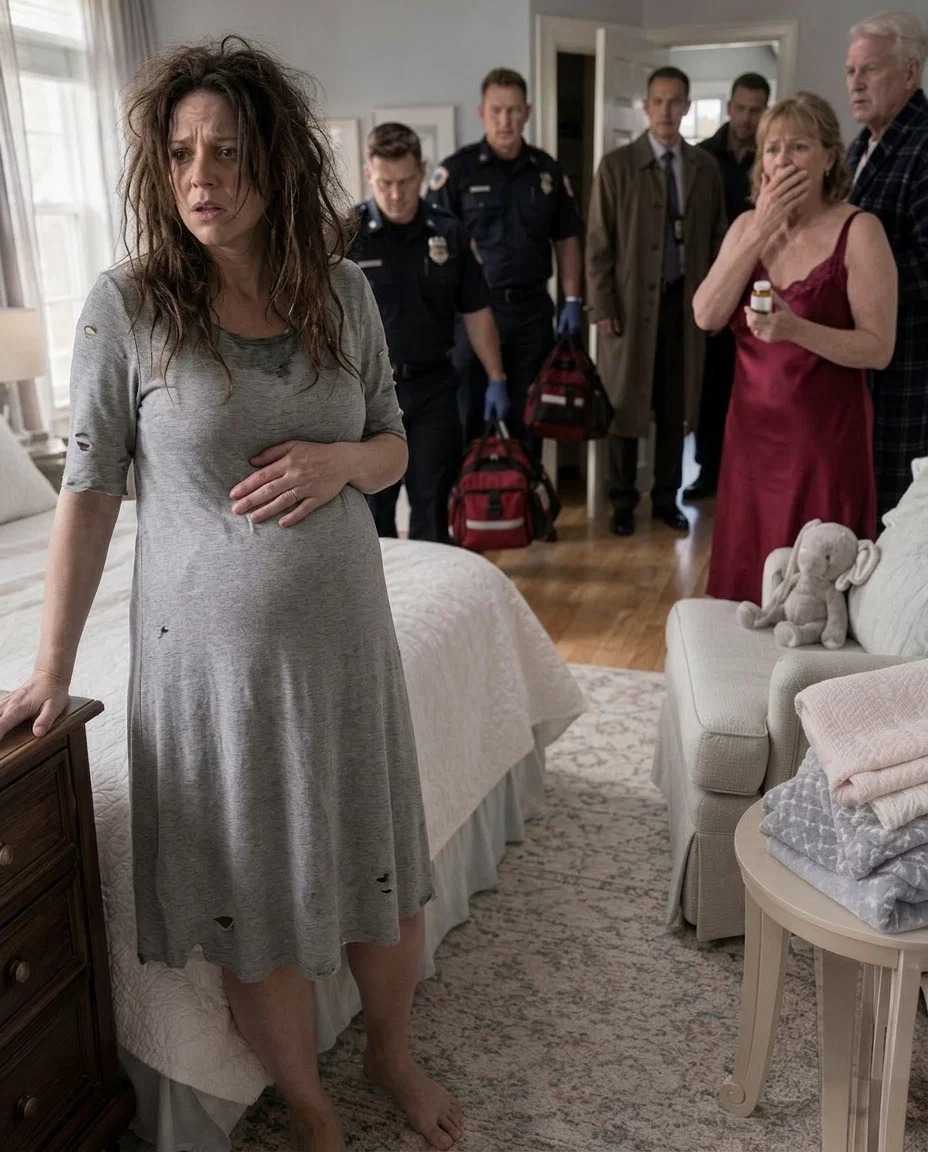
The first contraction ripped me out of sleep at 3:47 in the morning, so sharp I thought something inside me had broken. I lay frozen in the dark, one hand pressed to my swollen belly, waiting for the pain to fade like all the false alarms before it. But this was different. I was eight months pregnant with twins, and this pain came deep from my back, rolling forward through my body like a warning. Daniel should have been beside me, scared and half-awake, asking if it was time.
I had imagined it so many times: him grabbing the hospital bag, me breathing through the pain, the drive through empty streets, the hospital lights, the first cries. But Daniel was gone. His mother, Barbara Stewart, had convinced him the business trip could not be delayed.
“First babies never come early,” she had said. “You’ll still be pregnant when he gets back.”
Daniel had argued, but not enough. That was the part that hurt most. He wanted to stay, but he still heard his mother’s certainty as truth. I told him to go because I had backups, because I trusted my doctor, and because I already suspected Barbara would become worse if Daniel stayed. Another contraction started building. Then the doorway darkened. Barbara stood there in a pale pink robe, one hand resting on the frame. Her silver hair was pinned perfectly, and she did not look sleepy. She looked ready.
“Going somewhere, Melody?”
I breathed through the pain until it eased.
“Hospital.”
Barbara stepped inside and switched on the overhead light. The room flashed harsh yellow. My half-zipped hospital bag sat near the door, close enough to see and too far to reach.
“The babies are coming,” I said.
“Women have given birth for centuries without running to hospitals at the first little pain.”
“This is not a little pain.”
“No,” she said. “It is labor. Which means you need to stay calm and follow the plan.”
The plan. For three weeks, Barbara and her husband Richard had been staying in our house “to help.” They brought casseroles, herbal teas, folded laundry, and unwanted opinions. Barbara called our home “Daniel’s place.” She criticized my doctor, left articles about hospital birth risks on the table, and kept talking about “natural birth” as if my high-risk twin pregnancy were a personal challenge to her pride. Then there were the keys. For the last week, my car keys had disappeared again and again. Now I saw the familiar weight pulling at the pocket of Barbara’s robe.
“I need my phone,” I said.
“Why? So some doctor can scare you into surgery?”
“I’m timing contractions.”
I unlocked the phone partly under the blanket and tapped the recording shortcut my attorney, Sandra, had installed two weeks earlier. A small red icon appeared. Another contraction hit harder, forcing me upright. Barbara watched me from the foot of the bed.
“I already set up the birthing pool in the living room,” she said. “Janet will be here soon.”
I stared at her.
“Janet?”
“From church. She has helped with births.”
“Janet sells essential oils out of her trunk.”
“She understands natural birth.”
“I’m carrying twins.”
“And your body was made for this.”
“My pregnancy is high-risk. I need medical care.”
Barbara’s sweetness vanished.
“No.”
There it was. Plain. No more pretending. I pushed the blanket aside and swung my feet to the floor.
“I’m going to the hospital.”
A heavier figure appeared behind her. Richard stood in the doorway, wide awake.
“You ought to get back in bed.”
“Move.”
Barbara reached into her robe pocket and pulled out my car keys. They jingled once.
“I’ll hold onto these.”
Something inside me stopped being afraid. Not because I was safe, but because the truth was finally clear.
“Barbara, give me my keys.”
“No.”
Richard stepped back and pushed the bedroom door almost shut. For a second, all I heard was the clock, the furnace, and my own breathing. Then my phone vibrated softly in my hand. The emergency plan had started.
PART 2
People think danger is loud. Sometimes it wears slippers, smiles softly, and locks the door. I leaned against the dresser, refusing to sit.
“You are not qualified to make medical decisions for me.”
“We are helping you avoid a decision you will regret,” Barbara said.
“I regret many things already. Going to the hospital will not be one of them.”
Richard laughed.
“Hospitals are for the weak. Barbara had Daniel at home, and he turned out fine.”
“He almost died, didn’t he?”
The room went still. Barbara’s jaw tightened.
“That is not true.”
“Daniel told me you hemorrhaged. He told me an ambulance came.”
“He was a child. He misunderstood.”
Another contraction seized me before I could answer. I gripped the dresser and breathed through it, my phone still in my palm. When it passed, Barbara stepped closer.
“You see? You can do this. Women are strongest when they surrender.”
I glanced at the phone. Still recording. Still connected. I had prepared because people like Barbara become dangerous near important moments. Weddings, births, money, funerals—those moments reveal who wants love and who wants control. When she first suggested a home birth, I thought she was annoying. Then the articles appeared. Then the keys started disappearing. Then Richard asked Daniel about insurance, hospital costs, and our joint accounts. Then forty-seven thousand dollars vanished from our savings.
So I stopped arguing and started collecting evidence: bank records, screenshots, doorbell footage, texts, recordings, and copies stored with Sandra. I let Barbara believe I was too pregnant, too emotional, and too polite to fight back. Underestimation is useful when your enemy talks too much. I stepped toward my hospital bag. Richard moved fast and snatched my phone from my hand.
“Enough. No dramatics.”
“Give it back.”
“You’re in labor, not under attack.”
“Those can be the same thing.”
He tossed the phone onto the armchair across the room.
“You are staying here until Janet gets here.”
“I don’t care if the president gets here.”
The grandfather clock chimed four downstairs. Then another contraction slammed into me so hard I cried out. When it eased, something warm trickled down my leg. Not much, but enough to send fear through me. Barbara noticed my face.
“What?”
“Nothing.”
Then my phone screen flashed from the chair. A calm automated voice filled the room.
“Emergency protocol activated. Emergency services have been notified of your location. Please remain calm. Help is on the way.”
For one perfect second, no one moved. Richard lunged for the phone.
“What did you do?”
“It’s a safety protocol,” I said, breathing hard. “If the phone detects active labor and I’m not moving toward the hospital route, it sends alerts.”
Barbara spun toward me.
“You called the police on us?”
“I didn’t have to. You did that yourselves.”
The automated voice repeated the message. GPS location. Daniel. Dr. Martinez. Sandra. Emergency services. Everything had been sent. Barbara’s face went pale.
“You are making us look like criminals.”
“If the robe fits.”
Her expression twisted.
“You vindictive little—”
“Careful,” I said. “Everything is still recording.”
That stopped her. Sirens began in the distance. Barbara turned toward the window.
“No.”
“Yes.”
“You don’t understand what you’re doing. Reports get filed. Agencies get involved. These things follow families.”
“You should have thought of that before you stole my keys.”
“Stole?” Richard scoffed.
“I know about the money,” I said.
The room froze again. Barbara recovered first.
“Family helps family.”
“Family asks.”
“We planned to put it back.”
“You planned to keep taking it after the babies were born.”
Richard glanced at her, and that one look told me enough. The pounding at the front door shook the house.
“Emergency services! Open the door!”
Barbara stepped toward me, but a contraction dropped me to one knee. Then the front door burst open below us. Heavy footsteps rushed up the stairs. My water broke as they reached the bedroom.
“Move,” I said.
This time, strangers moved for me.
PART 3
A female paramedic entered first, followed by another paramedic, a police officer, Sandra, and a county worker. Barbara saw the badge and gasped.
“You called child services on us?”
The worker looked at her calmly.
“We are here because of an allegation of medical endangerment involving unborn children and unlawful restriction of the mother’s access to care.”
Barbara laughed in disbelief.
“Unborn children? They aren’t even born.”
The officer wrote something down. Sandra looked at Barbara.
“Please keep talking.”
The paramedic took my arm.
“Melody? How far apart are contractions?”
“Two minutes. Twins. High-risk. Dr. Martinez. Twin A may be breech.”
“We’re moving fast.”
Sandra turned to Barbara, whose fist still held my keys.
“Hand those over.”
“They’re not—”
“Mrs. Stewart, do not add obstruction to this. Give me the keys.”
Richard stepped forward.
“This is my son’s house.”
“My house,” I said through the pain.
Sandra opened her folder.
“And if you want to keep talking, Mr. Stewart, explain why you and your wife moved in without a lease while siphoning forty-seven thousand dollars from the homeowners’ joint account.”
Richard’s face changed. Barbara turned on him. She had not known Sandra had the exact number. The paramedic checked my blood pressure and went serious.
“We need to leave now.”
Barbara grabbed the stretcher rail.
“She is not leaving. Janet is on her way. We already prepared the pool.”
The paramedic knocked Barbara’s hand away.
“If you interfere again, you will be removed.”
As they wheeled me toward the stairs, I saw the inflatable birthing pool in the living room. Towels were stacked beside it. A diffuser puffed lavender into the air. For one sick second, I imagined what could have happened there if help had not come. At the ambulance, Barbara screamed from the doorway.
“Daniel will never forgive you!”
I looked back.
“He already did.”
Then the doors shut. At the hospital, Dr. Martinez was waiting under the bright emergency lights.
“Melody,” she said. “I’ve got you.”
Those three words almost broke me. After a quick exam, her face turned serious.
“You are eight centimeters. Twin A is breech. We are going to the OR now.”
Relief hit me through the terror. If we had waited longer, we might not have had this choice. The surgery blurred into lights, hands, voices, and pressure. Then a cry split the air.
“Twin A, female.”
Charlotte. A moment later, another cry came.
“Twin B, male.”
Oliver. Both babies were breathing. When they laid them against my chest, warm and alive, I understood that every document, every recording, every backup plan had led to this moment. I had gotten them here. When I woke in recovery, Daniel was there, wrinkled shirt, red eyes, face full of fear and guilt.
“Mel,” he whispered. Then, before anything else, “I’m sorry.”
“They’re okay,” I said.
Later, Dr. Martinez told us the truth. Charlotte’s cord had been wrapped twice and showed signs of compression.
“If there had been a longer delay,” she said, “this could have ended very differently.”
Daniel covered his face. When he lowered his hands, something in him had changed forever.
“She could have died.”
Dr. Martinez did not soften it.
“Yes.”
After she left, Daniel looked at me.
“They never see our children.”
“No,” I said. “They don’t.”
Three months later, Barbara and Richard accepted a plea deal. The court ordered restitution, probation, counseling, and permanent restraining orders. They were forbidden from contacting me, Daniel, or the twins. Some people later said they were still family. I learned my answer. Family is not permission.
Children need safe adults, not biological titles. Forgiveness is not required when someone only wants access again. Charlotte and Oliver are three now. They are loud, funny, stubborn, and safe. Daniel became the kind of father he never had: present, gentle, willing to apologize, willing to change.
One day, I will tell my children the whole story. I will tell them their father broke a pattern. I will tell them documentation matters, instinct matters, and love without respect becomes possession. Tonight, after dinner, Daniel carried them upstairs. Charlotte wore fairy wings.
Oliver still clutched a toy bulldozer. I tucked them into their soft green room and watched them breathe in the warm glow of the night-light. Safe. Healthy. Loved. Out of reach. And I felt no guilt for the people kept outside that circle. Only peace.
THE END