
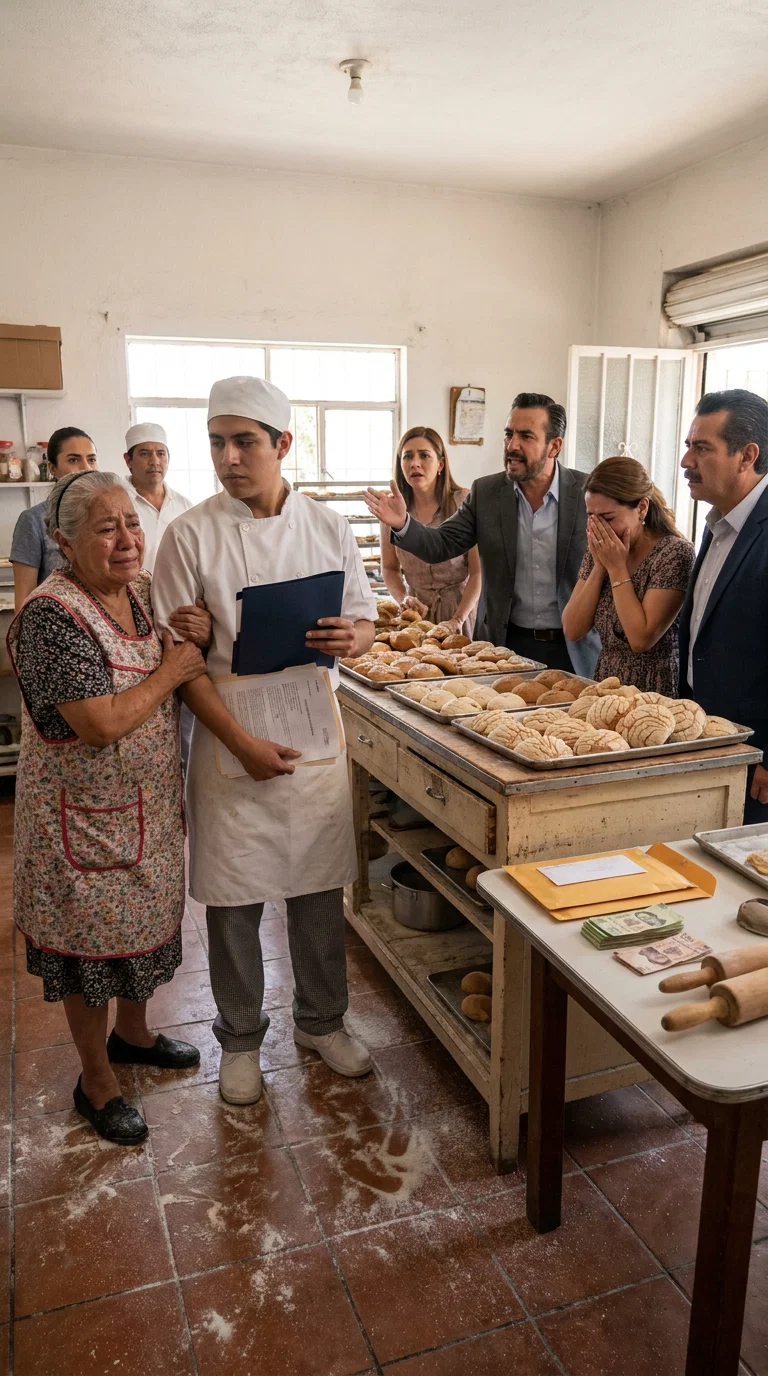
The lawyer pulled out another folder.
This one was dark blue, with my name printed on a white label.
Memo stared at it as if it were a weapon.
“What is that?”
I didn’t answer right away. Instead, I took Doña Juana’s twelve hundred pesos and placed the bills in front of her one by one, like I was returning something sacred.
“This was the only honest thing anyone gave me that week.”
Doña Juana wiped her eyes with the corner of her apron.
“Son, I didn’t come here for money. You told me there were papers about my stove.”
Susana gave a poisonous little laugh.
“How convenient. The old lady knew nothing, and now she’s about to win a prize.”
Doña Juana lowered her head.
Anger rose in me slowly, hot as steam from the ovens at dawn.
“Don’t speak to her like that.”
Memo slapped the table.
“She’s a stranger. We’re your blood.”
I stepped closer.
“My blood was eating steak while I was telling them I might lose an eye.”
He went quiet.
The lawyer cleared his throat.
“As I was saying, Mr. Sebastián Rivas has formalized the purchase and donation, with lifetime usufruct, of the house on Abasolo Street in the Independencia neighborhood, in favor of Mrs. Juana Martínez. A maintenance fund of five million pesos has also been established for housing, food, and medical care.”
Doña Juana stopped crying.
For a moment, she looked like she had forgotten how to breathe.
“No, son.”
“Yes.”
“I can’t accept that.”
“You can, and you will. The roof over your house is failing, your stove leaks gas, and every time it rains, water runs through the wall. You shouldn’t have to sleep afraid that one spark will end everything.”
Memo grabbed his head.
“Five million? For an old woman who gave you a thousand pesos?”
“Twelve hundred,” I corrected. “And it was everything she had.”
Susana stood up.
“This is manipulation. That woman took advantage of you when you were weak.”
Doña Juana stood too, trembling with shame.
“I knew nothing about any prize, miss. I only saw a frightened man.”
Susana looked her up and down.
“Well, that coffee became very expensive.”
Then Doña Juana did something I never expected.
She raised her hand and slapped her.
Not hard.
But clearly.
“You may call me poor,” she said. “But don’t call me an opportunist.”
The bakery fell silent.
Outside, a corn vendor rolled past with his cart, calling out about cream, cheese, and chili. The neighborhood kept moving like any normal Sunday, with children playing, dogs barking at motorcycles, and the smell of charcoal drifting from nearby houses.
Inside, my family was falling apart around a metal table.
Memo pointed at Doña Juana.
“I’ll sue her.”
The lawyer opened the blue folder.
“Before making threats, Mr. William, you should hear the rest.”
Memo turned on him.
“And who do you think you are?”
“The notary who certified that Mr. Sebastián legally collected his Melate prize, paid all required taxes, and has no financial obligation to his adult siblings.”
Susana went pale at the word Melate.
Until then, I don’t think any of them had heard the whole number spoken aloud.
Forty million.
Not inheritance.
Not family business money.
Not anything from my parents.
Just a ticket I bought at a small shop one night with twenty extra pesos and almost no hope left.
It wasn’t like a movie. No confetti. No music. Just papers, signatures, taxes, bank details, warnings, and patience. They told me not to tell everyone, to be careful of sudden phone calls and long-lost relatives.
I left with the receipt folded in my pocket and a new kind of fear.
Because poverty teaches you to fear hunger.
Money teaches you to fear people.
Memo lowered his voice.
“Chano, we’re brothers.”
“Yesterday, I was just a garage baker.”
“I was angry.”
“No. You were comfortable.”
Susana came closer with fake tears in her eyes.
“Sebastián, I didn’t know your eye injury was that serious.”
“I told you I could lose my sight.”
“I thought you were exaggerating.”
“You always thought that.”
My cousin Beto, who had been silent until then, muttered, “Well, your test was cruel too.”
I looked at him.
He was right.
That hurt because it was true.
“Yes,” I said. “It was cruel. I’m ashamed that I lied. But I’m even more ashamed that my family needed to believe I was nearly blind before they considered helping me—and even then, they didn’t.”
Doña Juana suddenly looked at me.
“You weren’t sick?”
My chest tightened.
That was the only judgment that mattered.
“No, Doña Juana. My eye is fine.”
She stepped back.
“Then you lied to me.”
“Yes.”
“You watched me give you my savings even though you didn’t need them.”
I lowered my head.
“Yes.”
Her eyes filled again, but this time it was not from emotion.
It was disappointment.
“That wasn’t right, son.”
Those words hurt more than Memo’s insults.
“You’re right.”
I placed the bills in her hand.
“That’s why this isn’t payment. Nothing could repay what you did. It’s an apology—with a safe roof, medical care, a new stove, and rest. But if you don’t want it, I won’t force you.”
Doña Juana clutched the money.
“I won’t be part of revenge.”
“It isn’t.”
“Then look me in the eyes and tell me you are not using me to punish your siblings.”
I lifted my gaze.
I couldn’t answer immediately.
Because some of it was true.
“At first, yes,” I admitted. “I wanted them to feel what it was like to watch you receive what they believed belonged to them. But then I saw your stove, your roof, your burned hands from cooking for others, and I understood this wasn’t about them anymore. It was about making sure, for once, the money went where it was truly needed.”
Doña Juana took a deep breath.
“I’ll accept repairs for the stove and roof.”
The lawyer began to speak, but she raised one hand.
“Not the millions. Not like that.”
Memo smiled, thinking he had won.
“There. Even she understands.”
Doña Juana looked at him.
“Don’t be happy, young man. I refuse because I’m not greedy. You receive nothing because you weren’t kind.”
Memo’s face turned red.
I let out a bitter laugh.
“Then we change the plan,” I said.
The lawyer looked at me.
“Sebastián…”
“We create the trust.”
Susana frowned.
“What trust?”
I opened the blue folder.
“One for scholarships for the children of bakers, cooks, bricklayers, domestic workers, and single mothers in this neighborhood. Doña Juana will sit on the committee, if she agrees. She won’t receive the money as a prize. She’ll help decide who truly needs help.”
Her eyes widened.
“Me?”
“You know the difference between need and greed better than anyone at this table.”
The bakery filled with a new kind of silence.
Outside, distant cumbia floated from a house. For a second, I remembered every early morning kneading dough while Monterrey still slept in the heat, waiting for the first customer to come in for hot conchas.
I remembered how Doña Juana used to buy bread even when she had tortillas at home.
“So the business moves, son,” she always said.
Memo grabbed the expensive bottle he had brought.
“This is ridiculous. You’re giving millions to strangers and nothing to us?”
“I’m giving you something.”
Susana lifted her face.
“What?”
I took three envelopes from the drawer.
One for Memo.
One for Susana.
One for my mother, who hadn’t come because of her blood pressure—and because my siblings conveniently didn’t want to bring her.
“Memo, I’m paying off Toñito’s clinic debt.”
He froze.
“How do you know?”
“Your wife called me two months ago crying. You said there was no money for therapy, but you bought a boat.”
His expression changed.
“That’s none of your business.”
“A child who struggles to walk is the business of any decent adult. But the money goes straight to the clinic. Not to you.”
Memo clenched his jaw.
“I don’t need your charity.”
“Your son needs therapy.”
He had no answer.
I handed the envelope to his wife, who stood near the door with tears in her eyes. She took it without asking him.
“Thank you, Sebastián,” she whispered.
Memo didn’t even look at her.
That confirmed it. His pride weighed more than his child.
I turned to Susana.
“I’m not paying for your trips, credit cards, gym membership, or dinners in San Pedro.”
She crossed her arms.
“I didn’t ask you for anything.”
“Good.”
Her face lost color.
I opened her envelope.
“But I’m paying Valeria’s overdue tuition directly. My niece isn’t responsible for the life you pretend to afford.”
Susana broke down crying.
Real tears this time.
“You know nothing.”
“I know the school sent a final notice. I know Valeria hid the letter because she was ashamed. I know she messaged me asking if I needed help at the bakery so she could earn money.”
My sister sank into a chair.
“I didn’t want anyone to know.”
“I didn’t want everyone to know my siblings despised me either. But here we are.”
I placed the third envelope on the table.
“And I bought Mom a one-story house in Guadalupe, near the church and the market, so she won’t have to climb stairs anymore. She’ll have a morning nurse and an account for her medicine. You can visit her, but you won’t control the money.”
Memo cursed.
“You’re punishing us.”
“No. I’m removing your chance to fail someone again with money that isn’t yours.”
Memo did what he always did when he lost.
He tried to destroy.
“And who are you to act holy? You lied about being sick. You manipulated an old woman. You trapped us like rats.”
Doña Juana stood.
“Enough.”
“You be quiet.”
Memo’s hand lifted slightly.
I didn’t wait to see if he meant to point or push.
I caught his arm and forced him back against the counter. A tray of conchas crashed to the floor. Sugar scattered across the tiles.
“Don’t touch her.”
Memo glared at me.
“You’ll end up alone, Chano.”
I let him go.
“No. I was already alone. Now I simply have enough light to see it.”
Susana stood, crying.
“Let’s go, Memo.”
My brother grabbed his bottle.
Before leaving, he said, “Blood calls.”
“It also stains,” I replied.
They left one by one.
Cousins, nephews, awkward companions. Some said goodbye with embarrassment. Others refused to meet my eyes.
In the end, only Doña Juana, the lawyer, my sister-in-law with the clinic envelope, and I remained among fallen bread and silence.
Doña Juana began picking conchas from the floor.
“Don’t do that,” I said.
“Don’t step on bread, son.”
I crouched beside her.
“It’s dirty.”
“Then give it to the dogs. But bread is not rejected.”
That was when my eyes filled.
I sat on the floor of my own bakery, surrounded by sugar and shame, and cried harder than I had when I collected the prize.
Doña Juana placed a hand on my head.
“Money only makes bigger what a person already carries. If it’s pride, it swells. If it’s guilt, it shouts. If it’s heart, it gets to work.”
“I don’t know what to do with so much.”
“Start by not becoming like them.”
The lawyer closed the folders.
“So, a trust?”
I looked at Doña Juana.
“Only if you help me choose.”
She sighed.
“I accept. But don’t put my name on anything. People will think I’m already dead.”
I laughed through my tears.
“Then we’ll call it Dawn Bread.”
“That, I like.”
The months that followed were strange and busy.
I didn’t buy a mansion.
I didn’t buy a boat.
I didn’t move to San Pedro or become one of those people who say “investments” when they mean fear.
I repaired the bakery. New ovens. A proper display case. A simple sign. I still woke before dawn, because money can buy rest, but it can’t replace the smell of bread coming out of the oven.
Doña Juana got a safe new stove.
She refused a new house.
But she accepted roof repairs, a proper gas installation, and a refrigerator that no longer needed rope to keep the door closed.
The trust began small.
Valeria returned to school with a new uniform and no need to show off.
Toñito received therapy, and one day he walked into the bakery with a walker and called me “uncle” as if nothing had happened.
We paid for medicine for a neighbor, supplies for the child of a domestic worker, and a baking course for a young woman trying to leave a dangerous marriage.
Every peso hurt less when it had a face.
Memo came back after four months.
He arrived on a rainy afternoon without his truck, his watch, or his beer. He stood at the door while I took pineapple empanadas from the oven.
“Toñito climbed three steps by himself,” he said.
I didn’t look up.
“I’m glad.”
“Mom says I should thank you.”
“She already did.”
He stood in silence.
“I don’t know how.”
I placed the tray on the counter.
“Start without asking for money.”
That hurt him.
But he didn’t leave.
“I’m sorry.”
The words came out rough and ugly, like a rusted screw being pulled loose.
But they came out.
I didn’t run to hug him.
Forgiveness is not sweet bread to be handed out warm.
“I heard you,” I said. “I don’t know what to do with it yet.”
He nodded.
“Fair.”
Susana came back later with Valeria. She didn’t ask for anything. She brought a bag of flour.
“I didn’t know what to bring,” she said.
“Flour is always useful.”
She cried.
I did too, but not in front of her.
Over time, I understood that my test had been cruel. But life answered with a bigger lesson: it is not enough to learn who loves you when you have nothing. You must also decide who you will become when you have everything.
A year later, we held the first official scholarship gathering at the bakery.
No press.
No speeches.
Just pot coffee, cornbread, fresh sweet rolls, and borrowed chairs. Doña Juana brought a huge pot of charro beans because, according to her, you can’t celebrate with only paper.
My mother arrived in a wheelchair wearing her blue shawl, her eyes wet.
“Your father would be proud,” she told me.
I don’t know if that was true.
But I wanted to believe it.
At the end of the day, after everyone had gone, Doña Juana handed the twelve hundred pesos back to me again.
“Don’t keep it like a trophy anymore,” she said. “Use it.”
“For what?”
“Buy Melate tickets for all the scholarship kids.”
I laughed.
“You want to make them millionaires?”
“No. I want them to know even a cheap piece of paper can open a door. But if it opens, they must walk through it with decency.”
I bought the tickets.
Nobody won.
That was better.
That night, I closed the bakery and sat on the sidewalk for a while. The air smelled of rain on warm asphalt, charcoal from a distant grill, and yesterday’s bread.
I thought about my siblings laughing at me while their plates were full.
I thought about Doña Juana giving me everything she had.
I thought about the forty million pesos, the winning number, and the strange life that had fallen into my hands like dough without shape.
Then I understood the prize had not been the money.
The true prize was seeing, before I became rich, who still looked at me as a person.
My eye had never been sick.
But that week, I finally learned how to see.
I saw that blood does not always mean family.
I saw that poverty does not prevent generosity.
I saw that money can buy houses, ovens, and legal papers, but it cannot buy nobility.
And I saw, at last, that a neighbor with an apron, twelve hundred pesos, and a broken stove could have more heart than an entire table full of last names.

