
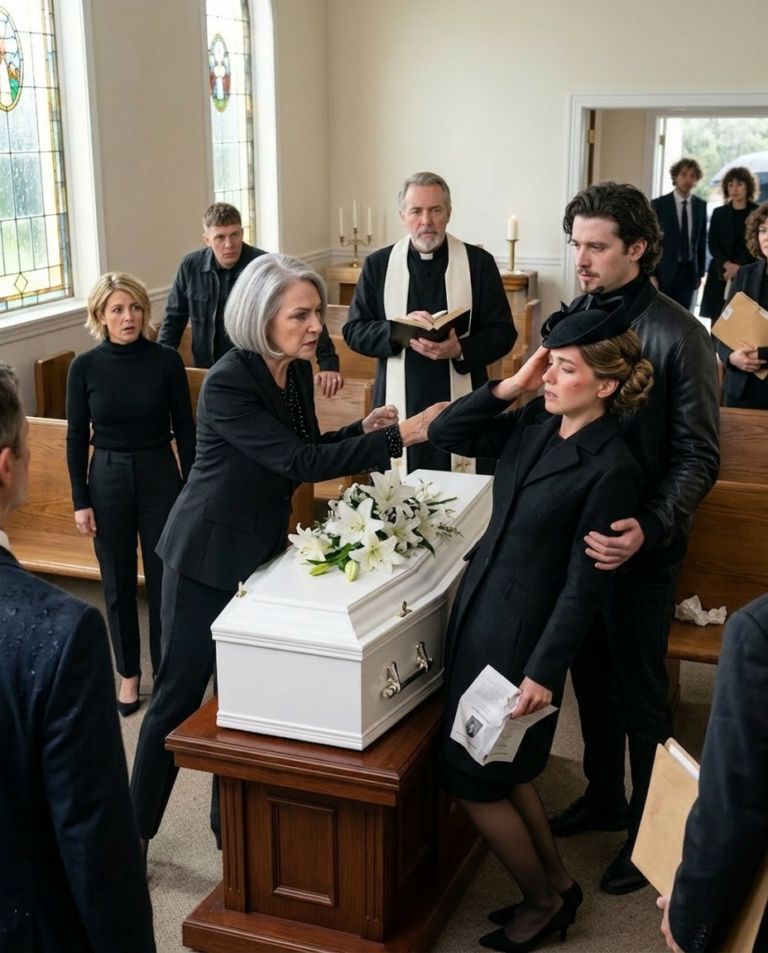
The second time, Evelyn’s slap still burned across her face.
The chapel was filled with the scent of lilies, candle wax, polished wood, and rain soaked into dark coats. Outside, the storm tapped against the stained-glass windows like the sky itself was holding back tears.
Ethan and Ava, Hannah’s twin babies, lay in two small white coffins near the altar. Their names were carved in gold, bright and beautiful in a way that felt almost cruel.
Hannah had not slept in four days. That was not an exaggeration. It was the exact number of nights she had spent staring into darkness, too exhausted to cry and too broken to rest.
Her black dress hung loosely on her body, as if it belonged to another woman. A stronger woman. A woman who had not left pieces of herself in hospital hallways and quiet rooms where doctors lowered their voices before saying, “We’re sorry.”
To her right stood Ryan, her husband.
He was looking at the floor.
Not at the coffins.
Not at Hannah.
He stood with his hands clasped together, as if silence could save him from what he had failed to do.
Beside him was Evelyn, Ryan’s mother. She wore black lace, a carefully arranged veil, and an expression so calm that mourners kept touching her arm and praising her strength.
They told Ryan he was brave.
They told Evelyn she was remarkable.
They said she was holding the family together.
Hannah listened to every word and felt each one cut deeper. Because none of them understood what kind of fortress Evelyn had built—and what fear it had been built from.
Evelyn had not entered Hannah’s life like a villain.
That would have been easier.
She came with family dinners, spotless dishes, folded napkins, and soft words that sounded almost loving.
When Ryan proposed, Evelyn cried in the photos and said she had finally gained a daughter.
When Hannah became pregnant, Evelyn brought vitamins, blankets, and advice wrapped in kindness.
When Ethan and Ava were born early, Hannah allowed her into the hospital.
That was her first mistake.
Not every woman who smiles beside a crib is there to protect.
Some are there to control.
The twins became sick weeks before they passed away. First, Ethan’s breathing changed—just a little, almost too softly for anyone else to notice. But Hannah noticed, because mothers learn the hidden language of their children before they learn how to sleep.
Then Ava developed a fever. It came and went, fading for a few hours before returning stronger.
At 2:14 a.m. on a Tuesday, Hannah called the pediatric hotline for the third time. Ethan was pressed against her chest, and Ava was crying nearby.
Ryan rolled over in bed and told her she was overreacting.
The next day, Evelyn told a nurse that Hannah had a history of panic attacks.
She said it gently.
That made it worse.
By the eighth day, the words had started spreading.
Panic.
Anxiety.
Paranoia.
By the eleventh day, Ryan signed discharge papers Hannah was too exhausted to fully read.
The babies came home.
And nothing felt safe anymore.
So Hannah began making copies.
She did not fully know what she was searching for yet. But something inside her—something tired, wounded, but still awake—told her that one day she would need dates, names, doses, and signatures.
She saved registration forms.
Medication notes.
Pediatric records from St. Agnes Children’s Center.
She photographed the label of a bottle Evelyn swore she had never touched.
She copied pharmacy receipts found folded in the trash.
She noticed the insurance documents Ryan removed from the kitchen drawer the morning after the babies died.
Grief can blur the world.
But sometimes it can also sharpen one detail until nothing else matters.
And Hannah began to see.
Inside the chapel, the minister read from Psalm 23, his voice unsteady.
A chair creaked behind Hannah.
Someone cried quietly into a handkerchief.
A little girl asked her mother why the boxes were so small, and the mother covered her mouth before she could finish.
Hannah’s fingers tightened around the funeral program.
Then Evelyn leaned close.
Her perfume reached Hannah first.
Sweet.
Expensive.
Suffocating.
Then came her voice.
“God took them,” Evelyn whispered near Hannah’s ear, “because He knew exactly what kind of mother you were.”
It was not grief speaking.
It was cruelty.
Hannah did not answer at once.
She looked at Ethan’s name.
Then Ava’s.
She listened to the rain, the open Bible, the hum of the lights, and Ryan’s dangerous silence beside her.
Then she turned her head.
“Can you please be quiet—just for one day?”
She did not scream.
She did not insult her.
She did not create a scene.
But the chapel stopped.
The minister paused mid-verse.
A cousin froze with a handkerchief in her hand.
Ryan’s uncle stared at the floor.
Evelyn’s sister suddenly became very interested in the lilies near Ava’s coffin.
Thirty-seven people were close enough to hear.
And all thirty-seven waited.
That was what Hannah would remember later.
Not only the cruelty.
The waiting.
Because in many families, abuse survives not because the abuser is powerful, but because everyone else finds silence more convenient.
For less than a second, Evelyn’s mask slipped.
The grieving grandmother disappeared.
The dignified widow disappeared.
Only a cold woman remained—angry not because Hannah was hurting, but because Hannah had challenged her in front of witnesses.
Then Evelyn raised her hand.
The slap cracked through the chapel.
Hannah’s head turned to the side, heat rushing across her cheek.
Before she could steady herself, Evelyn grabbed her arm and shoved her forward. Hannah stumbled against the polished edge near Ethan’s coffin.
A shocked sound moved through the room.
Someone called Hannah’s name.
Evelyn leaned closer, barely smiling.
“Keep quiet,” she whispered, “or you’ll regret it.”
Ryan finally lifted his head.
For one second, Hannah believed it was over.
She thought that surely this would break whatever loyalty still tied him to his mother.
She thought her husband would finally see her.
Ryan looked at Hannah’s face.
Then at Evelyn’s hand.
Then at the coffin.
And in a flat voice, he said, “That’s enough, Hannah. Stop making a scene.”
Something inside Hannah became completely still.
It was not peace.
It was clarity.
For months, Ryan and Evelyn had built a version of Hannah that everyone could believe.
A nervous woman.
An unstable mother.
A tired wife.
Someone who could no longer separate instinct from panic.
Evelyn used the word “hysterical” softly, as if it were a diagnosis instead of a weapon.
Ryan repeated it in clinics, phone calls, kitchens, and family conversations.
At first, Hannah argued.
Then she explained.
Then she begged.
Eventually, she learned that some people do not want the truth. They only want a useful word to bury you under.
But before Hannah was a wife, before she was a mother, before she became the woman everyone pitied in that chapel, she had worked on criminal fraud cases for the Prosecutor’s Office.
She had studied bank statements until one wrong date exposed a lie.
She had watched people smile under oath while hiding evidence in the wrong drawer.
She had learned that guilty people do not always run.
Sometimes they simply trust that their victim is too broken to look.
But Hannah was not broken.
She was grieving.
And those were not the same thing.
At 6:32 that morning, before putting on her black dress, before tying up her hair, before touching Ethan and Ava’s blankets one last time, Hannah opened a small wooden box that had belonged to her grandmother.
Inside was an old black mourning brooch with a smooth, teardrop-shaped surface.
Hidden inside it was a tiny camera.
That camera did not belong to her grandmother. It belonged to Hannah. She placed it carefully inside the clasp. She did not cry while doing it.
She had already cried herself empty.
What remained was precision.
By 9:47 a.m., the brooch had recorded Evelyn’s whisper.
It had recorded the slap.
It had recorded the threat.
It had recorded Ryan calling a grieving mother’s pain a spectacle in front of her children’s coffins.
And perhaps most importantly, it had recorded everyone else’s silence.
Hannah lowered her eyes.
She let her shoulders fall.
She allowed Evelyn to believe she had won.
She allowed Ryan to take her by the elbow as though he were guiding an unstable woman away from the altar.
The minister stood frozen with the Bible open in his hands.
Rain kept tapping against the stained-glass windows.
Evelyn adjusted her veil with elegant fingers and wiped away a tear that had never fallen.
Then the chapel doors opened.
Everyone turned.
Two men in dark suits entered first, rain shining on their shoulders.
Between them walked a woman Hannah had not seen in four years.
She carried no flowers.
She offered no condolences.
She held a sealed evidence folder tightly against her chest.
Hannah recognized her immediately.
Ryan recognized her too.
But too late.
The color drained from his face.
Evelyn’s hand dropped from her veil.
For the first time that morning, her confidence cracked.
Hannah lifted her marked face toward her children’s coffins.
Her voice was low, almost breathless, but steady.
“My mother did hear me.”
The woman walked down the center aisle.
Each step seemed louder than the storm outside.
She looked directly at Ryan.
Then she opened the folder.
“Ryan Caldwell, don’t move.”
The words echoed through the chapel.
Ryan released Hannah’s elbow as if he had been burned.
Evelyn tried to rebuild her grieving-grandmother expression, but the label on the folder was visible from the front row.
**ST. AGNES CHILDREN’S CENTER — MEDICATION REVIEW**
Below it, another line was stamped in red.
**URGENT RETENTION**
The minister stepped back until he reached the altar rail.
Hannah said nothing.
She simply touched the black brooch pinned over her heart.
It was still warm.
Evelyn followed the movement with her eyes, and her lips parted slightly.
In that moment, she understood. She understood that her whisper had been captured. She understood that the slap had not only been seen. It had been recorded.
She understood that Hannah had not come to the funeral to fight. She had come to endure long enough for the truth to arrive. The woman removed another document from the folder.
It was not a statement. It was not a court order. It was a pharmacy receipt.
The chapel became so silent that Hannah could hear Ryan breathing.
The receipt was not in Hannah’s name.
It was not in Ryan’s name either.
At the top, printed clearly, was Evelyn’s name.
The date was three days before Ethan’s breathing changed.
Ryan stared at the paper as though he had forgotten how to read.
“Mom,” he whispered, sounding like a child for the first time, “what is that?”
Evelyn did not answer.
Her eyes stayed fixed on the receipt.
Not with guilt.
Not yet.
With calculation.
Hannah knew that look.
She had seen it in case files, interviews, and suspects who were not searching for confession—but for escape.
The woman stepped closer and held up the document for Hannah to see.
“Hannah,” she said, “I need you to confirm whether this is the same medicine bottle you photographed in your kitchen at 2:14 a.m.”
Everyone turned toward Hannah.
The relatives who had stayed silent.
The minister who had not known what to do.
Evelyn’s sister, now crying quietly.
Ryan, nearly collapsing against the front pew.
Evelyn, with her twisted veil and closed mouth, silent for the first time since Hannah had known her.
Hannah felt her cheek burn.
She felt the ache at her temple.
She felt the weight of the brooch over her heart.
Behind her, Ethan and Ava’s coffins remained white, small, and unbearably still.
For weeks, she had been told her instinct was illness.
For weeks, she had been told her questions were shameful.
For weeks, they had made her doubt every call, every dose, every photo, every fear.
But a mother can be humiliated. She can be isolated. She can be exhausted. She can be buried beneath other people’s lies.
And still remember the exact moment something stopped feeling right. Hannah looked at Evelyn. Then at Ryan.
Then at the pharmacy receipt in the woman’s hand.
And for the first time since her babies died, her voice did not shake.
“Yes,” she said.

