
I bought the two-million-dollar mansion on a quiet hill outside Nashville after twelve years of building a medical software company that no one in my family had ever believed counted as real work.
My name was Claire Lawson. I was thirty-four, and the first time I stood in that foyer, beneath the curved staircase and the morning light, I felt like the frightened girl who once studied beside a laundromat had finally found her way home.
I invited my parents to the housewarming six weeks ahead of time.
I sent them the address, the date, the time, and a message that said, “It would mean a lot if you came.”
Mom answered with a thumbs-up emoji.
Dad replied, “We’ll try.”
My younger brother, Mason, was eighteen, about to begin college two hours away, and had spent his whole life being treated like a national crisis every time he needed socks, snacks, or applause.
On the morning of my housewarming, Mom texted, “Sorry, honey. We have to help Mason move into his dorm today. You understand.”
I stared at the message while caterers carried trays across my kitchen and my friends arranged flowers in the dining room.
Mason’s dorm move-in had been on the calendar for months, but so had my housewarming.
They had chosen his twin XL sheets over the biggest day of my life without even trying to pretend the decision had been hard.
I typed, “Of course. Good luck with move-in,” then put my phone away before the ache could rise into my throat.
The party was beautiful anyway.
My coworkers came, my neighbors came, my college roommate flew in from Seattle, and my assistant cried when she saw the library because she remembered me sleeping under my desk during our first product launch.
People took photos on the terrace, in the kitchen, beside the pool, and beneath the chandelier my mother would have called “too fancy for someone like us.”
At 10:17 that night, my cousin posted a picture of me standing barefoot in the foyer, holding champagne, with the caption, “Claire built her dream from nothing.”
The next morning, Dad called before I had even finished my coffee.
No congratulations.
No apology.
No, “I’m sorry we missed it.”
He said, “Why didn’t you tell us the house was that big?”
I looked at the marble island, the flowers still fresh from the party, and waited.
Then he said, “Your mother and I need a key.”…
Part 2
For a moment, I thought I had heard him wrong.
“A key?” I asked.
Dad breathed out impatiently, the same way he used to when I was little and asked why Mason never had to clean up after himself.
“Yes, Claire. A spare key. We are your parents, and a house like that should be accessible to family.”
I almost laughed, but the sound would have hurt too much.
“You skipped the housewarming,” I said.
“We were helping your brother move,” Dad replied. “He needed us.”
“I needed you too,” I said quietly.
The line went silent, but not because of guilt.
Because of annoyance.
Then Dad said, “Don’t make this dramatic. Mason is still a kid, and you’re an adult with a mansion. Frankly, it would be selfish not to share it.”
There it was.
My accomplishment had taken less than twenty-four hours to become family property.
He began listing all the reasons they needed access: holiday gatherings, weekend visits, storage for Mason’s old furniture, a place for relatives to stay when they came to Nashville.
Then he added, “And your brother may want to spend breaks there if campus gets too noisy.”
I placed my mug down carefully.
“Dad,” I said, “you could not make time to see the house when I invited you, but now you want a key so Mason can use it as a vacation dorm?”
His voice turned hard. “You don’t need to talk about your brother like that.”
“You’re right,” I said. “I need to talk about me.”
Mom took the phone then, probably because Dad had put me on speaker.
“Claire, sweetheart, don’t be cold. We’re proud of you.”
“You were proud after you saw the photos,” I said. “Before that, I was a scheduling conflict.”
Mom made a small hurt sound. “That’s unfair.”
“No,” I replied. “Unfair was driving past my new home to unpack Mason’s mini fridge while asking me for access the next morning.”
Dad snapped, “Enough. We raised you.”
“And I built this house after years of raising myself emotionally,” I said.
He stopped breathing for a second.
Then I said the sentence that broke him.
“You don’t get a key to a life you never showed up to celebrate.”
Part 3
Dad did not respond right away.
When he finally spoke, his voice sounded smaller, though still angry enough to hide behind pride.
“So that’s it? You’re shutting us out?”
“No,” I said. “You did that yesterday. I’m just locking the door.”
Mom began crying in the background, and for most of my life, that sound would have made me apologize for things I had not done.
This time, I stayed silent.
Dad said, “Your mother is upset.”
“I was upset yesterday,” I replied. “Nobody turned the car around.”
That ended the call.
For the rest of the week, my phone filled with messages from relatives who had seen the photos and heard my parents’ version.
Apparently, I had become wealthy, arrogant, secretive, and cruel because I refused to hand over keys to a house they had not cared enough to visit.
Mason texted me two days later.
“Mom says you won’t let us use your mansion. That’s kind of messed up.”
I replied, “Mom and Dad missed my housewarming to move you into a dorm. Ask them why they wanted a key after the pictures.”
He did not answer for three hours.
Then he wrote, “I didn’t know your party was that day.”
That message changed the shape of my anger.
My parents had not only chosen him.
They had hidden that choice from him so he could stay innocent and I could stay unreasonable.
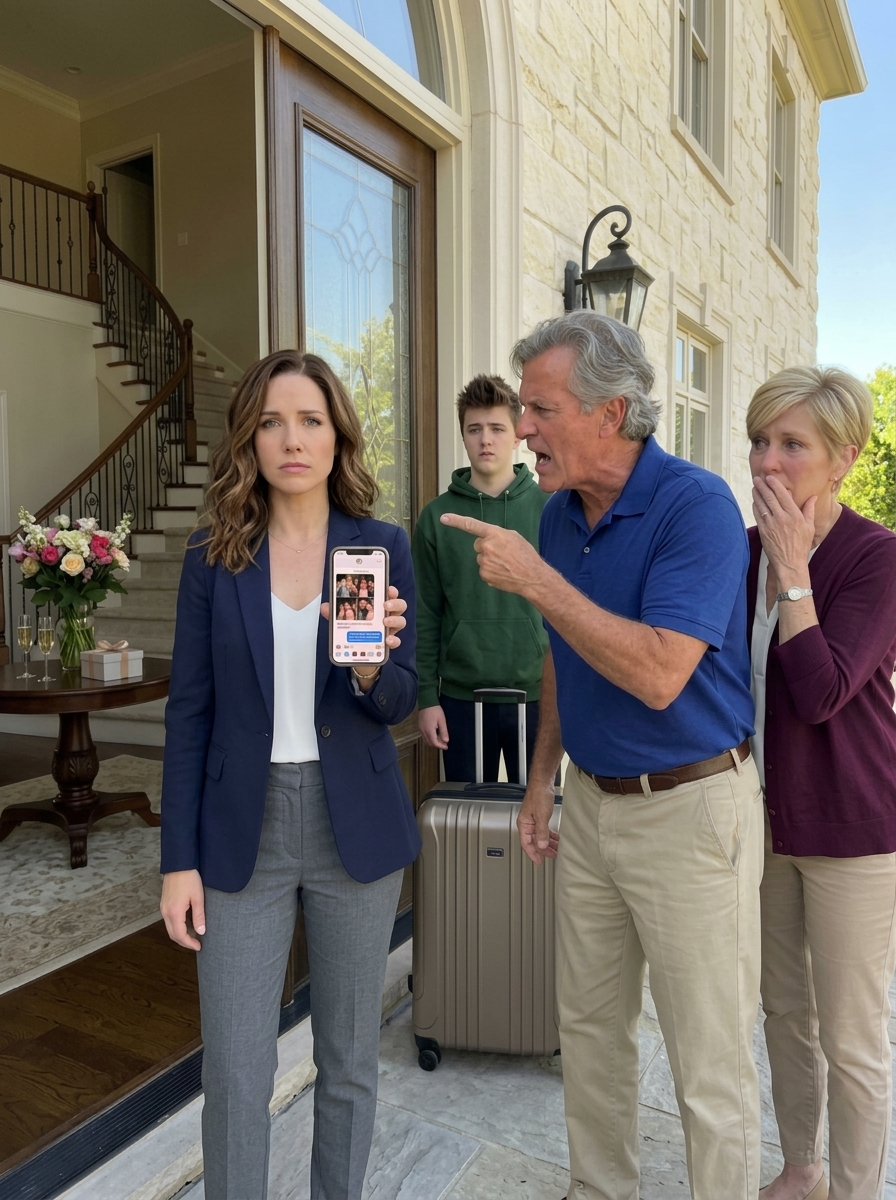
A month later, Mom and Dad finally came to see the house, not with suitcases, not with demands, but with grocery-store flowers and faces stiff with discomfort.
I met them at the front door and did not step aside immediately.
Dad looked older than he had sounded on the phone.
He looked past me into the foyer, then lowered his eyes and said, “We should have been here.”
It was not perfect.
It was not enough.
But it was the first sentence he had ever given me without forcing me to compete with Mason inside it.
Mom cried when she saw the kitchen, the terrace, the library, and the guest room I had decorated in warm blue.
“This is beautiful,” she whispered.
“I know,” I said. “I wanted you to see it because you were happy for me, not because you wanted access.”
Dad flinched, but he nodded.
They did not get a key.
They got dinner.
That was the boundary, and for once, no one crossed it.
Over time, Mason and I became closer after he understood that our parents had used his needs as a shield for their favoritism.
He visited during spring break, asked before coming, brought groceries, and slept in the guest room like a guest instead of an heir.
My parents still struggled with the word “no,” but they learned that my house was not a family reward center.
It was mine.
The first Christmas I hosted, everyone arrived on time.
Dad stood in the doorway holding a pie and asked, “May we come in?”
That single question healed more than any key ever could.
Because the mansion was never the real dream.
The dream was finally living somewhere my boundaries were not treated like locked doors, but like the walls that kept my peace standing.

