
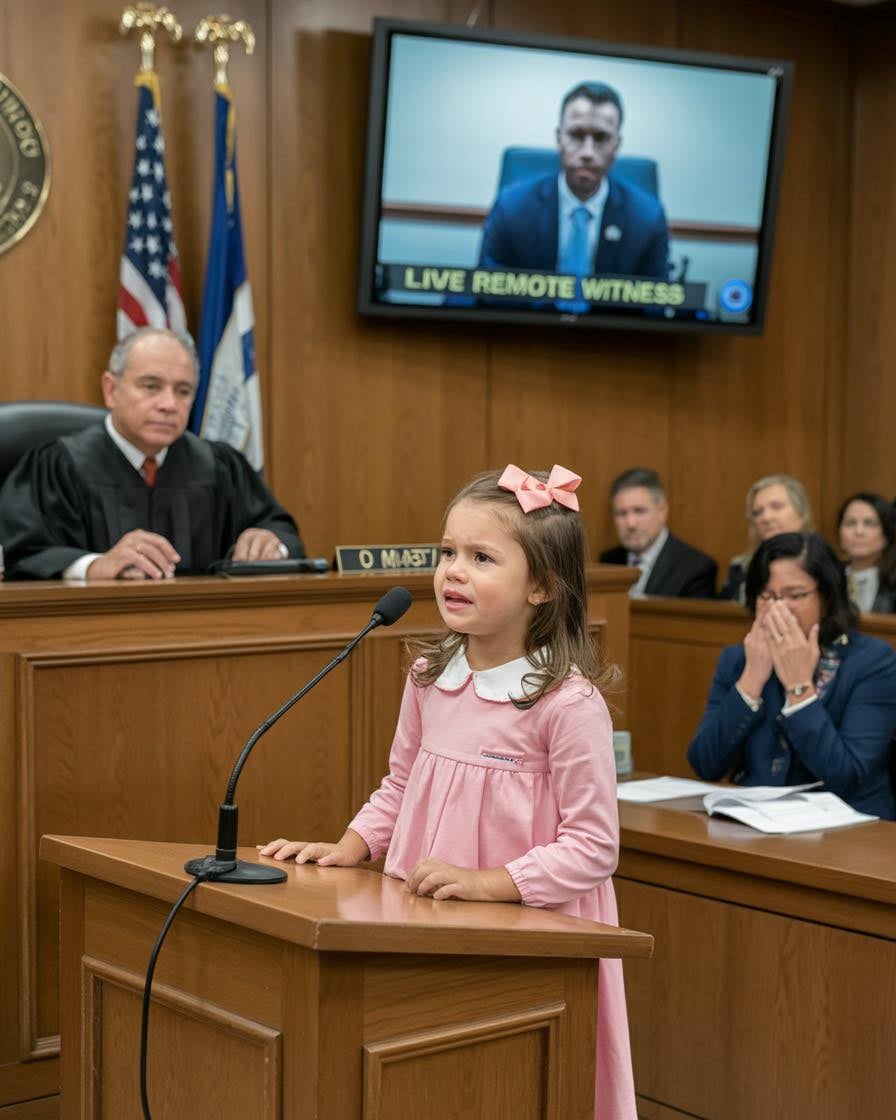
My daughter had been quieter than usual for weeks before the hearing, and I had told myself it was the divorce. Children go quiet during divorces the way animals go quiet before storms, retreating into themselves, watching the adults around them with a wary attention that looks like withdrawal but is actually something closer to surveillance. I had watched Harper pull inward through all of October and into November, speaking less at dinner, choosing her words more carefully when she did speak, studying my face when she thought I wasn’t looking with an expression I could not quite read. I had assumed she was grieving the family as she had known it. I had assumed the silence was pain finding no outlet. I was wrong about what it was. I was right that it was pain, but the silence was not resignation. It was something far more deliberate than that, and I would not understand what until she stood up in a courtroom and asked a judge if she could show him something I didn’t know about.
Caleb and I had been married for twelve years. He was the kind of man who understood how rooms worked, how to read the temperature of a conversation and adjust himself to become whatever the moment required. Charming at parties. Thoughtful with my friends. Attentive in front of our families. He had a way of occupying space that made people feel he was generous with it, as if his presence were a gift he was sharing rather than a territory he was claiming. I had loved that about him once. I had mistaken it for warmth. It took years before I understood it was performance, and by then the performance had become so seamless that challenging it felt like challenging reality itself, because everyone around us had accepted the version of Caleb he presented and nobody, including me, had the vocabulary to describe what was underneath it.
What was underneath it was control. Not the loud kind. Not the kind that leaves marks or raises voices or provides the obvious evidence that makes other people take your side. His control was architectural. It lived in the structure of our finances, in the way he managed information, in the subtle redirection of conversations so that my concerns always ended up sounding unreasonable by the time he was finished rephrasing them. He handled our money with the focused precision of someone building a case, and when I asked questions about accounts or expenditures, he answered in a tone that was patient on the surface and condescending underneath, the tone of a man explaining something simple to someone who should already understand it. Over time I stopped asking. That was the point. The architecture was designed to produce exactly that silence.
When he filed for divorce, I was not surprised. I was relieved, which is a different thing, and then immediately frightened, because relief in the context of someone like Caleb meant that the worst part was not ending. It was beginning. He wanted full custody of Harper. He wanted the house. He wanted the financial settlement structured in a way that I was certain, but could not fully prove, was built on hidden assets and accounts he had moved beyond my reach. His attorney was expensive and sharp. My attorney was competent and doing her best. And Caleb walked into the proceedings with the same calm, generous, fatherly bearing he brought to everything, sitting with his back straight, his jacket perfectly fitted, looking at the judge with the patient expression of a man who simply wanted what was best for his daughter and could not understand why his emotional, unstable wife was making this so difficult.
I had spent months feeling like I was drowning in a room full of people who could not see the water. Every claim I made sounded, when Caleb’s attorney was finished reframing it, like the complaint of a woman who was vindictive, disorganized, and incapable of the clear thinking that custody required. I had tried to raise the issue of a hidden account. I had documentation that was incomplete because Caleb moved money with obsessive care and because every trail I followed ended at a wall he had built before I got there. My attorney presented what we had. Caleb’s attorney dismissed it as paranoid speculation driven by marital resentment. The judge listened with the measured patience of someone who has heard a thousand versions of the same story and who has learned to wait for the facts to sort themselves from the noise.
The morning of the hearing, I sat at the table beside my attorney and tried to keep my hands still. Caleb sat across the room with his lawyer, composed and unhurried, radiating the particular confidence of a man who believes the outcome has already been decided in his favor. Harper was in the gallery with a court appointed advocate, a small figure in a blue dress with her hair pulled back, holding a tablet in her lap the way you hold something you have been carrying for a long time and are finally ready to set down.
I did not know about the tablet. I did not know what was on it. I did not know that my ten year old daughter had spent weeks building something she called, in the folder name she gave it on the device, “For when I no longer believe you.”
The hearing moved through its early stages with the procedural rhythm I had grown accustomed to over months of legal proceedings. Caleb’s attorney made her arguments. My attorney made ours. Financial documents were presented and contested. Character was discussed in the careful, coded language that courtrooms use to avoid saying directly what everyone in the room understands. Caleb’s attorney described me as emotionally reactive. My attorney described Caleb as financially controlling. The judge listened, asked questions, made notes. The morning felt like wading through something thick and gray, a process that was technically about Harper’s wellbeing but that had become, in practice, a contest between two adults’ competing versions of reality, with the child herself sitting quietly at the edge of the room as if she were a footnote in her own story.
Then Harper stood up.She did not ask permission in the conventional way. She did not raise her hand or wait to be acknowledged. She simply stood, holding the tablet against her chest, and said, in a voice that was small but steady and aimed directly at the judge, “Your Honor, can I show you something my mom doesn’t know about?”
The room went still. My attorney looked at me. I looked at Harper. Caleb’s posture changed. It was a small shift, barely visible if you were not watching for it, but I had spent twelve years learning to read the microscopic adjustments in his bearing that signaled the difference between confidence and alarm. His shoulders tightened. His jaw set. His eyes moved to Harper with an expression that was not anger, not yet, but something preceding anger, the look of a man who has just realized a variable he did not account for.
“Harper,” he said. His voice carried the warm, fatherly tone he used in front of other people, but there was a thinness behind it now, a thread being pulled too tight. “Sweetheart, this isn’t the time.”
Harper looked at him with a seriousness that did not belong on a ten year old’s face. “You told me the judge needed to know the truth,” she said.Something broke in Caleb’s expression. Not dramatically. Not in a way that anyone who did not know him would have noticed. But I noticed. The mask shifted, just slightly, and behind it I saw the man I had been trying to describe to attorneys and judges for months, the man nobody believed existed because he was so good at not existing in front of witnesses.
“Harper,” he repeated, and this time the false sweetness was gone. “Don’t do this.”
Caleb’s attorney stood so quickly she nearly knocked over her chair. “Your Honor, this is clearly inappropriate. The child is being influenced, and whatever she has been told to present.”
“Sit down, counselor,” the judge said.Her voice had changed. For the first time all morning, it sounded less procedural and more human, the voice of a woman who had been listening carefully and who had just heard something that made her want to listen more carefully still.
I could not breathe properly. I did not know what video Harper had. I did not know what she had seen. All I knew was that my daughter had been carrying something in silence for weeks, and that the silence had not been the withdrawal I assumed. It had been preparation.
The judge looked at Harper. “I want to see what you have. But first I need you to tell me one thing. Why did you save it?”Harper swallowed. Her fingers gripped the tablet as if it were the only solid thing in the room.“Because I thought if I showed it to Mom, she’d cry again. And I didn’t want her to cry anymore because of Dad.”
The courtroom went silent. Not the procedural silence of people waiting for the next motion. A different silence, heavier and more human, the silence that falls when a child says something so plain and so true that the adults in the room are momentarily unable to match it.

