
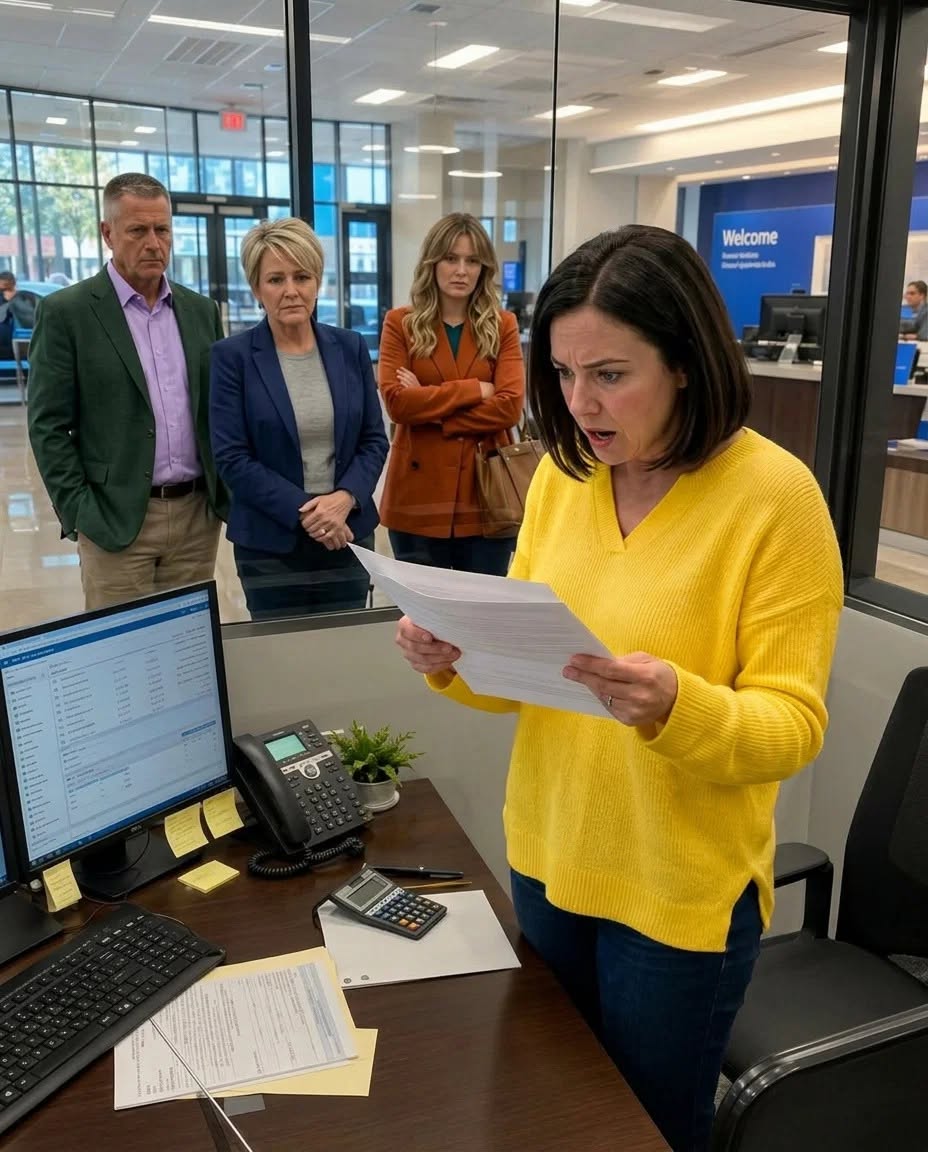
PART 1
At exactly seven o’clock in the morning, my phone buzzed against the granite island in my kitchen.
When the caller ID shows your bank’s corporate routing number, you do not send it to voicemail.
I answered at once.
“This is Sloan.”
“Sloan, it’s David Sterling, branch director from the downtown office.” His usual polished tone was gone. His voice sounded tight, careful, and far too serious for that early in the morning. “I know we’re not open yet. I need you to confirm you’re somewhere private. And I need you to sit down.”
I did not sit.
I reached over and switched off the coffee grinder.
“I’m standing, David. Tell me what you’re seeing.”
There was a pause, followed by the sound of his mouse clicking.
“Our automated fraud department placed a hard lock on your banking profile at three this morning. Sloan, there is exactly one hundred thousand dollars in credit card debt attached to your Social Security number. The account was opened twenty-two days ago, upgraded to a signature tier, and maxed out over the weekend through luxury retail purchases and vendor deposits.”
The sunlight coming through my kitchen window suddenly felt too bright.
I did not drop the phone.
I did not waste time asking how this could happen.
Shock could wait. Procedure could not.
“My credit files at all three bureaus have been frozen for four years,” I said. “I haven’t applied for new credit since I bought my house.”
“I know,” David said quietly. “That is why I called you directly instead of sending this through the normal fraud process. The application bypassed your hard inquiry protections because someone submitted an internal verification override using your excellent banking history with us.” He lowered his voice further. “Sloan, the people using the card are in my lobby right now. They are demanding that I remove the freeze so they can complete one final wire transfer.”
My fingers tightened around the edge of the counter.
“Who is in your lobby?”
“A man and two women. They are carrying authorized user cards linked to your master profile. They identified themselves as your parents and your younger sister. They are currently threatening my tellers with a corporate complaint if I don’t release funds for a commercial lease deposit.”
They had not stolen from some faceless bank.
They had stolen from me.
“Do not lift the freeze,” I said. “Do not tell them you spoke with me. I’m leaving now.”
I did not call my parents and scream.
I did not text my sister demanding answers.
Loud emotion is what guilty people use to blur the truth. I use documents.
I went straight to my home office safe and removed my passport, original Social Security card, and driver’s license. I placed them inside a rigid plastic folder, locked the safe again, and drove downtown.
The trip took eighteen minutes.
I kept both hands on the wheel while the gray morning traffic moved past my windshield.
Panic is a luxury for people with safety nets.
I had a paper trail.
When I pulled into the bank parking lot, I saw their vehicles immediately.
My father’s heavy luxury sedan sat in one of the best visitor spaces near the glass entrance. Chloe’s SUV was parked beside it. Both cars were positioned with the quiet confidence of people who never doubted their right to take the closest spot.
I walked through the double doors just as the armed security guard was unlocking the teller gates.
And there they were.
My mother, Beatrice, sat on a leather sofa reading a financial magazine as calmly as if she were waiting for a spa appointment.
My father, Richard, paced outside the branch director’s frosted glass office door, glancing at his large silver watch with the practiced impatience of a man used to being obeyed.
My younger sister, Chloe, stood near the coffee station wrapped in a flawless camel-colored wool coat that looked newly purchased. A structured designer handbag gleamed on the marble table beside her.
They were wearing my credit score.
Beatrice noticed me first.
Her face instantly arranged itself into the patient, wounded mother expression she used whenever she wanted strangers to believe I was unreasonable.
She stood smoothly and brushed her silk blouse flat.
“Slo, darling,” she sighed loudly enough for the tellers to hear. “There is no reason for you to come here and create a scene. David should never have bothered you this early.” She gestured toward Chloe with soft, theatrical concern. “Her interior design firm has run into a temporary cash flow issue, and the commercial lenders are being impossible. She deserves help from her family. You have a successful career and a beautiful home.”
I stopped walking.
I did not match her volume.
I looked at the expensive coat on Chloe’s shoulders.
Then I looked back at my mother.
She had just admitted to a federal crime in the same tone someone might use to explain borrowing a casserole dish.
Richard did not even stand straighter.
He leaned against the glass wall and exhaled like I was wasting his morning.
“Don’t turn this into a legal drama,” he said. “We secured a bridge loan using your profile. We’ll pay the minimums until Chloe’s business starts making money. You’ll handle it. You always do. Now go into David’s office and authorize the release so we can continue with our day.”
Chloe finally looked up from her phone and rolled her eyes.
“Honestly, your credit utilization was basically zero,” she said. “It isn’t like you were using it. I don’t understand why you’re being so territorial.”
They believed a shared bloodline gave them permission to ignore federal law.
They believed the bank lobby was another family living room where they could control the story until I surrendered just to keep peace.
Then the frosted glass door opened.
David Sterling stood in the doorway, his expression formal and unreadable.
He looked at my parents, then at me.
“Sloan. Please come in.”
I walked past my father without saying a word.
The moment I moved toward the chair across from David’s desk, Beatrice tried to follow me inside.
“I need to be present for this meeting,” she announced, placing one manicured hand against the door frame. “I am managing this transaction, and my daughter is clearly confused about our family arrangement.”
David did not blink.
He placed his own hand against the edge of the door.
“Ma’am, you are not the primary account holder. If you step into this office, I will have security remove you from the premises.”
Beatrice’s mouth dropped open.
For the first time that morning, the mask slipped.
She stepped back.
David shut the heavy door with a sharp click.
Inside the office, the silence was complete.
David woke both monitors and turned one slightly toward me.
“I have the original digital application open. It was submitted online exactly twenty-two days ago. Because your corporate checking history with us is flawless, the system accepted an override code generated from a recognized profile match.”
The screen showed application fields, timestamps, and contact information.
“When our fraud team flagged the wire transfer last night, they tried to call the primary account holder for verification,” he continued. “But they did not reach you.”
I looked at the screen.
The name was mine.
The Social Security number was mine.
The birthdate was mine.
The contact information was not.
David scrolled to the primary contact section.
He did not point.
He simply let the information speak.
“Why is your mother’s phone number listed as yours?”
I stared at the ten digits.
It was not a typo.
It was the foundation of a trap.
They had not merely used my name.
They had redirected every security code and approval message straight to my mother’s phone so mine would never ring during the application process.
“Because she needed to intercept the approval texts,” I said.
David’s jaw tightened.
He opened another tab labeled identity verification.
“If the contact number was changed during the application to bypass the freeze, the system would have required visual secondary verification. A government-issued photo ID proving that you authorized the change.”
He pressed enter.
A scanned image appeared on the screen.
David stared at it for several seconds.
Then he looked at the legitimate driver’s license I had placed on his desk.
Finally, he turned the monitor toward me.
“Sloan,” he said quietly, “look at the address and the signature on this uploaded ID.”
I leaned forward.
The face on the screen was mine, pulled from an old photo.
But the address was not my home.
It was my father’s architectural firm.
And the signature at the bottom was not my handwriting.
“That’s my mother’s signature,” I said flatly.
She had not even tried to imitate mine.
Beatrice had been so protected by arrogance, so certain the world would bend around her convenience, that she had simply signed her own name on a fake state ID carrying my photograph.
David leaned back.
The polite branch director vanished. In his place sat a banking professional looking at a major compliance breach inside his own institution.
“This is no longer unauthorized family use,” he said. “This is synthetic identity theft and federal wire fraud.”
He opened the transaction ledger.
A list of red charges filled the second monitor.
Fourteen thousand dollars at a boutique interior design showroom.
Nine thousand at a luxury electronics retailer.
Six thousand at a high-end day spa.
Vendor deposits.
Retail purchases.
I thought of Chloe in the lobby, wrapped in that pristine wool coat with the designer handbag shining beside her.
They had not stolen my identity for emergency medicine.
They had not done it to stop an eviction.
They had stolen it to decorate a fantasy.
At the top of the ledger, one line was highlighted in yellow.
Status: hold pending fraud review.
Amount: $45,000.
Type: wire transfer.
“Where was the wire going?” I asked.
David clicked the routing details.
“The destination is a commercial holding account at Coastal Fidelity. Beneficiary name: Chloe Vanguard Interiors LLC.”
My sister’s brand-new interior design company.
The one my mother had described as having a “minor cash flow issue.”
Chloe had not only bought herself luxury items.
She was trying to fund an entire startup with my credit score, using my father’s firm as the delivery address.
“They spent fifty-five thousand on retail charges and vendor deposits,” David said. “Last night, they attempted to wire the remaining forty-five thousand directly into Chloe’s LLC for a commercial lease. Because the wire amount was large and the destination had no prior connection to your financial history, our system froze the account.”
They had not come to the branch at dawn to confess.
They had come to bully the bank into releasing the last of the money before fraud investigators reached me.
“David,” I said calmly, “print the transaction ledger. Print the application metadata showing the IP address. Print the high-resolution scan of the fabricated ID.”
He paused.
“Sloan, if I give you the complete fraud audit file, that formalizes the claim. The bank will be legally required to begin an internal investigation immediately and report the fabricated ID to federal authorities. Once I hit print, there is no reversing this.”
“I am not trying to reverse it,” I said. “I am the victim of identity theft. Print the logs.”
David nodded once.
The large printer came alive behind him.
The steady sound of paper sliding into the tray felt like a lock clicking shut.
PART 2
David gathered the documents, aligned the pages, stapled them neatly in the corner, and slid a thick manila envelope across his desk.
“The supplementary cards they have in the lobby are permanently deactivated,” he said. “The forty-five-thousand-dollar wire has been cancelled. The account is now locked in active fraud status.”
I placed the envelope inside my bag.
Then I stood, adjusted my blazer, and opened the heavy glass door.
The lobby lights felt harsh after the quiet office.
Beatrice rose from the sofa at once, smoothing her blouse and arranging a victorious smile.
Richard checked his watch and crossed his arms, already preparing to accept what he thought was good news.
Chloe glanced up from her phone with the same bored expression she used whenever consequences belonged to someone else.
“Finally,” Beatrice sighed, again making sure the employees could hear her. “I assume David removed the hold. Chloe has a meeting with the leasing agent in an hour. We don’t have time for your theatrics.”
Richard stepped toward me.
“Sign the release, Sloan. We’ll draft repayment terms this weekend. You’re embarrassing the family over a simple bridge loan.”
Chloe clutched her handbag.
“Seriously. It’s just credit. You have plenty of money. You’re acting like we stole an organ.”
I did not yell.
I did not cry.
I looked directly at Chloe and let my voice travel clearly through the marble lobby.
“There is no bridge loan. The account is permanently frozen. The forty-five-thousand-dollar wire to your LLC has been cancelled. The fifty-five thousand dollars in charges are being flagged as federal wire fraud.”
Beatrice’s polished smile fractured.
For the first time, real fear showed through the arrogance.
“You cannot do that,” she hissed, stepping closer and lowering her voice. “You will ruin your sister’s launch. We already signed the lease. If that wire doesn’t clear today, Chloe will be in breach.”
“I did not authorize the application, Beatrice,” I replied, deliberately refusing to call her Mom. “I did not authorize you to upload a fake state ID with my face and Richard’s office address. I did not authorize funds to be wired to Chloe’s LLC.”
Richard moved into my personal space, trying to use his size to pressure me.
That tactic is useless against evidence.
“Listen to me carefully,” he said in a low, threatening voice. “You are going back into that office and fixing this. You are not going to destroy this family over paperwork.”
“It is not paperwork,” I said. “It is a felony.”
I opened the folder just enough to remove the top page David had printed.
I held it flat under the sterile lobby lights.
“This is the application metadata. It proves the fabricated ID was uploaded from an IP address registered to your architectural firm. The routing information proves the wire was not going to a landlord. It was going directly into Chloe’s business account.”
The color drained from Richard’s face.
He stared at the audit log like it might explode in his hands.
Beatrice stopped breathing.
Chloe took one involuntary step backward.
The expensive coat suddenly looked too heavy on her shoulders.
“Dad,” Chloe whispered. “What is she talking about? You said she gave permission.”
Richard did not retreat.
His panic hardened into calculation.
He reached inside his suit jacket and pulled out a folded document printed on thick legal paper.
“You think you can shut us down that easily?” he said, lowering his voice so only I would hear. “We expected you might become difficult, Sloan. You’ve been so stressed lately.”
He unfolded the document just enough for me to read the bold heading.
Limited Durable Power of Attorney.
“We didn’t just open a credit card,” he said, a cruel smile touching his mouth. “You signed this last month giving me full financial authority to manage your assets if you became incapable. We have a notary stamp.”
I did not blink.
My mind became very fast and very cold.
They had not only stolen a credit line.
They had created a legal weapon to take control of my entire financial life.
Then my phone buzzed in my palm.
Security Alert. Horizon Institutional Wealth.
Urgent request to liquidate $250,000 from primary investment portfolio received.
Pending power of attorney document verification.
Richard’s smile widened slightly.
He had timed it perfectly.
While my mother and sister created a loud distraction inside the bank over a fraudulent credit card, my father had sent a forged legal proxy to my brokerage to drain a quarter million dollars from my investments.
He thought the weight of a notarized document would scare me into surrender.
He expected me to release the bank funds in order to protect the larger account.
Beatrice immediately understood that Richard had revealed his strongest card.
Her entire demeanor changed.
She shifted from entitled mother to tearful, concerned parent.
She looked past me toward the tellers, her eyes filling on command.
“I am so sorry you all have to see this,” she said, voice trembling with practiced pity. “Sloan has been under terrible psychiatric stress. We had to step in and assume legal guardianship of her finances for her own safety. She is confused and lashing out. We are only trying to get her the help she needs.”
It was terrifyingly effective.
If I yelled, cried, or grabbed for the paper, I would become exactly what she wanted everyone to see.
The unstable daughter.
The exhausted parents.
The family crisis.
So I did not give them a performance.
I gave them procedure.
“May I inspect the document, Richard?” I asked, my voice polite, calm, and empty of emotion.
He hesitated.
Then his ego won.
He kept his fingers tight on the top corner and held the document where I could read it.
I did not try to take it.
I scanned the dense legal language.
It was a standard durable power of attorney giving Richard broad authority over real estate, bank accounts, and investments.
But I was not focused on the clauses.
I was looking for the execution block at the bottom of the second page.
There was my forged signature.
Beside it was the date: October 14th.
Below that sat a raised blue notary seal from the person who claimed I had appeared in person and signed away my financial authority.
Evelyn Vance.
Commission expires 2029.
State of Illinois.
“Evelyn Vance,” I read aloud, making sure my voice carried across the quiet lobby. “The senior commercial escrow manager at your architectural firm, Richard. That is your employee’s official notary stamp.”
“Evelyn is a licensed and bonded notary,” Richard snapped. “She legally witnessed your signature. The document is valid. Now tell David to lift the freeze on Chloe’s business wire, or I will fax this proxy to your corporate HR department and inform them of your mental breakdown.”
“A legal document is valid only if the principal actually signs it in the physical presence of the notary,” I said, unzipping my folder. “And since I have not stepped inside your architectural firm in over two years, Evelyn just committed notary fraud to help you execute a financial crime.”
Chloe made a sharp, frightened sound.
“I’m checking the date on the forged document,” I said, pointing to the line under the notary seal without touching it. “October 14th.”
Beatrice rolled her eyes.
“Yes, Sloan. October 14th. The day you came to the office and finally agreed to let your father help manage your overwhelming portfolio. What is your point?”
I did not answer her right away.
I reached into my folder, passed over the bank statements, and removed my navy blue United States passport.
I opened it to the middle pages and laid it flat on the marble table.
Then I tapped the international customs stamp beside their forged legal document.
“My point, Beatrice,” I said, looking directly at her, “is that on October 14th, I was in Geneva for a global supply chain summit. I left the United States on the 12th and returned on the 18th. Here is the Geneva entry stamp. Here is the exit stamp. Underneath it is the corporate flight manifest.”
The silence that fell over the bank was thick and total.
The tellers stopped typing.
Their hands hovered above their keyboards.
Richard stared at the ink in my passport.
The color drained from his face in a visible wave.
The arrogant patriarch disappeared.
In his place stood a man realizing he had attached a federal crime to a date when I was thousands of miles away on another continent.
Beatrice opened her mouth.
No sound came out.
Her polished maternal mask dissolved into raw fear as her mind searched desperately for a new lie.
“You couldn’t have been in Geneva,” Chloe stammered, her voice thin and panicked. “You told Mom you were working from home that week.”
“I told Beatrice I was unavailable,” I corrected. “Because I knew she would ask for money for your fake business. I never told her where I was physically located.”
I pulled out my phone, opened my encrypted email, and began drafting a message.
I entered the address for the state notary commission’s fraud division.
I copied my attorney and the institutional fraud department at Horizon.
“What are you doing?” Richard demanded.
His voice had lost control.
“I’m attaching a photograph of your forged document and the application metadata David printed showing the IP trace to your office. I am reporting Evelyn Vance for notary fraud and reporting you for attempted asset theft.”
Then I hit send.
Richard’s chest rose and fell sharply.
“You reported Evelyn. She’ll lose her commission.”
“Yes,” I said calmly, slipping my phone back into my pocket. “And when investigators review her notary journal, they will find that my actual signature is not in the October 14th entry because I was not there. And when Evelyn realizes she is facing felony charges, she will not protect your architectural firm. She will tell them exactly who ordered her to stamp that forged document.”
The frosted office door opened sharply behind us.
David Sterling stepped into the lobby.
He had not been waiting quietly behind his desk.
He had been watching through the glass and listening while Richard admitted his intent to use the forged document as leverage in front of witnesses.
“David,” Richard stammered, trying to fold the power of attorney back into his jacket. “This is a private family matter. We are leaving immediately.”
“You are not leaving with that document,” David said coldly, stepping into his path. “It is now physical evidence in an active bank fraud investigation. Hand it over, or I will have security lock the exterior doors and call dispatch.”
Beatrice gasped.
Chloe shrank back near the coffee station, eyes darting toward the entrance.
Richard froze.
If he gave David the paper, the bank would log it as evidence.
If he refused, he would look like a criminal trying to remove proof.
He shoved the document into David’s waiting hand.
David held his desk phone in the other.
He looked at me first.
Then at my father.
“Sloan,” David said, his voice echoing across the silent lobby, “your brokerage just called my direct branch line. They received your email and the evidence proving you were outside the country during the notarization.”
He lowered the phone.
“They are not only locking your investment portfolio. Horizon’s compliance team has triggered a multi-institution federal fraud alert. Federal authorities are being sent to this branch now.”
PART 3
The words federal authorities seemed to hang in the air like a physical weight.
For a second, even the building seemed to stop humming.
The tellers slowly lowered their hands from their keyboards and stepped back from their cash stations.
The armed guard near the entrance shifted position, moving squarely in front of the double glass doors.
Richard’s face changed completely.
“David, call them back,” he stammered. His voice cracked, stripped of all its boardroom authority. “Tell them this was a misunderstanding. Tell them the primary account holder is here and the legal proxy was submitted by mistake.”
“I do not work for your brokerage,” David said, his tone flat and final. “I cannot cancel a federal response to a felony committed inside my branch. The forged power of attorney is secured in my desk. The fabricated ID is locked in our fraud queue. The timeline is no longer in my hands.”
Beatrice let out a sharp gasp and stumbled backward into the leather sofa.
“Richard, do something!” she hissed, grabbing his arm. “Tell him to delete the application. The money is still here. It’s a victimless mistake.”
“A victimless mistake?” I repeated, my voice cutting cleanly through her panic. “You used a fake government ID to access fifty-five thousand dollars of my credit capacity for luxury purchases. You redirected security approvals to your own phone. You conspired with your husband’s employee to commit notary fraud. You attempted to liquidate my investment portfolio. The fact that the system stopped your larger theft does not make you innocent, Beatrice. It only means you are bad at math.”
Chloe was trembling.
The perfect coat looked absurd on her now, like a costume she had stolen and could not afford to keep.
“Sloan,” she whispered, all entitlement gone from her voice. “I didn’t sign anything. I just wanted to start my business. Mom and Dad told me they had a private arrangement with you. They said you were a silent partner in the LLC. I didn’t know they forged your signature.”
“You knew I was not your silent partner,” I said. “You knew because I told you at Thanksgiving that I would not fund an interior design business for someone who cannot balance a basic spreadsheet. You did not ask questions because you wanted the coat, the bag, and the lease more than you wanted the truth.”
Richard yanked his arm free from Beatrice.
He looked toward the exit, calculating.
“We are leaving,” he announced, his voice rising. “You cannot legally hold us without a warrant.”
He took two quick steps toward the doors.
He did not take a third.
The security guard raised one gloved hand and moved directly into the path, blocking the sensors so the doors would not slide open.
“Sir, you need to remain where you are. The branch director has initiated a hard lockdown protocol until law enforcement arrives.”
“Move,” Richard snapped. “You’re a private security guard. You have no authority to detain me.”
“I have authority to secure the perimeter of a federally insured financial institution during an active verified fraud event,” the guard replied. His hand rested near his utility belt. “If you attempt to force your way through, I will restrain you until authorities arrive.”
Richard stopped.
The boundary finally registered.
He was not in a boardroom.
He was not in his office.
He was inside a cage made from his own evidence.
Then he turned back to me.
His face was damp with sweat.
The panic in his body shifted into something else—softness, pleading, a paternal warmth so false it made my skin crawl.
“Sloan, please,” he said quietly. “If federal authorities come through those doors, my architectural firm is finished. My licenses will be revoked. Your mother and I could go to federal prison. You are our daughter. You cannot let this happen to us.”
I did not blink.
I looked at the man who had just tried to strip my financial life bare while standing a few feet away from me.
“I am not letting them do anything to you, Richard,” I said. “I provided my correct phone number and my passport. You did everything else.”
Beatrice buried her face in her hands and sobbed loudly.
But there was no audience left for her performance.
The tellers watched her with quiet disgust.
David stood near his office door, arms crossed, his expression made of stone.
“Sloan, please,” Chloe begged, tears streaking her mascara. “Tell them it was a misunderstanding. Tell them you gave verbal permission.”
“No,” I said.
Outside the glass doors, red and blue lights flashed against the gray morning traffic.
An unmarked vehicle pulled into the parking lot, blocking Richard’s sedan and Chloe’s SUV.
Four people stepped out.
Two uniformed officers.
Two plainclothes detectives in tactical vests marked Financial Crimes Task Force.
The lead detective walked to the entrance, held up a gold shield, and looked at the security guard.
The guard nodded and manually unlocked the door.
As the heavy glass slid open, the noise of the city rushed into the silent lobby.
The detective’s eyes swept the room.
He ignored my trembling family and came straight toward David and me, his gaze landing on my open passport on the marble table.
Richard’s survival instinct immediately took over.
He stepped forward, palms raised, voice smooth and controlled.
“Detective, thank goodness you’re here. This is a terrible family misunderstanding. My daughter Sloan has been under serious psychiatric distress. We simply secured a temporary credit line and legal proxy to protect her assets while she gets help. She is paranoid and lashing out.”
The detective did not shake his hand.
He did not even look at him.
He looked at David.
“I’m Detective Russo, Financial Crimes Task Force. We received a priority escalation from Horizon Institutional Wealth, supported by a digital fraud report filed from this branch.”
“I’m David Sterling, branch director,” David said. “The man speaking to you just presented a forged power of attorney to bypass a fraud freeze. The envelope in my hand contains metadata proving his wife uploaded a fabricated state ID to open a one-hundred-thousand-dollar credit line under the victim’s Social Security number. The IP address traces to his architectural firm. He also used the forged proxy to attempt a two-hundred-fifty-thousand-dollar investment liquidation.”
Richard opened his mouth.
No words came out.
I stepped forward and tapped my passport.
“My name is Sloan. The power of attorney claims I signed it in my father’s office on October 14th, verified by his employee’s notary stamp. My passport proves I was in Geneva, Switzerland, from October 12th through October 18th for a corporate summit.”
Detective Russo looked at the passport.
Then at the notary seal.
He did not need tears.
He did not need a confession.
He had a geographical impossibility.
He turned to Richard.
“Sir, a family dispute is an argument over holiday dinner. A notarized forgery used to attempt a quarter-million-dollar institutional liquidation across state lines is a federal felony.”
Beatrice gasped.
“We didn’t actually take anything!” she cried, pointing at me with shaking fingers. “The wire didn’t go through. You can’t arrest us for trying to help our own daughter.”
“Ma’am,” Russo said, removing a pair of handcuffs, “you successfully defrauded a federally insured institution for fifty-five thousand dollars in luxury charges using a fabricated government ID. The fact that the bank stopped your second attempt does not erase the first.”
The metal cuffs clicked around Beatrice’s wrists.
She did not fight.
Her knees buckled, and one officer had to hold her upright.
Her silk blouse wrinkled.
Her perfect mask was gone.
Richard stepped backward, sweat shining at his temples.
“I am a prominent commercial architect,” he said. “I demand to call my attorney.”
“You can call counsel from the holding facility,” Russo replied.
When the handcuffs locked around Richard’s wrists, the sound echoed against the marble ceiling.
Chloe finally broke.
She stood near the armchair, clutching the designer handbag against the stolen coat.
“Mom. Dad,” she whispered. “What about my commercial lease? The landlord needs the deposit today. My whole business…”
I looked at my sister.
I looked at the coat.
The bag.
The costume built from my stolen credit.
“Your LLC is dead, Chloe,” I said evenly. “The forty-five-thousand-dollar wire is permanently cancelled. That designer bag is stolen merchandise purchased with fraudulent funds. I suggest you set it down before the officers charge you with possession.”
Chloe stared at me.
Then, with shaking hands, she dropped the bag onto the marble floor like it had burned her.
She was not arrested in that moment.
But she was left alone in the lobby, her fake empire reduced to an empty coat and a dead lease.
I watched the police escort my parents through the glass doors into the gray morning.
I did not feel victorious.
I felt the steady relief of a system finally working the way it was supposed to.
David turned to me.
“The signature credit line has been removed from your Social Security number. The fifty-five thousand dollars in retail charges are now First Meridian’s internal fraud liability, and our legal team will pursue restitution directly from your parents. You owe nothing.”
He paused.
“Horizon also confirmed your portfolio is secured under a secondary biometric protocol. They did not touch a cent of your actual liquidity.”
I nodded, zipped my passport and documents back into my folder, and walked out of the bank.
Three weeks later, the paper trail completed their collapse.
The state notary commission permanently revoked Evelyn Vance’s license.
Facing felony fraud charges, she cooperated with investigators and produced timestamped emails proving Richard had ordered her to stamp the forged proxy under threat of termination while I was documented out of the country.
Richard’s architectural firm was hit with a multi-agency compliance audit.
His state operating license was suspended pending criminal trial.
He and Beatrice were indicted on multiple felony counts of wire fraud, synthetic identity theft, and conspiracy.
The legal fees needed to keep them out of pre-trial detention drained their savings and forced them to mortgage their home.
Chloe’s commercial landlord terminated her lease once the fraud investigation appeared in local business journals.
Without my credit score supporting her ambitions, she abandoned the luxury retail launch, sold her vehicle, and took a junior administrative job answering phones to cover her legal costs.
I filed for a permanent restraining order against my entire family.
The judge granted it without hesitation after reviewing the police report and the bank’s metadata.
They thought they could use the banking system to erase me and steal my future.
But systems respond to proof.
And mine was bulletproof.