
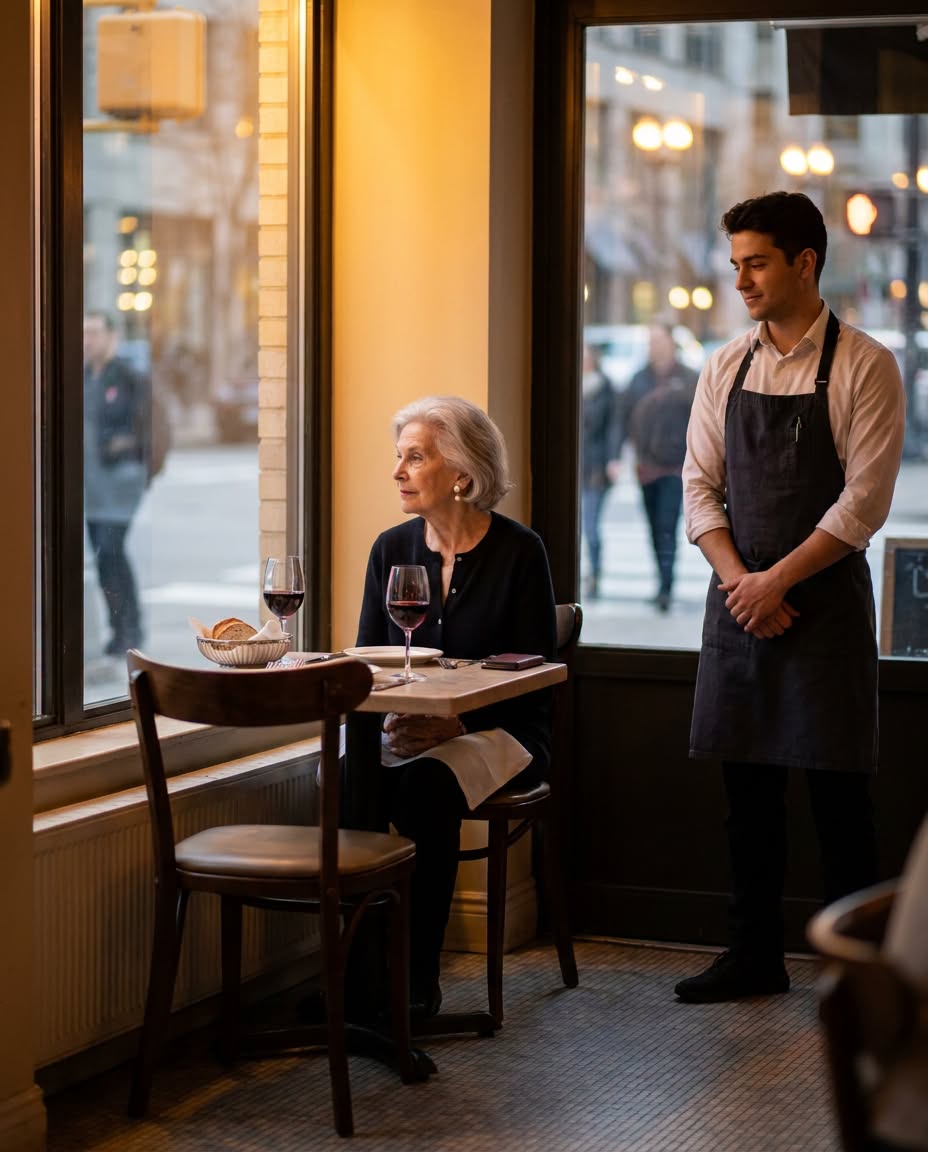
I’m nineteen, I bus tables to pay for community college, and until last Friday at 6:40 p.m. the bravest thing I’d ever done was parallel park. That’s when our new manager, Brent — headset, clipboard, calls customers “revenue units” — looked across a packed dining room at table 7, where a small woman in pearl earrings sat as she has every Friday at 6:00 for two years, with two glasses of wine, one of them untouched, and said the sentence that started everything: “Move the single to the counter. That’s a four-top burning $200 an hour.” I told him she wasn’t a single, that it was a table for two. He told me to handle it or he would. And then I stood there, holding a tub of dirty dishes, and watched him crouch beside Mrs. Alba with his customer-service smile — watched her look down at the two glasses, and begin gathering her purse with the smallest hands I have ever seen, and apologize. To him. She apologized to him. Something in me snapped so quietly that I didn’t recognize the sound until my apron was already off and sitting on his clipboard, and I heard myself say, “If she moves, I quit. And before you decide, you should ask why this table is always set for two.”
Here is what I knew about Mrs. Alba before that night, collected in two years of refilled waters: she asked about my textbooks my first week and never forgot an exam date after that; she tipped in cash, folded small, always with a peppermint; she dressed for Fridays like they were occasions, because to her they were; and sometimes she spoke softly toward the empty chair, and smiled at what it didn’t say back. Our old manager, Sal, thirty years on the floor, guarded her without explanation — “Table 7 is Mrs. Alba’s, forever, don’t ask” — but Sal retired in May, and corporate sent Brent, whose training had a spreadsheet where the humanity goes. The signs of collision had been building for weeks: Brent timing table turnover with an actual stopwatch, Brent breaking up the servers’ habit of comping Mrs. Alba’s second glass — the untouched one — which Sal had done every Friday since anyone could remember. So the confrontation wasn’t an accident. It was arithmetic meeting something arithmetic can’t count.
Mrs. Alba answered my challenge herself, because that woman has more spine standing with her purse held like a shield than most of us will ever grow. Quietly, to Brent, to the now-silent room: fifty-four years ago, this building wasn’t a restaurant — it was the Alameda Ballroom, and on a Friday at 6:00, on the very square of floor where table 7 stands, a young machinist named Ernesto Alba asked a girl in borrowed shoes to dance, and married her eleven months later. They danced here every anniversary until the ballroom closed; when it reopened as a restaurant, they came every Friday, same spot, and Ernesto would touch her glass and say, “Fifty-four years since the shoes, Rosie.” He died two Junes ago, on a Tuesday, and on that first unbearable Friday she came anyway, alone, and Sal — who knew — set two glasses without being asked and never charged her for Ernesto’s again. “So you see,” Mrs. Alba finished, gently, devastatingly, “I’m not taking up a table, young man. I’m keeping an appointment.” Three tables had phones out. A woman at table 9 was crying into her pasta. Brent’s face was still choosing between spreadsheet and shame when a man rose from the corner booth — sixties, gray suit, had eaten alone all evening, unremarkable until the moment he wasn’t — and said, “I think I’ll decide this.” Because it was Friday. And the owner of our restaurant group visits one location every Friday, unannounced, to eat alone and watch how his people treat theirs.
The owner’s name is Mr. Castellano — his signature is on my paychecks, though I’d never seen his face — and what he did next he did slowly, in front of the whole dining room, the way you do things you want remembered. He introduced himself to Mrs. Alba first, not Brent, and asked permission to sit in Ernesto’s chair for one minute, “which I understand is a privilege.” He listened to her tell the shoe story again, laughed in the right place, and dabbed his eye in another. Then he stood, turned to the room, and made three announcements in a voice that needed no headset: that table 7 was, effective immediately and in perpetuity, the Alba Table — a small brass plaque would say so within the month, “Reserved Fridays, 6:00, for E. & R. Alba, who danced here first”; that Mrs. Alba would never receive a check in his restaurant again, “because some accounts were paid in full before we ever got here”; and that the young man who put his apron on a clipboard — me, nineteen, dying — was exactly the kind of employee “this company will be needing for management training, if he’ll take his apron back.” As for Brent, there was no public execution; Mr. Castellano is not that kind of man. There was one quiet sentence at the corner booth after service — I was clearing the next table and heard it, and I’ll carry it into every job I ever hold: “Son, the numbers are how we keep the doors open. She is why the doors are worth opening. Learn the difference by Monday or don’t come in.” Brent transferred to corporate inventory in three weeks. Nobody timed his goodbye.
The plaque went up on a Thursday, and Mrs. Alba cried when she saw it, then straightened up and informed us all that Ernesto would think it was “far too much fuss,” which is how we learned that being scolded by Mrs. Alba feels like winning an award. The video from table 9’s phone found its way online — I didn’t post it, but I won’t pretend I’m sorry — and now, some Fridays, strangers ask to be seated near table 7, and they’re quieter and kinder for the whole meal, the way people are in the presence of something proven. Mrs. Alba still comes at 6:00. Two glasses. She’s teaching me Ernesto’s toast in Spanish, and she checks on my grades like they’re stock prices, and last week she told me that the night Brent crouched beside her, she had truly meant to go — “an old woman learns not to stay where she’s a bother” — until a boy put down his apron. “You gave me back my appointment,” she said. I’ve thought about that every day since. I’m nineteen. I don’t know much. But I know this now, and I’m writing it down so I never forget it: every table you’ll ever wait on is set for more than the people you can see. Guard the empty chairs. They’re the fullest ones in the room.