
Part 1: The Name That Was Erased
My name is Sable Rowan Vale, and for most of my adult life, I learned how to disappear even while wearing a uniform.
That may sound dramatic until you spend twenty years in military intelligence, where the safest person in the room is often the one no one remembers seeing. I had sat behind tinted glass in cold command centers, listening to men with stars on their shoulders argue over maps. I had slept on transport aircraft with my boots still on, stared at satellite screens until my eyes burned, drank scorched coffee at three in the morning, and made calls that changed routes, delayed convoys, and kept names from becoming folded flags on coffins.
But to my family, almost none of that existed.
To them, I was still the daughter who left home too quietly. The one who did not smile in Christmas photos. The sister who never came back for barbecues, baby showers, or Thanksgiving football. The strange one. The difficult one. The one my father had stopped explaining to other people.
So when I drove through the gates of Fort Halder on a cold April morning for my father’s retirement ceremony, I did not expect a warm welcome.
I only expected military efficiency.
I did not even get that.
The base had been polished for the occasion. Fresh flags snapped in the wind. The grass was cut so low its sharp green scent slipped through the cracked window of my car. Ahead of me, official vehicles rolled through the checkpoint, carrying formally dressed families who smiled as if they were going to a wedding instead of the end of a forty-year command career.
My father, Lieutenant General Harlan Vale, loved ceremony. He loved clean lines, polished shoes, folded programs, and flags placed at identical angles. He loved anything that could be controlled.
Except me.
I stopped at the gate and handed my military ID to a young corporal. He could not have been more than twenty-two, his face still soft beneath his cap, though his posture was rigid enough to compensate.
He scanned the tablet.
Then scanned it again.
His eyes moved from the screen to my uniform, then back to the screen.
“I’m sorry, ma’am,” he said carefully. “I don’t see your name on the list.”
The wind pressed against my car door. Behind me, a short impatient honk sounded.
“My name is Sable Vale,” I said.
He swallowed. “I have Marion Vale. Penn Vale. Liora Hensley, guest of Penn Vale. But no Sable Vale.”
There it was.
Not an accident.
Not a typo.
A neatly arranged absence.
I looked past him toward the event building, where a white tent had been raised beside the auditorium. Rows of chairs waited beneath the fabric. The brass band was warming up, one bright trumpet note stumbling upward before going silent.
“My father is Lieutenant General Harlan Vale,” I said.
The corporal’s face shifted from confusion to panic. He looked at my ID again, this time truly reading it.
His mouth opened, then closed.
Behind me, a glossy black SUV pulled into the second lane. I recognized it immediately. My mother had always loved vehicles that made other people move aside.
The rear window lowered.
My younger brother, Penn, leaned out from the back seat, his dress uniform arranged as if he had been born wearing it. Beside him sat his fiancée, Liora, wearing pearl earrings and a smile that never reached her eyes. My mother sat in the front passenger seat, one hand resting on her necklace as if checking that the world was still in place.
Penn looked at the corporal, then at me.
For one second, his face tightened.
Then he gave a careless shrug.
“Clearance issue,” he called through the window. “She knows how it is.”
Liora laughed softly.
My mother did not look at me.
The SUV rolled forward.
The corporal stood frozen, trapped between the screen and the star on my shoulder.
“I can call someone to verify, ma’am.”
“No need.”
My voice was calm. That surprised him. It did not surprise me.
I had been left off more important lists than this. Promotion dinners. Family announcements. My mother’s birthday slideshow. My father’s official biography in the local paper, which mentioned “one son carrying on the proud Vale legacy” and somehow forgot the daughter who had deployed before Penn learned how to polish boots properly.
I parked the car, stepped out, and buttoned my jacket against the wind.
Only then did the corporal see my full dress uniform. The ribbons. The command insignia. The star.
His hand snapped up into a salute so fast his elbow almost cracked.
“General.”
The word fell between us like a shell.
I returned the salute.
“Carry on, Corporal.”
He lifted the barrier himself.
I walked through the gate, not because I wanted them to see me and not because I wanted revenge.
At least, that was what I told myself.
But every step across the clean pavement carried twenty years of swallowed words. Every glass window of that building reflected a woman my family had chosen not to know.
When I reached the auditorium doors, I saw my father through the glass.
He was laughing with the installation commander, one hand on the man’s shoulder, his silver hair bright under the lobby lights. He looked proud, relaxed, untouchable.
Then his eyes moved across the lobby and found me.
For half a breath, the smile fell from his face.
Not because he was surprised.
Because he recognized me.
That was when I understood something cold and clear.
He knew exactly who had been left off the list.
Part 2: A Ceremony for a Selective Legacy
The lobby smelled of floor wax, lemon polish, and expensive perfume. That was the first thing I noticed. Not the portraits on the walls, not the framed campaign photographs, not the glass cases full of challenge coins and old medals. For me, smell always came first. It had saved me more than once: burned wires, diesel where it did not belong, cheap cologne on a man who claimed he had never entered a room.
That morning, everything smelled like control.
The hallway had been arranged for my father’s final bow. His career covered the walls in glossy rectangles: Harlan Vale shaking hands overseas, standing beside a helicopter, speaking behind a podium, being watched by young soldiers as if he were carved from stone. Harlan Vale with Penn at his first commissioning, father and son glowing in matching dress blues.
There was not a single photograph of me.
I stopped in front of the display for less than two seconds.
Long enough to see the gap.
Not long enough to let it cut me.
A woman in a navy suit checked programs near the entrance. Her eyes moved over me, paused at my rank, then dropped to her clipboard.
“General, I’m so sorry,” she whispered. “I don’t have a reserved seat card for—”
“I know.”
Her face went pale. “I can find you a seat.”
“I’ll find one.”
Inside the auditorium, the crowd had settled into a carefully staged performance of respect. Rows of uniforms. Dark suits. Women in soft colors. Adult children pretending not to check their phones. The stage held a podium, two flags, a row of chairs for senior officers, and a large screen powerful enough to make any memory look official.
My family sat in the front row.
Of course.
My mother, Marion, wore cream wool and pearls. Penn sat beside her, his chest full of medals, his chin clean-shaven, his face bright with practiced pride. Liora leaned close to him, whispering behind the program.
My father stood near the stage, accepting handshakes.
I chose a seat across the aisle, three rows back, in the section for command guests. There was no name card for me. I did not need one.
An unfamiliar colonel looked at me twice. The second time, his eyes widened slightly. He knew enough to understand he did not know enough.
That was usually where people stopped.
The band finished warming up. Conversation thinned. The lights dimmed. The national anthem began.
Everyone stood.
I stood straight, hands at my sides, eyes forward. For one ridiculous second, I remembered being nine years old in our driveway, saluting my father when he left for deployment. I used the wrong hand. Penn laughed. My father corrected me gently in front of the neighbors, then later told my mother, “She wants attention too badly.”
After that, I stopped saluting that way.
When the anthem ended, applause spread through the room. We sat.
The ceremony proceeded exactly as expected. A chaplain gave the invocation. A senior aide spoke about duty. Then Major General Orson Brigg, the installation commander, stepped up to the podium and began telling the story of my father’s career.
He was good at it. I will give him that.
He spoke of discipline, strategic vision, devotion to soldiers, overseas deployments, training reforms, joint operations, and the long burden of leadership. My father lowered his eyes at the right moments. My mother dabbed beneath her eye with a tissue. Penn stared straight ahead, proud as a monument.
It was all very moving if you did not know what had been buried beneath it.
I did not mean actual bodies.
Not exactly.
I meant the family conversations cut short whenever I entered the room. The school letters my father never answered. The graduation he missed because Penn had a baseball injury. The first deployment call, when my mother said, “Your father is busy, but we are proud in our own way,” then hung up before I could tell her I was scared.
Onstage, General Brigg turned a page.
His voice changed.
Not much.
Just enough.
“Before we proceed with the final honors for Lieutenant General Vale,” he said, “there is one additional matter.”
A ripple moved through the front row.
My mother leaned toward Penn.
My father turned his head slightly.
General Brigg looked down at the paper, then across the room.
“Today, we recognize not only an outstanding career, but also a service member whose contributions were, by necessity, absent from public record for many years.”
My pulse did not quicken.
That was how I knew something was wrong.
No one had told me this was going to happen.
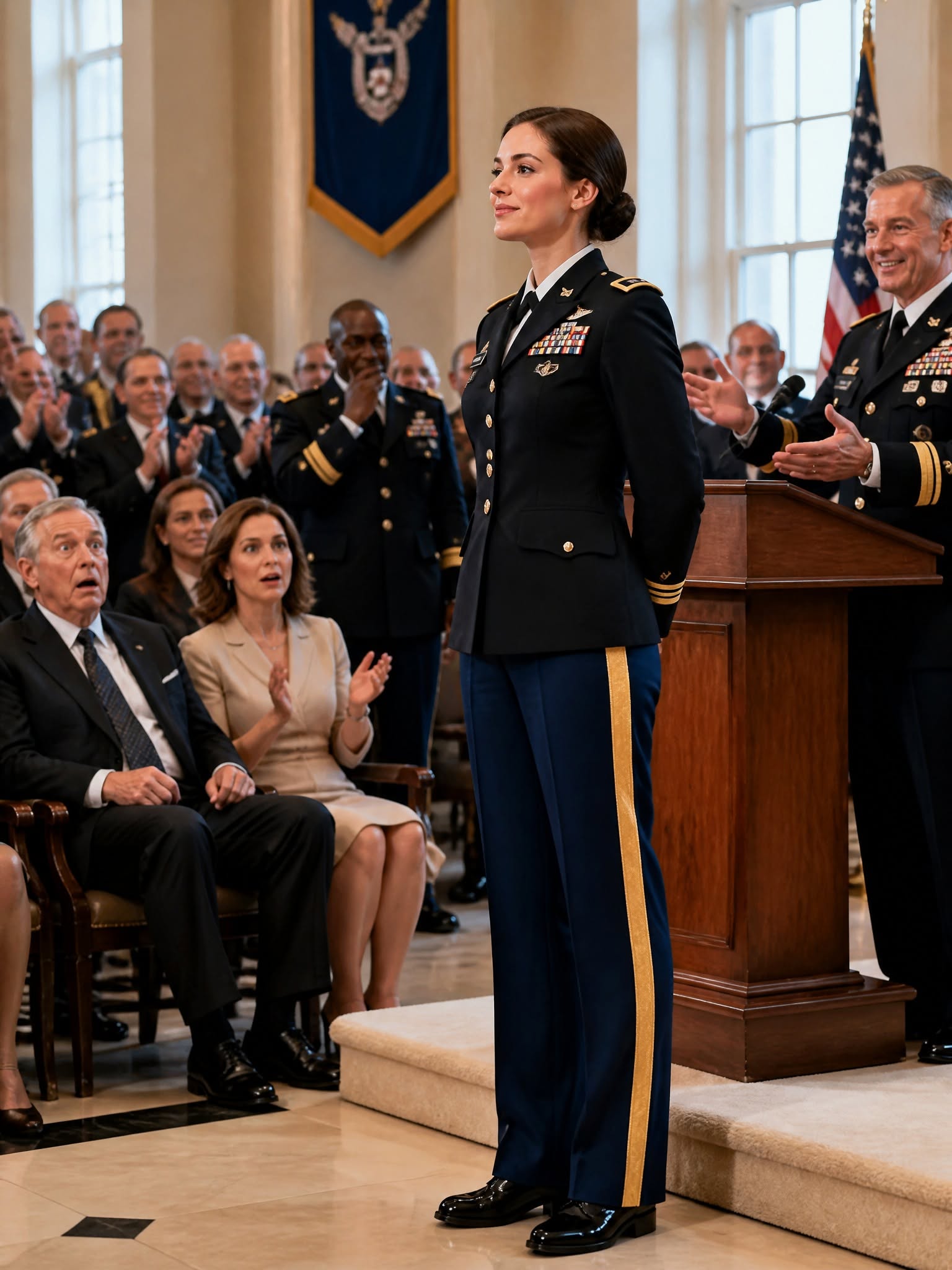
“Ladies and gentlemen,” Brigg continued, “please rise and welcome Brigadier General Sable Rowan Vale.”
The room went dead still.
Then chairs began to scrape.
Uniforms rose.
Heads turned.
My mother’s face changed first: confusion, then irritation, then something smaller and more frightened.
Penn looked as if the air had been slapped out of his lungs.
My father did not move.
General Brigg looked directly at me.
“Welcome, General.”
Those simple words still broke something.
I stood and walked toward the stage with every eye on my back. The carpet muffled my footsteps, but I heard them as if I were crossing an empty aircraft hangar. My father watched me approach. For the first time in years, he did not look through me or around me.
He looked at me like an order he had not expected to receive.
And with a calm that felt almost cruel, I wondered whether he was afraid of what I had come to reclaim.

Part 3: The Medal and the Video
General Brigg stepped aside when I reached the podium. That small movement told the room more than any introduction could have. Senior officers do not step aside by accident, especially at a ceremony like that.
The applause began too late.
That made it worse.
It started in the back, thin and hesitant, then spread row by row as people realized they were meant to honor me. The sound grew stronger, but I could hear the confusion beneath it. Applause has texture. Real applause rises like weather. Forced applause scatters like silverware dropped on the floor.
This was both.
A woman in dress uniform approached from the side of the stage carrying a narrow case. Colonel Mireya Ashe. I knew her, though we had never worked in the same unit for more than a week. She once found me coffee in a windowless building outside Stuttgart after seventy hours of crisis mapping. She did not say, “You look tired.” She said, “Drink this before you start turning wallpaper patterns into data.”
By military standards, that made her a friend.
She stopped in front of me and gave the faintest nod.
“General Vale.”
I nodded back.
She opened the case.
Inside was the medal I had refused to think about since the notification came through. Not because I did not care. Because some honors arrive attached to nights you are only trying to survive.
General Brigg returned to the microphone.
“For exceptionally distinguished service in defense intelligence, including leadership during Operation Glass Harbor and related joint security actions, the Department of Defense recognizes Brigadier General Sable Rowan Vale.”
He continued reading.
I heard phrases like “prevented mass-casualty events,” “coordinated interagency response,” “unconventional threat analysis,” and “personally assumed operational risk.”
Those words sounded clean.
The memories were not.
A blue-lit room. Rain hammering a metal roof in a country whose name still tightened my stomach. An analyst crying silently into her sleeve because she had been awake too long. A convoy marker blinking on a screen. A pattern no one believed. My own voice saying, “Stop them now,” while three men above me demanded proof I did not have time to provide.
If I was wrong, careers would end.
If I stayed silent, people would die.
Colonel Ashe placed the medal in my hand.
It was heavier than it looked.
My father’s entire retirement ceremony seemed to shrink around it.
Brigg gestured toward the microphone.
“General, if you’d like to say a few words.”
I did not want to.
That was the truth.
I had spent my career avoiding rooms like this. I did not enjoy being watched. I did not enjoy people deciding I mattered only after someone with authority gave them permission to believe it.
But my mother was looking at me as if I had built a life without asking my family’s permission, and Penn’s fiancée looked as if she had swallowed broken glass.
So I stepped forward.
The microphone smelled faintly metallic.
I placed my hands on both sides of the podium and looked over the room.
“For most of my career,” I said, “my work was not designed to be seen.”
No one moved.
“That is not a complaint. That is the job. Some people serve in front of cameras. Some serve in public command. And some serve in places where success means nothing happens, no headline appears, and no family receives a knock at the door.”
A few faces changed. Senior officers understood. Younger soldiers leaned in.
“My job was not to be remembered,” I continued. “My job was to notice what others missed. A wrong shadow in an image. A missing signal. A supply route too quiet. A name appearing in two places where it should not have appeared.”
I let that settle.
“I have been called distant, cold, absent. I have been told silence looks like arrogance, and duty looks like abandonment from the outside.”
My mother looked down.
Penn’s hand tightened around his program.
I kept my eyes forward.
“But I did not give my life to absence. I gave it to service. To soldiers who never knew my name. To families who got one more birthday, one more phone call, one more ordinary morning because someone behind a locked door refused to ignore a pattern.”
The room was so quiet I could hear the projector humming overhead.
Then I looked at my father.
Not for long.
Long enough.
“I did not come here today to take anything away from Lieutenant General Vale’s service,” I said. “His record stands. But mine does too.”
My voice did not break.
That mattered to me more than the medal.
“I spent years invisible because the mission required it. Today, it does not.”
I stepped back.
The applause came again, this time real enough to hurt.
I meant to move aside and let the ceremony continue. I thought my part was over.
Then the screen behind us flickered.
I turned.
General Brigg’s face tightened.
Colonel Ashe looked toward the sound table.
A staff sergeant raised both hands, confused, as if trying to say he had not touched anything.
The screen brightened.
A video appeared.
The man in the video sat in a dim room with beige walls and a folded American flag behind one shoulder. He wore a uniform that was not meant for ceremony, but one that had lived with the man wearing it. His hair was short. A scar cut through his left eyebrow. He looked directly into the camera.
“My name is Captain Elias Rook,” he said. “And if you are watching this at General Vale’s retirement ceremony, then someone finally decided the truth deserved a room.”
A murmur moved through the auditorium.
My father’s face went white.
And before Captain Rook said another word, I knew this was not an ordinary tribute video.
Part 4: The Truth From the Man Who Survived
Captain Elias Rook had been dead for eleven minutes when I first heard his name.
Not officially. Officially, he was missing with six members of his reconnaissance team after contact was lost during a mountain surveillance rotation. Unofficially, the first report used words like “presumed” and “unrecoverable,” words that in the military can be more brutal than simply saying dead.
I was in a secure operations room two oceans away, wearing yesterday’s shirt under my uniform jacket and drinking coffee so bitter it tasted like punishment.
That was the memory that returned when his face appeared on the screen.
Not pride.
Not honor.
Scorched coffee and rain against concrete.
In the video, Elias Rook leaned forward.
“Eight years ago, my team was assigned to a routine observation point,” he said. “At least, that’s what the paperwork called it. We were told the road was clear. We were told the signals were unrelated. We were ordered to proceed.”
He gave a short laugh without humor.
“Then a voice came over the secure channel and told us to stop moving.”
My hands went cold.
I had never told my family about Rook.
I had barely told myself.
“At the time, I didn’t know who she was,” he said. “No one did. She didn’t make a speech. She didn’t explain. She just said, ‘Captain, if you want to see sunrise, get your men behind stone and stay off that road.’”
Several people in the room shifted.
I remembered saying those words.
I remembered the colonel beside me shouting that I was exceeding authority. I remembered my finger hovering over the transmit button, then pressing down anyway. I remembered the heat signatures crossing the ridge exactly where they were not supposed to appear.
Rook lowered his gaze for a moment.
“We followed that order because something in her voice made disobeying sound stupid. Twenty-seven minutes later, the road we were supposed to take was gone.”
No one breathed.
“My youngest soldier was nineteen. He had a photo of his little sister taped inside his helmet. Another was two weeks from going home. I had a wife I had not seen in six months. We lived because Brigadier General Sable Vale saw the truth before anyone else wanted to admit it.”
I did not look at my father.
I could not.
Not yet.
Rook continued, his voice rougher now.
“When I later learned that decision nearly ended her career, I tried to file a statement. I was told the matter was classified. I was told to move on. But I do not move on from being alive.”
A strange sound came from the front row.
My mother.
Not quite a sob. Something smaller.
The video did not stop.
“So I am saying it now. To the soldiers in that room: some leaders stand where everyone can see them. Others stand in the dark and take the hit so others can walk into daylight. General Sable Vale did that for me.”
He paused.
Then his eyes narrowed slightly.
“And to Lieutenant General Harlan Vale, sir, I mean no disrespect. But if your daughter was absent from your story, it was not because she lacked honor. It was because you stopped reading before her chapter began.”
The screen went black.
The silence afterward was not empty.
It was crowded.
Everything old I had buried seemed to rise at once: the report my father never asked to read, the disciplinary investigation that vanished after the truth came out, the family dinner where Penn said, “Dad says you made enemies because you couldn’t follow the chain of command,” and my mother said, “Maybe one day you’ll learn humility.”
I had been thirty-two then.
Old enough to understand.
Still young enough to hope someone would ask what had happened.
No one asked.
Onstage, General Brigg stepped forward, but even he seemed unsure how to return the room to ceremony. My father remained seated, both hands open on his knees, staring at the blank screen.
Then Penn stood.
It was the wrong move.
Everyone knew it the moment he did it.
“Dad,” he said quietly, though the stage microphone still caught the edge of his voice.
My father did not answer.
Penn looked at me, and something like accusation crossed his face. Not because I had lied.
Because I had stopped allowing him to.
Liora pulled at his sleeve and whispered, “Sit down.”
He did not.
“Sable,” he said louder. “You could have told us.”
That was when the room turned against him.
Not violently.
Worse.
Morally.
Dozens of officers turned their heads. My mother closed her eyes. My father finally looked up.
I stepped to the edge of the stage.
Penn was still standing in the front row, jaw tight, cheeks red.
“I tried,” I said.
My voice carried without effort.
He blinked.
“When?”
“At Fort Brindle,” I said. “After the investigation. I came home for two days.”
Penn’s face faltered.
“You told me not to bring classified drama into Dad’s house.”
His mouth opened, then closed.
I looked at my mother.
“You told me I was upsetting him before a promotion board.”
She pressed the tissue against her mouth.
Then I looked at my father.
“And you said, ‘A good officer knows when silence is the price of service.’”
His face broke.
Not completely.
Just enough.
The whole auditorium heard it.
That was not revenge.
Revenge would have felt hotter.
This felt like a door opening in a house sealed for years, letting everyone smell the rot inside.
General Brigg announced a brief recess.
The ceremony dissolved into whispers.
My father closed his eyes.
Penn continued, his voice rough.
“I thought loyalty meant standing where he stood. If he didn’t mention you, I didn’t. If he dismissed you, I did. It was easier than asking why my sister looked like a stranger every time she came home.”
The room was painfully silent.
No glasses clinking. No polite coughs.
Only my brother learning too late that honesty cannot erase what cowardice helped build.
I looked at him for a long moment.
Then I said, “You were not a child at the gate.”
He nodded once.
“No.”
“You were not a child when you let Liora laugh.”
Liora’s face went red.
Penn whispered, “No.”
“And you were not a child when you watched them leave my name out of that program.”
His throat moved.
“No.”
I folded the program and placed it on the cake table.
“Then I will not accept a child’s apology from you.”
He looked up sharply.
“You want me to say more?”
“I want you to live differently. That is harder.”
My father let out a long breath, almost like pain.
“I can make a statement,” he said. “Correct the program. Send an addendum. Make calls.”
I looked at him, and something inside me settled.
There it was. His instinct. Fix the record. Control the damage. Clean the surface.
“No,” I said.
He frowned.
“No?”
“No statement. No public family tribute. No rewritten biography with my name squeezed in because witnesses made shame inconvenient.”
My mother cried harder.
I did not soften.
“You had years to know me privately. Today you discovered me publicly. That does not give you the right to claim me.”
My father stared at me.
For one second, I saw him understand.
Not agree.
Understand.
For the moment, that was enough.
General Brigg appeared at the edge of the circle.
“General Vale?”
Both my father and I turned.
The room seemed to hold its breath.
Brigg looked at me.
“Your vehicle is ready whenever you are.”
My father’s face changed again.
Of course Brigg had arranged a vehicle. Of course my schedule did not end with a family reception. Of course I had not come here as an abandoned daughter begging for attention. I had come between obligations.
I nodded to Brigg.
“Thank you.”
My mother stepped forward.
“You’re leaving?”
“Yes.”
“But we haven’t talked.”
I looked at her wet eyes, her pearls, her trembling hands around a napkin.
“We did,” I said. “You just didn’t like what was said.”
Then my father did something I did not expect.
He saluted me.
Not sharply. Not ceremonially. Slowly.
A soldier’s acknowledgment.
A father’s surrender would have looked different.
I returned the salute because rank required it.
Not because forgiveness did.
Then I left the reception hall while the whole room watched the Vale family finally become what they had tried so hard to avoid.
A cautionary tale in formalwear.
Part 8: Apologies Are Not Doors
Six months later, my father sent me a compass.
It arrived on a Tuesday morning at my office near Quantico, wrapped in brown paper with no return address. My assistant, Odelia, placed it on my desk beside a stack of briefings and said, “This looks personal, which means I’m going to pretend I didn’t see it.”
Odelia had worked with me for two years. She could identify a crisis by the way I removed my glasses.
“Thank you,” I said.
She paused at the door.
“Need coffee?”
“Not yet.”
“Terrifying answer.”
After she left, I opened the package with a letter opener shaped like a tiny sword, a joke gift from a NATO analyst who once said I looked like I could classify a birthday card.
Inside was a brass military compass, old and scratched, set in a velvet-lined case.
My father’s compass.
I recognized it immediately. He carried it when I was a child. Not because he needed it in combat, but as a symbol. He used to let Penn hold it at family picnics and teach him how to find north. I once asked if I could try.
My father said, “When you learn patience.”
Penn smirked.
I went behind the garage and taught myself with a library book.
Now the compass lay on my desk, its edges worn smooth by his fingers.
Under it was a note.
“I should have taught you north. You found it anyway.”
No signature.
I read it twice.
Then I closed the case.
I did not cry. I did not call. I did not place it on a shelf for visitors to see and ask about. I put it in the bottom drawer, beside a spare pair of gloves and an old challenge coin from a unit that no longer existed on paper.
Some apologies are not doors.
They are only weather reports.
They tell you the storm has moved, not that the house has been rebuilt.
After the ceremony, my family tried in different ways.
My mother sent messages that began softly and ended in guilt.
“I keep thinking about you as a little girl.”
“I wish you would let us explain.”
“Your father isn’t sleeping well.”
I answered three times.
Then I stopped.
Penn was different. At first, he sent one message a week, never demanding, never dramatic.
“I read about Rook’s unit today. I understand more now.”
“I corrected someone at brigade when they called intel support ‘desk work.’ Thought you should know.”
“Liora and I postponed the wedding. Not your problem. Just true.”
That last one surprised me.
I did not ask why.
Eventually, he sent a longer message.
“I’m not asking you to make me feel better. I’m trying to become the man who should have stood up at the gate instead of making a joke. I don’t know if I can fix anything. I know I can stop being the same man.”
I stared at that message for a while.
Then I replied, “Good. Keep going.”
That was all.
My father did not text.
He sent objects.
The compass. A photo of me at nine, saluting with the wrong hand in the driveway. A copy of my basic training graduation program with my name circled in blue ink. A folded flag patch from one of his old field jackets.
Each item arrived without pressure.
Each one said, in his limited language, “I remember more than I admitted.”
But remembering is not repair.
One October evening, I accepted an invitation to speak at a military intelligence leadership course. The lecture hall was full of young officers with open laptops and exhausted eyes. I spoke about pattern recognition, moral courage, and the danger of mistaking certainty for leadership.
At the end, a lieutenant raised her hand.
“Ma’am,” she asked, “how do you handle people doubting you when you can’t show them the evidence?”
I looked at her face. Eager. Tired. Afraid of becoming invisible.
The room waited.
“You stop building your identity around their doubt,” I said. “Document what you can. Protect your team. Tell the truth when the rules allow. And find people who do not need public proof before treating you with respect.”
She wrote it down.
So did half the room.
Afterward, I walked outside into the sharp evening air. Campus lights glowed white along the sidewalk. My phone buzzed.
A message from my father.
“Your mother wants to host Thanksgiving. I told her not to invite you unless she can accept no as an answer. I’m asking once. Would you consider dinner?”
I stood beneath a maple tree, watching leaves scrape across the pavement.
For a long while, I thought about the house where my absence had once been useful. The dining room where Penn’s accomplishments filled the conversation while mine were treated like classified inconvenience. The hallway wall with no photos of me.
Then I thought about my apartment. Its clean silence. Its single armchair. Its morning light. The people who knew me without needing blood to justify loyalty. Odelia with her terrible coffee timing. Mireya with her blunt mercy. Rook, alive somewhere, probably making another video no one asked for.
I typed back.
“No. Not this year.”
After a moment, I added:
“I hope dinner is peaceful.”
Ten minutes later, he replied.
“I understand. You owe us nothing. I am learning that.”
I read it twice.
Then I put my phone away.
Part 9: Not Every Ending Is a Reunion
The following spring, I went back.
Not for Easter. Not for a birthday. Not because my mother cried over the phone or because Penn said the family missed me.
I went because my father asked to meet at a diner on Route 17, halfway between my office and the town where I grew up. Neutral ground. A public place. No portraits. No family table. No walls curated to prove I had not existed.
The diner had red vinyl booths, chrome edges, and the smell of bacon grease soaked into every surface. A waitress with blue nails poured coffee before I sat down. Outside, trucks hissed along the wet road, throwing mist against the windows.
My father was already there.
No uniform.
No cardigan either.
Just a gray jacket, open at the collar, his hands wrapped around a coffee cup he had not touched.
He stood when he saw me.
I hated that it moved me.
“General,” he said.
I slid into the booth.
“Harlan.”
His face flickered.
He deserved that.
The waitress returned. I ordered black coffee and toast. My father ordered nothing else. For a few minutes, we listened to plates clatter and old country music playing too softly from the ceiling speakers.
Then he pushed a folder across the table.
I did not touch it.
“What is this?”
“Copies,” he said. “The corrected family record I submitted to the military archive association. Your name. Your rank. Your public awards. Nothing classified.”
I looked at the folder.
“Why?”
“Because the previous record was false.”
“That didn’t require a meeting.”
“No,” he admitted. “It didn’t.”
He looked older than he had on the day of the ceremony. Not weaker, just less protected by performance.
“I also wrote a letter,” he said.
“For me?”
“For myself first. Then for you.”
He took an envelope from the folder and placed it beside my coffee.
I left it there.
“I’m not reading that in front of you.”
“I know.”
The waitress brought my toast. The butter came in tiny foil packets, the kind that never spread right unless you warm them in your palm. I did that while my father watched, and suddenly I remembered being seven, sitting across from him in another diner after a doctor’s appointment, struggling with the same kind of butter. Back then, he had opened it for me without turning it into a lesson.
Memory is cruel because it refuses to be consistent.
It gives you one soft thing in a room full of knives.
“I need to say something,” he said.
I spread butter on the toast.
“Then say it.”
He inhaled.
“I loved the idea of being the father of a son in uniform. I understood it. I knew its shape. Penn made sense to me.”
The toast tasted like cardboard.
“You did not,” he continued. “Not because you were wrong. Because you reflected every limitation I did not want to examine. You questioned systems I survived by obeying. You succeeded in spaces I did not respect because I did not understand them. And when your career became something I could not explain, I chose to make you the problem.”
I looked out the window.
A pickup truck passed with a cracked taillight.
“I let your mother follow my silence,” he said. “I let Penn imitate it. I let our family become smaller because my pride needed more room.”
His voice cracked slightly on the last sentence.
“I am sorry, Sable.”
There it was.
The sentence I once would have crawled over broken glass to hear.
It did not heal me.
That is the part no one tells you. An apology can be real, and the wound can still remain. A person can finally say the right words, and you can still be standing among the ruins of what they refused to build.
I turned back to him.
“I believe you.”
His eyes filled with something like hope.
I stopped it before it grew.
“But I do not forgive you.”
The words rested between us with the coffee and the unopened envelope.
He closed his eyes.
I continued, because mercy and clarity are not enemies.
“Not because I want to punish you. Not because I want you to hurt forever. I don’t. I hope you become better. I hope you and Mom learn to tell the truth without needing an audience. I hope Penn keeps becoming braver than he was.”
My hands stayed around my coffee mug.
“But forgiveness is not a retirement gift. It is not a corrected record. It is not something you earn because shame finally caught up with you.”
He nodded slowly, eyes wet now.
“I understand.”
“Do you?”
“I’m trying.”
That was honest enough.
I picked up the envelope and slipped it into my coat pocket.
“I’ll read it later.”
“Thank you.”
“I’m not coming home.”
His mouth tightened, but he nodded.
“I know.”
“I may meet you again. Maybe. In places like this. Neutral places. Honest places. But I will not walk back into that house so everyone can feel forgiven just because I sat at the table.”
His jaw trembled once.
Then he said, “That’s fair.”
No.
It was not fair.
Fair would have been a father who came to my graduations. A mother who asked questions before judging the answers. A brother who stood at the gate and said, “Her name belongs here.” Fair would have been a family that did not need a commander, a medal, and a dead-silent room to recognize their own blood.
But fair was not available.
So I accepted clean.
Clean was enough.
We finished our coffee without pretending the conversation had turned sweet. When we stood outside the diner, the rain had stopped. The road shone silver beneath the morning light.
My father did not reach out to touch me.
I respected him for that.
He gave a slow nod.
“Goodbye, Sable.”
“Goodbye, Harlan.”
I drove back to Quantico with his letter in my pocket and no ache pulling me toward the rearview mirror.
That night, I opened the envelope.
The letter was three pages long. Careful. Specific. No excuses. He named the checkpoint. The program. Fort Brindle. The breakfast he left before. The years he let silence harden into family policy.
At the bottom, he had written one final line.
“I see you now, and I know seeing you late does not give me the right to stand beside you.”
I folded the letter and placed it in the drawer with the compass.
Then I turned off the light and slept through the night.
No dreams.
No alarms.
No ghosts.
Part 10: The Room Was Already Mine
People like to imagine recognition as a grand ending.
A commander says, “Welcome, General.” A room stands. A family gasps. A medal catches the light. The truth arrives in polished shoes, and every old wound closes because the world finally knows who you are.
Life does not work like that.
The ceremony changed the record. It changed the room. It changed the way strangers said my name.
It did not give back the birthdays, the missed calls, or the years I sat alone in airports watching other soldiers run into their families’ arms. It did not erase the checkpoint, the program printed without my name, or Penn’s careless voice saying “clearance issue” as if my absence were a joke he had the right to tell.
But it gave me something else.
A clean line.
Before that day, part of me still wondered whether I had imagined being erased. Whether I had been too sensitive, too proud, too distant. Whether, if I had explained myself better, smiled more softly, visited more often, asked less from people used to giving nothing, my family might have loved me correctly.
After that day, I stopped wondering.
They had known enough.
They had chosen comfort.
And I had survived anyway.
One year after my father’s ceremony, I stood in another auditorium, smaller this time, filled with young intelligence officers about to receive their first assignments. The air smelled of new carpet and nervous sweat. Outside the tall windows, white light poured in, stretching across the floor in long golden rectangles.
I gave the keynote without notes.
I spoke about uncertainty. About courage without applause. About the danger of letting powerful people define truth only when it becomes convenient.
I did not talk directly about my father.
But near the end, I looked at a young woman in the second row, her shoulders held too tightly, her face carrying the old hunger of someone desperate to be taken seriously.
“If you remember one thing,” I said, “remember this. Do not shrink your life to fit inside someone else’s refusal to see you. Their blindness is not your boundary.”
She blinked hard.
I knew that blink.
After the ceremony, she approached with a trembling hand and asked if I would sign her program. Her name was Cadet Ivenna Sol. She said her family thought intelligence work was “not real soldiering.”
I signed my name and handed it back.
“Then become so good reality has to adjust,” I told her.
She smiled as if someone had opened a window.
That evening, I returned to my quiet apartment. Odelia had left a stack of files on my desk with a note: “Urgent, annoying, probably survivable.” Mireya had texted to ask if I wanted dinner. Penn had sent a photo of burned rice with the message: “Still a national security threat.” I laughed out loud in my kitchen, alone but not lonely.
My father’s compass stayed in the drawer.
His letter stayed with it.
Sometimes I opened the drawer and looked at them. Not with longing. Not with anger. Just acknowledgment. Proof that the past had happened. Proof that late truth was still truth, even if it arrived too late to rebuild what it broke.
I did not return to my family the way they wanted.
I did not attend Thanksgiving. I did not pose for a corrected portrait. I did not let my mother turn my boundaries into proof of cruelty. I met Penn for coffee twice, and both times he listened more than he spoke. That was new. Maybe one day it would become something real.
My father and I continued meeting every few months at diners, base cafés, and quiet public places with no walls full of selective history. He never asked me to come home again.
That was how I knew he had begun to understand.
Not every ending is a reunion.
Some endings are a woman standing in her own doorway, locking it when she chooses, opening it when she chooses, no longer waiting for a name card at someone else’s table.
My name is Brigadier General Sable Rowan Vale.
I was left off the list at my father’s retirement ceremony.
Then the commander said, “Welcome, General.”
And for the first time in my life, I did not need my family to make room for me.
The room was already mine.
THE END.

