
PART 1
“You don’t deserve that degree,” my father spat.
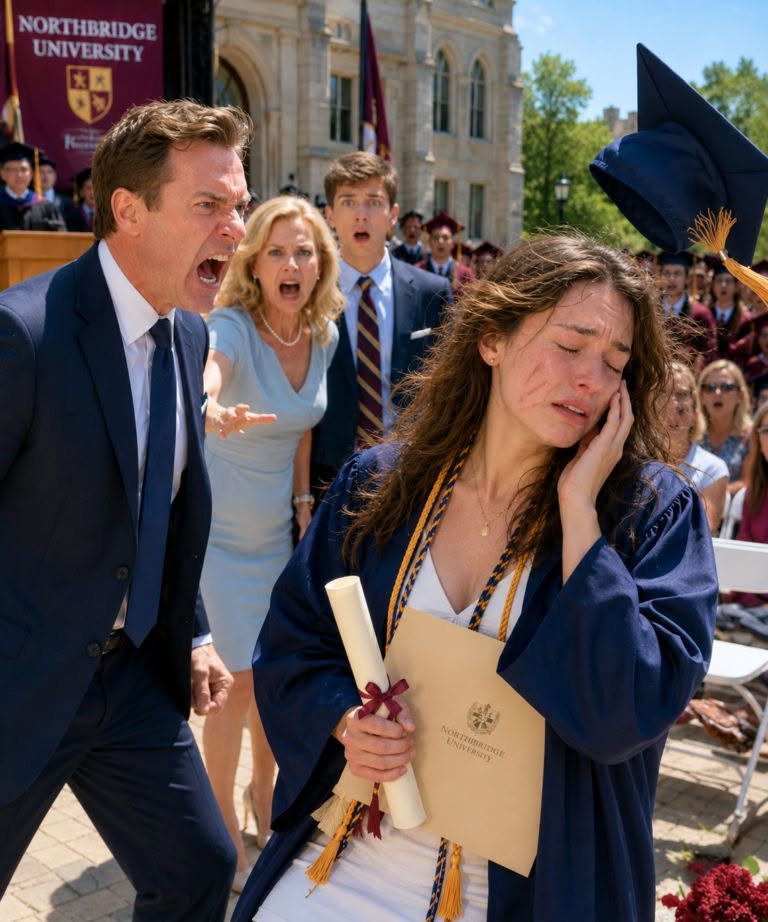
A second later, his hand struck my face so hard that my maroon graduation cap flew off my head and skidded across the main quad of Hudson Valley University.
The sound of the slap cut through the courtyard like a crack of thunder. Conversations stopped. Cameras lowered. Families who had been laughing and cheering moments earlier froze in place, as if the entire ceremony had suddenly lost power.
My cap landed beside the leather case that held my diploma. I stood completely still, my cheek burning, my hand trembling at my side, while hundreds of students, professors, parents, photographers, and university staff stared at us.
My father, Arthur Vance, was red with rage.
“You’re a disgrace,” he hissed, stepping closer. “You stood on that stage like you actually earned something.”
Before I could answer, my mother, Victoria, rushed forward with a look of pure hatred on her face.
“You’re a failure wearing a graduation gown!” she snapped loudly. “Stop embarrassing this family in front of everyone!”
A wave of horrified whispers moved through the crowd. One professor lowered his camera, stunned. A campus security officer began walking toward us, but I slowly raised one hand to stop him.
“No,” I said quietly, keeping my eyes on my father. “Let him finish.”
My best friend, Paige, appeared beside me in her own graduation gown, pale with shock.
“Audrey, are you okay?” she whispered. “What is going on?”
I didn’t answer.
Not because I hadn’t heard her.
Because I had spent four years preparing for this moment.
I hadn’t expected my father to strike me in front of everyone. I hadn’t expected the sting in my cheek or the silence of the crowd pressing down on me. But I had expected the truth to corner my parents eventually.
For years, Arthur and Victoria had fed our relatives a carefully built lie.
They told everyone I had dropped out of college. They said I was lazy, reckless, and too undisciplined to finish school. They acted like heartbroken parents who had tried everything to save their ungrateful daughter.
But the truth was completely different.
I had earned a partial academic scholarship. I worked double shifts at a diner in the mornings, tutored students in the afternoons, and studied until long after midnight. Some weeks, I slept only three hours a night. Some weeks, I lived on coffee and cheap bread so I could keep paying tuition.
There were nights I cried silently in library bathrooms because I was too exhausted to keep pretending I was fine.
And yet, that morning, when the dean announced my name with Summa Cum Laude honors, the courtyard exploded with applause.
That was the moment my younger brother, Julian, stopped smiling.
He stood behind my parents in a tailored suit, wearing an expensive watch and polished leather shoes. Julian had always been treated like the golden child, even though he had dropped out twice and ruined a business I warned him would fail.
For Julian, there was always money.
Courses. Vacations. Phones. Gas cards. Investments.
For me, my parents always claimed there was nothing left.
When my father watched me walk across that stage to accept my honors diploma, his face twisted. He did not look proud. He looked furious, as if every clap from the audience was an insult aimed directly at him.
That was why he stormed toward me.
That was why he hit me.
I bent down, picked up my cap, and brushed dust from my diploma case. My cheek throbbed, but my voice stayed calm.
“You’re right, Dad,” I said clearly. “Everyone here should hear the truth.”
My mother’s expression changed instantly.
“Audrey,” she warned. “Do not make a scene.”
But I was already walking toward the main podium.
The university president, Dr. Sterling, stood near the microphone, unsure whether to stop me or call security.
I reached into the hidden lining of my graduation gown and pulled out a thick manila envelope sealed with wax. I had carried it against my chest all day, waiting for the right moment.
“Dr. Sterling,” I said into the microphone, my voice spreading across the entire quad, “before I leave this university, I need to submit a formal report against the people who stole my tuition money, forged federal documents in my name, and tried to erase me from my own family.”
From below, my father roared, “Shut your mouth, Audrey!”
But it was too late.
The microphone was on.
And everyone could hear me.
PART 2
The courtyard fell into a heavy, stunned silence.
Dr. Sterling looked at the thick folder in my hand, then down at my parents. Their faces had changed completely. The anger was gone. In its place was panic.
“Ms. Crestwood,” Dr. Sterling said carefully, still speaking into the microphone, “are you filing a formal administrative and legal statement?”
“Yes,” I said. “And I have proof.”
My mother gave a sharp, artificial laugh, the kind she used whenever she wanted to make someone else look unstable before they could defend themselves.
“Please don’t encourage this nonsense,” she announced to the crowd. “Audrey has always been dramatic. She invents crises because she wants attention.”
I turned and looked directly at her.
“Did I also invent the three student loans opened under my Social Security number?” I asked. “The ones with forged electronic signatures?”
Her laugh died immediately.
Whispers spread across the courtyard. The photographers, who had been covering a simple graduation ceremony, suddenly raised their cameras again. They were no longer capturing smiling graduates.
They were watching a respected family fall apart in public.
I took a breath and continued.
“Four years ago, I came here on a partial merit scholarship. The rest of the tuition was my responsibility. I worked from my first semester and never asked my parents to pay for me. But during my junior year, I found three high-interest education loans in my name. I had never applied for them. The money had been transferred into an account controlled by my parents.”
Arthur moved toward the stage.
“This is a private family matter!” he shouted. “Turn off the microphone!”
Two campus security officers stepped in front of him.
“Sir,” one said firmly, “step back.”
Julian lowered his eyes to his expensive shoes. The proud, untouchable expression he usually wore had disappeared.
I opened the folder and handed the documents to Dr. Sterling. Inside were bank records, routing numbers, signature comparisons, IP tracking reports, and a legal summary prepared by a consumer protection attorney who had quietly helped me build the case for six months.
“When I confronted my parents,” I said, “my father told me I owed them for raising me. My mother said no court would believe me because she had already spent months telling people I was unstable. I was nineteen. I was broke, frightened, and completely alone. So I stayed quiet. I finished my degree. And I saved every document.”
Paige stepped beside me and took my hand.
“Finish it,” she whispered.
I swallowed hard.
“They did not just steal my identity,” I said. “They told our relatives I had dropped out because of substance abuse. They said I refused to work. They used my credit to support Julian’s failed startup while I was sleeping on a bench at the transit station after closing the diner at three in the morning.”
A gasp came from the front row.
An older woman pushed through the crowd. It was my Aunt Beatrice, my mother’s older sister. Her face was pale with shock as she stared at Victoria.
“Victoria,” she said, her voice shaking, “you told the estate trustees Audrey couldn’t attend family events because she had been institutionalized.”
My chest tightened.
That was new information.
They had not only stolen from me. They had used lies to block me from the family trust.
My mother’s eyes filled with tears, but they were not tears of guilt. They were tears of fear. She knew her control was slipping.
“Audrey,” she pleaded softly, “please think about Julian’s future.”
I looked down at my brother.
He said nothing.
No apology.
No denial.
No shame.
His silence told me everything.
Arthur grabbed my mother’s arm. “We’re leaving.”
Dr. Sterling’s voice cut across the quad.
“No, Mr. Vance. You are not leaving. Municipal police have already been called, and the exits are being secured.”
For one second, I thought nothing could hurt worse than what had already happened.
Then Julian raised his head and looked at me.
“She knew the money was for my startup,” he said flatly. “She always knew.”
PART 3
The ground seemed to shift beneath me.
It was not my father’s shouting that broke the last piece of my childhood. It was not the slap or the lies my mother had spread for years.
It was hearing Julian talk about my stolen identity as if it had simply been a business arrangement.
As if my name, my credit, my future, and my survival had always belonged to him.
“What did you just say, Julian?” I asked into the microphone.
He straightened, as if he still believed he could talk his way out of it.
“I said you understood the situation,” he replied. “Everyone knew the company needed funding. It was supposed to generate a major return. I only needed a temporary injection of capital.”
“A temporary injection?” I repeated, laughing once in disbelief. “I worked sixteen-hour days. I sold Dad’s old vintage watch to cover my sophomore tuition balance. I lived in my car for three weeks because I couldn’t afford a security deposit. And you call my life your capital injection?”
Arthur lunged toward the stairs again.
“That is enough!”
But nobody listened to him anymore.
Not the security officers. Not the president. Not the families who had come to celebrate their children and were now witnessing the truth spill out in broad daylight.
Aunt Beatrice stepped closer to my mother.
“You swore Audrey was a disgrace to this family,” she said.
Victoria lowered her head.
“I did what I had to do to protect my son’s future.”
That sentence hurt more than the slap.
Because in that moment, I finally understood.
My mother had not made a mistake.
She had chosen.
She had chosen Julian’s comfort over my survival.
Police cars arrived before the ceremony officially ended. There was no joyful music, no cheerful tossing of caps. Graduates collected their diplomas quietly while families moved away from us as if they were avoiding broken glass.
Arthur, Victoria, and Julian were escorted into the administrative building for questioning. Julian tried to argue that his name was not on the loan forms, but the officers did not give him room to perform his usual charm.
I stayed outside on a concrete bench beneath the shade, my gown still zipped, an ice pack pressed against my swollen cheek.
Paige sat beside me and wrapped an arm around my shoulders.
“You finished it, Audrey,” she said softly.
I looked down at my diploma case.
“I didn’t want my graduation to be like this.”
“I know,” Paige whispered. “But they made those choices.”
She was right.
No one dreams of exposing their family on graduation day. No one imagines walking off a stage and giving statements to investigators. Freedom does not always feel like victory at first. Sometimes it feels like grief, because you are finally burying the last hope that the people who gave you life might someday love you properly.
Within a week, the financial fraud investigation moved toward a grand jury case.
The evidence became impossible to deny.
There were forged signatures copied from my old school forms. Intercepted tuition refund checks. Wire transfers. Loan applications. Digital records. Server logs.
Arthur claimed I had verbally approved the loans. Victoria filed a statement saying she had managed the money because I was emotionally unstable. Julian insisted he had no idea where the funds for his company had come from.
But the digital records told the truth.
Investigators recovered messages from their private accounts.
In one message, Victoria had written to Arthur:
“As long as Audrey doesn’t request a certified credit report, she won’t see the distribution line.”
In another, Julian had asked:
“When does Audrey’s next tuition refund clear? My office lease is overdue.”
Reading those messages was the moment I stopped crying.
Not because it no longer hurt.
Because I finally stopped questioning myself.
For years, I had wondered if I was being too sensitive. I had wondered if maybe there was some reason my parents treated me with such coldness. I had wondered if being a good daughter meant staying quiet, smiling at family dinners, and allowing myself to be sacrificed for the image of a perfect household.
But good families do not destroy one child to protect another.
Six months later, Arthur and Victoria accepted a plea agreement. They avoided a long prison sentence, but they were ordered to pay major civil judgments and full restitution. The fraudulent loans were removed from my record after judicial review. Julian was held legally responsible for receiving stolen funds, and his company collapsed under court order before the end of the year.
The family split exactly as expected.
Some relatives said I had done the right thing.
Others whispered that I should have handled it privately. They claimed family loyalty mattered more than the law.
Aunt Beatrice was the only one who came to my new apartment. She arrived with kitchen supplies, a wool blanket, and swollen eyes.
“Forgive me, Audrey,” she said, her voice breaking. “Forgive me for believing them instead of looking for you.”
I did not rush to comfort her.
It was the first apology from my family that did not come with a hidden demand attached.
With my final academic stipend, a junior analyst job at a consulting firm, and Paige’s steady support, I rented a small apartment near the park. It had a folding desk, two chairs, an old espresso machine, and a wide window overlooking a blooming jacaranda tree.
To me, it felt like a palace.
Two months later, my framed degree arrived by courier.
I opened it carefully and hung it above my desk.
Not because I needed strangers to admire it.
Not because it proved I was smart.
I hung it there because it proved I had survived long enough to tell the truth.
Behind the frame, hidden from view, I taped a photo Paige had taken in the administration lounge after the confrontation. In it, my cheek was red, my eyes were full of tears, and my diploma was pressed tightly to my chest.
I looked broken.
But I also looked free.
One night, my father sent me a restricted message.
“One day, Audrey, you will regret destroying this family.”
I read it three times.
Then I looked at my degree, my desk, my window, and the quiet life I had started building with my own hands.
I typed back one final reply.
“I didn’t destroy this family, Arthur. I only stopped hiding what you did.”
Then I blocked him forever.
My parents had planned for my graduation to become the day I was publicly humiliated. They wanted everyone to remember me as the unstable dropout, the failure in a graduation gown, the daughter who had no right to stand on that stage.
But reality changed the ending.
That day became the day everyone finally saw who they were.
And it became the day I learned a truth no one in that family had ever taught me: honoring your name does not mean staying silent for the people who hurt you. Sometimes, it means standing up first and saying exactly what the truth is.

