
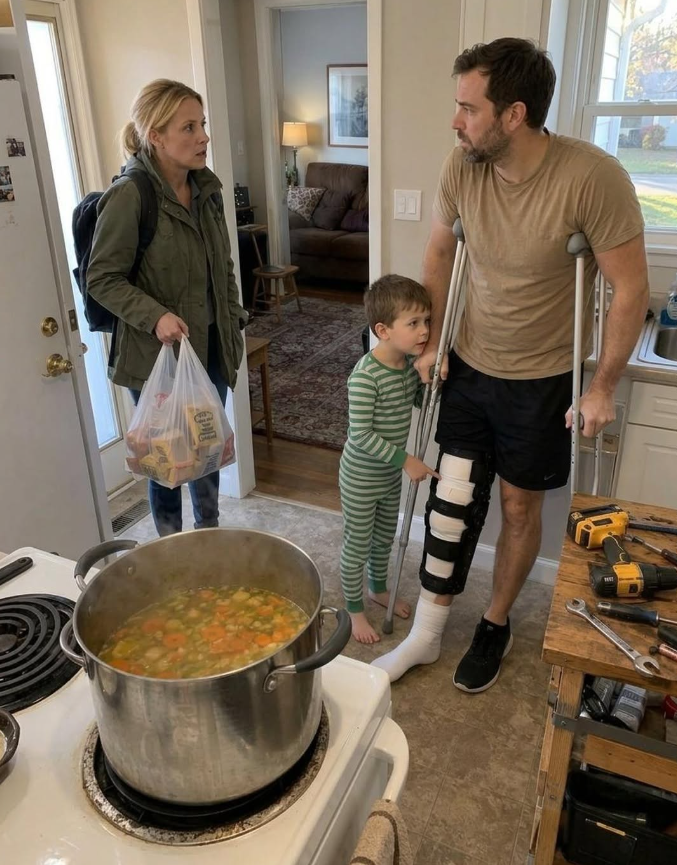
The moment I opened my apartment door, I stopped so suddenly my keys slipped against the lock. Lemon cleaner hung in the air, mixed with the warm smell of bread and melted cheese, and for one strange second I thought I had walked into the wrong unit after another exhausting hospital shift. The blankets that usually lived in piles on the couch were folded. The coffee table was clear. The kitchen sink, which normally looked like a small monument to survival, was empty and shining under the light. Then I heard movement near the stove. A tall man turned slowly, one hand braced on the counter, a medical support wrapped around his knee, wearing one of my oversized gray T-shirts like he had borrowed it from a much smaller life. “I stayed out of your bedroom,” Adrian said quickly, lifting both hands. “I only cleaned the front rooms. I figured it was the least I could do.”
The night before, I had found him outside the grocery store near our building, sitting against the brick wall with his bad leg stretched in front of him and the kind of tired eyes that made a person look twice. My name is Claire Bennett, I’m a single mother, and at thirty-nine I was working double shifts at St. Agnes Hospital while trying to keep my eight-year-old son Oliver fed, warm, and hopeful. Our rent was $1,475 a month, and I was already behind by two notices. I had $63 in checking, a loose outlet in the kitchen, a front door that stuck every time it rained, and a landlord named Mr. Pritchard who ignored every maintenance request until money was involved. Adrian told me he had worked construction and hospital facilities before a knee injury cost him his job, then a workers’ compensation fight cost him his apartment. I told myself one night on the couch was kindness, not a commitment. By morning, I expected him to be gone.
Instead, Oliver burst from the hallway yelling that Adrian had fixed the front door and made him finish his homework before dinner. On the table were grilled cheese sandwiches, soup with parsley and thyme, and a note listing every ingredient Adrian had used from my cabinets: bread, cheese, carrots, celery, broth cubes — will replace when possible. I wanted to be grateful, but fear was sitting right beside gratitude. He had sorted the mail without opening anything sealed, and he had seen the landlord’s notice lying on the counter. “You’re close to eviction,” he said gently. “I can’t give you money yet, but I can give you leverage.” The next morning, he walked with me to Mr. Pritchard’s basement office and calmly listed the failed stairwell light, loose railings, clogged dryer vent, and unsafe door frame. Then he said one sentence that changed everything: “Thirty more days for Ms. Bennett, in writing, or we document the insurance liability and code issues today.”
Mr. Pritchard signed within minutes, and by evening the building already felt safer. Adrian fixed the railings, cleared the vent, tightened the outlet cover, and kept a careful file of every repair like a man preparing for court. He reopened his disability claim with help from an attorney, showed me his paperwork without being asked, and slowly began receiving modest payments. When an old job-site supervisor named Miller showed up weeks later demanding a cut of Adrian’s settlement, Adrian’s past came into focus: he had been blacklisted after reporting dangerous work conditions, then dragged through a compensation battle while his savings disappeared. I called the police when Miller threatened us, and Adrian handed over notes, dates, names, and records as if he had been building an estate of evidence from the wreckage of his own life. He later found remote work as a logistics dispatcher, paid back every dollar of groceries he had used, helped Oliver with school projects, and even helped me organize my overdue bills, including rent, medical insurance notices, and the small mortgage paperwork from my late mother’s house that I had been too overwhelmed to face.
A year later, Apartment 3C no longer felt like a place I was barely holding together. The front door closed smoothly, herbs grew in a planter Adrian built for the windowsill, and Oliver’s crooked crayon drawing still hung on the refrigerator, now surrounded by school calendars, photos, and a postcard from Adrian’s sister. Mr. Pritchard eventually offered Adrian a maintenance contract for the building, and Adrian, with his quiet confidence returning, told him his rates had gone up. One evening, I handed him a real key, not the emergency spare under the mat, and told him it was for the door he had fixed. He looked at it for a long time before closing his hand around it. I had let a homeless man sleep on my couch because I thought I was giving him shelter for one night. What I didn’t understand then was that some people do not come into your life to take from what little you have left — some arrive carrying tools, patience, and the steady courage to help rebuild what everyone else ignored.