
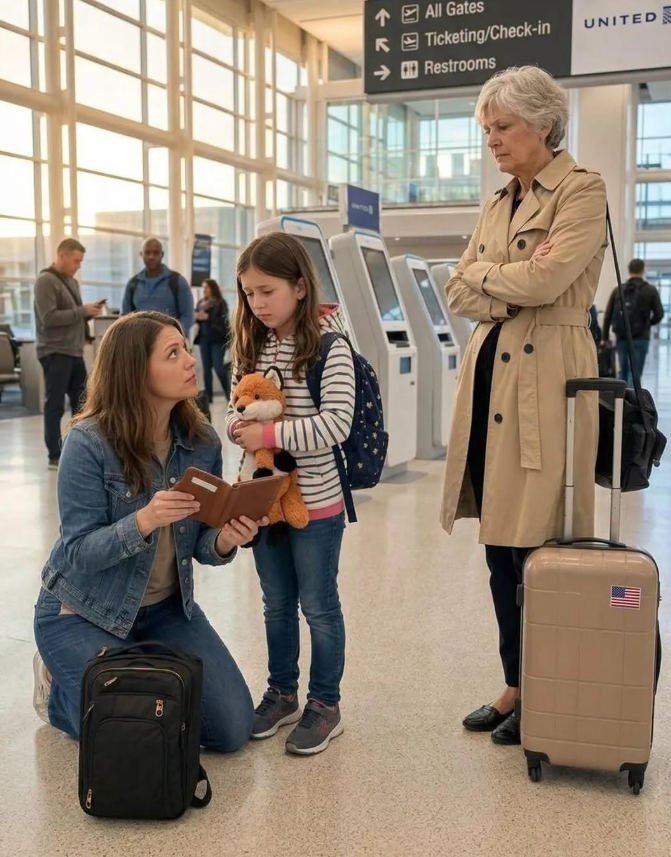
My daughter’s vacation ended under the harsh white lights of the airport, with an empty passport case trembling in her nine-year-old hands. Ellie looked so small standing at the check-in counter, her stuffed fox tucked under one arm and her new pink backpack sliding off her shoulder. “Mom,” she whispered, her voice breaking, “it was in here. I put it in here.” I searched every pocket, every zipper, every folded shirt, and then my own purse, even though I knew she had proudly carried the passport herself. Behind us, my mother-in-law Carol stood beside her suitcase with a calm little smile that made my stomach tighten. The airline agent apologized softly and said Ellie could not board an international flight without her passport. Then my little girl folded into my arms and sobbed like she had broken something that could never be fixed.
We had planned that Cancun trip for five months. My husband Brian and I had saved nearly $4,800 for flights, hotel, meals, and the matching swimsuits Ellie found on sale, and she had drawn tiny purple palm trees on a countdown calendar taped to our refrigerator. Carol, my father-in-law George, and Brian’s sister Janelle were traveling with us, which already made me uneasy because Carol had a long history of turning family moments into loyalty tests. Ellie was sensitive about touch, and Brian and I had taught her that she could politely say, “No thank you,” when someone demanded a hug. Carol hated that boundary. She called it rude, dramatic, and disrespectful, even though Ellie never raised her voice and always offered a wave instead. That morning at the airport, when Carol said, “Maybe this will finally teach her to be more responsible,” I felt something cold move through me. I told the others we were going home, and Janelle actually asked if I wanted to leave Ellie behind so the money would not be wasted.
The ride home was quiet in the worst way. Ellie cried until her voice went hoarse, then stared out the window whispering, “I’m sorry,” over and over while I kept telling her she had nothing to apologize for. When Brian came home from work and saw her asleep on the couch with swollen eyes, I told him everything: the empty case, Carol’s comment, Janelle’s suggestion, and the way Ellie had looked at me as if she had ruined the whole family’s happiness. Brian sat beside our daughter and touched her hair like he was afraid she might disappear. Later that night, my phone buzzed with a photo in the family group chat from Janelle’s teenage son. There, sitting on a hotel blanket in Cancun, was Ellie’s passport, with a caption saying it had somehow ended up in Grandma’s things.
Brian called Carol, and for once he did not soften his voice. She admitted enough with one sentence: “Maybe now she’ll learn something.” When I made her say what Ellie had done, Carol snapped that Ellie had refused to hug her at the front door, in front of everyone. That was the whole reason. My husband opened his laptop that night and pulled up years of payments we had made for his family: Carol’s phone bill, George’s medication copays, Janelle’s rent, condo fees, credit cards, and “temporary” transfers that never ended. In the past twelve months alone, Brian had sent them $28,740; over seven years, a financial advisor and an attorney later helped us trace more than $174,000 that had quietly left our home. We froze the card Carol used, removed her from our phone plan, changed passwords, protected our accounts, and reviewed our insurance, mortgage, and savings plans so our daughter’s future could stop funding someone else’s lifestyle. The attorney said court probably would not recover much because Brian had paid voluntarily, but that did not matter anymore; the real investment was protecting our own estate, our peace, and our child.
When the passport came back by overnight courier, Ellie would not touch it, so Brian locked it in our document box and promised no one else would ever handle it again. It took time for her to feel safe; for weeks she checked her school bag three times a night and asked whether saying no could make someone take something else from her. We answered the same way every time: if a grown-up punishes you for having a boundary, the grown-up is wrong. Three months later, the three of us returned to the same airport for our own Cancun trip, with Ellie’s passport zipped in a pouch around my neck because that made her feel safe. When the agent smiled and said, “You’re all set,” Ellie cried again, but this time it was relief. On the beach, she built a crooked sandcastle and named it Fort No Hugs Unless I Say So, and Brian laughed until he had to sit down in the sand. Carol never gave Ellie a real apology, only letters shaped like guilt, but by then our door was closed. The lesson from that airport was never Ellie’s to learn; it belonged to the grandmother who smiled while a child cried and the father who finally chose his daughter over obedience.

