
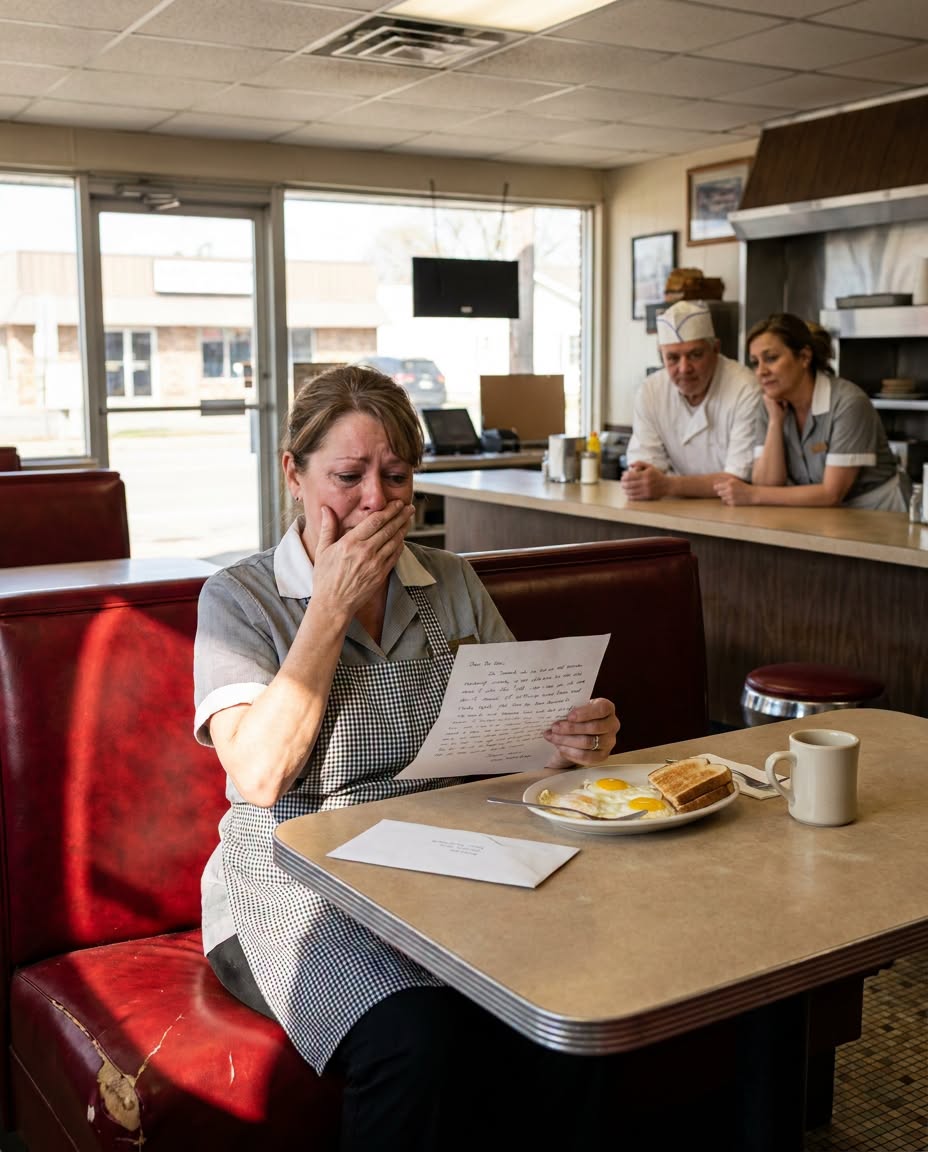
For fourteen years — more than seven hundred Mondays — the same man in the same gray suit ate breakfast alone at my diner at 7:15: booth three, two eggs over medium, wheat toast, black coffee, a newspaper read front to back, and a twenty-dollar tip on an $8.40 check, every single time. His name was Mr. Harmon, and that is nearly all I knew. He wasn’t chatty; he was polite — waitresses know the difference — he said please and thank you like load-bearing words, called me “Miss Dot” like I was somebody, and if the diner was slammed he’d fold his paper and bus his own table on the way out, quiet as a cat. His twenties helped pay for my son’s braces, the transmission in ’19, and every Christmas that squeaked by. Three Mondays ago, booth three sat empty at 7:15, and I put a reserved card on it anyway — I don’t know why; yes I do. The second Monday I made his eggs and ate them myself at the counter at 7:15 while the cook pretended not to watch me. And the third Monday, at 7:15 exactly, two lawyers came in — you can tell lawyers; they sit like the booth might bill them — and the older one said, “We’re looking for a waitress named Dot. We were told to come Monday, 7:15. Those were the instructions.” Mr. Harmon had passed two weeks before. The lawyer laid a sealed envelope on booth three’s table, my name on it in fourteen years of fountain-pen handwriting, and relayed his client’s exact words: “She’ll want to sit down. Tell her the eggs can wait. Tell her booth three is a good place to hear things.” So I sat in Mr. Harmon’s booth for the first time, on his side, while the cook turned off the bacon, and opened the envelope with my thumb, and the first line put my hand over my mouth: “Dear Miss Dot. You never once asked why a man eats alone for fourteen years. You just made sure he never felt it. Now it’s my turn to answer the question you were too kind to ask.”
The letter was four pages, and I read it out loud at booth three because Marlene threatened me with the coffee pot, and here is Mr. Harmon’s answer, in the parts that are mine to share. His name was Walter Harmon, and he had been, of all things on God’s earth, an estate attorney — forty years of wills, trusts, and the last wishes of strangers, “a career,” he wrote, “spent watching what money does to families at their worst hour, which will either break your faith in people or teach you to look very hard for the exceptions.” The Mondays started in 2012, the year his wife June died — Monday had been their diner day, a different diner, one that closed — and the first morning he wandered into ours, hollowed out, “a man who had written four thousand bereavement plans and could not navigate his own,” a young waitress he’d never met looked at him, he wrote, “saw straight through the suit, and said: ‘Booth three’s quiet, hon. I’ll keep the coffee coming and the questions to zero.’” I don’t remember saying it. He remembered it for fourteen years. “You gave a drowning man a standing appointment,” the letter said. “The twenty dollars was never a tip, Miss Dot. It was a subscription. Cheapest membership I ever held in anything, and the only one that ever held me back.”
Page three was where the lawyers earned their briefcase. Mr. Harmon, being Mr. Harmon, had spent fourteen years quietly doing what estate attorneys do: paying attention and papering it. He knew about the braces — “you worked doubles that autumn; your feet told me, you never did” — knew the transmission year, knew my boy Nathan’s name from overheard phone calls and had followed his box scores in the paper he read front to back, “sports section first on Fridays in the spring, Miss Dot, you never noticed, good.” And so his estate, having no children — June and he had never been able — was organized as follows, per the documents the older lawyer slid across booth three one at a time like a man dealing the gentlest poker hand in history: the bulk to a hospice foundation in June’s name, “where the real waitresses of this world work”; a bequest to the diner itself, structured as a trust to cover “booth three’s proximate needs” — which his instructions defined, with a lawyer’s precision and a lonely man’s whole heart, as a new roof for the building (our landlord had been threatening the leak fight for years; Mr. Harmon had apparently heard every word of it from booth three), the espresso machine Marlene had joked about for a decade, and “a bacon quality upgrade, non-negotiable, the cook knows why”; and then, for me. For Miss Dot. A paid-off note on my house — he had, God knows how, and then I remembered exactly how, he was an estate attorney, found the mortgage — and an education trust for Nathan “for anything after high school, trade school included and encouraged, tell him the world needs transmissions more than it needs lawyers.” And at the bottom of page three, one line alone: “Total comes out near seven hundred Mondays of what your kindness was actually worth, by my professional assessment. I did the math, Miss Dot. It’s what I do. You’re paid current through 2026.”
I want to tell you what happened in the diner while the lawyer read the numbers, because the numbers are not the story: the cook — Big Ray, twenty years at that flat-top, a man whose entire emotional vocabulary is bacon doneness — came around the counter, took off his apron, and sat down across from me in booth three, in the customer seat, possibly for the first time in his life, and put one enormous hand flat on the table like he was holding it down. Marlene cried into a stack of napkins and then began refilling everyone’s coffee in the whole diner, unasked, including the lawyers’, “because Walter would want the room taken care of,” which became the first official act of what we now call the Harmon Rule. The regulars, arriving through it all, were briefed in whispers, and old Pete from the counter — who’d nodded at Mr. Harmon across the room for a decade of Mondays without one word exchanged — stood, cleared his throat, and addressed booth three directly: “Walter. You quiet magnificent son of a gun.” Fourteen years, that man sat among us like a gray cat, and it turned out he had been the richest man any of us ever poured coffee for, in every denomination that counts, and he’d chosen, for his last appointment on earth, a vinyl booth, 7:15, Monday, and the waitress who kept the questions at zero.
The roof went on in September; the espresso machine arrived in October and Marlene wept on it; the bacon upgraded and Big Ray, when pressed on “the cook knows why,” admitted that YEARS ago Mr. Harmon had once, quietly, sent back bacon — the only complaint of his tenure — and Ray had upgraded his supplier for one week before the owner reversed it, and Mr. Harmon had never said another word, “but he KNEW, Dot. He noticed everything. He was just too polite to make a thing of it, so he made it a CLAUSE.” Nathan starts diesel-tech school in the fall — first in our family past high school — and he wrote his application essay about a man he never met who read his box scores, and he keeps a twenty-dollar bill folded in his wallet that he will not spend, “seed money,” he calls it, “for whoever I end up being somebody’s Monday for.” Because that’s the Harmon Rule, the one we made official, chalked small over booth three where the reserved card now lives permanently: EVERYBODY’S SOMEBODY’S MONDAY. Watch for the quiet ones. Keep the coffee coming and the questions to zero. You cannot know — you are not supposed to know — which drowning stranger your ordinary kindness is holding to a schedule, or for how many years, or what ledger somewhere is quietly marking you paid current. Fourteen years I thought I was waiting on Mr. Harmon. The whole time, booth three was holding US. Two eggs over medium, wheat toast, black coffee. 7:15. We still make it every Monday. Marlene eats it now, or Ray, or Pete, or me — somebody sits with him. Nobody eats alone at booth three anymore. That’s the subscription, hon. It renews forever.

