
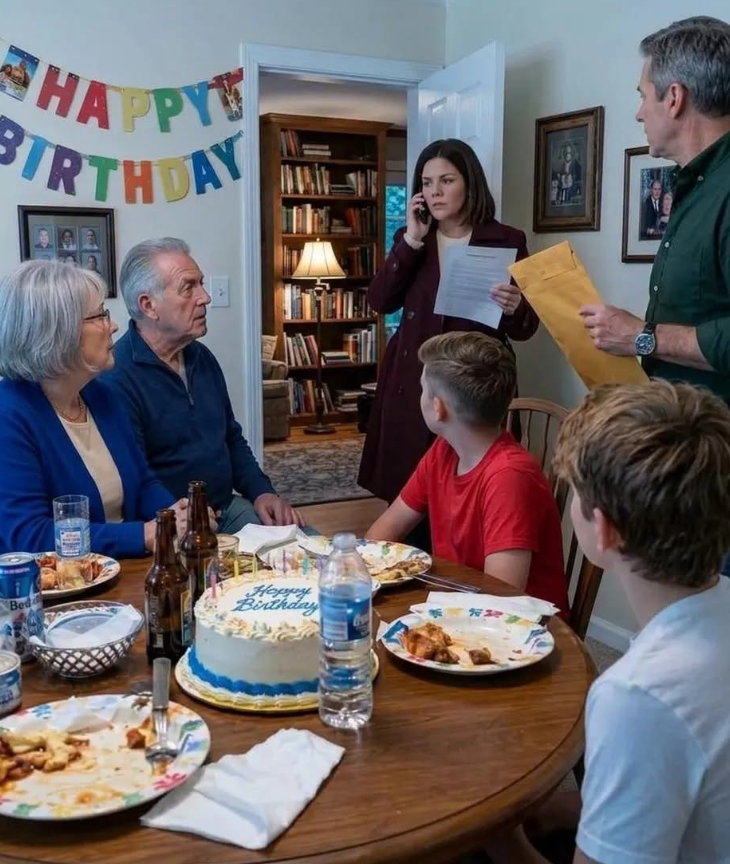
I walked into my parents’ dining room still wearing my coat and found a yellow “Congratulations” banner hanging above the fireplace. My brother Jake sat beneath it with a beer in one hand and a folder in the other, while a sheet cake decorated with a tiny plastic house waited on the table. Before I could ask what was happening, he raised his glass and proudly announced that he had sold my home for $300,000. My mother applauded, my father nodded approvingly, and several relatives offered me sympathetic smiles as though Jake had rescued me from a disaster. He claimed my payments were behind and foreclosure was approaching, even though I had never missed a mortgage payment. When I opened his folder, I found a power of attorney, a deed transfer, and a payoff letter bearing a signature that resembled mine but was not mine. Then my phone rang, and the buyers’ attorney asked why federal agents were standing inside his office.
My name is Sarah Morrison, and I had purchased the modest two-bedroom house in Clintonville when I was 25 after years of saving every available dollar. Jake, meanwhile, moved between failed business ideas while our parents covered his rent, car repairs, and overdue bills, always describing his problems as temporary setbacks. Before leaving for a government assignment overseas, I gave my parents a spare key for emergencies, never imagining they would hand it to my brother. Jake later claimed that I had authorized him to sell the property because I was struggling financially, but my mortgage was current, my taxes were paid, and the so-called lender notices in his folder were fabricated. He had sold the house to David and Michelle Parker, a young couple who used $42,000 of their savings for the purchase and had already moved in with their infant son. According to Jake, he was simply “handling things” while I was away, yet he had never called, emailed, or asked for permission.
Three days before the family celebration, a property alert had reached me during a layover in Frankfurt, notifying me that a deed had been recorded in my name. I contacted my attorney, Ana Reyes, who discovered that the transfer relied on a forged authorization notarized by someone named Nina Carmichael, an alias previously associated with questionable property transactions. I said nothing to Jake because investigators asked me not to reveal what I knew while they traced the money and preserved the documents. During dinner, Ana confirmed that an emergency filing had been submitted and warned me not to let Jake remove the folder from the house. When I confronted him about the nonexistent foreclosure, he finally admitted owing $72,000 from equipment financing and a failed partnership, then insisted he intended to pay his debts and invest whatever remained from my sale. As my parents stared at him in disbelief, another call came through with news that made Jake’s face lose every trace of color: the sale proceeds had been routed through a company he created using my last name.
The investigation revealed that Jake had supplied copies of my identification, signature samples from my home office, and access to my mail to a title-fraud network introduced by an old friend. Ana obtained a temporary court order protecting the property while the title insurance company reviewed the Parkers’ claim and froze the remaining funds. My actual lender confirmed there had never been a late mortgage payment, while the fraudulent payoff letter listed an account that did not belong to the bank. Jake hired an attorney and changed his explanation several times, first claiming I had approved the transaction verbally and later suggesting I had forgotten because of work stress. My parents were questioned after admitting they knew Jake planned to sell the house, although they believed his story that I was in financial trouble. Investigators also found that he intended to use part of the money for personal debt, part for a new investment, and the rest to challenge how our parents’ estate would eventually be divided. The title insurance company ultimately agreed to unwind the forged deed, compensate the innocent buyers, and pursue restitution from everyone involved.
The Parkers offered to leave, but I could see that they had bought the house honestly and had already turned the second bedroom into a nursery. After careful thought, I agreed to sell it to them legally, at a fair price, using my real signature and terms approved by both attorneys. Michelle preserved the lavender I had planted near the front steps and gave me a pot to take with me, a kindness my own family had never considered. Jake eventually accepted responsibility, cooperated with investigators, and faced consequences that I refused to soften for him. My parents apologized, but I told them forgiveness would require more than words; I needed time, respect, and the certainty that my decisions would no longer be rewritten for someone else’s convenience. The following spring, I purchased a brick bungalow with old wooden floors and planted that lavender beside my new porch. Losing the first house hurt, but signing the next deed reminded me that what Jake had tried to take was never just property—it was my right to decide what happened to the life I had built.

