
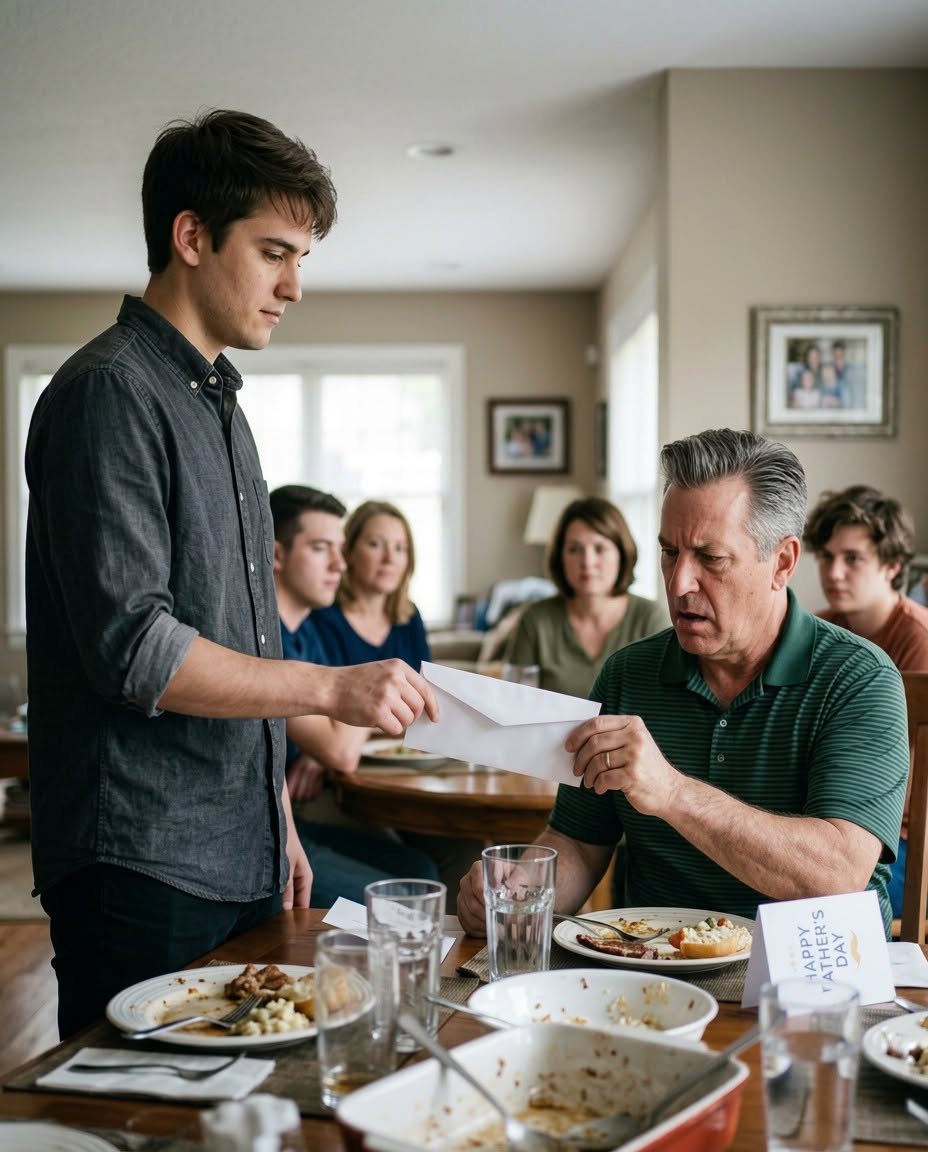
During Father’s Day dinner, my dad humiliated me in front of the entire family, calling me the only child he could not be proud of and the disgrace at the table. No one spoke up. I smiled, handed him an envelope, wished him a happy Father’s Day, and left. Minutes later, he opened it and screamed so loudly that the neighbors came outside.
On Father’s Day, my father embarrassed me in front of everyone.
The backyard smelled of charcoal smoke and grilled meat. Paper plates covered the tables, cousins laughed, and children raced through the sprinkler. My sister had hung a blue banner along the fence that read Best Dad Ever. My brothers arrived with expensive bottles of whiskey. My father, Victor Reynolds, sat at the head of the patio table like a ruler waiting to receive tribute.
I nearly left before dessert.
Then he lifted his glass.
“I am proud of all my children,” Dad said loudly.
Everyone smiled.
My sister Caroline touched the pearls around her neck. My brother Grant leaned back with the effortless confidence of someone who had rarely been denied anything. Tyler, the youngest, raised his beer.
Then Dad looked directly at me.
“Except the disgrace sitting at this table.”
The silence came instantly.
My fork stopped halfway toward my plate.
Dad smiled as though he had delivered a joke, but there was no humor in his eyes.
“She walked away from this family, wasted her education, and came back thinking she deserves respect.”
No one defended me.
Not Caroline, who once borrowed money from me after her husband lost his job.
Not Grant, who drove a truck purchased with our mother’s life insurance.
Not Tyler, who had slept on my couch for six months after Dad threw him out.
My aunt lowered her eyes.
My cousins suddenly found their plates fascinating.
I studied my father’s face and felt the last part of me that still wanted his approval finally go quiet.
For years, I had waited for him to admit the truth.
That he had not paid for my education.
That I had not abandoned my mother.
That I had never stolen from the family business.
But beneath that Father’s Day banner, I finally understood that he would rather destroy me publicly than admit one private lie.
So I smiled.
I opened my purse and removed a white envelope.
Dad frowned.
“What is that?”
“Your Father’s Day gift.”
I set it beside his glass.
Then I stood, picked up my handbag, and said, “Happy Father’s Day.”
Caroline whispered, “Maya, don’t be dramatic.”
I turned toward her.
“I am done being quiet.”
Then I walked out through the side gate.
I had barely reached my car when the first scream came from the backyard.
Then another.
It was loud enough that Mrs. Donnelly next door stepped onto her porch.
Grant ran after me, his face pale and furious.
“What did you give him?”
I opened the driver’s door.
“The truth,” I said. “He never owned Mom’s house.”….
Part 2
My mother, Elaine Reynolds, died when I was twenty-three.
At least, that was when everyone said I lost her.
The truth was that I had begun losing her years earlier—every time my father corrected her in front of visitors, controlled her access to the bank accounts, or told her she was too emotional to understand financial decisions.
Mom was gentle.
She was not weak.
That was the distinction Dad never understood.
She knew he was moving money out of the family construction company. She knew he had opened credit lines against the house. She knew he had emptied my college fund to cover Grant’s gambling debts and later told the family I had wasted the money and quit school.
I never quit.
I worked overnight shifts at a hotel, borrowed what I needed, and completed my accounting degree without taking a single dollar from him.
That was one reason he hated me.
Numbers did not become frightened when he yelled.
They simply recorded the truth.
After Mom died, Dad claimed there was no will. He said the business and the house automatically belonged to him because he had been her husband. He told me that my mother had died disappointed in me. He told relatives I stopped visiting because I was selfish.
I was not selfish.
I had been banned from her hospital room.
A nurse later told me that my father removed my name from the visitor list the day after Mom requested to speak with me privately.
For ten years, I carried that grief without challenging him because I had no evidence.
Then, three months before Father’s Day, a woman named Helen Brooks called my office.
She had been my mother’s attorney.
Her voice trembled when she introduced herself.
“Maya,” she said, “I have been trying to find you for years.”
Helen told me that six months before her death, Mom had established a trust.
The house belonged to it.
So did her shares in Reynolds Construction.
Dad was allowed to remain in the property and manage portions of the company only if he did not misuse the assets, conceal financial records, or attempt to remove me as the beneficiary.
I was the beneficiary.
Me.
The disgrace.
Helen had sent legal notices after Mom died, but they were returned. She later discovered that Dad had altered my mailing address in the estate documents and replaced it with an empty lot in another county.
Then he forged my name on a waiver.
That was how he maintained control.
But eventually, he made a mistake.
He attempted to refinance the house again.
This time, the title company contacted Helen because the trust documents were still connected to the deed. She reopened the case, located me through my professional accounting license, and asked one question.
“Do you want to know what your mother actually left you?”
I said yes.
The truth arrived in several boxes.
Bank statements.
Trust documents.
False signatures.
Letters my mother had written but my father never delivered.
One envelope had my name written across it, and inside was a sentence that broke something open in me.
Maya, if your father tells you I gave him everything, do not believe him.
By Father’s Day morning, Helen had submitted the petition.
The envelope I placed beside Dad’s drink was not truly a present.
It contained a court order removing him as trustee, freezing the company accounts, and informing him that the house he had ruled like a private kingdom legally belonged to my mother’s trust.
After spending ten years calling me a disgrace, he was forced to read my name as the person who held authority over everything.
PART 3
My father called thirty-four times that evening.
I ignored every call.
Grant contacted me next.
Then Caroline.
Then Tyler.
Their messages arrived one after another, each more frantic than the last.
You humiliated Dad.
You are destroying the family.
Mom would be ashamed.
Caroline sent the final one.
I stared at it for several minutes before answering.
Mom wrote the trust.
She never responded.
The court hearing took place two weeks later at the Franklin County courthouse in Ohio.
My father arrived in his finest navy suit, the one he wore to weddings, business meetings, and banks. Without the patio table, the whiskey glass, and the family’s silence protecting him, he appeared much smaller.
Helen sat beside me.
She placed Mom’s trust papers on the table with the same gentleness someone might use when handling an old photograph.
Dad’s lawyer argued that there had been confusion.
He claimed Mom was ill when she signed the documents.
He said Dad had only managed the assets to preserve stability for the family.
He suggested that I was resentful because my father had made “difficult parenting decisions.”
Then Helen presented the forged waiver.
The judge looked directly at Dad.
“Mr. Reynolds, did your daughter sign this document?”
Dad’s jaw became rigid.
“She knew what was best for the family.”
“That was not my question.”
He remained silent.
Then Helen produced the financial records.
The refinancing agreements.
The missing insurance funds.
The checks issued to Grant.
The transfers from the business accounts.
The address-change forms that redirected my legal notices to a property where I had never lived.
By the time Helen read my mother’s letter aloud, even Tyler was crying.
Dad did not shed a tear.
He looked at me as though I had betrayed him simply by surviving the story he had created.
That day, the judge stripped him of all authority over the trust. The house remained protected. The business accounts stayed frozen until a forensic examination could be completed. Dad received sixty days to leave the property unless the court approved a supervised occupancy agreement.
Outside the courthouse, he finally confronted me.
“You did this to your own father.”
The old wound opened again, but it was no longer large enough to consume me.
“No,” I said. “Mom did this to protect me from you.”
His expression hardened.
“She was my wife.”
“And I was her daughter.”
I did not see him again for nearly a year.
The audit later uncovered more than any of us had expected.
Dad had emptied retirement accounts, borrowed against company equipment, and treated the business like a private bank for Grant’s debts and his own image.
Reynolds Construction required major restructuring, but it survived.
I brought in professional management and preserved the employees’ jobs because they were not responsible for my father’s deception.
The house was more complicated.
One rainy afternoon, after Dad finally moved out, I walked through the rooms alone.
My mother’s roses still climbed the fence.
The kitchen cabinets still showed tiny chips from the ceramic plates we used growing up.
In the hallway closet, behind a container of Christmas lights, I discovered another letter.
This one was shorter.
Maya, if you are standing here, then you made it through. Do not let anger be the only thing you inherit.
I sat on the floor and cried until the rain ended.
I did not preserve the house as a monument to what had happened.
Six months later, I converted it into the Elaine Reynolds Home Fund, a small organization that helped women escaping financial abuse afford housing deposits and legal advice.
The following Father’s Day, I did not attend a family barbecue.
I spent the afternoon planting roses in my mother’s yard with three women the fund had assisted. We ate sandwiches from paper plates and laughed when the garden hose accidentally sprayed all of us.
For the first time in years, Father’s Day no longer felt like an open wound.
It felt like evidence.
Some men call themselves fathers because their children carry their surname.
Others surrender that title the moment those children refuse to carry their lies.

