
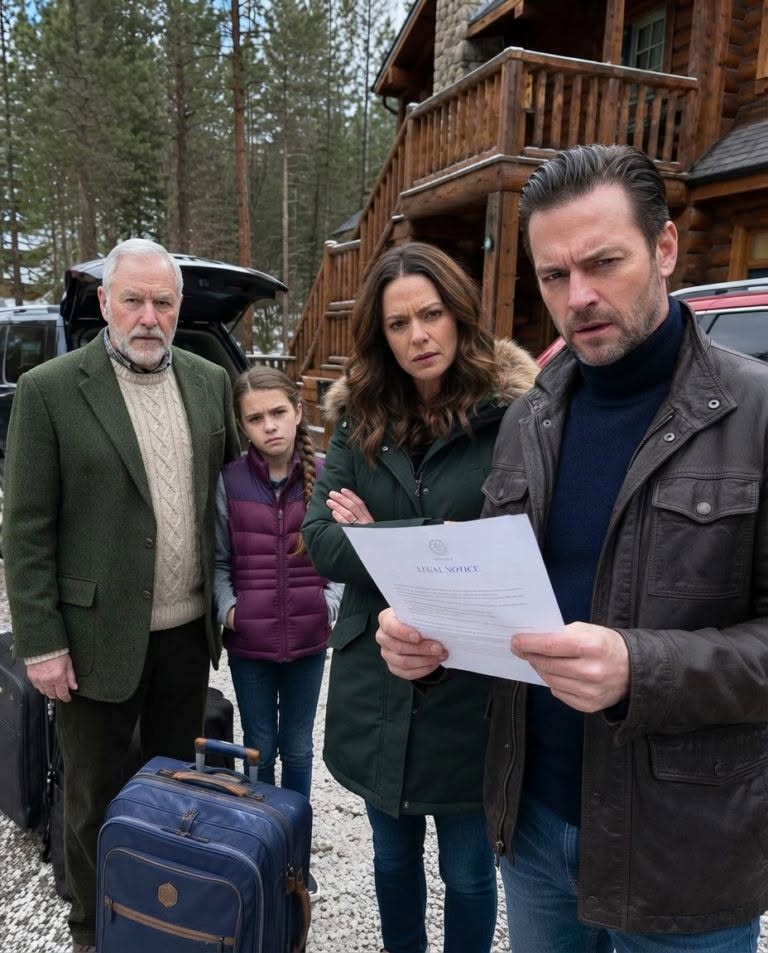
PART 1 — THE HOUSE HE BUILT FOR HIMSELF
For most of his working life, Grant Holloway believed retirement would finally bring him peace.
He had spent forty years working overtime, postponing vacations, and accepting holiday shifts because his family needed the money. By the time he was sixty-eight, his mortgage was paid, his old truck had traveled nearly a quarter of a million miles, and his body carried the marks of decades of physical labor.
Then he moved into the mountains and built a cabin.
It took him three summers.
This was not a prefabricated house delivered from a catalog. Grant cut much of the cedar siding himself after a storm brought several trees down. He installed the beams, built the stone fireplace, and shaped the kitchen counters by hand.
He worked slowly because his knees were no longer young, but he did not mind.
For the first time, he was building something entirely for himself.
Each morning, Grant drank coffee on the porch while fog covered the valley below. At night, he sat beside the fire, listened to an old radio, and read books he had owned for decades.
Nobody demanded his time.
Nobody asked for money.
Nobody expected him to solve another problem.
The peace lasted a little more than a year.
One Tuesday evening in October, his son Daniel called.
Grant was stirring chili on the stove when Daniel said, without greeting him, “Claire’s parents are moving into the mountain house.”
Grant stopped stirring.
Daniel had not asked whether they could stay.
He had simply announced that they were coming.
“What did you say?” Grant asked.
“Their condominium is being renovated. They need somewhere peaceful for six or eight weeks. You have three bedrooms up there that nobody is using.”
Grant looked around the kitchen.
He had positioned the window above the sink so he could see the ridgeline while washing dishes. After spending forty years looking at a parking lot through a workplace window, he had promised himself that one day he would choose his own view.
Now Daniel was describing the house as unused space.
“Why didn’t you ask me first?” Grant said.
Daniel released an irritated breath.
“Dad, don’t make this complicated.”
“I’m asking a simple question.”
“It’s only a few weeks. Claire’s mother has trouble with her hip, and they can’t live in a construction site. What difference does it make to you?”
Grant sat at the kitchen table.
“I built this house.”
“Nobody said you didn’t.”
“You seem to have forgotten.”
Daniel’s voice grew sharper.
“If you have such a problem with it, go back to the city.”
The chili began burning, but Grant did not move.
His only son had just told him to leave the home he had spent years building.
Grant remembered carrying Daniel through a snowstorm when he was six. He remembered hospital bills, lunches packed before sunrise, broken bicycles repaired late at night, and countless hours spent beside his son’s bed whenever he was sick.
Parents carried memories like invisible receipts, even when they never intended to collect payment.
Grant did not expect gratitude for raising his son.
But he had never imagined Daniel would view the one thing Grant created for himself as a family asset waiting to be reassigned.
“Dad?” Daniel asked. “So we’re fine?”
“When are they coming?”
“Saturday morning.”
“All right,” Grant said before ending the call.
He threw away the burned chili and stood at the sink, looking through the window he had placed exactly where he wanted it.
He did not call Daniel back.
He did not argue or beg to be understood.
Grant knew that people often mistook silence for surrender.
But sometimes silence meant preparation.
That evening, he opened a folder beside the kitchen table.
Inside were the deed, tax records, building permits, insurance papers, well registration, and septic certification.
Every document showed the same name:
Grant Holloway.
There was no shared cabin.
There was no joint ownership.
The house and eleven acres belonged entirely to him.
Grant thought about the way Daniel and Claire had spoken about the cabin over the years, as though it were already part of their future inheritance.
They discussed what would happen “eventually,” forgetting that Grant was still alive and living there.
He had spent forty years being useful to everyone around him.
He would not spend retirement being treated as invisible.
That night, Grant photographed every room and emailed the property documents to Eleanor Voss, the lawyer who had handled his original land purchase.
She called the next morning.
“Do you want them prevented from entering,” Eleanor asked, “or do you want your son to understand what he has done?”
“Both,” Grant replied. “But mostly the second.”
“Then don’t be there on Saturday,” she advised. “If you are standing in the doorway, it becomes an argument. Let the documents speak for you.”
Grant changed the front-door lock himself.
Then he prepared a plain envelope with Daniel’s name written across it.
Inside, he placed a copy of the deed, the county occupancy record, and a letter.
It read:
Daniel,
You told me that if I did not approve of your plans, I could return to the city.
I could have done that. What you could not do was claim this house without asking.
I built it, and it belongs only to me.
Claire’s parents may stay here after you call and genuinely ask me. A real request includes the possibility that I may say no.
Until then, the door will remain locked.
I am not angry.
I am simply finished pretending that my life is available whenever someone needs additional space.
Dad
On Friday afternoon, Grant placed the envelope against the front door, packed one bag, and drove to a motel eleven miles away.
He was not running from the confrontation.
He was choosing not to participate in it.
PART 2 — THE LOCKED DOOR
Saturday morning was cold and bright.
Grant parked his truck at a bend in the road about two hundred yards below the cabin. From there, he could see the porch through an opening in the pine trees.
At 10:07, a silver SUV appeared, followed by Daniel’s car.
Claire’s parents stepped out first, carrying several suitcases. Her father even brought golf clubs.
Daniel walked toward the porch smiling.
That smile stayed with Grant.
His son looked proud, as though he had efficiently solved a difficult family problem. He had needed a place for his in-laws, and he had treated his father’s home as the obvious solution.
Then Daniel noticed the envelope.
He removed it, tried the door, and discovered that the lock had been changed.
After reading the papers, he immediately called Grant.
Grant watched his phone ring but did not answer.
Over the next two hours, Daniel called eleven times.
From the truck, Grant watched the suitcases being returned to the SUV. Claire’s mother spoke angrily while Daniel gestured toward the cabin and the documents.
Finally, Daniel sat on the porch steps with his head in his hands.
Grant expected to feel satisfied.
Instead, he felt only the grim relief that comes after making a necessary decision.
He drove back to the motel.
Daniel’s first voicemail was furious.
The second accused Grant of humiliating the entire family.
The third attempted to explain why Daniel’s decision had been reasonable.
The fourth was quieter.
The fifth, recorded late that night, contained only one sentence:
“I didn’t know the house was only in your name.”
Grant listened to it several times.
That sentence revealed everything.
Daniel had never checked because he had never imagined the property might not eventually belong to him.
Grant realized that his son had begun viewing the cabin as an early inheritance rather than the home of a living person.
Perhaps Grant had helped create that attitude.
Throughout Daniel’s childhood, Grant gave without requiring him to ask. He protected his son from knowing how much each sacrifice cost.
Over time, the giving became invisible.
Daniel began treating it like weather—something that simply arrived without effort or limit.
Grant did not return the call that night.
He waited until Monday.
They met at a diner in the valley, choosing neutral ground.
Daniel looked exhausted when he sat across from his father.
“You embarrassed me,” he said.
“I know.”
“Claire’s parents drove for two hours.”
“I know.”
“You could have called me.”
“You called me on Tuesday,” Grant replied. “I asked why you had not spoken to me before making plans. Do you remember your answer?”
Daniel looked out the window.
“I said you were making it complicated.”
“Then you told me to leave my own house.”
“I was frustrated. I didn’t mean it.”
Grant wrapped both hands around his coffee.
“Everything means something, Daniel. You did not speak as though the idea had just occurred to you. You had already decided that if I became inconvenient, I should leave.”
Daniel started to interrupt, but Grant raised his hand.
“I gave you everything I could while you were growing up. I did it willingly. You do not owe me for any of it.”
He paused.
“But somewhere along the way, you stopped seeing those things as gifts. You began seeing them as the natural order of life.”
Daniel’s eyes became wet.
“When a man thinks that way,” Grant continued, “he stops seeing his father as a person. He sees him as a resource. Resources are not consulted. They are assigned.”
“So you’re refusing to help our family?” Daniel asked.
“If you had called and said, ‘Dad, Claire’s parents are struggling. Could they stay with you for a few weeks?’ I would have agreed immediately.”
Daniel stared at him.
“I would have prepared the rooms and filled the pantry,” Grant said. “I might even have driven down to collect them.”
“Then why did you lock the door?”
“Because you never asked. You informed me. And when I objected, you told me to leave. You cannot treat someone that way and call it family support.”
For several moments, neither man spoke.
Finally, Daniel said, “I didn’t think it mattered to you that much.”
Grant nodded slowly.
“That is the problem. It always mattered. I was simply quiet for so long that you assumed nothing was happening inside me.”
Grant finished his coffee and returned to the mountain alone.
The fire had gone out, and the cabin was cold.
He rebuilt it in ten minutes.
His hands still remembered how.
PART 3 — A REAL INVITATION
Claire’s parents spent the renovation period inside Daniel and Claire’s small apartment.
The arrangement lasted six difficult weeks.
Grant never mentioned it.
For four months, Daniel did not call.
Grant lived quietly in his cabin, but the silence between father and son weighed more heavily than he expected.
Then, one Sunday afternoon in February, the phone rang.
Daniel’s voice sounded carefully rehearsed.
“Dad, would it be all right if I came up and saw the cabin?”
He did not ask to stay.
He did not assume he was welcome.
He asked.
Grant answered before Daniel finished the sentence.
“Yes.”
Daniel arrived the following Saturday.
They spent hours walking around the property. Grant showed him where the cedar trees had fallen during the storm and explained how he had milled them into siding.
He pointed out the large stump he had been unable to move and described the work required to raise the ridge beam.
Daniel asked questions.
This time, he listened carefully to the answers.
Late in the afternoon, warm sunlight entered through the kitchen window.
Daniel stood in the center of the room and slowly looked around.
“You built all of this,” he said.
“Yes.”
“I never really looked at it before.”
“I know.”
For the first time, Daniel seemed to understand that the cabin was not merely a building or a future inheritance.
It represented decades of work, postponed dreams, and a life his father had finally chosen for himself.
After a long silence, Daniel spoke again.
“Dad, would it be okay if I came back sometime? Not because I need anything. Just to visit.”
Grant looked at his son.
“You never need permission to visit me,” he said. “But I’m glad you asked.”
In the end, the lesson was not about an envelope, a legal document, or a locked door.
It was about the difference between an expectation and an invitation.
Daniel finally understood that the word “yes” means nothing unless “no” is also possible.
And Grant understood something too.
Setting a boundary did not mean he loved his son less.
It simply meant his love no longer required him to disappear.
Daniel stood in the house his father had built, finally aware that he was a guest.
To his surprise, that realization did not make him feel rejected.
It made him feel welcomed.

