
Part 1: Thrown Into the Storm
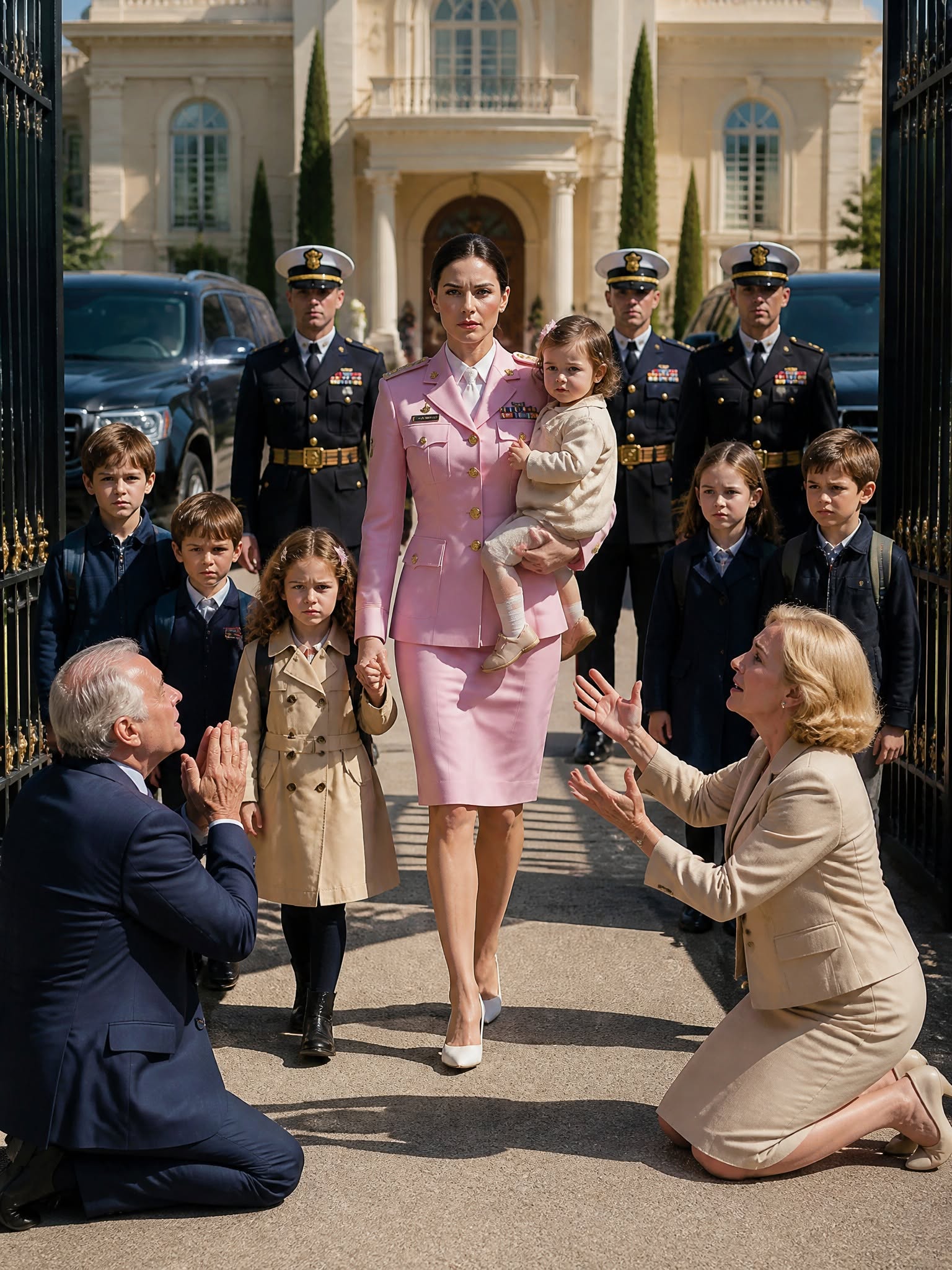
Rain struck my face like ice as I stood at the end of the driveway, holding my eleven-month-old daughter against my military field jacket. My five older children huddled behind me, soaked through, clutching backpacks and trash bags filled with the belongings my in-laws had thrown onto the pavement.
My husband, Nathan Whitmore, had been dead for only eight days.
Eight days since I saluted his flag-draped casket. Eight days since the family who praised him at his funeral decided his wife and children no longer belonged.
I looked at my father-in-law, Richard Whitmore. “These are your grandchildren. Nathan wanted them to grow up in this home.”
My mother-in-law, Eleanor, pulled her expensive shawl tighter and smiled coldly. “He lived here because we allowed it. But you were never one of us, Rachel. Wearing a uniform doesn’t make you a Whitmore.”
My oldest son, thirteen-year-old Ethan, stepped in front of his siblings. “Dad promised Mom this would always be our home. I heard him.”
Richard spun toward him with such anger that every child flinched. Something inside me changed forever.
“Do not speak to my son like that again,” I said calmly.
Richard laughed. “What are you going to do? Call in the Army?”
Eleanor threw another garbage bag into the rain. Tiny shirts, children’s books, and family photos spilled across the flooded driveway. My twin boys clung to my legs, my daughters cried, and baby Ava burned with fever against my shoulder.
Every window of the mansion glowed with light. Relatives, neighbors, business associates, and family friends watched from inside. Not one person opened the door.
For fourteen years, I had stayed silent for Nathan’s sake. I endured every insult because I loved my husband more than I hated their cruelty. But tonight, my silence ended.
Inside my military briefcase was a sealed yellow folder Nathan had given me three weeks before his final deployment.
“If they ever force you and the kids out,” he had whispered, “call Attorney Marissa Hale. Don’t open this unless that day comes.”
With trembling hands, I broke the seal. Then I looked Richard in the eyes.
“Before you celebrate,” I said evenly, “you should read the property deed.”
He frowned.
“The legal owner of this house isn’t you.”
I held up the document.
“It’s me.”
The color drained from Richard’s face. Eleanor’s smile vanished.
Before either of them could speak, headlights swept across the driveway. A black government SUV rolled through the gates, followed by two military police vehicles. Uniformed officers stepped out first. Then a four-star general approached me, stopped, and saluted.
“Ma’am,” he said loudly enough for everyone inside to hear, “Headquarters has been trying to reach you. Your security detail is ready whenever you are.”
Silence fell over the estate.
At that moment, they finally understood the woman they had thrown into the storm was not just Nathan’s widow.
I was a decorated senior military officer.
And I was the legal owner of the home they had just tried to steal.

Part 2: The House That Never Belonged to Them
The general’s salute cut through the storm like a blade. Rain soaked my hair, my jacket, and the trash bags around my children’s feet, but the cold no longer mattered.
General Marcus Reed lowered his hand only after I returned the salute.
“Colonel Whitmore,” he said, “Headquarters has been attempting to reach you for four hours. Your emergency security detail has been activated.”
Richard stared at me. “Colonel?”
His voice sounded smaller now.
Eleanor’s lips parted, but no words came out.
I adjusted my hold on Ava. Her skin burned against my chest, and her breathing had become shallow.
“My daughter needs a doctor.”
General Reed turned immediately. “Medic!”
Two military medics rushed from the second vehicle with emergency bags and thermal blankets. One gently took Ava while the other knelt beside my younger children.
“She has a high fever,” I said. “She’s been exposed to the cold for almost twenty minutes.”
“We’ll stabilize her, ma’am.”
Ethan stood beside me with clenched fists. He had tried to protect everyone, but now that help had arrived, his strength finally cracked.
I placed a hand on his shoulder. “You did well.”
His chin trembled. “Dad would’ve stopped them.”
“Yes,” I said. “He would have.”
The mansion doors remained open behind us. Warm light spilled across the rain while the people inside stared, embarrassed or frightened. They had watched six grieving children be thrown into a freezing storm and done nothing.
Richard quickly said, “This is a family misunderstanding. There was no need to bring military police onto private property.”
Attorney Marissa Hale stepped from the SUV, silver hair tied back, leather case beneath one arm.
“This is not your private property, Mr. Whitmore.”
Richard stiffened.
Marissa gave me a brief, sympathetic nod. “I’m sorry, Rachel. Nathan made me promise not to contact you unless this exact situation occurred.”
Eleanor found her voice. “What situation?”
“The situation in which you attempted to remove Rachel and the children from the estate.”
Eleanor laughed nervously. “This house has belonged to the Whitmore family for generations.”
“No,” Marissa said. “The land belonged to the family. The original house was demolished twenty-two years ago. The current residence was built through Whitmore Development Holdings, which defaulted on loans after Richard’s failed expansion.”
Richard’s face darkened. “That information is confidential.”
“Not to the legal owner.”
Marissa removed documents from her case. Six years earlier, Nathan had purchased the outstanding debt through a private trust. Three years later, he acquired the property outright. Six months ago, he transferred ownership to me. A whisper moved through the crowd.
Eleanor looked at me as if I had stolen something. “You knew?”
“No,” I said. “Not until tonight.”
It was true. Nathan and I had divided responsibilities. I handled deployments, military obligations, and the children. He handled his family’s business problems, which he often hid because he believed protecting me meant carrying every burden alone.
Richard snatched the deed and scanned it. “This signature could be forged.”
“It was notarized, recorded, and verified,” Marissa said.
“I’ll challenge it.”
“You may. But until a court rules otherwise, the house belongs to Colonel Whitmore.”
Richard looked at General Reed. “This has nothing to do with the military.”
“The property dispute is civilian,” General Reed replied. “The attempted intimidation of a senior officer and the exposure of six military dependents to dangerous weather conditions are separate concerns.”
Eleanor went pale. “We didn’t know she was important.” The words hung in the rain. I turned toward her. “You didn’t know I was important?”
She realized too late what she had said. “I meant your rank.”
“My rank should not have mattered. I am their mother. I was Nathan’s wife. These are your grandchildren. That should have been enough.”
No one in the doorway spoke.
Then I looked at the mansion, then at the garbage bags in the flooded driveway.
“You have thirty minutes to collect your personal belongings.”
Eleanor blinked. “What?”
“It is not your home.”
Richard stepped forward. “You wouldn’t dare.”
“I have ordered evacuations under enemy fire. Do not mistake mercy for weakness.”
Military police moved closer. Richard stopped.
Eleanor’s eyes filled. “You would put two elderly people out in this weather?”
The hypocrisy was stunning.
I glanced toward Ava, now inside the medical vehicle. “I could. But my children will not learn cruelty from me. You may stay in the guesthouse until ten tomorrow morning. After that, you leave the property.”
Marissa added, “That is more generous than the law requires.”
Several guests began gathering coats.
“No one leaves yet,” I said.
The doorway froze.
One of Richard’s business partners, Harold Pierce, cleared his throat. “Colonel, I don’t believe we were part of this disagreement.”
“You stood inside and watched.”
He reddened. “We didn’t know the circumstances.”
“You saw children in the rain. You saw an infant without a coat. You heard them crying.”
No one answered.
“I am not asking you to explain why you did nothing. I am telling you to remember it.”
General Reed approached. “Ma’am, the medics recommend transporting your daughter to Fort Hamilton Medical Center immediately.” Fear swallowed my anger. “How serious?”
“Her temperature is dangerously high, but they believe they reached her in time.”
“I’m going with her.”
As I turned toward the vehicle, Marissa caught my arm.
“There is another document.”
She removed a sealed envelope from the yellow folder. Nathan’s handwriting covered the front.
RACHEL — OPEN ONLY AFTER THEY REVEAL THEMSELVES.
My heart stopped. Patrick—no, Richard—was watching us. The moment he saw the envelope, his face changed. Not confusion. Fear.

Part 3: The Letter and the Impossible Photograph
On the drive to Fort Hamilton, I sat beside Ava while a medic monitored her breathing and temperature. Ethan sat across from us, silent.
After several minutes, he spoke. “Mom, why did Grandpa look scared when he saw Dad’s letter?”
“You noticed?”
“He looked the way he did at the funeral.”
My pulse tightened. “What do you mean?”
“At the cemetery, when the man in the gray coat came up to him. They argued near the cars. Grandpa told him to leave.”
“Did you hear what they said?”
Ethan swallowed. “The man said, ‘Nathan kept copies.’”
The vehicle suddenly felt colder than the storm.
At the hospital, Ava was rushed into pediatric emergency care. My other children arrived with General Reed minutes later, still damp beneath borrowed blankets. After the doctor confirmed Ava’s fever was dropping and she was expected to recover, I finally opened Nathan’s envelope.
The first page began:
Rachel, if you are reading this, then my parents did exactly what I feared they would do.
Nathan wrote that the Whitmore family business was not what it appeared to be. Richard had used Whitmore Development to acquire distressed properties through shell companies. Elderly homeowners were pressured into fraudulent agreements. Families were evicted. Insurance claims were manipulated after suspicious fires damaged buildings the company wanted condemned.
Nathan had discovered the scheme while reviewing old financial records. When he confronted his father, Richard denied everything. Then an accountant disappeared. A building inspector died in a supposed boating accident. Nathan began collecting evidence.
Then came the sentence that stopped me cold:
If something happens to me, assume my death is connected to what I found.
Nathan had supposedly died in a vehicle accident overseas, where he worked as a civilian logistics consultant. Tire failure. Mountain road. No witnesses. A sealed casket.
I had accepted the explanation because grief leaves little room for suspicion.
Now every memory changed shape.
His silence before deployment. The way he held each child too long. The folder. The deed. The letter.
Nathan warned me not to trust Richard, Harold Pierce, or anyone who claimed the crash was an accident before an independent examination. The memory card attached to the final page contained records, names, dates, photographs, and recordings.
At the bottom, Nathan wrote:
There is one more thing. Marissa knows where to take you. Trust her, but do not tell her everything until you are certain she is not being followed.
Then a text arrived from an unknown number.
DO NOT RETURN TO THE MANSION. NATHAN’S DEATH WAS NOT THE FIRST.
A second message followed.
ASK RICHARD WHAT HAPPENED TO HIS OLDEST SON.
Nathan had never mentioned an older brother.
Before I could process it, General Reed appeared with an evidence bag. Someone had tried to enter Nathan’s study through a rear window at the estate. The intruder escaped, but left behind a black glove with a gold emblem stitched near the wrist: a falcon holding a key.
Ethan stared at it. “I’ve seen that before. Dad had one.”
Then my phone rang.
Unknown number.
A man whispered, “Colonel, they know you opened the letter.”
“Who is this?”
“Daniel Cross.”
Nathan’s investigator.
“What did Nathan discover?”
“Your husband discovered Richard Whitmore did not build his fortune. The property fraud was only the surface. The family has spent thirty years hiding a seventh beneficiary.”
“What beneficiary?”
“The oldest Whitmore heir.”
“Richard’s son?”
“No. Richard’s brother.”
The line crackled. Daniel said the man had been declared dead twenty-eight years ago, but was alive. The mansion, the company, and most of Richard’s wealth legally belonged to him.
“Why does the deed matter?” I asked.
“To bring the real owner out of hiding.”
Then another voice spoke in the background.
Cold.
Familiar.
“End the call.”
The man in the gray coat.
Daniel whispered, “Your husband may still be alive.”
The call disconnected.
A photograph arrived on my phone moments later. It showed a man sitting in a dim room, bruised, thinner, wearing a stained shirt. His head was lowered.
But I recognized the wedding ring.
The scar near his left temple.
When he lifted his face toward the camera, the world stopped.
Nathan was alive.
Beneath the image were six words:
BRING THE DEED, OR HE DIES.
Part 4: The Man in the Chapel
For eight days, I had mourned my husband. I had saluted his coffin. I had told six children their father would never return. Now someone was using his life as leverage.
Ethan stared at the photo. “Mom… is that Dad?”
“Yes.”
“He’s alive?”
“I don’t know what condition he’s in. But yes. That’s him.”
General Reed studied the image and said we had to treat it as an active hostage situation. I refused an official operation for now. If the people holding Nathan could access military death reports, sealed transport records, and my private phone number, someone inside the system had been compromised.
Marissa arrived breathless, her coat torn. “Someone followed me.”
She placed a brass key on the table. Nathan had given it to her before leaving. It opened a deposit box beneath the old Whitmore chapel.
Then my phone rang again.
A distorted voice said, “Midnight. Whitmore Chapel. Bring the original deed alone.”
“How do I know Nathan will be there?”
A weak voice came through.
“Rachel.”
My heart stopped. “Nathan?”
“Don’t bring—”
A blow sounded. The distorted voice returned.
“Midnight.”
The call ended.
At 11:30, I left the hospital wearing civilian clothes beneath my field jacket. The deed in my case was a certified copy. The original remained in the hospital safe. General Reed’s team positioned themselves two miles away.
The chapel rose from the fog like a grave. Broken stained glass. Ivy-covered walls. Rainwater dripping from the bell tower.
Inside, a single lantern burned near the altar.
A man stepped from behind a stone pillar.
Gray coat. Silver hair. Falcon ring.
The man from the funeral.
“My name is Thomas Whitmore,” he said.
Richard’s missing brother.
“Where is my husband?”
“Alive.”
A hidden panel opened. Two armed men dragged Nathan into the chapel. He was thinner, wounded, but real.
“Rachel,” he rasped.
Thomas extended his hand. “The deed.”
“Release him first.”
Thomas smiled. “You have the confidence of a commander. Nathan always admired that.”
“Why fake his death?”
“I did not.”
Thomas claimed Richard arranged the crash, Harold Pierce arranged the false body, and he had rescued Nathan before they could finish the job.
Nathan struggled. “He’s lying, Rachel!”
Before I could respond, a gunshot exploded from the rear of the chapel. One of Thomas’s guards fell. General Reed’s team had entered through the tunnel.
Chaos erupted.
I dropped behind a pew as shots tore through rotting wood. Nathan struck the second guard. I lunged forward and seized the weapon.
Thomas ran toward the altar, holding a trigger.
“If I release this, the tunnel collapses.”
Then Richard’s voice echoed from the entrance.
“Drop it, brother.”
Richard stood beneath the broken archway with a revolver.
Eleanor stood behind him.
And Harold Pierce held a knife against her throat.
The enemy had not come from one side.
The entire family had arrived for war.
Part 5: The Brothers and the Hidden Heir
Thomas stared at Richard with hatred carved deep into his face.
“You finally came,” he said.
Richard aimed the revolver. “You should have stayed dead.”
Harold demanded the deed and Nathan’s evidence. Thomas told the truth: their father had left the company to both brothers equally, but Richard wanted everything. Twenty-eight years earlier, Richard staged a warehouse fire, forged records claiming Thomas stole company funds, and paid a coroner to identify a burned body as Thomas.
Harold had managed the shell companies, false loans, suspicious fires, and bribed officials.
Eleanor realized Richard had lied about everything, including Thomas’s death.
Harold threatened my children at the hospital. Nathan, wounded but fierce, said Harold was bluffing because the medical transfer had been classified—unless someone inside the military had helped him.
Then Andrew—Nathan—lunged at Harold. Richard fired.
The bullet struck Nathan in the side.
General Reed’s team opened fire. Harold fled behind the altar. Thomas tackled Richard. During the struggle, Thomas dropped the trigger, part of the tunnel collapsed, and Harold vanished into the broken floor.
Richard nearly let Thomas fall, but Nathan crawled forward despite bleeding heavily and caught his uncle’s wrist.
That was who my husband was.
He saved the man who had abducted him.
Medics carried Nathan to a helicopter as dawn broke. I rode beside him, pressing my hand against his wound.
“Don’t leave me again.”
His eyes fluttered. “There’s something you don’t know.”
“Save your strength.”
“Ethan.”
My breath caught. “What about him?”
“He isn’t Richard’s grandson.”
Before he could explain, the monitor screamed.
Nathan’s heart stopped.
The medics brought him back, barely.
At Fort Hamilton, surgeons rushed him into the operating room. I stood in the corridor with blood on my hands and one unfinished sentence in my mind.
Ethan isn’t Richard’s grandson.
Marissa arrived with the children under military escort, then revealed another document Nathan had left for me to open only if Thomas appeared.
It was Ethan’s adoption record.
I had given birth to Ethan, but Nathan had adopted him after marrying me. Ethan’s biological father was Captain Michael Reeves, my first love, who had died before I knew I was pregnant.
But Michael Reeves had been born Michael Whitmore.
Thomas’s hidden son.
That made Ethan the legal descendant of Thomas Whitmore, the rightful heir to half the original estate.
Richard had thrown his own grandnephew into the storm.
Not merely a child.
The child whose existence could destroy his claim to everything.
Then the hospital alarm sounded. Smoke spread through the east wing. Ethan and my daughter Lily vanished.
Harold called from Ethan’s phone.
“Now you understand why the boy matters.”
He demanded Thomas at Whitmore Tower.
We staged a controlled exchange. Thomas agreed to cooperate after learning Ethan had been taken.
At the unfinished penthouse, Harold stood behind Ethan and Lily with Major Steven Rourke, the compromised military officer who had altered Nathan’s casualty records. Harold demanded Thomas sign over his claim.
When Harold pushed Lily toward the open edge, I surrendered my weapon.
But Ethan had inherited courage. He slammed both feet into Rourke’s knee, Lily dropped, and Thomas attacked Harold. I grabbed my weapon and shot Rourke in the shoulder.
Harold dragged Ethan toward the edge.
“Another step, and he falls!”
Ethan looked at me, terrified but steady.
“Mom, trust me.”
Then he threw himself backward.
Harold lost balance. Thomas caught Ethan’s arm. Harold slipped over the edge, clinging to the concrete lip.
“You’re an officer,” he gasped. “You have to save me.”
I thought of Nathan’s coffin, Ava’s fever, and my children crying in the rain.
Then I grabbed Harold’s wrist.
“I am also not you.”
General Reed’s team stormed in and pulled him to safety.
He was arrested beside Rourke.
Then my phone rang.
The surgeon said Nathan was awake.
Part 6: The Confessions
Nathan looked pale beneath the hospital lights, but he smiled when I entered.
“You look terrible,” he whispered.
“So do you.”
I took his hand. For several seconds, we only looked at each other—the dead husband and the grieving wife, returned to the same room across an impossible distance.
“The children?” he asked.
“Safe.”
“Ethan?”
“He knows.”
Pain crossed his face. “I wanted to tell him myself.”
“You should have told me years ago.”
“I was afraid you’d think I loved him less because he wasn’t mine.”
“Nathan, you became his father before he could speak. Blood did not make you his father.”
He told me he had signed the adoption papers the day after our wedding. He only learned six months ago that Michael was Thomas’s son, which was when he transferred the deed to me. He knew Ethan’s existence could reopen the entire inheritance.
Eleanor came to his room later, older and broken. She admitted she had discovered Thomas was alive fifteen years earlier and said nothing because Richard threatened Nathan. She also handed over a flash drive containing Richard’s private recordings: insurance fraud, bribery, payments to Rourke, and more.
“I was afraid,” she said.
“Silence preserved nothing,” Nathan replied.
The evidence was enough. Richard, Harold, and Rourke were charged with conspiracy, attempted murder, kidnapping, fraud, and multiple homicides connected to the company’s fires. Thomas received limited immunity in exchange for testimony, though he still faced charges for keeping Nathan captive.
The family empire collapsed in forty-eight hours.
But the most painful trial happened privately.
Ethan stood beside Nathan’s bed.
“Are you still my dad?”
Nathan’s face crumpled. “Always.”
“Even though Michael was my real father?”
“Michael gave you life. I am grateful to him every day. But being your father has been the greatest honor of my life.”
Ethan took his hand, then carefully climbed onto the bed and hugged him.
Thomas watched from the doorway under guard.
Ethan noticed him. “You’re my grandfather?”
“Biologically,” Thomas said.
“Dad says biology isn’t everything.”
Thomas looked at Nathan. “Your dad is right.”
For the first time, I saw the possibility that Thomas might become something more than a wounded man fueled by revenge.
Then General Reed entered with troubling news.
Richard had agreed to confess.
But only if he could speak to me alone.
Part 7: The Vault Beneath the Mansion
Richard sat behind reinforced glass in the military detention wing, stripped of the mansion, money, and fear that once made him powerful.
“You wanted to speak,” I said.
He claimed Nathan’s evidence was incomplete. Beneath the mansion’s west wing was a vault containing the real company ledger: names of judges, senators, military contractors, bank executives, and others tied to burned properties, bribed officials, and arranged accidents.
Harold had rigged the vault with explosives years earlier.
A federal bomb team entered the mansion at sunset. I went with them despite General Reed’s objections. Dust covered the west wing. Children’s photos still lay where Eleanor had thrown them.
The vault had two locks, one for each Whitmore brother. Thomas inserted his falcon ring into the first. The second required Richard’s ring, but an inscription revealed something more:
THE BLOOD OF BOTH LINES OPENS WHAT GREED CANNOT.
Ethan.
I did not want him near it, but he refused to leave.
“This is Dad’s evidence,” he said. “I can help.”
Thomas placed his hand on one metal plate. Ethan placed his on the other. Nothing happened until Nathan, who had left the hospital against medical advice, appeared at the end of the corridor and reminded them of the old family oath.
Eleanor recited it:
“Blood builds the house. Truth keeps the name. What belongs to one must protect all.”
The vault opened.
Inside were ledgers, photographs, contracts, and recordings—enough to expose decades of corruption.
Then a hidden screen played a recording from fifteen years earlier. It showed Eleanor handing Richard a document that transferred Thomas’s shares. She had not merely discovered Thomas was alive. She had helped complete the theft.
Andrew—Nathan—stared at her. “You lied again.”
Eleanor collapsed in shame.
Thomas realized she had also known his son Michael survived and never told him.
He nearly lost control, but Ethan stepped between them.
“You all keep saying you hurt people because you were afraid. Dad was afraid too. Mom was afraid. But they still protected us.”
His words struck harder than any accusation.
The truth came out.
The company would be placed into a trust controlled by Ethan and supervised by Marissa, not to preserve wealth, but to repair what Whitmore Development had destroyed.
Then one final warning came.
Harold had escaped custody.
And he was heading toward the mansion.
Part 8: Hope House
Harold entered through the old tunnel beneath the chapel, carrying a detonator and a pistol.
“Step away from the vault,” he ordered.
Federal agents raised their weapons, but Harold smiled.
“Shoot me, and my thumb releases the trigger.”
He wanted the ledgers and Ethan’s signature. Thomas moved beside Ethan.
“You will not touch him.”
Harold laughed. “Now you want to be a grandfather?”
Thomas did not flinch. “I spent my life chasing what Richard stole. I thought revenge would return my family. It did not. Protecting him might.”
Harold understood greed. He did not understand sacrifice.
Nathan noticed the secondary wire beneath Harold’s shoe. The detonator was not wireless. He needed physical contact with the circuit.
Then Eleanor stepped forward.
“Harold.”
He looked at her.
She admitted she had chosen Richard for the name, the house, and the life, and had lost every person who ever loved her. She stepped closer.
“Let the children leave.”
“No.”
“Then take me.”
“You are worth nothing now.”
The words should have broken her. Instead, she smiled sadly.
“I know.”
Then she threw herself at him.
Harold fired. Eleanor was wounded in the shoulder, but Thomas pulled Ethan away, I cut the cable, and General Reed fired. Harold fell. The detonator slipped from his hand.
Nothing exploded.
This apology did not erase Eleanor’s past, but for once, she had stepped into danger instead of watching from safety.
She survived.
Harold did too, though he would spend the rest of his life in prison. The ledgers exposed a nationwide corruption network. Officials resigned. Executives were arrested. Families who had lost homes received compensation.
Richard was sentenced to life. Rourke received thirty-eight years. Thomas pleaded guilty to unlawful imprisonment and obstruction, but his cooperation reduced his sentence. Before entering custody, he transferred his legal claim to a trust controlled by Ethan and supervised by Marissa.
The trust had one purpose: rebuild the lives Whitmore Development had destroyed.
Six months later, Nathan stood beside me in the mansion garden. He walked with a limp, but he was alive. The children chased one another across the lawn. Ava, fully recovered, toddled between Lily and the twins. Ethan sat beneath an oak tree reading documents from the restitution foundation.
The mansion no longer looked the same. We removed Richard’s portraits, opened locked rooms, converted the west wing into foundation offices and temporary housing, turned the ballroom into a community hall, and used the dining room for free legal clinics.
What had once been a monument to power became a place of repair.
Eleanor lived in a small cottage miles away and saw the children only under supervision. Forgiveness did not mean pretending nothing happened. Trust had to be earned slowly. Some wounds healed. Others became boundaries.
Thomas wrote Ethan letters from prison. He never called himself Grandfather. He signed each one:
Thomas, who hopes to deserve a place in your life someday.
Ethan answered every letter.
One evening, Nathan gave me a wooden box. Inside was a medal case with my service medals beside a silver plaque engraved with our six children’s names: Ethan, Lily, Grace, Noah, Oliver, and Ava.
Beneath them were the words:
FOR THE OFFICER WHO SAVED HUNDREDS, AND THE MOTHER WHO SAVED US.
I looked at him through tears.
“You were supposed to be dead.”
“I was never very good at following plans.”
From the hallway came the sound of six children arguing over dessert.
“Our real family,” Nathan said.
“Yes.”
Not the family defined by a name.
Not the family preserved through silence.
The family that stayed.
The family that told the truth.
The family that chose love when fear would have been easier.
One year later, the brass sign at the gate no longer read WHITMORE ESTATE.
It read:
HOPE HOUSE — NO FAMILY TURNED AWAY.
On the anniversary of the night we were thrown into the storm, we opened the doors to twelve families who had lost their homes through Richard’s schemes.
Rain began again.
But this time, every door remained open.
No one was left outside.
No one was told they did not belong.
Nathan reached for my hand.
“You won,” he said.
I looked at our children laughing inside the house.
“No,” I answered. “We ended the war.”
And for the first time in generations, the Whitmore family did not pass its wounds to the next child.
We passed on something stronger.
Truth.
Justice.
And a home built not from blood, wealth, or power, but from the promise that love would never again close the door.
THE END

