
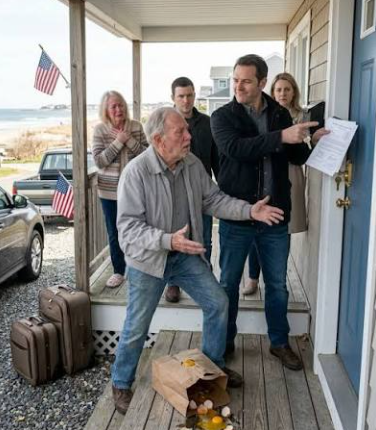
My father was standing outside the ocean cottage with a grocery bag in one hand when my brother-in-law told him to get out. The loaf of sourdough stuck awkwardly from the paper sack, green onions bent over the side, while the Monterey waves kept crashing against the rocks as if nothing sacred had just been violated. My mother stood in the gravel driveway in slippers and a lavender cardigan, mascara running down both cheeks, too shaken to form a full sentence. On the porch, Daniel Mercer held a new ring of keys and smiled like a man who believed a lock could rewrite ownership. My sister Claire stood behind him, pale and silent, refusing to meet anyone’s eyes. Their suitcases sat on the boards beside my parents’ door, dumped there like someone had already decided they no longer belonged. Then my mother whispered that Daniel had threatened to call the police if they tried to go back inside, and something in me went colder than anger.
I had bought that house for my parents’ fortieth anniversary after watching them spend four decades postponing every dream that cost money. My father, Robert Hayes, worked machine shops, cannery maintenance, early mornings, late repairs, and all the quiet jobs a family survives on but rarely celebrates. My mother, Linda, kept books for small businesses, clipped coupons, patched clothes, and somehow made every birthday feel full even when the checking account was thin. Their only real dream had been a small place near the ocean, the kind they used to point at during Sunday drives down the coast while eating deli sandwiches in the car. When I finally had enough after years in tech, I bought the Cypress Point cottage for $650,000 cash and placed it in the Hayes Family Residential Trust. My parents had lifetime residential rights; I covered taxes, insurance, maintenance, mortgage-free upkeep, and reserves, while the trust clearly banned sale, rental, sublease, collateral use, or interference from anyone else.
Daniel had always looked at love as if it were an underperforming investment. He asked too many questions about property taxes, short-term rental rules, insurance coverage, occupancy rates, and whether the guest room “sat empty” during peak season. Claire, who had spent much of her life being rescued from financial emergencies, slowly began calling my parents’ home “the property,” as if changing the word made it easier to change the purpose. When Daniel’s latest venture collapsed and their own debts worsened, his language turned bolder: cash flow, seasonal yield, management letter, efficiency. My mother had warned me weeks earlier that he wanted documents “in case of repairs,” and I told her not to sign a single page without calling me first. But while my parents were at the market buying bread, fruit, and lemon yogurt, Daniel brought a locksmith, changed the deadbolt, staged the rooms for guests, and scheduled a listing photographer for eleven o’clock — and that camera case was already pulling into the driveway.
I called my attorney, Joanna Tate, on speaker before Daniel could finish pretending this was a family misunderstanding. She confirmed the trust structure, my parents’ legal lifetime occupancy, and Daniel’s lack of authority over leasing, access, management, or sale. When officers arrived, Daniel produced a flimsy template document and claimed he was “protecting the asset,” but he had no deed, power of attorney, court order, lease, or property management contract. Inside, the violation became worse: my mother’s wedding photo had been turned face down, toiletries boxed, the pantry labeled “owner supplies” and “guest supplies,” and a binder titled House Manual sat on the kitchen island with check-in instructions, cleaning fees, Wi-Fi notes, and tourist recommendations. Joanna issued legal notices to Daniel, Claire, the locksmith, the rental platform, and the property manager he had contacted, while the officers documented unauthorized lock changes, occupancy interference, and attempted rental activity. Daniel handed the keys back only after the law made clear what family language could not hide.
The cottage survived, but nobody inside the family came away unchanged. My parents put the wedding photo back on the mantel, burned Daniel’s printed house manual, and slowly taught the porch to feel like theirs again. Claire came back months later without Daniel, thinner, humbled, and finally honest enough to admit she had known what was happening and had been too ashamed, jealous, and afraid to stop it. My father told her he loved her, but love was not the same thing as trust, and that sentence became the new foundation beneath all of us. A year later, we held my parents’ forty-first anniversary dinner in that same cottage, with roast chicken, lemon cake, open windows, and the sound of the sea moving through the rooms. Daniel had called it an asset; my mother looked at the house, the water, and the family still standing inside it, and said it had never been that. It was a home — built once with money, lumber, and legal documents, and built again the day we stopped greed at the door.

