
The music stopped while Eva Marshall was still holding the final pose, one arm raised beneath the bright gym lights and her heart pounding against her ribs. Coach Christina Blake lowered her clipboard after watching less than two minutes of the routine. “You learned the steps,” she said, offering a polished smile that carried no warmth, “but you’re not quite the image this team needs.” Sixteen girls waited on the bleachers, and the silence made the rejection feel louder than laughter. Eva asked whether she could perform another sequence, but the coach’s eyes drifted toward her waist before returning to the page. “Presentation matters when you represent the school,” she replied. Eva walked out without arguing, sat beside the trophy case, and stared at an old team photograph showing her late mother smiling in the second row.
Eva had spent $48 on white sneakers and saved another $320 for the uniform because joining the squad had never been about popularity. Her mother, Lauren Marshall, had cheered in that same gym before becoming a nurse, marrying Eva’s father, and raising three children. Two years earlier, a highway accident had taken Lauren, her husband, and Eva’s older brother, leaving fourteen-year-old Eva to live with her grandfather, Harold. Grief changed nearly everything: her sleep, her appetite, her confidence, and eventually her weight. Medication helped her return to school, but classmates still stared, and Eva began hiding beneath oversized sweaters. Harold never criticized her appearance; he worried about the curtains staying closed and the songs she no longer hummed. When he found Lauren’s old cheerleading photograph, he encouraged Eva to try out, hoping the experience might give her one small connection to the life she had lost. Now, sitting beside that photograph with tears on her cheeks, Eva felt she had disappointed both herself and the mother she still missed every day.
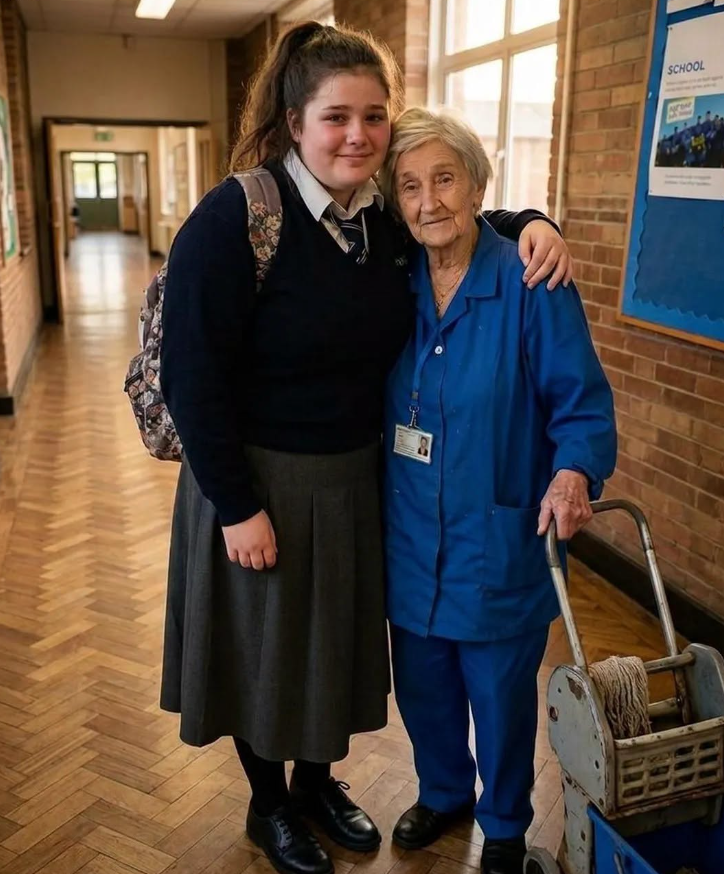
A mop bucket rolled to a stop beside her, and seventy-four-year-old custodian Evelyn Brooks carefully lowered herself onto the floor. Mrs. Evelyn did not offer empty comfort or tell Eva that the coach had probably meant well. She simply asked what had been said, listened closely, and told Eva to meet her behind the school at six the next morning. Before sunrise, Evelyn was waiting near the loading dock with hot chocolate and a worn canvas bag. From it, she removed a chipped blue-and-gold megaphone bearing the faded initials L.M.H.—Lauren Marie Marshall. Evelyn explained that Eva’s mother had forgotten it after graduation, and she had kept it because Lauren was the student who learned every custodian’s name, welcomed lonely newcomers, and convinced her squad to spend $1,100 in fundraiser money on winter coats rather than new warm-up jackets. “You went into that gym trying to inherit her uniform,” Evelyn said softly. “She would have wanted you to inherit her heart.” As Eva loosened the cracked handle, a folded yellow note slipped onto the pavement—and she recognized her mother’s handwriting immediately.
The note contained only five words: “Find the lonely one first.” Eva began following that instruction without announcing it to anyone. She guided a frightened freshman to class, helped a student gather papers after his binder broke, and started sitting with a transfer student who ate lunch alone. Teachers noticed, then students did, and within a month Eva had organized a volunteer group called First Welcome. Harold used the $320 saved for her uniform as the group’s first investment, despite watching every dollar because of his mortgage and rising insurance costs. When Principal Denise Carter learned why Eva had left the tryout, she consulted the district’s attorney and ordered written, skill-based evaluation standards for every athletic team, avoiding what could have become a painful court dispute. A retired teacher later contributed $5,000 from her husband’s estate to support First Welcome, allowing students to purchase winter clothing, meal cards, and school supplies for classmates in need. Coach Christina apologized and offered Eva another audition, but Eva declined the private favor and asked that every rejected student receive the same fair opportunity. At the new tryout, the judges scored technique, effort, timing, and teamwork—and no clipboard included a category for body size.
Eva eventually earned a place on the squad, though the uniform no longer felt like the most important part. Before games, she used her mother’s repaired megaphone to introduce younger students, thank cafeteria workers, and recognize classmates whose kindness usually went unnoticed. Mrs. Evelyn watched from the hallway beside her mop cart, smiling whenever Eva stopped to welcome someone standing alone. Harold kept Lauren’s old photograph on the refrigerator, but beside it he added a new picture of Eva surrounded by students of different shapes, sizes, and backgrounds. She had entered the gym hoping to look like her mother and left believing she had failed. What she discovered was that Lauren’s real legacy had never been preserved in a trophy case. It lived in the simple habit of noticing people—and making room for them before they had to ask.

