
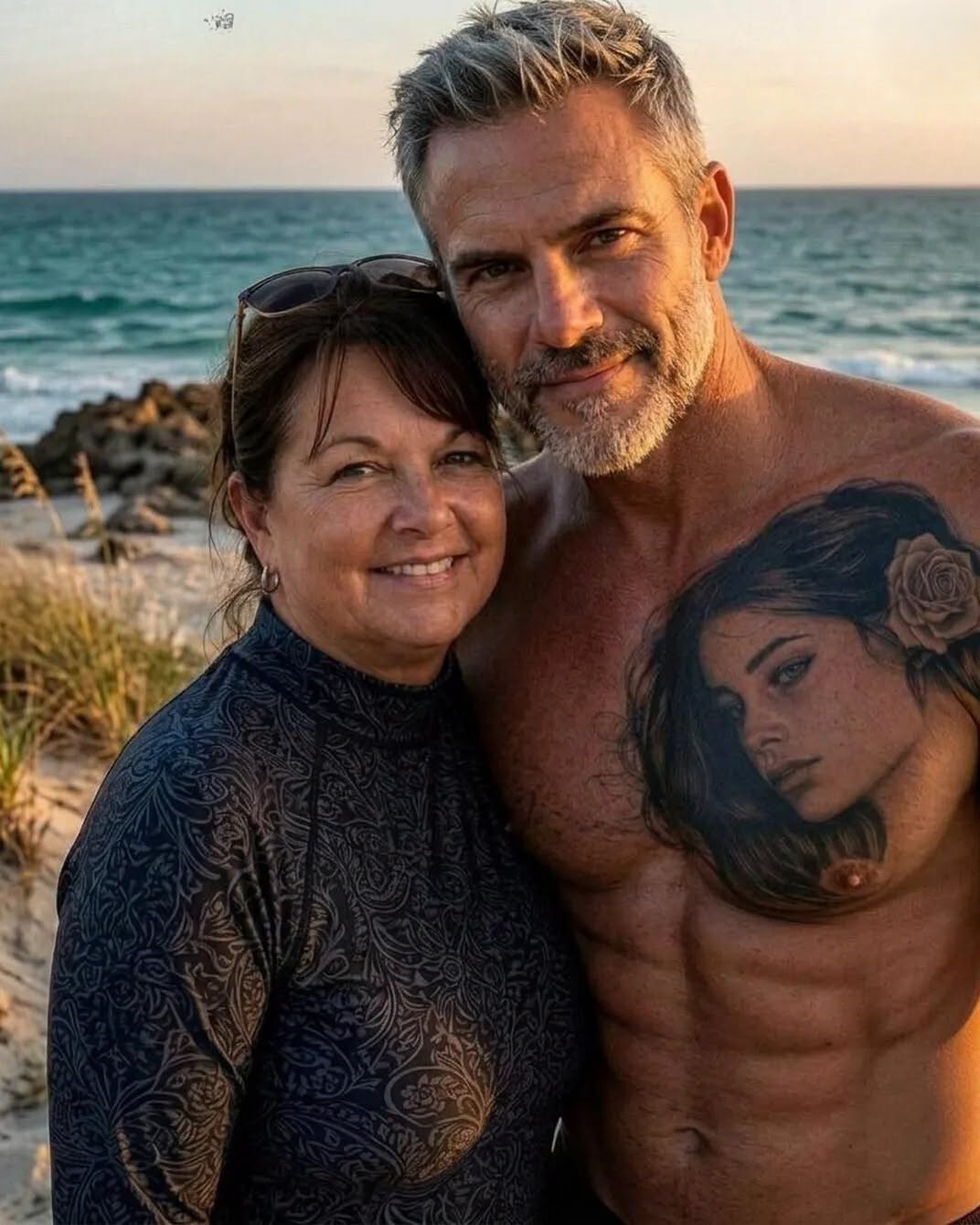
The photograph slipped from beneath a loose panel in Richard’s toolbox and landed face-up on the garage floor. A dark-haired young woman stared into the camera, the same small rose visible behind her ear as the woman tattooed over my husband’s heart. In her arms was a premature newborn wrapped in the cream-colored blanket we had brought our daughter Claire home in twenty years earlier. My knees weakened, and I lowered myself onto the cold concrete while rain blew through the half-open garage door. Richard had always claimed the tattoo artist invented the woman when he was nineteen, but the image in my hands proved she had been real. Then I turned the photograph over and found six words written in his handwriting: “Forgive me, Rose. She can’t know.”
Richard and I had spent nearly $58,000 on five unsuccessful fertility treatments before our adoption agency called about Claire, a medically fragile baby born more than ten weeks early. We brought her home after almost four months in neonatal care, believing her biological family had disappeared shortly after her birth. Richard was devoted to her from the beginning, reading Goodnight Moon every night and carrying her through the hallway whenever she could not sleep. Still, the portrait tattoo had bothered me throughout our marriage because no one permanently placed a stranger over his heart without a reason. When I confronted him years earlier, he laughed, kissed my forehead, and said the face belonged to nobody. Now I searched the toolbox again and discovered an old address book with one uncrossed name: Rose. I called the number, and an older woman answered our landline by whispering, “Richard, is that really you?”
Rose refused to explain everything over the telephone, so I met her at a diner in the next town with the photograph inside my purse. Her silver hair had replaced the dark waves in the picture, but her eyes were unmistakable. Before she could tell me why she had once held Claire, Richard entered the diner, looking less like an unfaithful husband than a man reaching the end of a promise. From his wallet, he removed a paper worn thin by twenty years of folding. It read, “Promise me she’ll always know she was wanted. Never let her believe someone simply gave her away.” I demanded to know whether Claire was Richard’s secret daughter or Rose’s child, but both of them said no. Then Rose placed Claire’s old cream blanket on the table, pointed to the tiny embroidered flower near its frayed corner, and finally told me who she had really been.
Rose had been one of Claire’s neonatal nurses, working overnight shifts while caring for her own terminally ill mother during the day. She held Claire during painful procedures, read beside her incubator, celebrated every ounce she gained, and once considered adopting her herself. However, Rose’s one-bedroom apartment, limited income, and lack of support made approval impossible for a medically vulnerable infant. Richard met her during Claire’s discharge, and Rose gave him the blanket, the handwritten promise, and a charcoal sketch another nurse had drawn of her reading beside the incubator. He used that sketch for the tattoo because he never wanted our family to forget the woman who loved Claire before we arrived. Richard admitted he should have told me, and I told him that a secret could begin with kindness and still damage a marriage. I had spent years imagining affairs, attorneys, insurance disputes, hidden mortgage payments, inheritance claims, and an unknown woman appearing in court to challenge our estate, when the truth involved no financial investment at all—only a nurse whose sacrifice had quietly helped create our family.
Richard called Claire, and she arrived at the diner confused until Rose described how she always kicked one foot free from the blanket and slept whenever someone hummed. Claire touched the embroidered rose, moved around the booth, and wrapped her arms around the woman who had cared for her when no parent was yet beside her. Rose froze for a moment before finally holding her back, whispering that she had been fortunate enough to love Claire first while we had received the privilege of loving her forever. I did not forgive Richard’s twenty-year deception immediately, but I no longer saw the tattoo as proof of another romance. It represented gratitude, memory, and a woman who had stepped aside so our daughter could step into a permanent home. That evening, I folded Claire’s blanket into her keepsake box and smoothed the tiny rose near the hem. For two decades, I believed my husband carried another woman over his heart; in truth, he carried the person history had almost forgotten.