
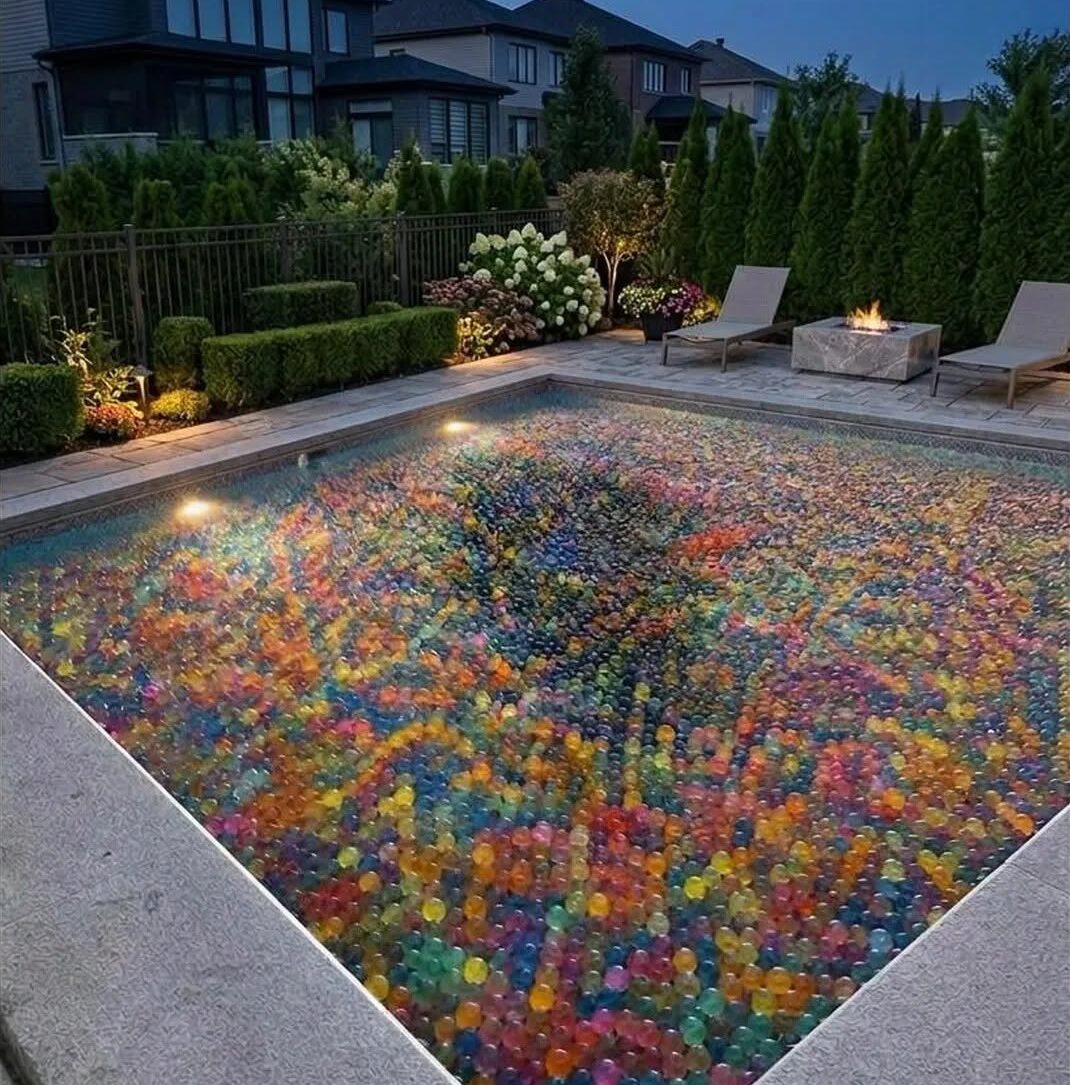
The first blue bead rolled across the patio and stopped against my slipper. When I looked up, our swimming pool had disappeared beneath millions of bright Orbeez, packed so tightly that the water was barely visible. Something large and rectangular rested at the bottom, its straight edges too deliberate to be ordinary debris. My husband, Carmelo, dropped his coffee and hurried outside while the beads clicked softly against the tile like rain on glass. The pool cover had been removed and folded beside the fence, although I had secured it at nine the previous night. Then the colorful beads shifted, revealing the yellow handle of a child’s shovel. I gripped the railing because only one person had ever filled our pool with Orbeez—our son, Mason, who had vanished three years earlier.
Mason disappeared during a crowded summer festival after someone bumped my shoulder near the ring-toss booth. One moment, his small hand was inside mine; the next, he was gone. Police officers, helicopters, and hundreds of volunteers searched fields, creeks, roads, and abandoned buildings, but nothing belonging to him was found. Mason had loved colorful water beads, assigning each shade a special purpose: blue for loneliness, yellow for birthdays, and red for emergencies. His cracked yellow shovel had been listed among the belongings missing with him. Carmelo and I had spent nearly $18,000 on searches, private investigators, and travel connected to possible sightings, yet every lead ended in disappointment. Now that same shovel appeared to be waiting beneath our pool.
We called 911, and police cars reached our house within seven minutes. Officers photographed the opened gate, torn bulk packaging near the hedge, and wheel marks beside the fence while a rescue team carefully cleared the beads. Divers attached straps to a sealed acrylic case larger than a coffee table and slowly raised it from the water. Inside were hundreds of folded letters, friendship bracelets, drawings, toys, a stuffed dinosaur, and Mason’s yellow shovel resting across the top. Detective Rios, who had handled the original disappearance, ordered everything documented before the case could be opened. Then the community-center director arrived wearing mismatched shoes, stared at the display, and admitted that the town had been keeping something from us for three years.
The items had come from a memorial created after Mason vanished. Children continued adding letters and gifts every summer, and several volunteers eventually decided to return the collection without asking our permission. Their attorney later arranged payment for the pool repairs, while our homeowner’s insurance covered the remaining damage without requiring a court dispute. The case contained no threat, hidden investment scheme, mortgage document, or claim against Mason’s estate—only memories from people whose lives he had touched. One child thanked him for sharing crayons; another remembered him giving up a prize to someone who was crying. At the bottom was a photograph taken shortly before he disappeared, showing Mason laughing beside a tub of Orbeez while helping younger children choose the brightest ones.
No arrests were made because investigators determined that the volunteers had acted out of misguided kindness rather than malice. Carmelo carried the acrylic case into our home, and I sat beside the pool holding Mason’s shovel for the first time in three years. I had remembered the festival only as the day my hand became empty, but the letters showed me what had happened before that moment. Mason had spent his final known hours sharing, comforting children, and making strangers feel included. One blue Orbeez remained in the shallow end, so I placed it carefully inside the cracked shovel and set both beside his photograph. We still did not know where our son had gone, but that morning the town returned a part of him we never knew it had been protecting.