
Part 1: The Man Who Blocked the Wrong Woman
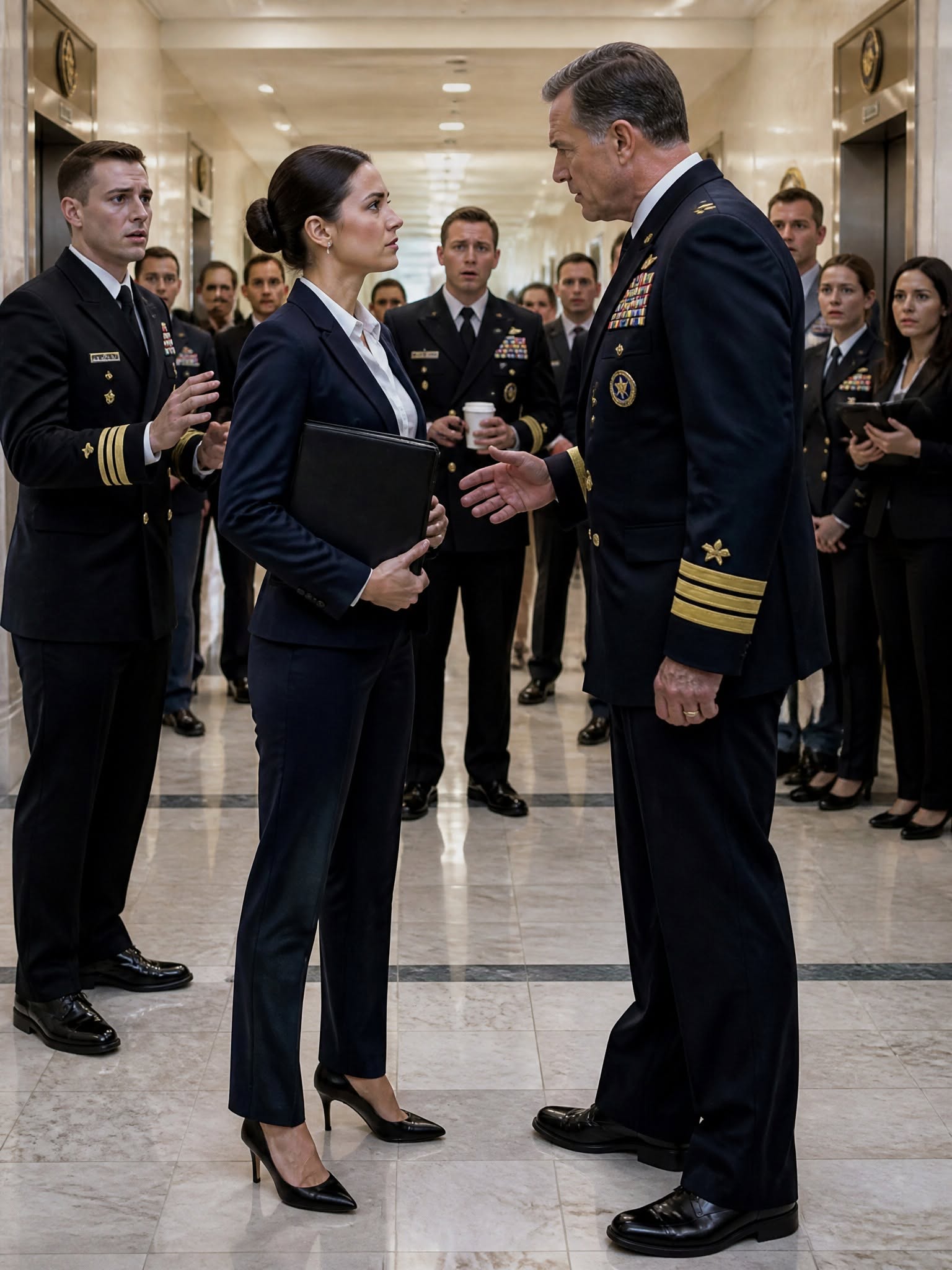
Major Derek Vance placed a hand on my shoulder in the White House basement and said, “Sweetheart, the tourist entrance is upstairs.”
Then he shoved me back hard enough that my tablet hit the marble floor.
The corridor went silent because everyone there could see the black folder in my hand stamped for the President’s eyes only.
I looked at my cracked tablet, then at his hand, then at the red digital clock above the security door.
6:42 a.m.
Eighteen minutes before I was scheduled to brief the President of the United States.
Vance smiled like he had won. He was tall, polished, and perfectly uniformed, the kind of man who believed rooms were built to obey him.
“You are not cleared for this room,” he said.
I picked up my tablet and slid it back into its case. I did not raise my voice, show my badge, or let him see my hands shake.
“Major,” I said, “you have six seconds to remove your hand from my shoulder.”
A few people shifted. A Secret Service agent near the elevator turned slightly.
Vance’s smile widened. “Oh, she counts.”
His aide laughed once.
Captain Noah Mercer. I had seen his file at 3:12 that morning. Two commendations, a mortgage in Arlington, and five suspicious deposits from a Delaware shell consulting firm.
I noticed the laugh.
I noticed the intern’s trembling coffee.
I noticed the Secret Service agent moving half an inch closer.
I noticed the silver lapel pin on Mercer’s jacket, a pin he should not have worn in a secure corridor.
Men like Vance always mistook calm for weakness.
They never understood calm was where I kept the knife.
“My name is Dr. Elena Ward.”
Vance’s eyes flicked to the folder, then back to my face. Recognition crossed him briefly before he hid it.
“I don’t care if your name is the Queen of England,” he said. “No civilian enters the Situation Room during a live national security session without my authorization.”
“That’s interesting.”
“Interesting?”
“Yes.” I looked at the camera bubble above us. “Because you do not control presidential intelligence access.”
Mercer stopped laughing.
Vance leaned closer. “You wandered into the wrong hallway at the wrong time. Take the win and walk away.”
There it was.
Not protocol.
A warning.
I could have flashed my badge and watched his face fold, but my father had once told me, “Never spend power just because someone asks to see it.”
So I stood there with a cracked tablet, a black folder, and seventeen minutes left.
“You are obstructing a presidential briefing,” I said.
Vance’s nostrils flared.
“Escort her out.”
The Secret Service agent did not move, but two young officers stepped forward. One reached for my arm.
I looked at his hand before it touched me.
He froze.
“Lieutenant,” I said, “you are about to make a career decision based on incomplete information.”
His fingers curled back.
Behind the security door, voices hummed through reinforced walls. The crisis had started ninety-one minutes earlier. A satellite over the North Atlantic had gone dark. Then two more. A Navy station in Iceland detected an unknown signal pattern. The Vice President’s secure line received twelve seconds of a child singing “America the Beautiful” backward. A Pentagon evacuation protocol triggered by itself. A Coast Guard cutter found a weather buoy transmitting with a White House authentication prefix from 2009.
By 6:12 a.m., the President had been moved to the Situation Room.
By 6:23, I had been summoned from a windowless analysis cell.
By 6:42, Major Derek Vance had decided I looked too young, too female, too civilian, and too inconvenient to matter.
That was his first mistake.
His second was touching me.
His third was thinking I came alone.
A door opened behind us, and Special Agent Leah Cross of the Presidential Protective Division stepped into the corridor.
“What’s the delay?”
Vance’s expression shifted. “Agent Cross, we have an unauthorized civilian attempting to enter a restricted national security session.”
Cross looked at my folder, my cracked tablet, and his hand hovering near me like evidence.
“She is expected,” Cross said.
“By whom?”
The elevator dinged. Another agent stepped out with his earpiece pressed tight.
“President Hayes is asking why Dr. Ward is not in the room.”
Vance’s confidence finally cracked.
I slid my badge from inside my navy blazer.
National Security Council. Special Intelligence Liaison. Presidential Direct Briefing Authority.
Vance stared.
Mercer stared.
The lieutenant looked like he wanted the floor to swallow him.
I tucked the badge away.
“Now,” I said, “remove yourself from the doorway.”
Vance stepped aside, but only half an inch. Enough to obey, not enough to surrender.
As I passed, he leaned close.
“You don’t know what you’re walking into.”
His eyes were too steady now. He was not embarrassed. He was measuring how much I knew.
I looked at him and said softly, “Neither do you.”
Then I walked into the Situation Room.
Part 2: The Pattern Was Too Loud
The Situation Room was smaller than people imagine. Heavier. Screens covered one wall. Maps glowed in cold colors. Phones sat in disciplined lines. Every chair seemed to know the weight of history. President Caroline Hayes stood at the head of the table in a slate-gray suit, one hand on the back of her chair. Television made her look taller, but it never captured her stillness. Everyone in the room unconsciously aimed toward her like compasses toward north.
Defense Secretary Adrian Cole sat to her right. National Security Advisor Maya Chen sat to her left. The Chairman of the Joint Chiefs appeared on secure video from the Pentagon. CIA, Defense, and White House deputies waited with binders open. One empty chair waited near the end of the table. Mine.
President Hayes looked at my tablet case. “Dr. Ward, are you injured?” “No, Madam President.” “Your equipment is.” “I’ve had worse mornings.” A few people exhaled, not laughing, but relieved to be human for half a second. “Then give me the morning,” she said.
I placed the black folder on the table. “The current working assumption is wrong,” I began. “We are not looking at a foreign cyber intrusion.”
The Chairman frowned through the screen. “With respect, Doctor, we have disabled satellites, a spoofed authentication prefix, and active command anomalies across federal networks.” “Yes, General. And all of them are too loud.”
The room went still. I touched my cracked tablet. A map of the North Atlantic appeared, showing three satellite blind spots forming a triangle. Inside it blinked a small dot.
“Five minutes after the first satellite failed, someone wanted us watching the sky. Ten minutes after the second, they wanted us watching Russia. Twelve minutes after the Vice President’s secure line received the audio, they wanted us watching domestic continuity protocols.” A second overlay appeared: old signal traces, archived and almost forgotten. “This is not a real attack pattern,” I said. “It is a rehearsal pattern.”
Maya Chen stopped writing. Secretary Cole leaned forward. “A rehearsal for what?” I looked at the President. “For moving the President.”
No one spoke. President Hayes remained still. “You’re saying someone created enough credible noise to force me into this room.” “Yes, Madam President.” “Why?”
I placed a photograph on the table: a weather buoy pulled from gray water, paint peeling, serial number scraped but not completely erased. “In 2009, a classified continuity exercise tested whether a hostile actor could spoof the White House authentication chain during a national emergency. The exercise was called Harbor Bell.”
Secretary Cole’s hand tightened around his pen. Too fast. Too small. But I saw it. “Harbor Bell was terminated,” he said. “It was,” I replied. “Officially.”
Maya looked up. “Who had access to the files?” “Originally? Defense, CIA, NSA, Secret Service, and a small White House continuity team.” “And now?” “The active fragments appear to have been rebuilt by someone with access to defense readiness logs, outdated presidential movement protocols, and current secure communications metadata.”
President Hayes lowered her voice. “Someone inside.” Secretary Cole said, “That is a serious allegation.” “Yes, sir. That’s why I brought evidence.”
I displayed a timeline: 5:08, 5:21, 5:39, 6:12. Then one entry in red: 6:31. “What happened at 6:31?” the President asked. “An override packet was sent from inside the Eisenhower Executive Office Building.” A deputy muttered, “Impossible.” “It should be,” I said. “Destination?” Maya asked. “The packet did not target the White House network.” “Then what?” “The presidential motorcade staging channel.”
The room went cold. The President did not look at the agents. She looked at me. “Would it have moved me?” “No, Madam President. Not by itself.” The shoulders that had eased tightened again. “The packet would have altered the recommended evacuation route if a second trigger occurred.” “What second trigger?”
Before I could answer, the red phone at the far end of the table lit silently. A communications officer picked it up and went pale. “Madam President, North Gate reports a vehicle incident on Pennsylvania Avenue. Box truck. Stalled. Driver fled.”
Cross stepped in behind me. President Hayes sat slowly, not from fear, but from focus. “What was the recommended route?”
I tapped the tablet. A blue line appeared, then a red one. The red route curved away from the standard hardened corridor and toward the exact traffic disruption now unfolding outside the gates.
Maya whispered, “God.” Secretary Cole stood. “This is premature. We don’t know the vehicle is connected.” “No,” I said. “But the person who sent the 6:31 packet knew it would be.”
President Hayes turned to Cross. “Lock movement.” “Already done,” Cross said. “To the building?” “To the floor.”
Then the President asked the question Vance had tried to prevent. “Dr. Ward, who sent the packet?”
I removed the last page from my folder: one thin authentication trace. Numbers, timestamps, routing marks. Nothing dramatic to anyone outside that room. Inside it, the page was a loaded weapon.
“The packet was authenticated through a defense liaison credential,” I said. Secretary Cole said, “Name.” I looked at the President. “Major Derek Vance.”
The door opened. Major Vance stepped into the threshold and raised both hands slowly. “Madam President,” he said calmly, “I need to correct the record before this goes any further.”
Part 3: The Trap Inside the Briefing
Vance stood in the doorway, respectful and almost wounded, using the kind of voice that gets believed in rooms built by men like him.
President Hayes did not invite him in or tell him to leave.
She let him stand where everyone could see him.
“Proceed,” she said.
Vance looked at me, then the evidence.
“Dr. Ward’s clearance was suspended last night pending an internal counterintelligence review. She was not to be given access to live presidential channels. The authentication trace she is presenting is likely contaminated.”
The room shifted toward me by half an inch.
Not physically.
Politically.
That was how traps worked.
Not with chains, but hesitation.
President Hayes said, “Dr. Ward?”
“My clearance was flagged at 11:48 p.m. by an automated compliance alert claiming I accessed an inactive archive without authorization.”
Vance nodded. “Correct.”
“The archive was Harbor Bell.”
His mouth tightened.
“The alert was reviewed by Defense Liaison,” I said.
“Yes,” he replied. “By me. Because you accessed compartmented material.”
“I did,” I said. “Because at 11:31 p.m., someone copied three Harbor Bell fragments from cold storage.”
The President’s eyes sharpened.
“Whoever copied them used my credential shadow,” I continued.
Vance scoffed. “Credential shadowing is theoretical.”
“No. It is inconvenient.”
The Chairman leaned closer. “Explain.”
“Someone duplicated my access signature, pulled the files, then triggered a compliance flag to suspend me before morning.”
Vance called it fantasy.
I turned my tablet toward the President.
“But they made a mistake.”
The false access event listed my terminal as Room 2B-417. I had not used that room since February.
“People forget rooms,” Vance said.
“Yes. They do.”
I tapped the screen. A grainy security still appeared, time-stamped 11:31 p.m. A man in uniform entered Room 2B-417, back to the camera, silver at the temples.
President Hayes looked at Vance.
“Is that you?”
“Madam President, many officers have similar—”
I zoomed in, not on his face, but on his left hand.
A gold West Point class ring.
Blue stone.
Initials engraved where his hand touched the doorframe.
D.V.
The room breathed once.
Secretary Cole said too quickly, “That still needs authentication.”
“Agreed.”
I placed a plastic evidence sleeve on the table. Inside was a silver lapel pin.
Captain Mercer’s hand went to his jacket.
Too late.
“This pin was transmitting a short-range handshake signal in the secure corridor,” I said. “It pinged my tablet case twice while Major Vance was blocking me.”
President Hayes turned toward Mercer. He looked like a man watching the bridge burn behind him.
Agent Cross moved one step.
Then another.
Mercer backed into the wall.
“I didn’t know what it was,” he said. “He told me it was a proximity authenticator for the exercise.”
“What exercise?” Maya asked.
Mercer looked at Vance.
Vance did not look back.
That answered enough.
President Hayes cut through the silence.
“Major Vance, step inside.”
He obeyed.
Cross nodded to another agent, and the door closed behind him.
Not locked visibly, but the sound had weight.
The President folded her hands.
“Major, you will answer one question before anyone else speaks. Who gave you Harbor Bell?”
Vance’s eyes flicked once.
Not to me.
Not to Mercer.
To Secretary Cole.
Tiny.
Almost nothing.
But enough.
Cole leaned back, his face empty.
Not surprised.
Disappointed.
At timing.
President Hayes saw it too. Her hand moved slightly on the table.
A signal.
The agents’ posture changed.
The room was no longer a briefing room.
It was a cage.
Vance spoke carefully. “I received historical materials through authorized channels as part of a readiness review.”
“Authorized by whom?”
“Defense continuity office.”
“Name.”
Vance hesitated.
Secretary Cole cut in. “Madam President, this line of questioning inside a live event—”
“Adrian.”
One word.
Cole stopped.
President Hayes kept her eyes on Vance.
“Name.”
Vance looked at me then, angry in a way that was almost honest.
“People like her don’t understand cost.”
There it was.
Not confession.
Motive.
President Hayes asked, “Cost of what?”
“Delay. Weakness. Endless civilian debate while threats move faster than committees. We build continuity plans for a reason. Then every administration locks them behind lawyers, optics, and polling data.”
“So you decided to manufacture a crisis,” I said.
His eyes snapped to me.
“I decided nothing.”
“You decided I was easier to remove than the evidence.”
His face flushed.
“You should never have been in that archive.”
“And you should never have built a presidential route trigger from a dead exercise.”
“Enough,” Cole snapped.
The word landed too hard.
Everyone looked at him.
President Hayes did not blink.
“Secretary Cole,” she said, “sit down.”
“I am sitting.”
“Then stop standing in your voice.”
No one smiled, but the line landed.
The President turned back to me.
“Dr. Ward, what was the second trigger?”I opened a final window on the cracked tablet: traffic cameras, White House perimeter data, emergency channels, satellite gaps, and one more stream.
National broadcast delay grid.
“The second trigger is not the truck,” I said.
Vance turned his head.
That was new information to him.
Good.
“The truck is theater. It creates visible security tension. The second trigger is media confirmation.”
“Confirmation of what?” Maya asked.
“That the President has left the White House.”
The President stayed still.
“If that false report goes live,” I said, “the route algorithm validates the evacuation model retroactively. Agencies respond to a movement that never happened. Local law enforcement shifts. Airspace posture changes. Command noise multiplies.”
“And in that noise?” the President asked.
“Someone moves something else.”
“What?”
I looked at the North Atlantic triangle pulsing on the map.
“Or someone.”
The communications officer raised a hand to his headset.
“Madam President, two national networks just received anonymous confirmation that Marine One has lifted from the South Lawn.”
Cross said, “Marine One is grounded.”
“Yes, ma’am.”
“Source?”
“Unknown. They’re asking for comment.”
President Hayes looked to Maya. “Deny immediately.”
Maya was already typing.
Then the officer swallowed.
“A local affiliate has already aired it.”
One red dot appeared on the screen.
Then another.
Then another.
A false story spreading across the country in real time.
Marine One has lifted. The President has been moved. Emergency relocation underway.
For a few minutes, America would move around a lie.
Sometimes a country did not need to be broken.
Only turned half an inch.
I looked at Vance.
He looked shaken.
Not because the plan was working.
Because it had moved beyond him.
“You didn’t know,” I said. “You thought you were forcing a readiness demonstration. You thought you were exposing weakness. But someone used your anger as a key.”
President Hayes stood.
“Agent Cross, Major Vance and Captain Mercer are to be separated and held for questioning. Secretary Cole remains in this room.”
Cole went pale.
“Madam President—”
“In this room,” she repeated.
As Cross moved Vance toward the door, he stopped beside me and whispered, “Ward. Check who signed the renewal memo.”
Then he was gone.
The door closed.
And the room did not get safer.
It got worse.
Part 4: The Signature That Should Not Exist
Guilty men lied. Cornered men bargained. But frightened men handed you the first thread they could reach.
Check who signed the renewal memo.
Maya looked at me. “What renewal memo?”
I was already searching.
The tablet lagged. The crack cut a thin line across the President’s reflection.
I pulled the Harbor Bell administrative chain: archived, redacted, fragmented, mirrored, then buried under a harmless title.
Interagency Communications Redundancy Renewal.
Fiscal review.
No flags.
No alerts.
No one would ever read that file unless they knew exactly where to look.
My father’s voice returned to me.
Never fear the locked door. Fear the open one no one notices.
I found the memo.
Dated eighteen months earlier.
Signed by three offices.
Defense.
Continuity.
White House Counsel.
Then a fourth signature, hidden in metadata.
I tapped it open.
For half a second, I thought the system had glitched.
It was not Secretary Cole.
Not Major Vance.
Not anyone in the defense chain.
It was someone who should never have touched a dead continuity exercise.
President Caroline Hayes’s husband.
Daniel Hayes.
The First Gentleman of the United States.
My mouth went dry.
Maya saw my face.
“Elena?”
The President heard the change in the air.
She turned slowly.
“What did you find?”
No one breathed.
I looked at the signature again.
Daniel Hayes.
Then my tablet chimed.
One incoming secure file.
No sender.
No subject.
Just one attachment:
WARD_FATHER_DEATH_REVIEW_REOPENED.pdf
My father had died seven years earlier in a training accident off the Virginia coast.
At least, that was what the Navy told us.
I opened the file before anyone could stop me.
A photograph filled the screen.
My father, alive, older, thinner, sitting in a windowless room beside a man whose face was turned away from the camera.
On the table between them sat a black folder stamped with the same mark as mine.
HARBOR BELL.
Then a message appeared beneath the photo.
DR. WARD, YOU HAVE BRIEFED THE WRONG PRESIDENT.
THE END

