
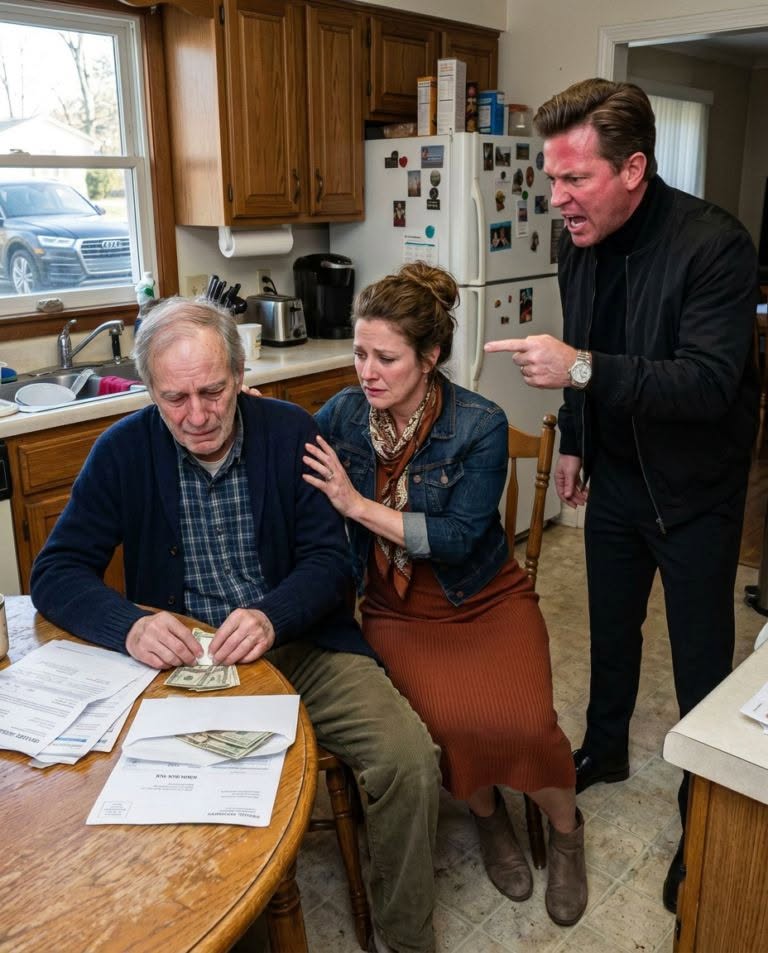
It cost $3,200 to save my life.
That was the amount I needed for cancer surgery.
I called my son, asking for help. He told me, “We just closed $12 million,” then answered with chilling indifference, “There’s no money for you, Dad.” When my daughter arrived carrying $2,000, everything began to change. A few days later, my angry son appeared at my front door.
My name is Arthur Bennett. I was sixty-eight when I discovered exactly how expensive it was to be forgotten.
The price came to $3,200.
That was the deposit the clinic in Columbus, Ohio required before scheduling surgery to remove the tumor growing near my stomach. Medicare paid for most of the procedure, but not everything. Deductibles, medication, transportation, extra fees, and that harsh upfront payment sat on my kitchen table like one final demand from fate.
I had spent forty-two years working as a machinist. After my wife died young, I raised our two children alone. I skipped meals so they could wear warm coats in winter. I sold my pickup to help my son finish college. I worked overtime when my fifteen-year-old daughter needed dental surgery.
So my first call was to my son.
Elliot Bennett picked up on the fourth ring. Music, laughter, and clinking glasses filled the background. He lived in Los Angeles now, a successful real estate investor whose tailored suits matched a voice that always sounded rushed.
“Dad,” he said. “Can this be quick?”
I forced myself to ask. “Elliot, I need your help. The doctors found cancer. They can operate, but I need $3,200 upfront.”
Silence followed, then a long sigh.
“Dad, we just closed twelve million on a property deal,” he said with a laugh, “but that doesn’t mean cash is lying around. It’s allocated.”
“I’m not asking for much.”
“You don’t understand business. Everything is tied up.”
“It’s surgery, son.”
His tone turned cold. “There’s no money for you, Dad.”
I remained frozen with the phone pressed to my ear long after the line went dead. The kitchen clock ticked above the sink. A neighbor’s dog barked outside. My hands shook so badly that coffee spilled across the payment notice.
That evening, my daughter Claire came to my house.
She was thirty-nine, divorced, teaching at a public school in Dayton while raising a teenage son on an income that barely covered expenses. One button was missing from her coat, and her eyes were red from the drive.
“Aunt Linda called me,” she said.
I tried to brush it off. “It’s nothing.”
She placed an envelope on the table.
“Here’s $2,000.”
I stared at it.
“Claire, no.”
“Yes.”
“You need this.”
“So do you.”
Her voice cracked, though she refused to cry.
“I sold Mom’s bracelet. The little gold one.”
The room fell silent.
That bracelet had been Margaret’s favorite. Claire had treasured it for twenty-two years.
“You shouldn’t have done that,” I whispered.
She squeezed my hand.
“Mom would have slapped me if I didn’t.”
Everything changed in that instant.
Three days later, Elliot pulled into my driveway in a black rental car. He looked furious before he even walked through the door.
“What did you tell Claire?” he demanded.
PART 2
Elliot stood on my porch wearing a navy overcoat that likely cost more than my refrigerator. His face was flushed with anger, not from the cold. Behind him, the rental car remained running at the curb, its exhaust drifting into the February air.
I rested against the doorframe, still drained from the medical tests and wearing the same brown cardigan Margaret had bought me years ago.
“What are you talking about?” I asked.
“Don’t play innocent,” Elliot snapped. “Claire called me crying, said she sold Mom’s bracelet because I refused to help you.”
“She didn’t call you to blame you.”
“She made me sound like a monster.”
I studied him. At forty-two, he was tall, polished, and constantly impatient—the kind of man who glanced at his watch while someone else spoke. I could still picture the boy he used to be, standing in the garage and asking me how machines worked. But that child had long been buried beneath expensive clothes and pride.
“You said there was no money for me,” I replied.
His jaw tightened. “Because you put me on the spot.”
“I told you I had cancer.”
“And I told you my money is tied up.”
“You said you closed twelve million.”
“That was gross value, Dad. Not cash in my pocket.”
“Then you could’ve said that without sounding pleased that I understood nothing.”
He walked inside without waiting for an invitation. The aging floorboards groaned beneath his shoes. His gaze swept across the living room, taking in the worn sofa, the pile of medical documents, and the framed photo of his mother on the mantel.
Then he noticed the envelope Claire had left behind. I had not used all the money. I had paid $1,200 toward the deposit and saved the rest for prescriptions and travel expenses.
“So you took her money,” he said.
“She insisted.”
“She has a kid. She has rent. She has nothing.”
“She had compassion.”
His eyes flashed. “And I don’t?”
I did not answer immediately.
That silence wounded him more deeply than an accusation would have.
Elliot paced near the kitchen.
“Do you know what this looks like? Claire telling everyone I abandoned my sick father while I’m doing business in California? You think that won’t reach people?”
I stared at him.
“That’s why you came?”
He stopped pacing.
Not because I was mistaken.
Because I had understood perfectly.
“You’re worried about how it looks,” I said.
“I’m worried about being manipulated.”
“No. You’re worried somebody might know the truth before you can explain it better.”
His mouth opened, then shut again.
For a few seconds, the only sound was the old furnace rumbling to life. Then Elliot reached inside his coat and pulled out a checkbook.
“How much is left?” he asked coldly.
I shook my head.
“Put it away.”
“Dad.”
“I said put it away.”
His expression changed—first confusion, then offense.
“You called me for money.”
“I called my son.”
The words settled heavily between us.
Elliot looked again at his mother’s photograph. Margaret had died from a brain aneurysm when he was nineteen and Claire was sixteen. He had cried once during the funeral and never again where I could see him.
“You always do this,” he said quietly.
“Do what?”
“Make me the villain.”
“I didn’t need to make you anything.”
His shoulders went rigid.
At that moment, Claire’s old Honda turned into the driveway. She climbed out carrying a grocery bag while her son, Noah, sat in the passenger seat. She stopped the second she noticed Elliot’s rental car.
Elliot opened the front door before she reached the porch.
“You happy?” he shouted. “You got what you wanted?”
Claire’s face lost its color.
Noah stepped out slowly. He was sixteen, tall and thin, staring at his uncle as though he were seeing something ugly for the first time.
Claire walked up the path.
“I wanted Dad alive.”
Elliot gave a short, bitter laugh.
“You sold Mom’s bracelet and made sure everyone knew.”
“I told Aunt Linda because I needed the jeweler’s name. That’s it.”
“You embarrassed me.”
Claire’s voice hardened.
“No, Elliot. You embarrassed yourself.”
He pointed at her.
“You have no idea what pressure I’m under.”
“And you have no idea what Dad’s doctor said because you never asked.”
That stopped him.
Claire moved past Elliot and came to my side. She placed a gentle but steady hand on my arm.
“The clinic called,” she said. “They can schedule you for Thursday if the rest is paid by tomorrow.”
Elliot’s expression changed once more.
This time, fear finally broke through his anger.
PART 3
For the first time since arriving, Elliot said nothing.
The breeze rattled the screen door behind Claire. Noah stood near the front walk with both hands tucked inside his hoodie pockets, watching his mother, his uncle, and me. He was still just a boy, too young to witness a family unraveling, yet old enough to understand every sentence.
Claire carried the grocery bag into the kitchen. Bread, soup, bananas, and a bottle of antacid shifted softly against each other as she set it on the counter.
“The clinic said tomorrow by noon,” she repeated. “After that, the surgeon is booked for three more weeks.”
I eased myself into a chair.
Three weeks.
The doctor had explained it with the calm voice doctors use when they do not want to frighten their patients. The tumor could still be removed. That was the encouraging part. But it was growing closer to major blood vessels. Waiting was possible, though risky. Every extra day gave the disease another chance to negotiate with my future.
Elliot turned toward Claire.
“How much is still owed?”
She crossed her arms.
“You don’t get to ask that like you’re balancing a spreadsheet.”
“How much?”
“Two thousand,” I answered.
Claire faced me.
“Dad, I told you I can find the rest. I can borrow from—”
“No,” I interrupted. “You’ve already done enough.”
Elliot reached into his pocket and pulled out his checkbook again.
“I’ll cover it.”
Nobody reacted.
Those words should have eased the tension. Instead, they filled the room with doubt. Pride had a way of making kindness look calculated.
Claire looked straight at him.
“Why now?”
His eyes drifted toward Noah before quickly looking away.
“Because it needs to be paid.”
“No,” Claire replied. “Why now?”
He let out an impatient breath.
“Do you want the money or not?”
“I want to know whether you’re helping Dad or saving your reputation.”
He slapped the checkbook onto the table.
“What do you want me to say? That I was wrong? Fine. I was wrong.”
But the apology sounded more like a slammed door than genuine regret.
Noah finally spoke from the hallway.
“That doesn’t count.”
All three of us looked at him.
Elliot frowned.
“Excuse me?”
Noah stepped farther inside. His voice trembled, but he never backed down.
“Saying the right words like you hate them doesn’t count.”
Claire whispered, “Noah.”
He never looked away from Elliot.
“My mom cried in the car after she sold Grandma’s bracelet,” he said. “She said it was okay because family takes care of family. Then she sat in the parking lot for ten minutes because she didn’t want Grandpa to see her crying.”
Elliot’s expression tightened.
Noah kept going.
“You came here because you were worried people would think you were selfish. You didn’t come because Grandpa was sick.”
The only sound left in the kitchen was the refrigerator humming.
Elliot looked ready to argue, but nothing came out. Noah’s simple honesty broke through the polished shield he had worn for years. Adults could always be dismissed as emotional or bitter. A teenager had nothing to gain by lying.
Elliot lowered his gaze.
When he finally spoke, his voice was much softer.
“I didn’t know she cried.”
Claire’s expression softened for a brief second before the wall returned.
“You would have known if you had asked.”
He gave a slow nod.
Then he looked at me.
“Dad, I thought you were exaggerating.”
The words hurt—not because they shocked me, but because he had finally admitted the truth hiding underneath everything.
“Why?” I asked.
He rubbed his forehead.
“Because you never ask for anything. When you finally did, I thought maybe… I don’t know. I thought it was just another bill, another problem, another thing pulling me backward.”
“Backward?”
He glanced around the kitchen.
“This house. This town. Everything I spent years trying to escape.”
Claire narrowed her eyes.
“You mean us.”
“No,” he answered quickly.
Then he hesitated.
“Maybe. Sometimes.”
I leaned back and let the truth settle between us.
It was painful, but unmistakable.
Elliot had not merely left Ohio. He had built an entirely new identity around never needing it again. Never needing the father who packed his lunches. Never needing the sister who kept every report card. Never needing memories of a mother wearing a little gold bracelet while making Sunday pancakes.
He had become wealthy enough to mistake love for a burden.
“Do you remember when you transferred to Northwestern?” I asked.
He frowned.
“What?”
“You didn’t have enough tuition. Financial aid left a gap. You called me from Chicago trying not to cry.”
His eyes lowered.
“I remember.”
“I sold my truck.”
Claire looked at me in surprise. She had known the truck disappeared, but never why.
“It was the only dependable vehicle I owned,” I continued. “For six months, I walked to the plant whenever the weather cooperated. When it snowed, Frank Wilkins picked me up at five every morning. I never told you because I didn’t want you carrying the guilt.”
Elliot slowly pulled out a chair and sat.
“I never knew.”
“No,” I said quietly. “You didn’t.”
There was no anger in my voice.
Anger would have been lighter.
“I never did it so you would owe me,” I said. “I did it because you were my son. Somewhere along the way, though, you convinced yourself that needing people meant weakness. Then, when I needed you, you treated me like a bad investment.”
He flinched.
Claire looked away.
Noah stared down at the floor.
Elliot opened the checkbook once more, carefully filled it out, tore off the check, and slid it across the table.
It was not written for $2,000.
It was for $10,000.
“I’m sorry,” he said.
This apology was different.
It was quiet.
It carried no excuses.
It sounded expensive.
I looked down at the check without touching it.
“I’ll accept what the surgery requires,” I said. “The rest belongs to Claire.”
Claire immediately shook her head.
“No.”
“Yes,” I answered. “For the bracelet.”
Elliot turned toward her.
“I’ll get it back.”
She blinked.
“What?”
“The bracelet. Where did you sell it?”
“Bellman’s Jewelry on Third Street.”
He reached for his phone.
Claire caught his wrist.
“Elliot, don’t turn this into another performance.”
He stopped.
Then he slowly lowered the phone.
“You’re right,” he admitted. “I’ll go tomorrow. Quietly. And if it’s already gone, I’ll repay you what it was worth.”
Claire gave a tired smile.
“You don’t even know what it was worth.”
Elliot looked toward our mother’s photograph above the fireplace.
“Yes, I do,” he said softly. “I just didn’t know until now.”
The following morning, Elliot drove me to the clinic himself. He did not wire money, send an assistant, or hire a driver. He sat beside me in the waiting room with his expensive coat folded across his lap while Claire completed the paperwork.
When the receptionist asked for the remaining balance, Elliot handed over his card without saying a word.
The surgery was scheduled for Thursday.
That night before the operation, Elliot stayed at my house. Claire took Noah home because he had school the next morning, though he protested until she promised to bring him to the hospital afterward.
Elliot slept on the sofa beneath an old quilt. Around midnight, I found him sitting awake in the dark, staring at the mantel.
“Can’t sleep?” I asked.
He shook his head.
I settled into the recliner beside him.
For several minutes, neither of us spoke.
Then he said quietly,
“I remember Mom wearing that bracelet at my graduation.”
“She wore it everywhere.”
“She used to tap it against the kitchen counter whenever she was thinking.”
I smiled faintly.
“That drove me crazy.”
He smiled too, though tears filled his eyes.
“I forgot that sound.”
“No,” I replied. “You buried it.”
He nodded.
After another long silence, he spoke again.
“When Mom died, I decided I had to become untouchable. I believed that if I had enough money, nobody could ever leave me helpless again.”
I looked at my son—not the successful investor, not the polished businessman, just my son.
“And did it work?”
He wiped his face.
“No.”
It was the most honest answer I had heard from him in years.
The operation lasted four hours.
I remember the freezing operating room, the bright surgical lights, and a nurse named Marisol telling me to picture somewhere I felt safe. I imagined Margaret hanging fresh sheets outside on a warm June afternoon while Elliot and Claire chased each other across the backyard.
When I woke up, my throat burned, every muscle ached, and Claire was asleep beside my hospital bed. Noah rested against her shoulder. Elliot stood near the window speaking quietly into his phone.
“No,” he said. “Cancel the meeting. Family emergency.”
A pause followed.
“I don’t care what it costs.”
He ended the call and turned.
When he saw my eyes open, his face softened.
“Dad?”
Claire woke immediately.
Later, the doctor came in smiling.
The surgery had been successful. The tumor was gone. More treatments, more appointments, more fear, and more expenses still lay ahead, but for the first time in weeks, the word “chance” felt bigger than the word “cancer.”
Two days after I returned home, Elliot visited Bellman’s Jewelry.
The bracelet was still there.
It had not yet reached the display case. It sat in a velvet tray waiting for appraisal. Elliot bought it back for more than Claire had received. He never complained or mentioned the cost.
That evening, he drove to Claire’s apartment in Dayton.
I was there, sitting at her small dining table while Noah worked on homework.
Elliot placed the bracelet in front of his sister.
Claire stared at the small box.
Her hands shook as she opened it.
She could not speak.
After several long seconds, she covered her mouth and turned away.
Elliot stood there awkwardly, looking more like a little boy than a successful businessman.
“I’m sorry,” he said. “For making you carry everything.”
Claire wiped away her tears.
“I didn’t do it for thanks.”
“I know.”
“I did it because he’s Dad.”
“I know.”
She studied him.
“Do you?”
He nodded.
“I’m trying to.”
It was the truest thing he could have said.
Not “I’ve changed.”
Not “Everything is fixed.”
People do not transform overnight because they write one check or cry once in the dark. But they can stop deceiving themselves. They can choose the first honest step.
Over the following months, Elliot stayed in Ohio longer than expected. He worked remotely from my kitchen table, speaking more quietly on business calls. He drove me to oncology appointments. Sometimes he still lost patience. Sometimes Claire still argued with him. Sometimes I watched them bicker over little things while feeling Margaret’s absence like an empty chair nobody dared move.
But something had changed.
Elliot began showing up before anyone asked.
He repaid Claire for the bracelet and added money toward Noah’s college fund. Claire resisted until he told her, “This isn’t charity. This is overdue family accounting.” She rolled her eyes, then accepted it.
He hired a home health aide to help me three days each week—but only after asking my permission instead of announcing the decision.
That mattered.
One Sunday after my second round of treatment, all of us gathered around my kitchen table eating Claire’s pot roast. It was too salty, but nobody complained.
Noah asked Elliot about California.
Elliot described skyscrapers, investors, permits, and negotiations. Then he surprised every one of us.
“Money is useful, but it doesn’t make you important. How you treat people when they can’t help you back—that’s the part that follows you.”
Noah nodded thoughtfully.
Claire looked across the table at me.
I knew exactly what she was thinking.
That sounded like something their mother would have said.
A year later, my scans came back clean.
The doctor refused to say the word cured. Doctors protect hope carefully. But when he smiled and said, “No evidence of disease,” it was enough.
We celebrated with lunch at a diner near the hospital.
Claire wore Margaret’s bracelet.
Elliot noticed it, smiled quietly, and said nothing.
When the check arrived, both of them reached for it.
I laughed until my side hurt.
“Put your wallets away,” I said. “I can still buy my children lunch.”
Elliot leaned back with both hands raised.
Claire smiled.
“Fine. But I’m leaving the tip.”
Outside, the Ohio sky was bright and crisp. Cars rolled along the damp street while a nearby church bell struck noon.
Elliot walked beside me, matching my slower pace.
At the curb he said quietly,
“Dad?”
“Yes?”
“I should have been there the first time you called.”
I looked at him.
There was no reason to punish him forever. The truth already had.
“Yes,” I answered. “You should have.”
He nodded.
Then I added,
“But you’re here now.”
Claire stepped to my other side and slipped her arm through mine. Noah walked ahead before turning around and telling us to hurry.
For a brief moment, we looked like any ordinary family leaving lunch together.
No miracle.
No perfect forgiveness.
No speech that erased the past.
Just a father who was still alive, a daughter wearing her mother’s bracelet, a son finally learning that wealth without love is nothing more than a locked room, and a grandson wise enough to know exactly what kind of man he never wanted to become.
That was enough.

