
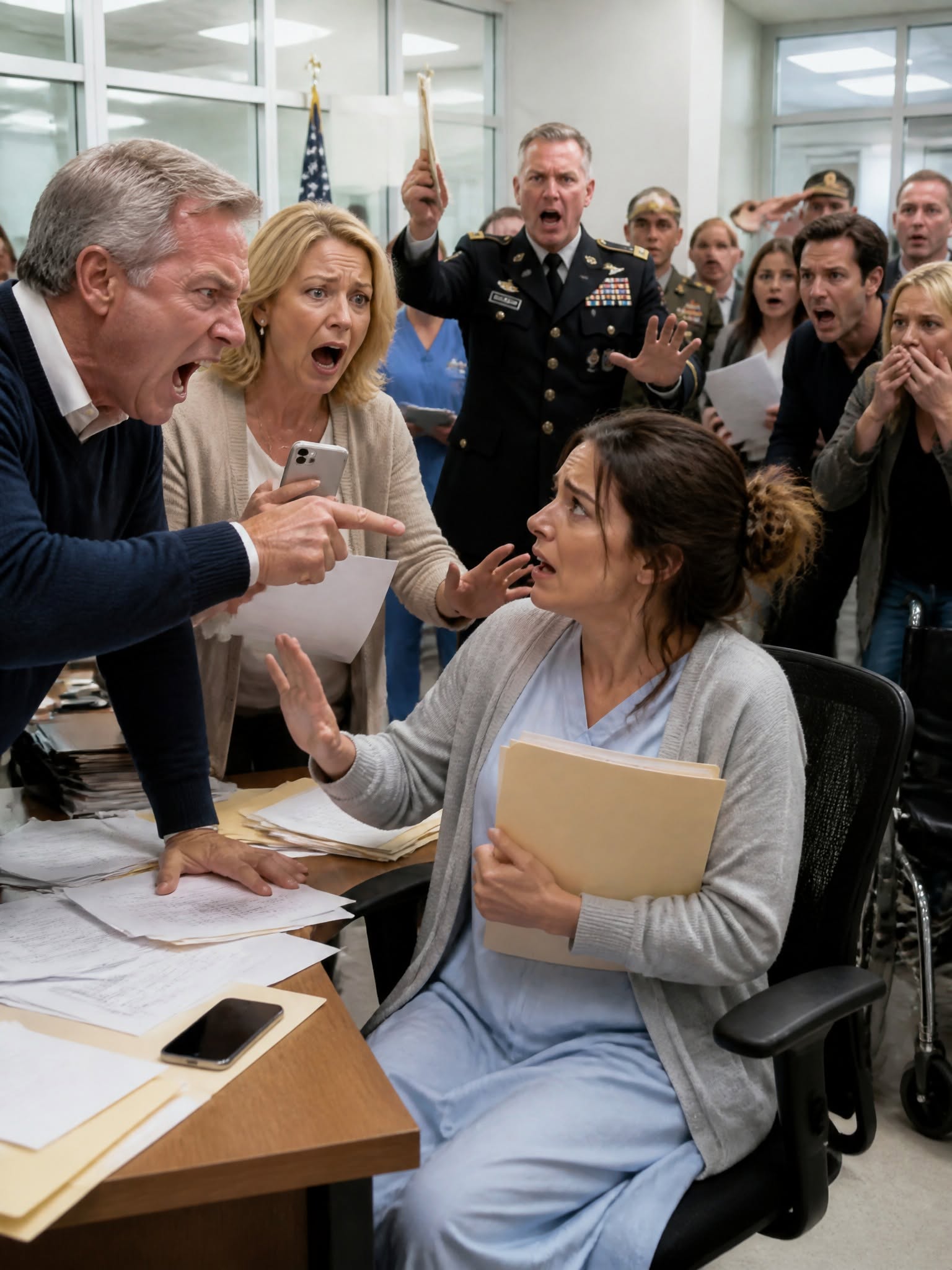
Part 1: Nine Calls from the ICU
The first thing I heard was the monitor beside my bed.
Beep. Beep. Beep.
The ceiling lights blurred above me, my throat felt raw, and pain pulsed through my hip, ribs, and bandaged abdomen. I remembered twisted metal, shouting, and a military evacuation drill that had become a real emergency after a vehicle failure.
I was Captain Mara Ellison, a trauma surgeon assigned to a military medical unit. I had spent years running toward injured people.
That afternoon, I became the patient.
A nurse named Nora noticed I was awake and checked my monitors.
“Do you know where you are?”
“Military hospital in San Antonio,” I whispered.
“And what happened?”
“Our vehicle rolled.”
Her expression softened. “You had surgery. Several fractures and internal injuries, but you’re stable.”
Stable felt like a strange word when every breath felt borrowed.
My phone sat in a clear plastic bag beside my ID and my grandmother’s silver watch.
“Can I call someone?”
Nora hesitated. “You should rest.”
“I need to call my parents.”
She placed the phone in my hand.
My father’s number was saved as Home. Victor Ellison could remember every property his company had bought in twenty years, but forgot my last three birthdays until his assistant reminded him. My mother, Celeste, could be affectionate when affection looked good in photographs, but never liked the parts of my life involving sacrifice, pressure, or anything she could not arrange neatly.
Still, they were my parents.
After coming so close to death, I did not want explanations. I wanted one familiar voice to say, “We’re coming.”
The first call went to voicemail.
So did the second.
By the fourth, I told myself they might be driving. By the sixth, I wondered if my phone was broken. On the seventh, Nora adjusted my blanket and pretended not to see the tears sliding toward my ears.
I called two more times.
Nine calls total.
The last rang long enough for hope to become humiliating. Then an automated voice said the subscriber was unavailable.
I placed the phone on my chest and stared at the ceiling.
Across the country, my younger sister Lena was celebrating her engagement at my parents’ estate outside Boston. I did not know it yet, but later I would see photographs of chandeliers, white roses, champagne towers, and my parents smiling beside Lena and her fiancé, Adrian Cross.
I would also learn that my name appeared nine times on my father’s screen that night.
My mother saw it.
Lena saw it.
They did not miss the calls.
They silenced them.
At the time, all I knew was that I was alone in an ICU room while strangers watched to make sure I kept breathing.

Part 2: The Changed Locks
Six days later, I was discharged with a rib brace, a cane, and strict instructions not to lift anything heavy. A driver from my unit took me to my small cottage outside the base, where I expected quiet walls and the faded green blanket my grandmother had knitted for me.
Instead, my key would not turn.
The lock was new.
An envelope was taped beneath the brass door knocker. My full name and rank were typed across the front:
Captain Mara Ellison.
Inside was a letter from a law office representing Ellison Crest Properties, my father’s company. It said that, as part of an urgent family estate restructuring, my possessions had been removed and transferred to a private storage facility.
My parents had ignored nine calls from my ICU bed.
Then, while I was still hospitalized, they entered my home, packed my life into boxes, and changed the locks.
I stood on the porch with my discharge papers under my arm and read the letter again.
That was when I understood their silence had not been accidental.
They had been waiting for something.
The storage facility sat between a tire shop and an empty warehouse on the industrial edge of town. Inside, a young employee checked my ID and pushed a cart toward me.
“Your delivery came three days ago,” he said. “Twelve plastic containers, four cardboard boxes, one military duffel, and one locked document case.”
Three days ago, I had still been attending daily medical checks. I could barely shower without sitting down, yet my parents had found time to inventory my life.
Everything I owned had been reduced to sixteen containers.
Inside were uniforms, medical textbooks, deployment photos, notes from service members who survived because our teams reached them in time, and a chipped blue mug my grandmother Ruth used every morning.
Near the bottom of one box, I found the faded green blanket.
I pressed it to my face and smelled cedar from the chest where I had stored it. The scent carried me back to Ruth’s kitchen, where flour dusted the counter and the radio played softly by the window.
Ruth Ellison was the only person in my family who never asked what my achievements could do for her.
When I was seventeen, after my father criticized my plan to enter military medicine, she told me, “People notice what you own before they notice who you are. Make sure you never become one of those people.”
I thought she was warning me about wealth.
I did not realize she was warning me about my family.

Part 3: The Trust They Tried to Take
My commanding officer arranged temporary quarters near the base while the cottage issue was investigated. That night, I sat at a folding table surrounded by boxes and organized every document connected to the lock change.
The legal notice mentioned an estate restructuring authorization.
I had never signed one.
The cottage belonged to me. I had bought it eight years earlier using military housing benefits and deployment savings. My father’s company had no authority over it.
When I called the attorney listed on the notice, he sounded uncomfortable the moment I said I owned the house.
“We were given documentation showing Ellison Crest had temporary management authority,” he said.
“Who signed it?”
A pause.
“The file contains your electronic authorization.”
“I never authorized anything.”
He stopped speaking.
I told him to preserve every email, record, and document. Then I called Tessa Monroe, an attorney who handled estate matters for officers on base.
She arrived the next morning with a leather folder and two coffees. She listened as I explained the ICU calls, the changed locks, and the storage notice.
“Do your parents have any reason to think they control your property?” she asked.
“Not that I know of.”
“What about trusts, family partnerships, inheritance documents?”
The word trust pulled at a memory.
I opened the locked document case from storage. Beneath mortgage papers and military records was a sealed envelope in Ruth’s handwriting:
For Mara. Open when you finally need to know.
Inside was a letter and trust documents.
The Ruth Ellison Family Trust had been created five years earlier. Its principal value was just over five million dollars.
I was the sole beneficiary.
Not Lena.
Not my father.
Me.
Tessa read the conditions aloud. The trust could not be transferred by standard power of attorney, electronic signature, or estate proxy. Any release required my physical presence, verified identification, and biometric confirmation.
My grandmother had built it so no one could pressure a clerk, copy my signature, or move the money while I was absent.
Then Tessa requested an emergency audit from the trust administrator.
Two hours later, the report came back.
Someone had tried to access the trust at 10:47 p.m. on the night of my accident.
I knew the time immediately.
At 10:47 p.m., I had been under fluorescent lights, fighting to stay awake while making my ninth call.
The request included a document bearing my signature.
The administrator rejected it because my biometric confirmation was missing.
I looked across the table at Tessa.
“They weren’t waiting to hear whether I recovered.”
“No,” she said quietly. “They were waiting to see whether you would still be necessary.”
My phone rang before I could answer.
My mother’s name appeared on the screen for the first time since the accident.
Nine calls from the ICU had not been enough.
One blocked financial transfer had brought her to me within hours.
Part 4: Flowers and Folders
My parents arrived the next afternoon with flowers, prepared concern, and three legal folders. My father’s black SUV stopped first. My mother’s sedan followed. Then Lena’s white crossover pulled in behind them.
Adrian stepped out in a navy suit despite the Texas heat, adjusting his cuffs like he was entering a boardroom.
My mother held the bouquet against her chest.
“Mara,” she said when I opened the door. “Look at you.”
She reached for me, but I stepped back before her hands touched my ribs.
Her concern faltered.
“We were terrified.”
“Were you?”
My father cleared his throat. “There were communication problems at the party.”
“Nine of them?”
“The estate was crowded. The signal was unreliable.”
The explanation sounded rehearsed.
Lena examined the cottage as if searching for reasons to feel superior.
“We brought flowers,” she said.
“I noticed.”
I let them in because I needed to know what they wanted. Tessa had advised me not to accuse them yet.
“Let them talk,” she had said. “People get careless when they think you’re still confused.”
My mother placed the flowers on the counter without looking for a vase. My father walked straight to the table and arranged the folders in front of an empty chair.
He had been inside less than a minute.
“Mara, before emotions make this harder, we need to resolve a practical matter.”
“What practical matter?”
“A temporary restructuring of family assets.”
The first agreement gave Ellison Crest Properties management authority over Ruth’s trust. The second allowed company executives to use the trust as collateral. The third transferred most of the trust to a holding company controlled by Lena and Adrian after their marriage.
My mother placed her hand near mine.
“This protects you. You’ve never been interested in business.”
“I understand contracts.”
“Military contracts,” my father said. “This is different.”
Adrian leaned against the wall. “The company has several projects moving at once. Your grandmother’s money is sitting unused.”
“It isn’t your money.”
His jaw tightened. “No one said it was.”
The documents said otherwise.
Lena wandered toward the couch and stepped on my military duffel. The edge of her shoe pressed against my unit patch.
She laughed. “You still drag this thing everywhere?”
“Move your foot.”
She nudged it aside. “You’re always dramatic about military stuff. You survived a training accident, Mara. You weren’t storming a beach.”
No one corrected her.
Not my mother.
Not my father.
Not the man she planned to marry.
Pain sharpened in my ribs as I moved the bag myself. I wanted to tell them about the people I had treated, people whose families would have crossed oceans for one more conversation.
Instead, I remembered Tessa’s advice.
“I need time to read everything.”
My father relaxed.
“Of course. Forty-eight hours should be enough.”
My mother smiled as if I had begun to reconcile. Lena photographed the flowers, carefully cropping the legal folders out of the frame.
Before leaving, she posted a picture of my mother touching my shoulder with a caption about healing, gratitude, and family strength.
Nothing about the unanswered calls.
Nothing about the changed locks.
Nothing about the five million dollars.
When their cars disappeared, Tessa stepped out of the bedroom, where she had listened with my permission.
“They never asked how you were feeling,” she said.
“No.”
“They didn’t ask about your recovery.”
“No.”
She looked at the folders.
“They came prepared for a transaction.”
Part 5: The Threat
We sent the documents to the trust administrator. By evening, the administrator confirmed they matched the rejected transfer attempt. The signature resembled mine, but it had been digitally inserted. The file history contained an ID linked to Adrian’s personal device.
Then Tessa received a preserved email from the audit.
Adrian had sent it to my father twenty minutes before my ninth call.
If Mara doesn’t survive the week, the trust passes according to the secondary family provision. Do not contact the hospital until we know whether we still need her cooperation.
I read the message three times.
The flowers still sat on the counter. Their sweet smell made me sick.
My family had not simply ignored my calls.
They had decided my survival was financially inconvenient.
The next morning, my father returned with Adrian. No flowers this time.
Victor entered without waiting to be invited and sat across from my desk. Adrian remained near the door, using height and silence the way insecure men used expensive suits.
“We need to finish this,” my father said.
“I’m still reviewing the documents.”
“You’ve had enough time.”
Adrian placed a new folder on the desk. “Final agreement.”
I did not touch it.
My father looked at the brace beneath my shirt. “You’ve been through a traumatic event. Your judgment may not be reliable.”
“My judgment is fine.”
“Your emotions are not.”
Adrian opened a second folder.
“This is what happens if we can’t resolve this privately.”
Inside was a draft complaint accusing me of mishandling medication during recovery. It included fabricated claims from an unnamed employee and an unsigned request for a formal military investigation.
The accusation was false, but it was not harmless. Even an investigation could delay my return to duty, affect my clearance, and damage a career I had built through years of exhausting work.
Adrian watched my face.
“People hear ‘military physician’ and ‘missing medication,’ and they stop listening to explanations.”
“You manufactured this.”
My father folded his hands. “No one wants to file anything.”
“Then why does it exist?”
“To help you understand the consequences of refusing reasonable cooperation.”
I looked at him.
This was the man whose voice I had wanted in the ICU. I had spent my childhood believing he was distant because he was busy, severe because he was responsible, and controlling because he wanted the best for me.
The truth was simpler.
Victor Ellison loved people only when they stayed useful.
He opened a narrow wooden case and removed a gold fountain pen.
“Sign the release,” he said. “The complaint disappears, the property issue is corrected, and this family moves forward.”
“And if I refuse?”
Adrian answered first.
“Then you may lose the uniform you care about more than your own family.”
A recorder, legally placed on my desk in my own home, captured every word.
I let my hands shake because fear was what they expected.
“I need more time.”
Adrian sighed. “For what?”
“To understand what I’m giving up.”
My father and Adrian exchanged a glance. They thought pressure had finally worked.
“We’ll give you until tomorrow,” my father said.
After they left, Tessa retrieved the recorder. Colonel Daniel Reeves, my commanding officer, joined by secure video and listened without moving.
When the recording ended, he asked, “Are you in immediate danger?”
“No, sir.”
“Do you believe they’ll file the false complaint?”
“Yes.”
He nodded once. “Then we document everything before they do.”
The next twelve hours moved with military precision.
My medical team preserved pharmacy logs and treatment records proving every medication was accounted for. Tessa contacted financial crime investigators already reviewing the forged trust documents. Property records confirmed my father’s company had used fraudulent authorization to remove my belongings. The storage company preserved surveillance footage showing Ellison Crest employees supervising the move.
By midnight, it was no longer my word against theirs.
It was a chain of evidence.
The next afternoon, I called my father.
“I’ll sign,” I whispered.
His relief came too fast. “You’re making the right decision.”
“I want to do it at Lena’s engagement gala.”
Silence.
Then: “Why?”
“Everyone thinks I’m fighting the family. I want them to see I’m choosing peace.”
My father loved public victories. I could almost hear him imagining applause.
“That would mean a great deal to your mother,” he said.
“I want the full family there. Lena, Adrian, the company board, everyone involved.”
“They’ll be there.”
After the call, Tessa studied me.
“They’ll think they’ve won.”
“That’s the point.”
They had chosen a ballroom filled with investors and friends as the stage for my surrender.
They did not know investigators would be in that ballroom too.
And they did not know the document I planned to sign was not a trust release.
It was a statement confirming I had never authorized them to touch a single dollar.
Part 6: The Gala
Planning gave me something pain had taken away: control.
My ribs still burned when I stood too quickly. Sometimes the soft beep of a microwave dragged me back to the ICU before I could stop it. But every morning, I got dressed, reviewed evidence, and reminded myself that surviving had given me choices.
Colonel Reeves met me in a base conference room with Maya Stone, a financial crimes investigator, and two members of her team.
Maya reviewed the forged signature, access logs, false property authorization, and desk recording.
“The trust attempt is not the only offense,” she said. “Your family’s company used fraudulent documents to enter your home and remove your possessions. The draft complaint may support coercion charges.”
“It still feels unreal.”
“That’s common when the people responsible are family,” Maya said. “You keep searching for an explanation that hurts less than the evidence.”
She was right.
Part of me still wanted to believe my mother had argued with my father after seeing the calls, or Lena had asked whether I was safe, or my father had misunderstood the hospital notification.
But the records showed no argument.
At 10:12 p.m., my mother texted my father:
Mara is calling again.
He answered:
Silence it. We cannot deal with her tonight.
At 10:39, Lena wrote:
If she dies, does the trust come to me automatically?
Adrian replied:
Most likely, but her cooperation is cleaner.
The messages were not emotional. That was what made them so hard to read.
They had discussed my possible death like a delayed property closing.
Maya pushed the records toward me. “You don’t have to attend the gala.”
“I know.”
“Then why go?”
“They’ve spent my life making me look unreasonable whenever I objected to being mistreated. If I disappear quietly, they’ll say I was unstable, injured, and confused. I want the facts presented where they planned to present their lie.”
Colonel Reeves looked at me. “Justice or revenge, Captain?”
“Justice,” I said. “Revenge would be hurting them because I can. Justice is stopping them from hurting me again.”
The night before the gala, I opened my uniform bag. My dress uniform smelled of cedar and pressed fabric. I ran my hand along the sleeve and remembered Ruth pinning my insignia in place years earlier.
“You earned this before you put it on,” she had said.
I dressed slowly the next evening, careful around my injuries. Each medal and ribbon represented a place, a person, or a moment my family had rarely asked about.
The uniform did not make me invincible.
It reminded me I had existed before their approval and would continue existing without it.
Before leaving, I fastened Ruth’s silver watch around my wrist.
Tessa met me outside.
“You can still change your mind.”
“I won’t.”
“Because you need to prove something?”
“No,” I said, looking back at the boxes visible through the cottage window. “Because I’m finished letting them decide what the truth looks like.”
The Hawthorne Ridge Club stood on a hill beyond bare trees, its tall windows glowing over polished cars. Music drifted through the glass doors.
My sister’s engagement party looked like a celebration.
Behind those doors, my father was preparing to announce my surrender.
Behind me, investigators were preparing to document his confession.
Part 7: The Public Refusal
The ballroom smelled of white roses, perfume, and expensive food. Crystal fixtures hung above polished floors while servers moved through nearly two hundred guests.
My family had never understood intimacy.
They understood audiences.
Conversation softened when I entered in uniform. Some guests recognized my rank. Others stared because I did not match the soft colors Lena had chosen.
My mother crossed the room before I had taken ten steps.
“Mara,” she whispered. “What are you wearing?”
“My uniform.”
“You were supposed to wear the blue dress I sent.”
“I never received a dress.”
Her eyes flicked toward watching guests. “You can’t turn tonight into a military display.”
“I walked through a door, Mother.”
“You know what I mean.”
I did.
She was not worried that I was in pain. She was worried that I looked like someone with a life beyond the Ellison family.
Lena stood near the stage in white silk. Her smile stiffened when she saw me, then recovered.
“My brave sister finally made it.”
The photographer turned toward us.
I stopped beyond her reach.
“Please don’t perform for the camera.”
Her smile vanished.
Adrian appeared beside her. “Did you bring the signed documents?”
“I brought everything necessary.”
His eyes dropped to the folder in my hand, and satisfaction crossed his face before he hid it.
My father approached with two board members from Ellison Crest. He shook my hand as if we had not spoken privately for weeks.
“Mara, I’m glad you found the strength to come.”
His sentence was loud enough for nearby guests.
“I’m glad you invited witnesses.”
His fingers tightened around mine.
“This is not the place for one of your episodes.”
“I haven’t had any episodes.”
“That is not what people have been told.”
Before I could answer, my mother signaled to staff. Two private security guards moved toward us.
One spoke quietly. “Ma’am, we were told there may be a concern involving your health.”
“Who told you that?”
He glanced at my father.
Victor stepped onto the stage before the exchange could continue. The music faded.
“Friends, colleagues, and family,” he began, “thank you for joining us to celebrate Lena and Adrian.”
Applause filled the room.
He spoke about love, partnership, legacy, and the future of Ellison Crest Properties. Then his tone changed.
“Our family has also faced a private challenge. My eldest daughter, Mara, recently suffered a serious accident.”
Faces turned toward me.
“She has struggled emotionally during recovery, and at times that pain has caused her to misunderstand the intentions of those who love her.”
Cold stillness settled over me.
He was doing exactly what we expected.
It still hurt.
“Tonight,” he continued, “Mara has chosen healing over conflict. She has agreed to place the assets inherited from my mother under responsible family management, ensuring Lena and Adrian can protect the Ellison legacy.”
Soft applause began near the front.
My mother smiled.
Lena reached for Adrian’s hand.
My father extended his arm toward the stage.
“Mara, please join us.”
I walked slowly across the ballroom, my boots striking the floor in a steady rhythm. When I reached the stage, he placed the gold fountain pen beside the documents.
“Sign here,” he said quietly.
I picked up the microphone instead.
“You told everyone I misunderstood your intentions.”
His smile stayed fixed. “This is not the time.”
“I think it is.”
Adrian moved toward the presentation controls, but before he reached them, the ballroom doors opened.
Maya Stone entered with her investigative team. Colonel Reeves walked beside Tessa, carrying a sealed evidence folder.
The applause stopped.
My father looked from them to me.
“What have you done?”
I faced the audience.
“My family asked me to make this transfer publicly,” I said. “So the refusal will be public too.”
The screens behind us changed.
The first certified record appeared.
It showed an attempt to take five million dollars from my trust while I was unconscious in intensive care.
Part 8: The Evidence
No one spoke as the timestamp appeared across the screen.
10:47 p.m.
I remembered the phone trembling in my hand. I remembered the automated voice saying no one was available.
My father stared at the screen as if refusing to blink could make it vanish.
The next image showed the forged trust authorization, my copied signature beneath language transferring control to Ellison Crest Properties. Beside it appeared the digital report linking the document to Adrian’s device.
“This is fabricated,” Adrian said.
Maya stepped forward. “The records were certified by the trust administrator and independently verified.”
My father reached for the microphone. “This is a private estate disagreement.”
The screen changed again.
A photo showed Ellison Crest employees removing boxes from my cottage. Another displayed the fraudulent property management authorization used to change the locks.
Guests began whispering. Several board members stepped away from my father.
Then the email appeared.
If Mara doesn’t survive the week, the trust passes according to the secondary family provision. Do not contact the hospital until we know whether we still need her cooperation.
My mother covered her mouth.
Lena shook her head. “I never saw that.”
“You replied to the conversation,” I said.
Her message appeared next.
If she dies, does the trust come to me automatically?
The color drained from her face.
“That isn’t what I meant.”
“What did you mean?”
She had no answer.
Then the final recording played through the ballroom.
My father’s voice filled the room.
“Sign the release. The complaint disappears, the property issue is corrected, and this family can move forward.”
Adrian’s voice followed.
“Then you may lose the uniform you care about more than your own family.”
The recording ended without music or commentary.
Silence did what shouting never could.
It left them alone with their own words.
My father stepped toward me.
“Mara, you are destroying this family.”
“No,” I said. “I am refusing to let you destroy me.”
Maya’s team approached Adrian first, informing him he was being detained in connection with suspected fraud, forgery, coercion, and unlawful access to protected financial assets.
His confidence collapsed.
“This was Victor’s plan,” he said immediately. “He told me the trust belonged to the company.”
Lena turned toward him. “Adrian?”
He would not look at her.
My father attempted to leave the stage, but another investigator stopped him. Victor’s face hardened when he realized the room no longer obeyed his authority.
He looked at me.
“You would really have your own father arrested?”
“You made your choices while I was lying in intensive care.”
“I was protecting everything I built.”
“You were willing to let me die because it made the paperwork easier.”
For the first time, his expression changed.
Not into guilt.
Into shame at being exposed.
After investigators escorted him away, my mother rushed toward me.
“Please tell them I didn’t understand.”
“You saw my calls.”
Tears filled her eyes. “Your father said the hospital would contact us if it was serious.”
“The hospital already had.”
“I was trying to keep the party from falling apart.”
“There it is,” I said.
She stared at me.
“The party mattered more.”
“Mara, please. I’m your mother.”
“You were my mother when the phone rang nine times.”
Lena grabbed my sleeve.
“I didn’t know Adrian forged anything.”
“You knew the trust came to you if I died.”
“I was confused.”
“You were curious.”
Her grip loosened.
Around us, the engagement party collapsed into whispers and hurried exits. The photographer lowered his camera. Servers stood near the walls, unsure what to do with the champagne.
Lena began crying.
“What am I supposed to do now?”
Even then, her first question was about herself.
I removed her hand from my sleeve.
“You’ll have to learn to live without what belonged to me.”
My mother whispered, “Can we talk privately?”
“We had years to talk privately.”
I handed the unsigned transfer agreement to Maya. Then I placed my father’s gold pen in front of my mother.
“Give that back to him.”
I left the stage without another word.
Cold night air hit my face outside.
For the first time since the accident, no one was asking me to save them.
And I finally understood that walking away from my family was not abandonment.
It was evacuation.
Part 9: The Boundary
The criminal case lasted fourteen months.
Ellison Crest Properties tried to survive by removing my father from leadership. Several investors withdrew, projects collapsed, and an audit uncovered other financial irregularities. Victor eventually pleaded guilty to fraud and coercion charges rather than face a public trial. Adrian accepted a separate agreement after providing records showing how long the scheme had been planned.
Their consequences were not as dramatic as the ballroom confrontation.
Consequences rarely are.
They arrived through court dates, frozen accounts, legal fees, business losses, and reputations falling apart piece by piece.
Lena ended her engagement two days after the gala. For months, she claimed Adrian and my father had manipulated her. Investigators found enough messages to prove she had known far more than she admitted. She avoided the worst charges, but lost access to the family company and the lifestyle she treated as a birthright.
My mother called every Sunday.
At first, she left long messages. She said she had been trapped between her husband and daughters. She said she feared conflict. She said families did terrible things under financial pressure.
She never said, “I chose the party over your life.”
She never said, “I saw your name on the phone and silenced it.”
After three months, I blocked her number.
Tessa asked if I was sure.
“Yes.”
“You may never receive the apology you deserve.”
“I know.”
“Does that bother you?”
“Less than hearing excuses.”
I did not forgive them.
For a while, I worried that refusing forgiveness would make me bitter. Then a therapist who worked with injured service members helped me understand that forgiveness and access were not the same thing.
I could stop hoping my parents would become different without inviting them back into my life.
I could stop carrying their cruelty without pretending it had not happened.
Most importantly, I could heal without making recovery comfortable for the people who hurt me.
Physical rehabilitation took nearly a year. The first time I walked across the therapy room without a cane, the fluorescent lights reflected off the floor like they had in the ICU.
For one second, I heard the monitor again.
Beep. Beep. Beep.
Then Nora appeared in the doorway with two paper cups of coffee.
“You look steadier,” she said.
“I feel steadier.”
She had followed my recovery through occasional messages. Unlike my family, she never asked about the money or the case.
She asked if I was sleeping.
If the pain was manageable.
If I needed a ride home.
Small questions can show the difference between concern and performance.
I eventually returned to medicine in a limited training role, then resumed surgical duties. The first patient I treated after returning was a young mechanic injured during a field exercise.
His mother answered the hospital’s call before the second ring. She arrived in house slippers and an old sweatshirt, hair still wet from the shower. She did not care how she looked or who saw her.
She only cared that her son was alive.
Watching her sit beside him hurt in a quiet place I had not expected.
But it also freed me.
The love I wanted from my parents was real. I saw proof of it every day.
They simply had not chosen to give it to me.
I kept Ruth’s trust, but I did not use it to rescue Ellison Crest or restore the family estate. With independent advisers, I created a medical fellowship for military clinicians specializing in emergency trauma care.
The fellowship carried Ruth’s name.
No Ellison Crest logo.
No family photos.
No speeches about legacy.
Just resources for people who ran toward emergencies.
I bought a modest home near a river outside San Antonio. It had a wide kitchen window, uneven wooden floors, and a porch that caught the morning sun.
The first thing I placed inside was Ruth’s blue mug.
The second was her green blanket.
Her silver watch stayed on my wrist.
Two years after the gala, a letter arrived without a return address. My father had written from prison.
He said he was sorry the situation had gone so far. He hoped time would help me understand he had acted under unbearable business pressure.
At the bottom, he wrote:
We are still family.
I read the letter once.
Then I placed it in the fireplace.
Family was not a word someone could use as a key after changing the locks on my home.
It was not a claim on my money, career, obedience, or silence.
Family was who answered when the phone rang.
Family was who came when the room was cold and the machines were loud.
Family was who cared whether I survived even when my survival offered them nothing.
My parents ignored nine calls from my ICU bed because they believed I would always return, explain, forgive, and give them one more chance to use me.
They were wrong.
I survived.
I recovered.
And when they finally needed my signature, I gave them something else instead.
A boundary they would never cross again.
THE END