
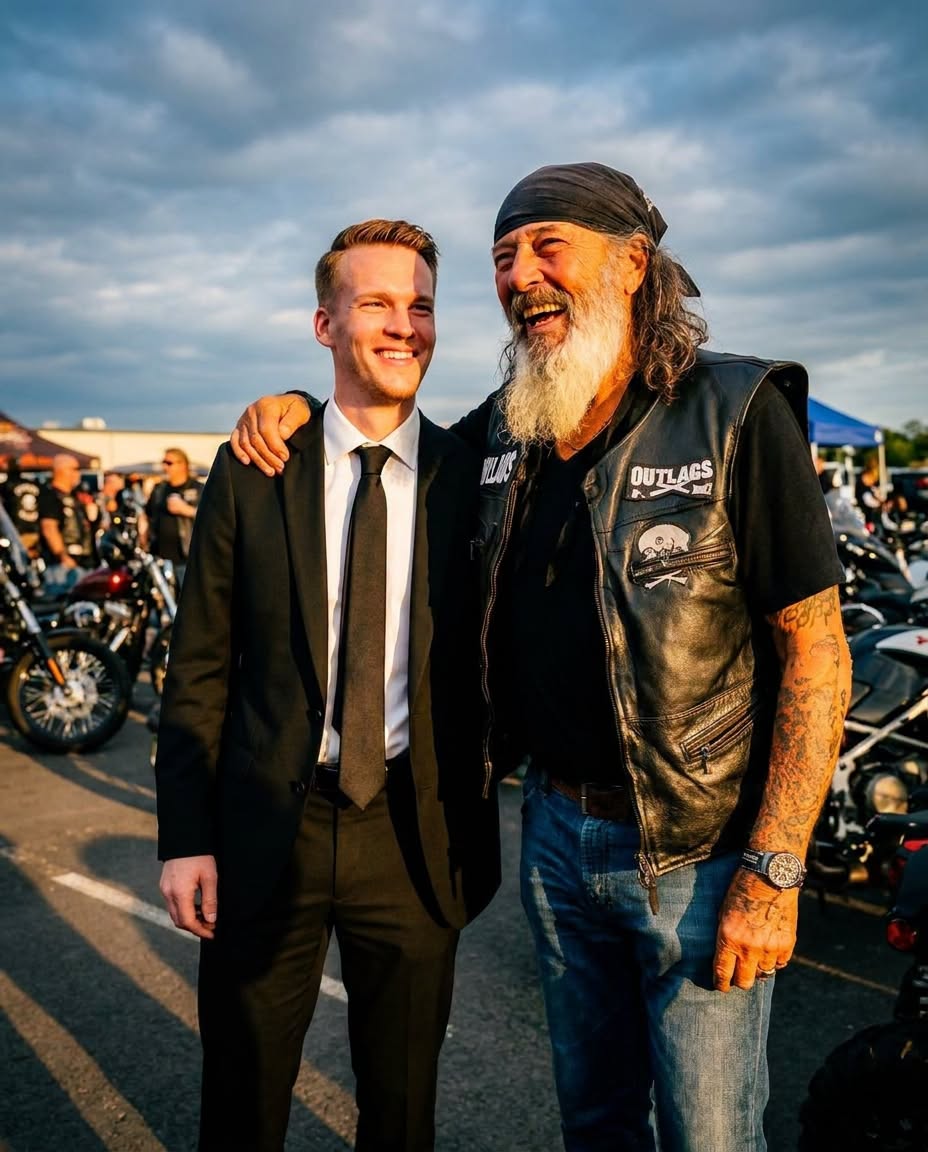
Fourteen-year-old David was digging through a dumpster behind a motorcycle repair shop when a shadow fell across the pavement. He looked up expecting a police officer, an angry owner, or another adult ready to tell him to leave. Instead, a six-foot-four mechanic everyone called Big Mike held out a wrapped sandwich and pointed toward an open toolbox. The shop smelled of motor oil, hot metal, and coffee that had been sitting too long on a burner. Mike did not ask for David’s paperwork, his foster history, or an explanation for the bruises hidden beneath his sleeves. He simply told him that anyone who ate at his table also learned how to work. That afternoon, David picked up a wrench, and the grease pit became the first place that ever felt like home.
Big Mike’s Custom Cycles sat in a worn industrial neighborhood the city preferred to describe as blighted. Behind the scarred workbenches was a small room with a sofa, spare blankets, canned food, and a cabinet filled with school supplies for young people who had nowhere else to go. David stayed there through high school, working evenings, studying at the parts counter, and learning that damaged machines could often be rebuilt if someone was patient enough to understand what had failed. Mike never formally adopted him, but he paid application fees, attended graduation, and sold a prized motorcycle to help cover David’s first semester of college. David eventually earned a law degree and joined a prestigious firm, yet embarrassment followed him into every polished conference room. When colleagues asked about Big Mike, he called him a family friend because admitting he had once slept behind a repair shop felt dangerous in a profession obsessed with appearances.
Years later, the city filed a condemnation action against Mike’s property, claiming the shop reduced surrounding values and violated redevelopment plans. David discovered the notice after Mike casually mentioned that an inspector had photographed the building and asked questions about the teenagers who sometimes stayed there. The city’s offer barely covered the mortgage, relocation expenses, or the investment Mike had made in tools and equipment over three decades. Worse, officials described his back room as evidence of unlawful activity rather than a refuge that had kept vulnerable young people out of far more dangerous places. David returned to the firm with photographs, property records, repair invoices, and a list of former teenagers Mike had helped. Then he stood before the senior partners, admitted that he had once been one of those children, and asked them to help defend the man he had spent years pretending was merely an acquaintance.
The legal team challenged the condemnation through zoning appeals, property valuation reports, insurance records, and evidence that the city had ignored safer alternatives to seizure. In court, David called witnesses who had once slept on Mike’s sofa and had since become teachers, nurses, social workers, business owners, and physicians. Each described receiving food, work, structure, and dignity without being treated like a criminal or a charity project. The city’s attorney argued that good intentions could not excuse unlicensed housing, but David answered that the case was never truly about building codes; it was about officials using redevelopment language to erase people they considered inconvenient. The judge blocked the seizure, required the city to recognize the shop’s community role, and approved a compliance agreement that allowed Mike to upgrade the property without losing it. When delivering the ruling, the judge observed that an institution could be imperfectly documented and still prove, through decades of measurable results, that it was an asset rather than a blight.
Big Mike’s Custom Cycles remains open, though the back room now has proper permits, fire protection, and a small nonprofit fund managed with David’s legal help. One evening, Mike caught a fifteen-year-old trying to steal tools and responded by setting a sandwich on the bench beside him. Then he handed the boy a wrench and told him to start by sorting sockets. David watched from the doorway in a tailored suit, his sleeves rolled back and grease already darkening his fingertips. He no longer separated the attorney he became from the runaway Mike once rescued. The law had protected the building, but the building had first created the lawyer capable of protecting it. Some families begin with birth certificates and shared names; theirs began with an old sandwich, an open toolbox, and one man’s refusal to throw a frightened child away.

