
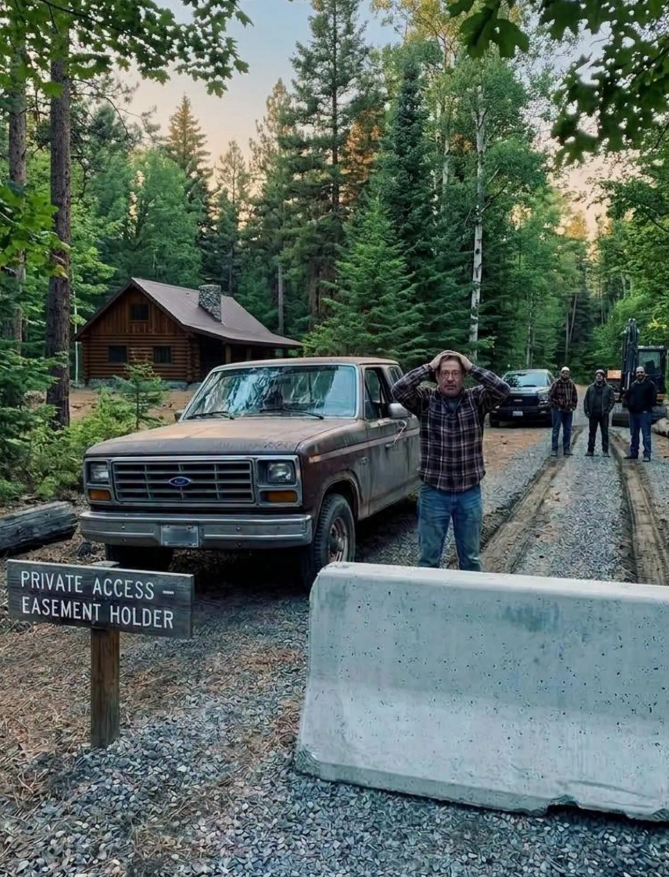
The first strike of the hydraulic jackhammer sent a crack through eleven inches of concrete and a tremor through the ground beneath my boots. Gray dust rose between the pine trees as the demolition crew broke apart the foundation that had blocked the only road to my home for nearly two months. Across the property line, Daniel Harper stood on his porch in a bathrobe, watching every piece disappear into the bucket of a waiting excavator. His wife, Elise, held up her phone and recorded the scene, although there was nothing left for them to challenge. A district judge had given them 15 days to remove the structure, and they had ignored every one of them. Now the work was happening at their expense, exactly as the order promised. I did not feel victorious—I felt the deep relief of watching my own land become mine again.
I had purchased the seven-and-a-half-acre property near Idaho’s Selkirk Range in 2011 after years of working on a power company line crew. The cabin, well, fencing, and driveway were fully paid for, and a recorded survey clearly showed where my parcel began and ended. For 13 years, I maintained the winding gravel road myself, spending about $900 each spring on fresh stone, drainage repairs, and equipment rental. The neighboring 40-acre lot had remained empty until Daniel and Elise arrived from Chicago in a spotless black SUV and announced plans to build a modern vacation home. Daniel first asked about my driveway while I was clearing a fallen branch from the county road, and the way he studied it made me uneasy. Seven weeks later, I returned from a five-day fishing trip and found a freshly cured concrete foundation stretching nearly 40 feet across it. My cabin was still visible through the trees, but my truck could no longer reach it.
Daniel admitted that his contractor had poured the slab but claimed they believed the ground belonged to them. When I mentioned my survey, he suggested I cut a new path through the woods and told me to handle the disagreement legally if I was so certain. That night, I parked beside the county road and carried my bags through the trees with a headlamp, feeling like an intruder on property I owned outright. The next morning, I took my plat map and survey to Martin “Marty” Keller, a Sandpoint property lawyer with more than 30 years of experience. He traced the boundary with his finger and confirmed that the entire foundation sat inside my parcel—not partly over the line, but completely on my land. Marty sent the Harpers a certified letter giving them 10 days to remove it and restore the driveway. Instead, their Seattle legal team proposed paying me $25,000 for an easement that would allow the foundation to remain, but my answer was immediate: the road that carried me home was not for sale—and Marty’s next discovery proved the foundation had never been an innocent mistake.
Their contractor eventually admitted that no professional survey had been completed before construction began. He had relied on an approximate online parcel map after Daniel told him to get the location “close enough” and resolve the details later. An email from Elise revealed that they expected me to become tired of walking through the woods and accept their arrangement. Marty requested an emergency court injunction, supported by a letter from the local fire district confirming that an ambulance or fire engine could not reach my cabin while the driveway remained blocked. At the hearing, the Harpers’ attorney argued that immediate removal would cause financial harm, affect their construction insurance, and disrupt the mortgage financing tied to their new home. The judge rejected that argument because a contractor’s estimate could not override a recorded survey, a legitimate investment in private property, or a homeowner’s right to emergency access. She ordered the Harpers to remove the slab within 15 days or allow me to hire a crew and recover the demolition bill, gravel costs, attorney fees, and court expenses from them. They did nothing, so on day 16 I hired a crew under a written estimate of $8,700, knowing the judgment would protect both my property and the estate I had worked decades to build.
By the second evening, the last concrete pieces were gone, the roadbed had been graded, and fresh gravel covered the damaged stretch. I drove slowly around the familiar curve until my cabin appeared between the trees, exactly as it had before the Harpers arrived. The lawsuit settled several months later, with Daniel and Elise paying the demolition cost, restoration expenses, legal fees, and compensation for the weeks I had been denied normal access. They listed their property for sale four months after the settlement and eventually returned to Chicago. I saw Daniel only once more at the county building, where he offered a quiet apology without meeting my eyes. I accepted the words, but I did not need them to feel whole again. Every spring, I still spread new gravel over that section of road, and each time my tires carry me home, I remember that boundaries matter most when someone assumes you will be too tired to defend them.