
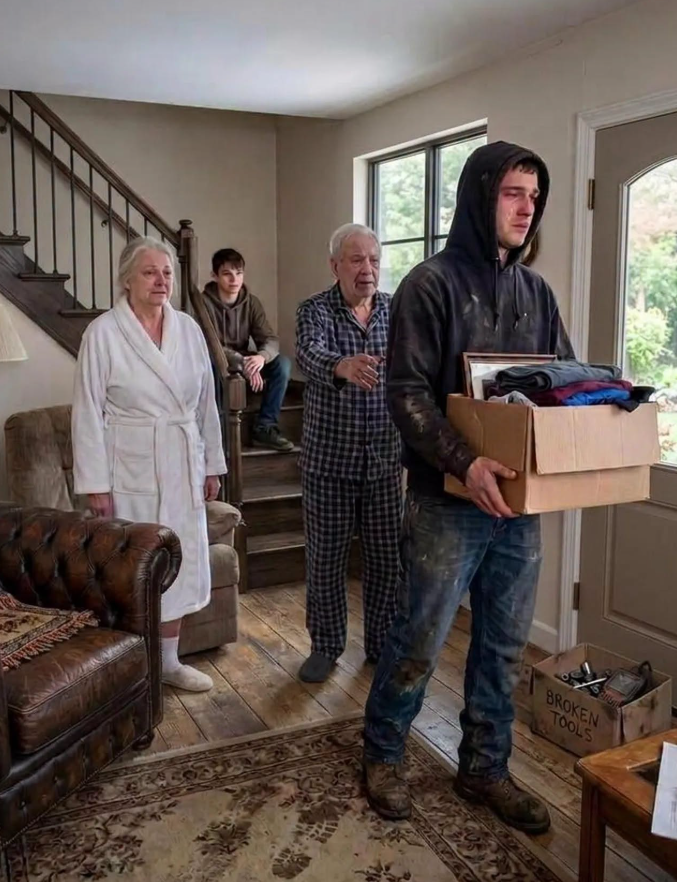
My father stood in the kitchen pointing toward the stairs as though he had already decided how the argument would end. “If you don’t like it here, move out,” he said, certain I would apologize and hand him another envelope on the first of the month. My mother crossed her arms beside him, while my younger brother, Jake, stayed in the recliner wearing the gaming headset I had probably helped pay for. None of them noticed that I was not angry, pleading, or trying to defend myself. I simply looked at my father and said, “Okay.” His expression changed for half a second, but he still believed I would calm down and remain exactly where I had always been. What he did not know was that I had signed a lease two days earlier—and the mortgage payment was due the next morning.
My name is Mike Reynolds, and at twenty-five, I had spent four years paying my parents $800 every month to live in our family home outside Millbrook, Ohio. My father, Gary, had left his job at the grain elevator after developing knee problems, while my mother, Sharon, cleaned houses three days a week. At first, the arrangement sounded reasonable because I worked full time as a diesel mechanic at Koenig’s Diesel and Ag Repair and believed adults should contribute. Then came extra charges: $30 for laundry, $50 for using the driveway, $40 for garage storage, plus vague utility balances and requests for temporary help. Jake, who was twenty and taking only a few community-college classes, paid nothing while my parents upgraded his computer, monitors, lighting, and internet service. I worked sixty-hour weeks repairing tractors, grain trucks, and farm equipment, yet inside that house, Jake was treated like “potential” while I was treated like dependable income.
Everything changed after I came home one Friday and found Jake entertaining friends in the garage. My rolling toolbox had been tipped over, sockets were scattered across the floor, and my $1,100 diagnostic scanner had a badly cracked screen after being used to hold the garage door open. Jake dismissed the damage as no big deal, and my parents defended him before they even asked what the equipment cost or whether I could still do my job. Instead of arguing, I photographed everything and began quietly looking for another place to live. The next morning, I rented a one-bedroom apartment above retired farmer Earl Henderson’s machine shed for less than I had been paying my parents, with a locked storage bay for my remaining tools. While moving my documents and clothes several days later, I passed my mother’s open laptop and saw a bank transaction that stopped me cold: their monthly mortgage payment was exactly $800—the same amount I had handed them every month for four years.
When my father demanded another $50 increase and told me to leave if I objected, I carried out my final bag and drove eleven minutes to my new apartment. The next day, the mortgage company called because no payment had arrived, and my mother finally admitted that my money had been covering the entire loan rather than simply helping with household expenses. Their financial problems ran deeper than I knew: previous late payments had been covered with credit cards, there was little savings, and no reliable investment or insurance plan protecting the family budget. I told her I would not return or finance a house where I no longer lived. Had the dispute reached court, my bank records and payment history could have helped an attorney establish exactly how much I had contributed, although my name appeared nowhere on the deed or estate documents. Without my monthly payment, my parents had to negotiate directly with the mortgage lender, my mother added another cleaning day, and Jake was told to sell part of his gaming setup and find a paying job.
Five weeks later, Jake called to say he had started working at the local tire shop. He apologized for damaging my scanner and spent four months paying me back, one cash envelope at a time. My father never gave me the apology I once believed I needed, but he slowly began treating me more like a son and less like a payment schedule. I still visit my parents twice a month, although I arrive on my own terms and never leave money on the kitchen counter. I remain in Earl’s apartment, where I am finally saving toward a small home with a secure garage of my own. The broken scanner now rests on a shelf as a reminder that helping family should never require surrendering your future. My father thought telling me to move out would end the disagreement, but saying “okay” was the first decision I had made entirely for myself.

