
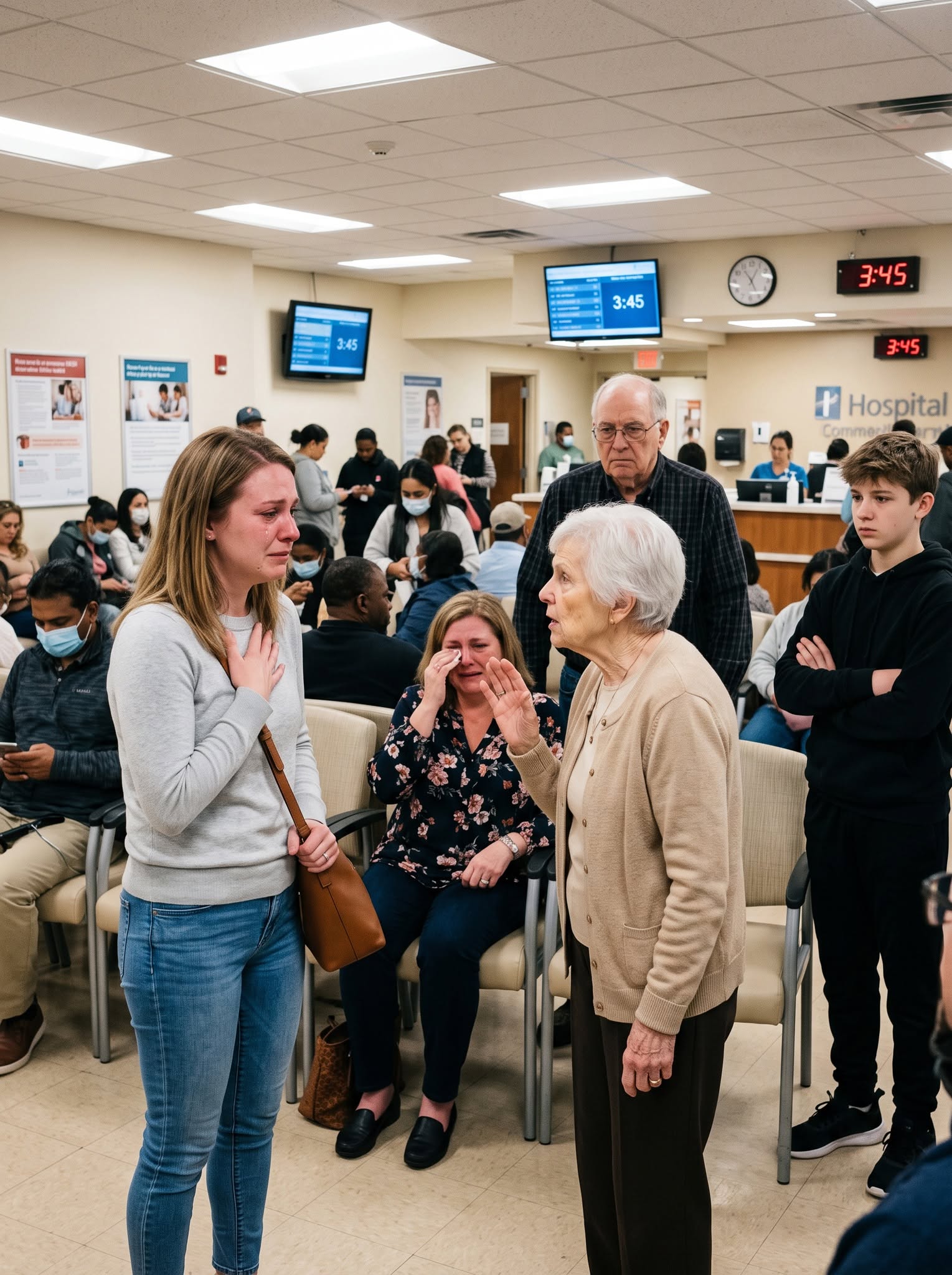
Part 1. The Woman in the Waiting Room
“Finally,” my mother-in-law said when I walked into the hospital room.
Not “Are you okay?”
Not “I’m sorry.”
Only finally.
Across the room sat a woman I had never seen before, dark-haired and tense in a wrinkled silk blouse. She looked at me once, then away. But I saw enough.
No guilt.
A challenge.
The nurse had warned me in the hallway that my husband, Aaron Blake, had not arrived alone. The doctor explained that Aaron had been found unconscious at a private residence across town. The woman who lived there had called 911.
My husband, forty-one, a runner, and supposedly busy with freelance work, had suffered cardiac arrest in another woman’s apartment.
I turned to her.
“I’m his wife. Who are you?”
She said nothing.
My mother-in-law, Denise, stepped between us and told me this was not the time. My father-in-law and Aaron’s brother stood beside the stranger like they had all agreed on their roles before I arrived.
That was the first time I understood I had walked into more than a medical emergency.
I had walked into the other half of my husband’s life.
Part 2. The Death and the Truth
In the family waiting room, Aaron’s father immediately began discussing the care Aaron would need when he came home.
I interrupted quietly.
“I just learned my husband had a heart attack in another woman’s home. Can we wait five minutes before planning his recovery?”
Denise looked toward the woman in silk.
“She has been Aaron’s friend for years. It means nothing.”
Years.
No one corrected her.
That single word split my marriage apart before Aaron ever died.
At 4:16 the next morning, the doctor told us they had done everything they could. A second cardiac episode had been too severe.
I sat in the plastic chair and felt nothing at first.
Not because his death meant nothing.
Because too many truths had arrived at once.
My husband was dead.
My marriage had been a lie.
And the woman who knew where he had spent his final evening still had not apologized.
3. The Family Bill
By noon, Denise was already talking about funeral deposits. Aaron had always wanted to be buried in the family plot, she said. The funeral home needed payment immediately. Naturally, she expected me to handle it.
My sister looked at her and said, “He was your son.”
Denise’s mouth tightened.
“She was his wife. She controls the accounts. We don’t.”
That was true.
I controlled the accounts because I had built them.
The mortgage came from my salary.
The utilities came from my salary.
The groceries Denise ordered twice a week went on my card.
Even my father-in-law’s truck insurance was paid with money I earned.
Aaron had freelanced for years, and I had structured our entire life around my income while telling myself that supporting him was what a devoted wife did.
Now his family expected me to finance the final performance too.
4. The Other Life
Over the next three days, I found emails, receipts, and a photo album still linked to our family tablet.
Restaurant dinners.
Weekend trips.
A bracelet I had never seen.
The woman’s name was Camille.
She and Aaron had been together for two and a half years.
Worse, his family had known enough to lie.
Denise had met Camille at a barbecue two summers earlier. They introduced her as one of Aaron’s colleagues. I remembered that day because I had been working on a deadline and sent Aaron with pasta salad.
When he came home, he said it was nothing special.
Nothing special.
On the fourth day, Camille called me.
“I think we need to meet,” she said. “There are things you should understand about Aaron’s wishes.”
“I understand what Aaron wanted,” I replied. “I was married to him.”
“He seriously discussed changing his beneficiaries.”
I ended the call and contacted my attorney, Maren Price.
Maren asked one question: “Did he actually change them?”
No.
The life insurance, retirement accounts, and investments still named me.
Aaron had talked.
He had not acted.
5. The Declined Card
Denise called again about the funeral deposit. The amount was large, for a service I had not chosen, arranged by people who had treated my financial support as an entitlement for years.
I told her I needed a few days.
“The deadline is tomorrow,” she snapped.
“Then you will need to cover it, and I will reimburse what I determine is appropriate later.”
Silence.
“You know we don’t have that kind of money.”
“I know.”
Then I called Maren and reviewed everything.
The house was in my name.
The savings account was mine.
The credit cards were mine.
Aaron had only been an authorized user.
So I removed him.
It took four minutes.
The next afternoon, Aaron’s brother called, furious.
“Mom tried to pay the funeral deposit, and the card was declined.”
“She is not an authorized user,” I said.
“She has used that card for years.”
“As a courtesy,” I replied. “That courtesy has ended.”
He accused me of cruelty.
I let him finish.
Then I said, “I am protecting my financial assets during legal uncertainty.”
For the first time in years, my hands shook from doing something difficult, not from fear.
6. No Legal Claim
Two weeks later, Camille sent a certified letter through an attorney. It said she had been in a long-term committed relationship with Aaron and had a reasonable expectation of certain considerations based on promises he had made.
I forwarded it to Maren with one line.
Please respond accordingly.
Maren answered in three precise paragraphs: Camille had no legal claim, and further contact would be treated as harassment.
I never heard from Camille again.
My in-laws tried one more strongly worded letter.
Maren handled it.
That ended too.
7. The House I Left Behind
Four months later, I sold the house.
Not because I had to.
Because I no longer wanted to live inside rooms where love had been performed while betrayal happened in the shadows.
I had painted those walls myself. I knew every creaking floorboard, every stubborn window, every patch of morning light in the kitchen.
But I also knew the truth of that house.
No rearranged furniture could make me forget it.
The market was strong. I sold it for more than I had paid and moved into a smaller apartment on the west side of the city.
No one there knew my name.
No one knew my story.
I painted my bedroom a deep blue-green, a color Aaron had once called too bold.
Every morning, I woke up to that color and felt something inside me settle.
8. The Cost of Being Needed
My in-laws moved in with Aaron’s brother. I did not pay their moving costs. I did not answer calls asking me to reconsider.
I did send Denise one personal check—three months of what I calculated I had been contributing to their expenses.
It was less than she expected.
More than I owed.
She never thanked me.
That was fine.
I had not sent it for thanks.
I went to therapy every Tuesday for seven months with Dr. Laila Okoro. I learned that Aaron’s betrayal was not only the affair.
It was the life I had built around supporting something that was never what I thought it was.
He had allowed his family to depend on me because it kept me obligated.
Too busy.
Too responsible.
Too needed.
Too exhausted to look closely.
When the structure that keeps you blind is removed, you have to decide what to do with the view.
9. The Better Investment
Eight months after Aaron died, I got the promotion I had been passed over for twice before. In the past, I had reduced my schedule or declined travel to manage his family’s needs.
This time, nothing stood in the way.
I took the role.
I traveled.
I made decisions.
I was good at it.
And for the first time, I allowed myself to know that.
My sister calls every Sunday. Old friends have drifted back. It turns out that when you are no longer exhausted, you become someone people can reach again.
I am not a cautionary tale.
I simply know the difference now.
Know what is yours.
Not just money, though money matters.
Your time.
Your energy.
Your attention.
Your care.
Know when you are giving freely, and when you have been arranged into giving.
Know the difference between love and infrastructure.
I learned that lesson at four in the morning in a hospital waiting room, watching my husband’s other life rearrange itself around his absence while everyone expected me to pay.
I did not pay.
I built something new instead.
That was the better investment.

