
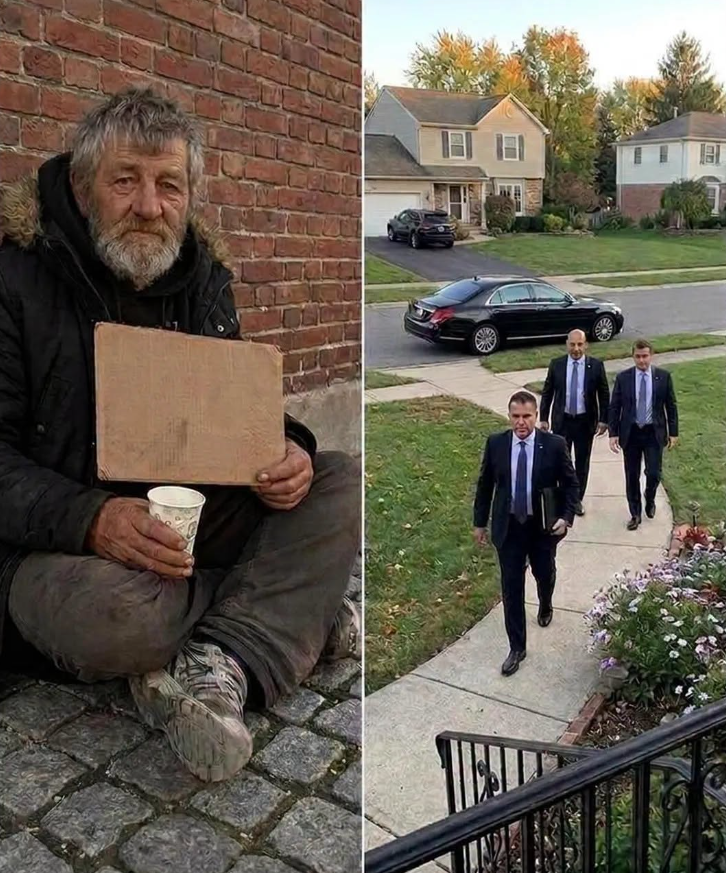
The three black SUVs rolled into my driveway at exactly seven the next morning, their dark windows reflecting the sunrise. Men in tailored suits stepped onto the gravel while my seven-year-old son, Eli, pressed himself against my side. Only hours earlier, I had finished a double shift at the diner with $23 in my pocket—barely enough for milk, bread, and a few dollars of gas. At a Route 9 station, I saw an older man trembling beneath a heavy coat despite the July heat, and I placed my last $20 into his hand. Before I walked away, he looked into my eyes and whispered, “Your father would be proud of you, Sara.” I had never told him my name, and I had grown up believing my father abandoned us before I was born. Now a polished stranger named Arthur stood on my porch holding a leather folder bearing my full name.
Arthur claimed the man from the gas station was Marcus Hale, my biological father, who had passed away overnight and named me as the sole beneficiary of his estate. Then his voice became urgent. He said Marcus had left behind lawsuits, hidden debts, and federal scrutiny that could destroy a working mother like me. If I signed a waiver immediately, Arthur’s firm would give me $75,000 and remove my name from everything before creditors discovered me. The offer sounded like salvation until he mentioned social workers and questioned whether my income was enough to provide Eli with stability. That was when I realized he was not protecting us—he was frightening me into surrendering something valuable. I tore the waiver in half and ordered him off my property, but as the SUVs disappeared, my fingers brushed against a folded envelope hidden inside my jeans pocket.
Marcus had slipped it there when I leaned toward him at the station. Inside was a letter, a private trust agreement, and the telephone number of an independent attorney. He explained that Arthur had controlled him for years through a financial scheme, forcing him to stay away while convincing my mother that he had chosen to leave. Marcus had quietly preserved his investment portfolio, insurance benefits, real estate holdings, and business interests inside a protected trust for Eli and me. The estate carried no secret mortgage or personal liability that could be transferred to us, despite Arthur’s warning. Recorded conversations and financial documents had already been delivered to outside counsel for review in court. When I called the number, the attorney confirmed that Arthur had attempted to redirect the trust and that investigators were preparing formal action against him.
The transfer took months, and I refused to make any major decision until every document had been reviewed. Eventually, Eli and I moved into a comfortable home with a backyard, but the greatest gift was not the money. It was learning that my father had watched from a distance, remembered my life, and found one final way to tell me the truth. I placed Marcus’s photograph beside Eli’s school picture and kept his letter in a wooden box nearby. The $20 I gave him could not change his final night, yet it gave us one honest moment together before time ran out. I had believed kindness was something only people with extra money could afford. Marcus taught me that sometimes the smallest gift opens the door to everything that was hidden.

