
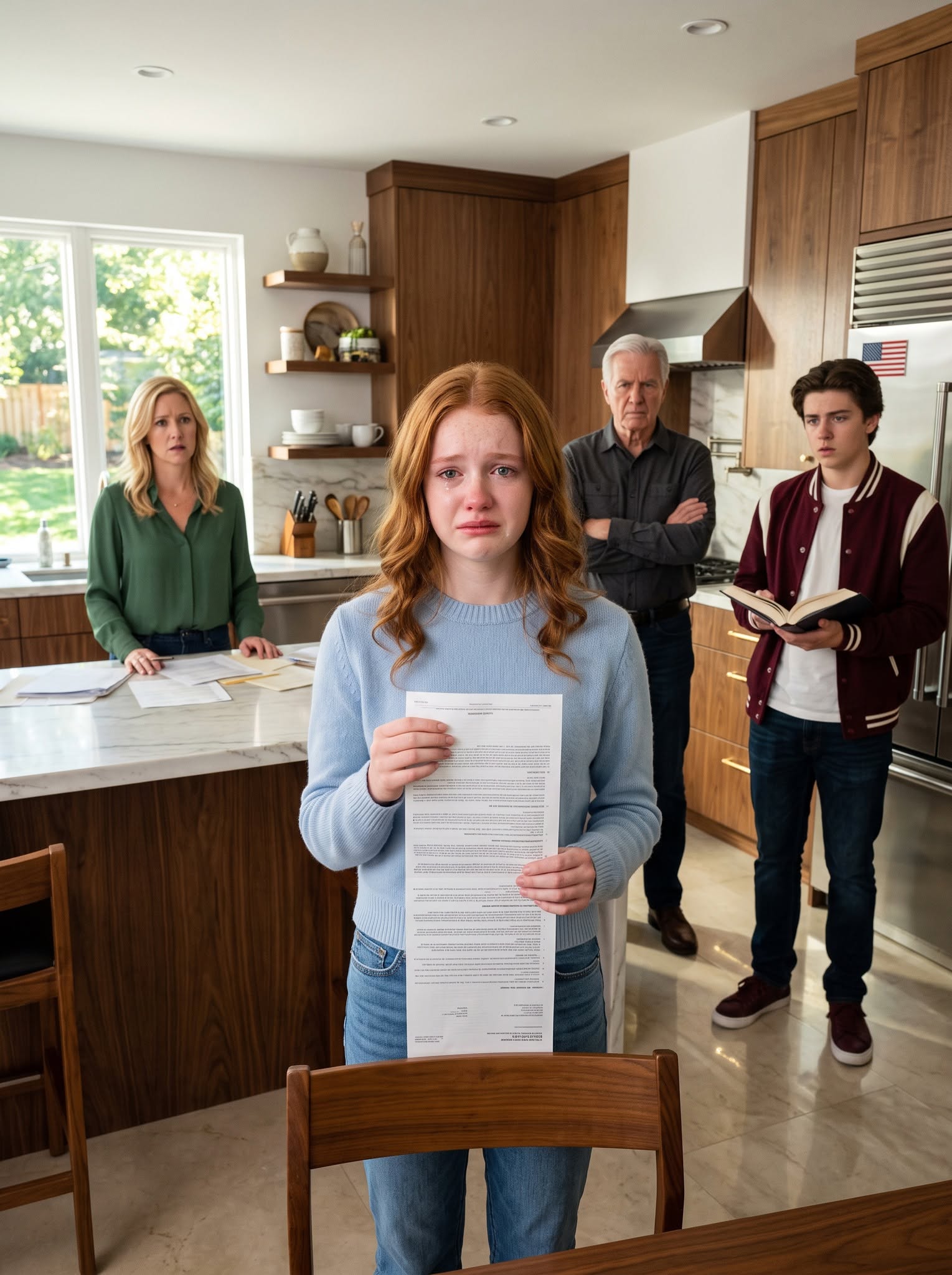
Part 1: The Daughter They Chose to Lose
I was fifteen years old when I discovered that, in my family, my brother’s college fund mattered more than my future. Even now, I can remember every detail of that afternoon with painful clarity. Sunlight filtered through the white kitchen blinds in thin stripes, stretching across the oak table where a bowl of polished green apples sat untouched.
My mother, Melissa Hart, rested her folded hands beside a letter from the insurance company while my father, Victor, stood behind her chair with his arms crossed. Their expressions were calm, almost businesslike, as though they were preparing to discuss an ordinary household expense instead of deciding what would happen to their daughter’s life.
They had just finished speaking with the insurance company. The treatment my specialist recommended would not be fully covered, and I already understood it would cost far more than we could casually afford. What I also knew was that my parents had savings, an account they had proudly talked about for years whenever the conversation turned to my older brother, Caleb, and the future they had carefully planned for him.
“What happens now?” I asked.
Mom glanced at the insurance letter before lifting her eyes to meet mine.
“We’re not going to move forward with the treatment,” she said.
For a moment, I thought I had misunderstood her. I assumed she meant we would seek another opinion, appeal the insurance decision, or find a different hospital.
“What do you mean?”
She released a quiet breath.
“Your father and I have talked about it. We believe that if this is meant to work out, a way will present itself.”
I turned to Dad, hoping he would say something different. He had always been the quieter parent, not because he disagreed with Mom, but because silence allowed him to avoid responsibility for decisions he fully supported. After a long pause, he rested one hand on the back of her chair.
“We can’t spend everything on this,” he said. “Caleb starts university next year. Tuition, housing, books, transportation—it is all planned. We made commitments.”
The refrigerator hummed softly behind me while Caleb’s music drifted downstairs from his bedroom. The ordinary sounds of the house felt strangely distant.
“You have the money,” I said.
“It is not that simple,” Mom replied.
“It sounds simple.”
Dad’s jaw tightened.
“We cannot throw away your brother’s future.”
The room seemed to fall silent after those words. I stared at him, waiting for him to realize what he had just admitted, but he never corrected himself. Mom said nothing either, and the insurance letter remained perfectly aligned with the edge of the table, as though its careful placement could somehow make their decision seem reasonable.
“My treatment is throwing away his future?”
“That is not what your father meant,” Mom said.
“It is exactly what he meant.”
“Elena, do not turn this into an accusation.”
I looked from one parent to the other, searching for hesitation, doubt, or even regret. I found none. Their expressions were composed, almost rehearsed, as though this conversation had already been settled long before I entered the room.
“You’re choosing his education over me.”
Mom frowned.
“Do not say it like that.”
“How should I say it?”
“This is not a choice between two children. We are making the most responsible decision we can with limited resources.”
I pointed toward the insurance letter.
“That treatment is what the doctor said I need.”
“And doctors recommend the most aggressive options,” she replied. “They have to. That does not mean every family can destroy its finances following every recommendation.”
My fingers tightened around the edge of the table until they felt numb. Upstairs, Caleb’s music grew louder, and Dad glanced toward the staircase before answering.
“Your brother has worked hard for this opportunity.”
“So have I.”
Neither of them responded.
Caleb had always been the center of our family, although I had spent years pretending not to notice. When he struggled with school, my parents hired tutors without hesitation. When I earned excellent grades, they treated them as the minimum they expected. He received new laptops, new shoes, birthday celebrations, and driving lessons, while I learned to be grateful for repaired sneakers, outdated electronics, forgotten promises, and constant reminders that my turn would come later.
I survived those disappointments by asking for less. I convinced myself that if something truly important ever happened, the difference between us would disappear. Instead, my illness proved exactly how wide that gap had always been.
Mom slid the insurance letter into a folder and closed it neatly.
“We are not discussing this all evening,” she said. “You are upset, and that is understandable. You need time to calm down.”
I pushed my chair away from the table and stood.
“Elena,” she warned.
Ignoring her, I looked directly at Dad.
“Are you really doing this?”
For a brief moment, he met my eyes before looking down at the folder in Mom’s hands.
“We are doing what we think is best for the family.”
Until then, I had always believed that no matter how differently Caleb and I were treated, I still belonged to that family. Hearing those words made me realize something I had never allowed myself to believe. My parents could say the word family without including me in it.
I walked upstairs without another word. Caleb’s bedroom door was closed, a thin strip of blue light shining beneath it, while family photographs lined the hallway, nearly all of them celebrating his accomplishments. I appeared in only a couple of older pictures near the staircase, taken before I learned how easily a person could become invisible inside her own home.
After closing my bedroom door, I sat quietly on the edge of the bed and waited. I didn’t slam the door or raise my voice because I refused to give them an excuse to describe this as nothing more than a teenager’s emotional outburst.
No one came after me.
For the next hour, the house continued exactly as it always had. Cabinets opened downstairs, water ran through the kitchen sink, the television filled the living room with canned laughter, and my mother began preparing dinner. That ordinary routine stayed with me longer than any argument because she had just told her sick daughter that the recommended treatment would not happen, then calmly moved on to deciding what everyone would eat that evening.
As the sunlight outside my window slowly faded into gray, I expected fear to overwhelm me. Instead, an unsettling sense of clarity settled over me. I realized that if I wanted to survive, I could no longer depend on my parents changing their minds because they genuinely believed they had already made the right decision.
I opened my old laptop and spent hours searching for answers. I looked up whether a minor could consent to medical treatment, what legally qualified as medical neglect, whether another relative could request emergency guardianship, and if foster care would cover necessary treatment. Every answer pointed toward complicated legal procedures, waiting periods, paperwork, and adults willing to help, but I wrote down every phone number and photographed every medical document I owned.
By the time I finished searching, I had made two decisions. The first was to protect my medical records before anyone could take them away. The second was far more frightening.
I was leaving.
There was no dramatic breakdown or tearful farewell. I packed two shirts, a pair of jeans, underwear, socks, my phone charger, my school ID, my medical records, and a sweatshirt into an old backpack. Then I emptied the glass jar where I had saved birthday money and cash from helping classmates with essays. The total came to seventy-three dollars, and after counting it twice, I tucked every bill into the backpack’s inner pocket.
Shortly after midnight, the house finally fell silent. I waited until everyone was asleep, slipped the backpack over my shoulders, and looked around my room one last time. The chipped mug filled with pens, the stack of library books beside my bed, and the second-place ribbon from a writing contest suddenly felt like pieces of a life that had already ended.
For years, I believed that if I worked harder, achieved more, and caused fewer problems, my parents would eventually look at me the way they looked at Caleb. Standing there in the darkness, I finally understood that my achievements had never been the issue. Their decision had been made long before that afternoon.
I stepped quietly into the hallway and walked past the family photographs toward the front door. For a moment, I considered leaving a note, but every sentence I imagined ended with the same memory of my father’s voice saying, “We cannot throw away your brother’s future.” No explanation I left behind would change what they believed.
I unlocked the door, stepped into the cool night air, and closed it as softly as I could behind me. The neighborhood was silent, and as I walked farther from the house, I kept expecting a light to switch on or someone to call my name. It never happened.
Part 2: The One Person Who Chose Me
I walked for several blocks before my legs began to shake. I hadn’t eaten since lunch, the backpack felt heavier with every step, and the cool night air settled deeper into my bones. Near a twenty-four-hour grocery store, I found a metal bench beneath a buzzing streetlamp and lowered myself onto it, too exhausted to think about where I would go next.
The store’s automatic doors opened and closed without pause as employees pushed long lines of shopping carts toward the entrance. Delivery trucks rumbled beside the loading dock, and customers came and went carrying bags of groceries, barely noticing the teenage girl sitting alone a few yards away. I pulled my sweatshirt tighter around my shoulders and finally allowed myself to face what had happened.
My parents hadn’t misunderstood my diagnosis or acted in panic. They had spoken with the insurance company, reviewed the costs, discussed their savings, and deliberately decided that protecting Caleb’s college fund mattered more than paying for my treatment. Their calmness hadn’t come from confusion. It came from certainty.
As I sat there, memories I had ignored for years returned one after another. Dad had spent weekends teaching Caleb how to drive while I stayed home washing dishes. Mom helped him build science projects late into the night, but when I asked her to read one of my stories, she promised she’d get to it later. Three weeks passed before I finally threw those pages away myself.
I had convinced myself those moments were ordinary disappointments, the kind every family experienced. Sitting alone beneath that streetlamp with seventy-three dollars in my backpack, I finally understood they had always been pieces of the same story. My parents hadn’t suddenly chosen Caleb that afternoon. They had simply made the choice impossible to ignore.
By dawn, the parking lot slowly filled with commuters carrying coffee cups and gym bags. People walked past me without a second glance, and I realized I had become invisible long before I ever left home. I had spent years learning how to speak softly, ask for less, and disappear whenever someone else’s needs seemed more important than mine.
I pulled out my phone and scrolled through my contacts. For several minutes, I considered calling my school counselor, but I knew that one phone call could trigger investigations, interviews, and the possibility of being sent right back home while adults sorted everything out. I couldn’t risk returning to the people who had already decided my life wasn’t worth the cost.
Then I stopped on one name.
Ruth.
She was my mother’s older sister, someone my parents described as difficult, irresponsible, and incapable of managing her own life. They complained that she worked only part-time, spent too much money feeding stray animals, and lived alone in a tiny apartment. Yet whenever I thought of someone who had ever made me feel seen, I thought of Ruth.
Unlike everyone else in the family, she listened when I spoke. She remembered the books I loved, asked about the stories I wrote, and never interrupted me to praise Caleb instead. When I told her I wanted to become a writer, she mailed me a worn collection of short stories with a handwritten note inside the cover.
Your voice belongs on the page.
I still kept that book hidden in my desk because Mom always rolled her eyes whenever Ruth encouraged me.
One memory returned more clearly than the rest. I was ten years old when Mom accidentally left a phone conversation on speaker while folding laundry.
“We are doing fine,” Mom said. “You do not need to lecture us about parenting.”
“I am not lecturing,” Ruth replied. “I am asking why Elena looks like she has not been hugged in weeks.”
Mom immediately took the call off speaker, but it was too late.
For the first time in my life, someone outside our house had noticed what I had never been able to explain.
My thumb hovered over Ruth’s number. I had no idea whether she could actually help me. Maybe she would let me sleep on her couch for one night. Maybe she could help me contact a social worker or find legal assistance. I didn’t believe she had money for expensive medical treatment, but at that moment, trust mattered more than money.
I pressed the call button.
The phone rang twice before she answered, her voice still thick with sleep.
“Hello?”
I opened my mouth, but nothing came out. The tears I had held back all night finally burned behind my eyes.
“Ruth,” I whispered. “It’s Elena.”
She didn’t ask why I was calling before sunrise.
She didn’t ask what I’d done.
She asked only one question.
“Where are you?”
I looked around the nearly empty parking lot before giving her the address.
“Are you alone?”
“Yes.”
I heard drawers opening and keys rattling on the other end of the line.
“Stay there,” she said. “I’m coming.”
The call ended.
Less than fifteen minutes later, an aging red sedan turned sharply into the parking lot and stopped beside the curb. Clear tape covered one of the rear windows, and the engine was still running when Ruth climbed out. Her auburn hair had been twisted into a messy knot, and she wore a gray cardigan over pajama pants, as though she had left home the instant she heard my voice.
She looked me over from head to toe, checking for injuries before saying a single word. I tried to stand, but my legs had become stiff from sitting in the cold.
Without asking any questions, she opened her arms.
I stepped into them.
She held me tightly, one hand resting against the back of my head, and for the first time since leaving home, I felt completely safe. I hadn’t realized how desperately I needed someone to hold me until that moment.
Ruth didn’t demand an explanation in the parking lot.
She simply said, “Let’s get you warm.”
The drive to her apartment took less than forty minutes. She turned the heater toward me and kept both hands on the steering wheel while quiet music played through old speakers. We barely spoke, and I was grateful for the silence because I wasn’t ready to explain everything that had happened.
Her apartment occupied the second floor of a small brick building. It wasn’t large, but it felt warmer than the house I had just left behind. Books covered nearly every shelf, a yellow lamp glowed beside a worn green couch, and the air smelled faintly of coffee, cinnamon, and fresh laundry.
“I can stay on the floor,” I said. “Just for tonight.”
Ruth set my backpack beside the couch and shook her head.
“You’re taking the bed.”
“I don’t want to put you out.”
“You are not putting me out.”
She handed me clean clothes, a glass of water, and quietly made up the bed without another word. Before leaving the room, she paused in the doorway.
“I’ll be right outside,” she said. “You do not have to talk tonight.”
I curled beneath the quilt, feeling warmth slowly return to my body. My phone rested silently on the nightstand beside me.
My parents never called.
For the first time since my diagnosis, I slept through the entire night.
Part 3: The Cost of Saving Me
The next morning, I woke to the sound of eggs sizzling in a frying pan. Sunlight slipped through the thin curtains, lighting the books stacked against every wall of Ruth’s apartment. She stood at the stove wearing jeans and a navy sweater, calmly preparing breakfast as though having a frightened fifteen-year-old sleeping in her home was the most natural thing in the world.
Back home, breakfast usually meant grabbing a granola bar while Mom reminded me not to leave crumbs by the front door. Ruth simply placed a full plate in front of me without asking whether I was hungry. I hadn’t realized how empty I felt until I finished half the meal in silence.
Only then did she gently ask, “Are you ready to tell me what happened?”
I set my fork down and started from the beginning. I told her about the specialist, the insurance company, the kitchen conversation, and the college savings account my parents refused to touch. Then I repeated the sentence that had followed me out of the house.
“We can’t afford both,” I said. “Dad said they couldn’t throw away Caleb’s future.”
Ruth never interrupted. She listened to every detail, including the hours I had spent researching youth shelters, emancipation, emergency guardianship, and every possible way to receive treatment without depending on my parents. When I finally showed her the photographs of my medical records, she quietly studied each page before setting my phone back on the table.
The apartment fell silent for several seconds before she spoke.
“You’re not going back there.”
It wasn’t a question.
I looked around the small apartment with its single bedroom and narrow kitchen before shaking my head.
“But there’s barely enough room,” I said. “And the treatment costs…”
She raised one hand, stopping me before I could continue.
“Do not worry about what I do or do not have. Worry about staying alive. We will figure out the rest.”
The certainty in her voice broke something inside me. She didn’t suggest discussing everything with my parents again. She didn’t ask whether I might have misunderstood them. She believed every word I said without demanding proof beyond the truth already sitting in front of her.
That same afternoon, Ruth began making phone calls. She contacted my specialist, spoke with hospital financial counselors, reached out to legal-aid organizations, and found a family-law attorney willing to explain our options. Every conversation sounded almost identical.
“She is fifteen. Her parents have declined to pay for recommended care. She is staying with me. Tell me what documents you need.”
Whenever someone quoted another expense, Ruth simply wrote the number onto a yellow legal pad before asking what payment plans were available. By evening, the paper had become a carefully organized list of treatment costs, medications, transportation, legal fees, and everyday living expenses.
Then she carried a metal file box from the bedroom closet and placed it on the kitchen table.
Inside were property records, tax documents, retirement statements, savings bonds, and stacks of financial papers. For years, my parents had described Ruth as someone who barely managed to survive, but the documents told a different story. She wasn’t wealthy, yet she had spent years living carefully enough to build something of her own.
She rented the apartment where we now sat, but she also owned a small condominium across town that she leased to a retired teacher. It had been paid off years earlier.
“You do not have to do this,” I said quietly.
She kept working through the paperwork.
“This is not your responsibility.”
That finally made her look up.
“You are my family.”
“My parents are your family too.”
“No,” she said. “They are adults who made a decision. You are a child who needs help. Those are not equal obligations.”
I stared at the paperwork covering the table.
“If you spend this on me, you could lose everything.”
She closed the calculator and looked directly at me.
“Things can be replaced. You cannot.”
By the end of the week, Ruth had listed the condominium for sale. She never made a speech about sacrifice or expected gratitude. She simply explained that selling the property would allow my treatment to begin sooner, and when a cash buyer appeared, she signed the paperwork without hesitation.
She combined the money from the sale with her personal savings, arranged payment plans for the remaining medical bills, and worked with an attorney to secure temporary guardianship. When the legal notice reached my parents, they responded with a short email saying they wouldn’t oppose the arrangement. They didn’t ask to see me, didn’t request a visit, and didn’t argue that I should come home. They simply wrote that perhaps time apart would allow everyone to think more clearly.
Ruth printed the email, placed it inside the metal file box, and never mentioned it again.
The following morning, she drove me to my first treatment appointment.
Recovery wasn’t dramatic. There were no miraculous breakthroughs or emotional speeches waiting in hospital hallways. There were early mornings, endless appointments, fluorescent waiting rooms, medication schedules, and days when simply walking across the apartment left me exhausted.
Through every appointment, Ruth stayed beside me. She packed water, crackers, extra socks, and a paperback novel before every hospital visit. When I wanted silence, she sat quietly beside me. When I needed to talk, she listened without trying to convince me everything would magically work out.
Late at night, after she thought I was asleep, I often saw her sitting alone at the kitchen table surrounded by bills and envelopes. More than once, she rested a hand against her forehead while staring at a calculator. By morning, however, the paperwork would be neatly stacked away, breakfast would already be cooking, and she greeted me with the same reassuring smile.
I had no way to repay what she was doing.
So I made myself a promise.
If I survived, Ruth would never again worry about paying rent, covering medical bills, or wondering whether her old car would make it through another winter. I had no idea how I would accomplish that, but from that day forward, every dream I had about the future included keeping that promise.
Weeks slowly became months, and little by little, my strength returned. First I could stand long enough to wash dishes, then I could walk around the block without stopping to rest. The first time I carried a bag of groceries up the apartment stairs, Ruth pretended not to notice, but I caught the proud smile that crossed her face as she turned toward the kitchen.
As my body healed, something else quietly changed inside me.
I stopped wondering whether my parents would ever regret what they had done.
Instead, I started wondering what I would do if the truth ever had the chance to catch up with them.

