
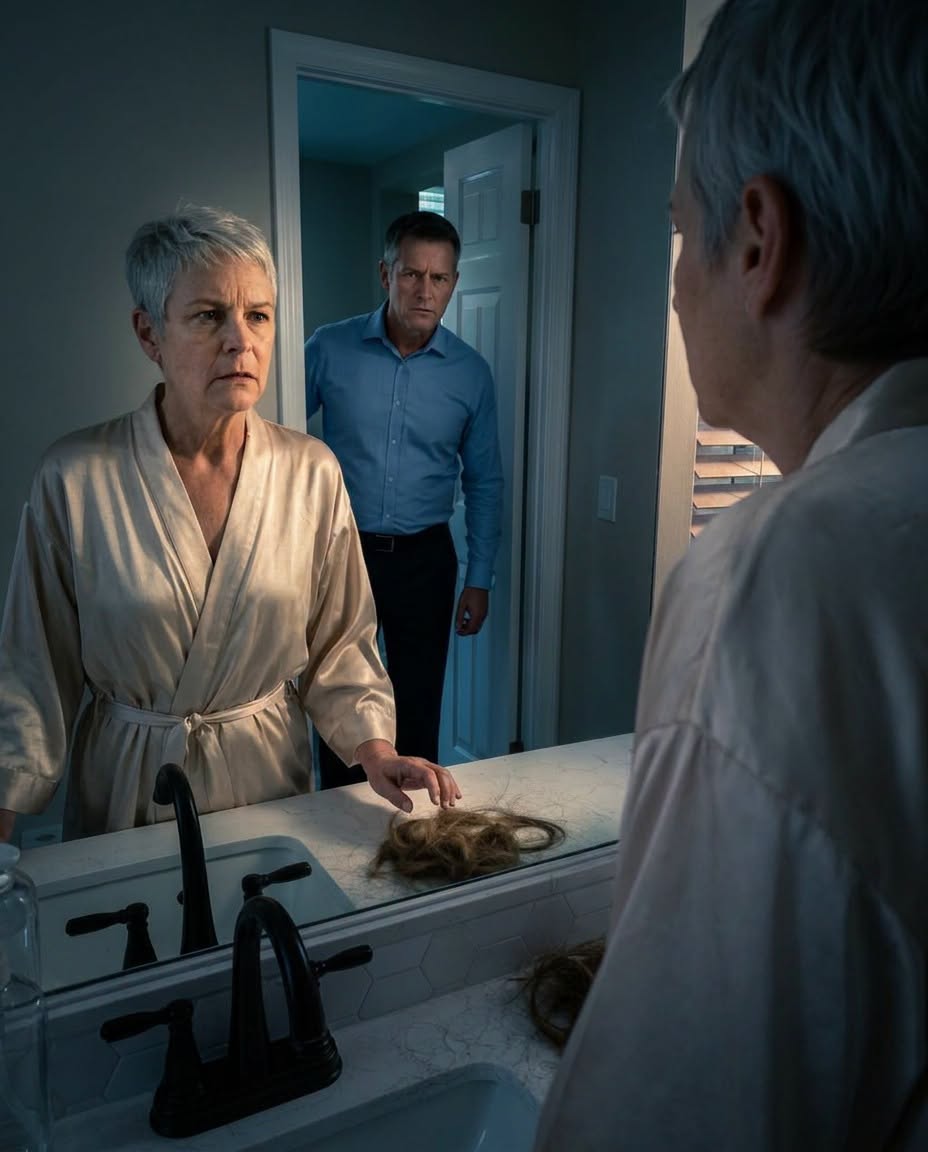
On the morning of our son’s Virginia wedding, I found my wife gripping the bathroom sink while jagged pieces of her silver hair covered the marble and tile. White peonies were arriving outside, rental chairs were being arranged on the lawn, and the clear June sky made the cruelty inside that room feel even more unreal. Maggie’s robe trembled as she looked at me through the mirror and whispered that Brianna, our son’s bride, had done it. The hair had not been trimmed or styled; it had been deliberately hacked away to humiliate her. Maggie still begged me not to confront anyone before the ceremony because she refused to turn Smith’s wedding into a battlefield. I helped her conceal the damage, then went downstairs and watched Brianna calmly eat breakfast while asking whether Maggie was ready for the elegant hairstyle they had planned. In that moment, the litigation attorney in me understood that the ruined hair was not an isolated prank—it was the first visible piece of a much larger pattern.
After the wedding, Maggie gave me a brown envelope she had quietly kept for two years. Inside were screenshots showing Brianna criticizing ordinary calls between mother and son, photographs documenting calculated exclusions, and greeting cards filled with warmth that disappeared whenever no witnesses were present. One birthday message supposedly written by Smith had been copied almost word for word from a draft in Brianna’s handwriting, turning his affection for his mother into something she could manage and control. Most disturbing was a video Brianna had recorded in the bathroom that morning, showing Maggie surrounded by her cut hair and presenting her humiliation online as a joke. I spent the honeymoon week building a careful timeline, separating documented events from assumptions and noting dates, witnesses, and messages as I would for a legal case. My purpose was not to destroy Brianna’s marriage or force Smith to choose sides. I wanted him to have access to the truth only if her behavior continued and he eventually needed to understand it.
When Brianna returned, Maggie and I invited her to our home without telling Smith. She arrived prepared to apologize for the public video, but her confidence faded when Maggie placed the full file on the dining table. Page by page, she saw the texts, photographs, copied birthday message, witness accounts, and two years of conduct arranged in a record she could no longer dismiss as misunderstanding. I told her the folder would remain with me and would be shown to Smith only if the manipulation continued. Faced with the evidence, Brianna stopped defending herself and admitted that she had felt threatened by the closeness between Smith and his mother. She had spent years reducing Maggie in private because making another woman seem smaller temporarily eased her own insecurity. The revelation did not excuse the cruelty, but it created a choice Brianna had avoided until then: continue controlling the family through secrecy, or begin changing before the truth reached her husband another way.
The change appeared slowly through actions rather than promises. Brianna removed the video, began calling Maggie without needing an occasion, encouraged Smith to spend more time with his mother, and stopped using public affection as a performance. Months later, she came to Thanksgiving, helped in the kitchen without seeking praise, and admitted privately that she no longer wanted to build her marriage around a secret. Before Christmas she told Smith that her fear of his bond with Maggie had led her to behave cruelly and dishonestly. Smith called me afterward and asked whether a documented file truly existed; I confirmed that it did but explained that he did not need to see it because the record described what had happened, not necessarily what his marriage was becoming. There was no lawsuit, financial settlement, or formal legal proceeding, yet the disciplined preservation of evidence created the accountability that arguments alone never could. Smith and Brianna remained married, while Maggie regained a relationship with her son that no longer depended on quietly accepting harm.
Maggie’s hair eventually grew back silver, full, and entirely her own. The brown envelope stayed locked in my desk, not as ammunition, but as a protected record of a crisis that might never need to be reopened. Some damage cannot be erased simply because the person who caused it begins behaving differently, and forgiveness does not require pretending the past was harmless. Yet Brianna’s willingness to face what she had done allowed the family to build something more honest than the polished appearances surrounding that wedding day. I had spent my career watching people use evidence to win arguments, but this time the evidence served a quieter purpose. It restored my wife’s dignity without forcing our son into a choice before he was ready to understand it.

