
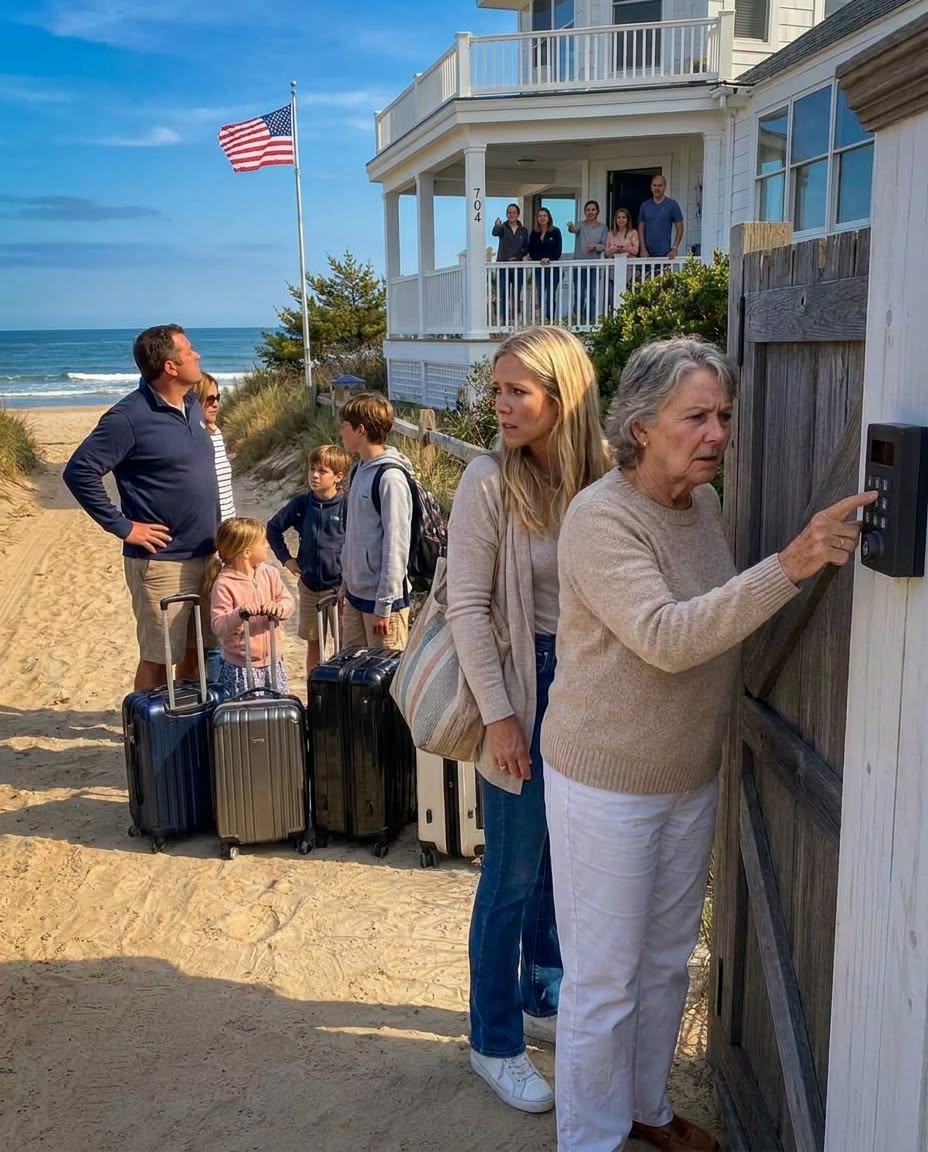
“We’re spending spring break at your beach house—stock the fridge by Thursday,” Vanessa wrote, as though my consent were an unnecessary detail. When I answered with one word—no—she replied with laughing emojis and announced that they were coming anyway. Before sunrise the next morning, I drove to Oak Island, walked through the quiet rooms, and changed the gate code twice to make certain it worked. Then I hired a local security service and explained that several uninvited guests might arrive expecting access. By midday, two cars rolled up carrying children, luggage, Vanessa’s mother, and enough certainty to fill the driveway. Vanessa tried the old code, demanded that I let the children inside, and waited for me to surrender as I always had. I remained behind the locked gate and told her the truth was simple: she had been told not to come.
My name is Clara Whitaker, and at sixty-six the modest seaside house had become more than property after my husband died. It was where my daughter Lily slept peacefully and where our lives felt steady enough to breathe. Vanessa, my daughter-in-law, had spent years turning requests into decisions: grocery money, school fees, car repairs, and a transfer of nearly $3,000 that I discovered only after reviewing my bank records. Each demand arrived wrapped in the word “we,” though the arrangement depended on my money and rarely included my opinion. My son Ethan avoided confrontation and called that silence balance, assuring me everything would settle because I had always helped before. The beach house followed the same pattern, slowly changing in family conversation from my home into “our place,” complete with room assignments for Vanessa’s mother and schedules discussed without me.
What finally disturbed me most was not the money or the house but what the arrangement was teaching Lily. During a family outing, Vanessa’s children announced what they wanted, and Lily quietly stepped backward before anyone had even asked for her preference. She said, “It’s okay,” with the ease of someone accustomed to making herself smaller so everyone else could move forward comfortably. I realized she had not merely been overlooked; she had learned to remove herself before exclusion became visible. When Vanessa later declared that her entire family would occupy the beach house despite my refusal, the pattern was too clear to excuse. My carefully softened boundaries had never failed because they were misunderstood. They failed because everyone had learned there would be no consequence for ignoring them.
The house remained solely titled in my name, and neither Ethan nor Vanessa held any tenancy, ownership interest, license agreement, or contractual right of access. Changing the gate code and engaging private security were not acts of retaliation but reasonable measures to protect privately owned premises after explicit notice had been disregarded. Vanessa tried appealing to inconvenience, the children’s presence, and the distance they had driven, but those facts did not convert an unauthorized visit into permission. Ethan stood between us waiting for the familiar compromise, yet no compromise appeared because my answer no longer moved. After they left, I ended the recurring financial support and refused further transfers that had never been formally agreed upon. I did not threaten, argue, or negotiate against myself; I simply stopped providing access to my property and resources where respect had been replaced by assumption.
The change that followed was quieter than the confrontation. Vanessa contacted me less often once every conversation stopped opening into money, accommodation, or automatic compliance. Ethan admitted he had never expected matters to go so far, and I told him they had not gone anywhere—they had simply stopped moving through my home without permission. Lily gradually began speaking before stepping aside, choosing without apologizing, and allowing herself to occupy ordinary space. Weeks later, we returned to the same beach house, with the same furniture, windows, and sound of water beyond the porch. Nothing new had been added, yet the rooms felt larger because something unnecessary had stopped entering them. I learned that a boundary is not a wall built to punish people; it is the point at which belonging must become respectful rather than assumed.

