
Part 1: The Challenge
The black fighting gloves landed across the toes of my boots with a dull thump.
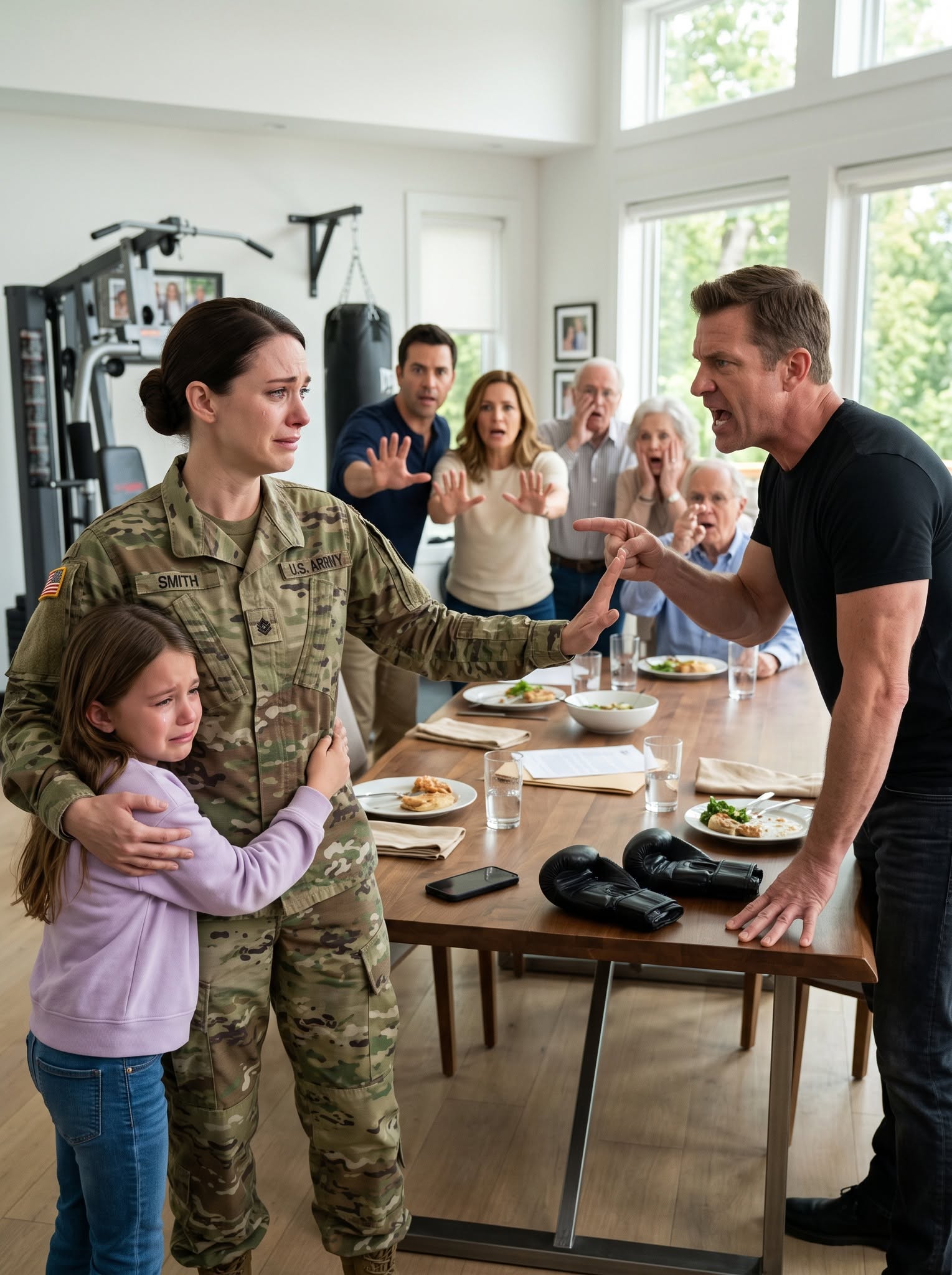
For one second, nobody at the Labor Day barbecue moved. The sprinkler kept clicking over the lawn. Grease hissed on the grill. Forty neighbors stared in silence.
My husband, Grant Whitaker, stood five feet in front of me, red-faced and shaking with anger.
“Put them on, Harper,” he shouted. “Or are you going to hide behind paperwork like the pathetic clerk you are?”
Our eleven-year-old daughter, Lily, stood near the curb, twisting the hem of her yellow shirt in both hands. She was not crying. That was worse. She had the frozen look of a child who had learned that sound could make danger worse.
Behind Grant, his mother, Celeste, laughed.
“Teach her respect,” she called. “A wife who embarrasses her husband deserves a lesson.”
Beside her stood Bianca, the woman Grant had been seeing for almost a year, filming everything on her phone. My own sister, Natalie, stood near them and refused to meet my eyes.
Grant stepped closer.
“Fight me now,” he said, “or I’ll prove in court that you’re too weak to raise my daughter.”
“She is not property,” I said.
His smile vanished.
“I’ll break you in front of her. Then we’ll see who she thinks can protect her.”
Lily made a tiny sound.
That was the moment ten years of restraint burned away.
I set my plate on the picnic table, folded my jacket, and stepped onto the grass in my gray T-shirt and old tactical boots.
No gloves.
No speech.
No raised fists.
I looked past Grant toward Lily.
“Go stand beside Mr. Bennett.”
Our seventy-two-year-old neighbor, Henry Bennett, opened his arm. Lily ran to him, and he placed himself between her and the lawn.
Only then did I look back at Grant.
“One rule,” I said.
He smirked. “What?”
“When you want me to stop, tap the ground three times.”
The crowd laughed.
Grant did not know about the locked case beneath my kitchen floor. He did not know why I counted exits in every room or never sat with my back to a window.
He knew me only as a quiet government clerk with an old SUV and a brown paper lunch bag.
That was the woman he thought he had trapped.
Ninety seconds later, Grant was on the ground, gasping as his palm struck the grass.
Once.
Twice.
Three times.
But the real destruction did not begin when he tapped.
It began when Celeste called the police and claimed I was a violent nobody who had attacked her innocent son.
Part 2: The Safe Zone
Four months earlier, Lily and I had moved into a small two-story house at the end of a quiet Virginia cul-de-sac.
The counters were scratched. The hallway leaned slightly. The basement smelled of old rain.
To me, it was beautiful.
There were no slammed doors, no broken bottles, no heavy footsteps approaching at midnight.
On our third morning, Lily watched me repair the cedar fence.
“Is it strong enough to keep Dad out?” she asked.
I stopped hammering.
“A fence only works when people respect it,” I said. “But I will make sure our boundaries are respected.”
She looked at the gate.
“Can this be our safe zone?”
The military phrase coming from her mouth nearly broke me.
“Yes,” I said. “This is our safe zone.”
Our neighbors quietly helped us build it. Henry fixed a valve without asking for payment. Calvin Brooks brought Lily roses from his garden. Ruth Ellis watched the school bus stop from her porch every morning.
Their kindness unsettled me at first.
Grant had trained me to look for a hidden price behind every favor. Celeste gave gifts only so she could later claim ownership. Even Natalie remembered every meal she had paid for and used it when she wanted something.
But these people asked for nothing.
For the first time in years, Lily slept through the night.
Every morning, I drove my ten-year-old SUV to a federal facility forty minutes away. My visible ID described me as an administrative records clerk. People assumed I spent my days sorting files.
That was exactly what I wanted them to believe.
For four months, peace became routine.
Then one August morning, three moving trucks and a black luxury SUV rolled into the cul-de-sac and stopped at the empty mansion next door.
Celeste stepped out wearing cream trousers, oversized sunglasses, and an expression of ownership.
Grant followed.
Then Bianca.
Lily’s backpack slipped from her shoulder.
“Why are they here?”
“I don’t know yet,” I said.
That was only partly true.
Celeste never moved without a purpose.
By noon, movers were dragging marble furniture across the driveway while landscapers tore out shrubs. When Calvin asked them not to block the sidewalk, Celeste pointed toward my house.
“This neighborhood is full of people who mistake cheap property for importance,” she said. “Especially the clerk next door.”
That afternoon, Grant installed a punching bag beside our fence.
Each strike rattled the dishes in my kitchen.
Lily covered her ears.
I watched through the window and noticed what Grant still had not fixed: his right hand dropped after every third strike, his feet crossed when he backed up, and anger ruined his balance.
Violence was what he wanted.
Fear was what Celeste wanted.
I intended to give them neither.
Then my front door opened, and Natalie walked into my kitchen carrying a designer handbag she could not afford.
Three new diamond rings glittered on her fingers.
That was when I realized Celeste had not moved next door just to intimidate me.
She had brought a plan.
And my sister had already agreed to help.
Part 3: The Sister Who Sold Me Out
Natalie dropped her handbag onto my dining table and crushed the corner of Lily’s math worksheet.
“Cute place,” she said, looking around. “Very modest.”
The word sounded like an insult.
“Why are you here?” I asked.
“Can’t I visit my sister?”
“You usually call first.”
She wandered to the refrigerator and studied Lily’s drawings before casually praising Celeste’s mansion, Bianca’s clothes, and the life Grant’s family could offer.
Then she sat down and showed off the diamonds.
“Celeste thinks you should stop fighting the divorce.”
“I filed for separation.”
“You know what I mean. Stop fighting over Lily.”
“Lily is not an object to divide.”
“Grant is her father.”
“He frightens her.”
“He has a strong personality.”
“He threatened me while she was in the room.”
Natalie sighed.
“You always make everything sound dramatic.”
I remembered the little sister who once crawled into my bed during thunderstorms. I remembered sharing my coat with her when we were children.
The woman in front of me had her face.
But I no longer recognized her.
She told me Grant’s family could give Lily private school, travel, and opportunity.
“She needs safety,” I said.
“She needs a better life.”
“She needs a father who does not use fear as discipline.”
Natalie rolled her eyes.
“Sign the custody agreement. Be reasonable for once.”
The diamonds clicked against her mug.
“Did Celeste buy those?” I asked.
Natalie pulled her hand back.
“They were gifts.”
“For what?”
“For being supportive.”
There it was.
Celeste had bought the one witness who could speak about my childhood, my marriage, and my private life in family court.
Before leaving, Natalie paused near the basement door.
“What do you keep down there?”
“Cleaning supplies.”
“With three locks?”
“The bottom lock sticks.”
She smiled.
Natalie had been sent to search my house.
After she left, I stood in the basement beneath a bare bulb. Under six bolted floor panels sat a reinforced safe. Inside were my service records, commendations, encrypted credentials, and a sealed government device tied to an identity Grant had never known.
I did not open it.
Not yet.
Instead, I installed more cameras and documented every interaction with the Whitakers.
Two days later, Grant crossed our property line while Lily washed the SUV. He reached through the open window and snapped the radio knob because he disliked the music.
Lily jumped back.
I stepped outside.
“You will not touch my property or intimidate Lily again.”
Grant leaned close.
“I can do whatever I want with my daughter.”
“No,” I said. “You cannot.”
For one second, uncertainty passed through his eyes.
Then he laughed and walked away.
He believed restraint meant weakness.
That mistake would cost him everything.
Part 4: The Truth Beneath the Clerk Badge
After Grant damaged the wisteria Lily and I had planted, I confronted him. He grabbed my collar.
A moment later, he was on the grass, stunned and breathless.
One hour later, Celeste arrived with Grant, Bianca, and Natalie behind her.
“You attacked my son,” she screamed.
“Grant grabbed me,” I said. “He lost his balance.”
“You used some military trick.”
The word made Natalie glance at me.
I kept my face calm.
“I stepped aside.”
Celeste threatened to take my house, destroy my job, and leave me begging for grocery money.
Then I looked at Natalie one final time.
“Do you believe Lily should live with a man who threatens her mother?”
Natalie crossed her arms.
“I believe Lily deserves better than this embarrassing little life you built.”
Something inside me cooled.
I stepped back, shut the door, and locked it.
Behind me, Lily stood halfway down the stairs.
“Is Aunt Natalie on Dad’s side?” she asked.
“She has made choices that are not safe for us.”
“Does that mean she doesn’t love us?”
The question hurt more than Celeste’s threats.
“Sometimes people say they love you while helping someone hurt you,” I said. “When that happens, believe their actions.”
Outside, Celeste kept pounding.
Inside, Lily and I finished fractions.
The next morning, I drove to work with the reinforced case locked in my trunk. Instead of entering the public administrative wing, I passed through an underground corridor, three biometric checkpoints, and a final steel door.
An armed security officer straightened.
“Good morning, Major Hayes.”
My legal name was Harper Hayes Whitaker.
Grant knew the Whitaker part.
He had never understood the Hayes part.
Before marriage, I had served as an Army intelligence officer. Later, I became a senior security-clearance adjudicator reviewing financial, personal, and operational risks for companies seeking sensitive defense contracts.
I had hidden that history not from shame, but because Grant and Celeste weaponized every piece of power they touched.
Inside a secure conference room, Director Naomi Pierce slid a folder across the table.
The cover read: Whitaker Global Transport.
Celeste’s company had submitted a forty-million-dollar proposal to transport protected military equipment between federal facilities.
My stomach tightened.
Naomi said another adjudicator would make the final recommendation, but I was still leading the security-risk audit.
I opened the file.
Unexplained transfers.
Inflated subcontractor invoices.
Payments tied to Grant and Bianca.
Celeste had not moved next door only to seize Lily.
She was trying to scare me before I discovered what her company had buried inside a federal bid.
Part 5: The Barbecue Trap
Labor Day arrived hot and windless.
Children ran through sprinklers while neighbors gathered beneath the oak trees. For the first hour, Lily was happy.
Then the black SUV stopped outside Celeste’s mansion.
Grant stepped out with four men from his fighting gym. Celeste and Bianca followed. Natalie came last.
“Stay near Henry,” I told Lily.
“Should we go inside?”
I considered it.
Leaving would protect Lily from the moment, but it would also teach Grant that he could drive us from any public space with enough aggression.
“No,” I said. “This is your neighborhood too.”
Grant walked through the children, forced Ruth to move her walker, and threw the gloves at my boots.
“Put them on.”
The lawn went quiet.
“You are threatening me in front of witnesses,” I said.
“I’m challenging you.”
“You are a grown man challenging your wife at a children’s barbecue.”
“Separated wife,” Bianca called.
Grant pointed toward Lily.
“Let everyone see who deserves custody.”
I placed my plate down and removed my jacket.
“One rule,” I said. “Tap three times when you want me to stop.”
Grant charged before I finished speaking.
He threw a quick combination, and I moved inside the wider strike, redirected his momentum, and sent him stumbling.
His friends stopped laughing.
“You got lucky,” he said.
He rushed again, attempting a flashy kick meant for the crowd.
He turned his back at the wrong time.
My boot hooked behind his ankle, my palm guided his shoulder, and gravity finished the lesson.
He hit the ground hard enough to end the performance.
I controlled his upper back and secured his wrist without pressing his neck.
“Tap,” I said.
He struggled.
“Tap.”
At eighty-nine seconds, his palm hit the grass.
Tap.
Tap.
Tap.
I released him immediately and stood.
Grant stayed curled in the dirt, gasping. His friends backed away. Bianca lowered her phone. Celeste stared at me as if the quiet clerk had taken off a mask.
I walked to Lily.
“Are you hurt?” I asked.
She shook her head.
Then Celeste charged forward and called the police, claiming a dangerous military veteran had attacked her son.
For the first time, she had accidentally spoken part of the truth.
And for the first time, Grant looked at me as though he realized he had never known his own wife.
Part 6: The Call That Destroyed Her
Two patrol cars arrived seven minutes later.
Celeste rushed to the first officer and claimed I had attacked Grant without warning. She said I had military trauma, violent episodes, and should not have custody of a child.
I stood beside Lily with my hands visible.
Before I could respond, Henry stepped forward.
“That is not what happened.”
A teenager named Tyler raised his phone.
“I recorded it.”
The video showed everything: Grant’s entrance, the gloves, the threats, Celeste laughing, Bianca filming, and Grant attacking first.
Officer Hayes watched the footage in silence.
Then he looked at Grant.
“Did you challenge your wife to fight?”
Grant glanced at Celeste.
“She embarrassed me.”
“That wasn’t my question.”
“She used some kind of secret move.”
“You threw the first punch.”
“She provoked me.”
The second officer opened his notebook.
“That sounds like an admission.”
Celeste’s confidence cracked.
“You cannot arrest him. Do you know who I am?”
“I know you made a false statement during an active investigation,” Officer Hayes said.
Grant was not arrested that afternoon because I chose not to request immediate charges. Lily was trembling, and I needed to get her away from the scene.
But the officers documented everything.
That mattered more.
As Grant was helped toward the SUV, Celeste turned back.
“I will call the Department of Defense tomorrow. I will have you fired before lunch.”
I almost smiled.
“Please do.”
Two days later, she used contacts from her company’s defense proposal to reach Lieutenant General Nathan Cole, head of a federal logistics command.
At 9:17 that morning, my secure device rang.
“Major Hayes,” General Cole said, amused, “I just received the strangest demand of my career.”
“From Celeste Whitaker?”
“She wants you dismissed, your benefits reviewed, and your access to federal property revoked.”
“I see.”
“She also threatened to withdraw her forty-million-dollar bid unless I acted immediately.”
“What did you tell her?”
“I told her that threatening a federal command to influence the senior adjudicator auditing her contract was an efficient way to trigger an ethics investigation.”
For months, Celeste had searched for a weapon big enough to destroy me.
At last, she found one.
Then pointed it at herself.
Part 7: The Empire Falls
Whitaker Global Transport’s proposal was suspended that afternoon.
By the next morning, federal auditors opened an inquiry into procurement interference, suspicious payments, and possible misuse of company funds.
I did not make the final decision.
I submitted my evidence, disclosed every family connection, and removed myself from the recommendation panel. Three independent officials reviewed the file.
They reached the same conclusion.
Celeste’s company was an unacceptable security and ethics risk.
The forty-million-dollar proposal was rejected, and the company was blocked from bidding on sensitive contracts while the investigation continued.
Celeste called me seventeen times.
I answered the eighteenth.
“You did this,” she said.
“You contacted a federal general and tried to use a contract as leverage in a personal dispute.”
“You set me up.”
“I asked you repeatedly to leave us alone.”
“You hid who you were.”
“I protected information you had no right to possess.”
“I am your family.”
“No. You are my husband’s mother. You used money to threaten my home and my daughter.”
Her voice broke.
“I will lose everything.”
“You were willing to take everything from Lily and me.”
“That was different.”
“It always is when the suffering belongs to someone else.”
I ended the call.
The collapse was fast. Investors withdrew. Lenders reviewed debts. Warehouse partners demanded advance payment. Insurance costs rose.
Then the Labor Day video reached local news.
Hundreds of thousands of people watched Grant threaten his wife, attack first, and tap three times on the grass.
His gym expelled him.
Bianca disappeared three days later.
Natalie lasted longer, but when the mansion began collapsing around Celeste, she came to my porch with two suitcases.
“I need somewhere to stay.”
“No.”
“You haven’t even heard me.”
“I heard you at my kitchen table. I heard you at my door. I heard you lie to the police.”
“I was under pressure.”
“You were wearing the pressure on three fingers.”
Her diamond rings were gone.
“Celeste took them back,” she whispered.
“That does not change why you accepted them.”
“We’re sisters.”
“We were sisters when you told me to give my frightened daughter to the man threatening her.”
“I made a mistake.”
“A mistake is forgetting a birthday. You helped an abusive man build a custody case.”
She cried in the driveway.
I felt grief.
Not guilt.
Forgiveness was not a key she could demand after helping someone burn down the house.
Part 8: The Gate Stays Closed
Two weeks later, the custody hearing began.
Grant entered the courtroom in a dark suit. Celeste sat behind him, no longer shining in diamonds. Their attorney argued that the Labor Day fight proved I was dangerous.
My attorney played the full video.
Then the police footage.
Then recordings of Grant threatening to break me, take Lily, and destroy my job.
Finally, Lily’s court-appointed advocate read her statement.
“I feel safe with my mother,” Lily had written. “I feel scared when my father gets angry. I do not want money. I want quiet.”
The judge removed his glasses.
The courtroom went still.
For the first time in Grant’s life, someone with more authority than his mother explained that fear was not fatherhood.
I received sole physical custody.
Grant was granted only supervised visitation, counseling requirements, anger-management treatment, and strict limits on contact. Celeste was denied independent visitation.
Outside the courthouse, Grant called after me.
“We were married for seven years.”
“I know.”
“You can’t erase that.”
“I’m not erasing it.”
“Then what are you doing?”
“Learning from it.”
He said he had no one left.
I looked at him calmly.
“You have supervised time with your daughter. Use it to become someone she does not fear.”
“What about us?”
“There is no us.”
“I can change.”
“Then change.”
“You don’t believe me?”
“My belief is no longer required.”
When he said he still loved me, I finally understood.
He had not missed me when I cooked his meals, managed his life, absorbed his insults, and protected Lily from his moods.
He missed me when no one was left to carry the weight of his choices.
“That is not love,” I said. “That is loneliness.”
By November, the Whitaker mansion was in foreclosure.
An unmarked moving truck came on a cold gray morning. Celeste drove away without looking at my house. Grant sat beside her with his hood pulled over his head. Natalie appeared briefly, carrying a garbage bag of clothes, but did not approach.
Nobody celebrated.
There was satisfaction in seeing a threat removed, but no joy in watching people destroy themselves.
Later, Lily sat at the kitchen table beneath the warm yellow lamp.
“Are they gone?” she asked.
“Yes.”
“For good?”
“They cannot come onto our property.”
She thought about that.
“Can we fix the purple tree in spring?”
The wisteria outside had been damaged but not killed. New buds had formed along the old vines.
“We can help it grow back,” I said.
“Will it look the same?”
“No.”
“Is that bad?”
“No. Different does not mean broken.”
Over the next year, our life grew beyond survival.
Henry helped repair the fence. Calvin taught Lily to prune roses. Ruth came to every school performance and clapped louder than anyone.
I did not teach Lily to hate her father.
I taught her that love without safety was not an obligation.
People called my boundaries cold.
Those people had never watched Lily freeze at the sound of an engine. They had never seen her measure rooms by the exits. They did not know how many nights she slept with shoes beside her bed because she thought we might need to run.
Peace was not cruelty.
Peace was something I built with my own hands.
One spring afternoon, Lily and I stood beside the blooming wisteria.
“It’s stronger now,” she said.
“Yes.”
“Because we fixed it?”
“Because the roots survived.”
Our house was still small.
My SUV was still old.
My coffee mug was still chipped.
But no one screamed in our kitchen.
No one punched walls.
No one confused money with authority or fear with love.
Grant had threatened me in front of our daughter because he believed strength belonged to the person who could create the most terror.
Ninety seconds later, he tapped the ground three times.
The months that followed taught him the truth.
Real strength was not forcing someone to their knees.
It was standing up, closing the gate, and never apologizing for protecting the life you rebuilt.