
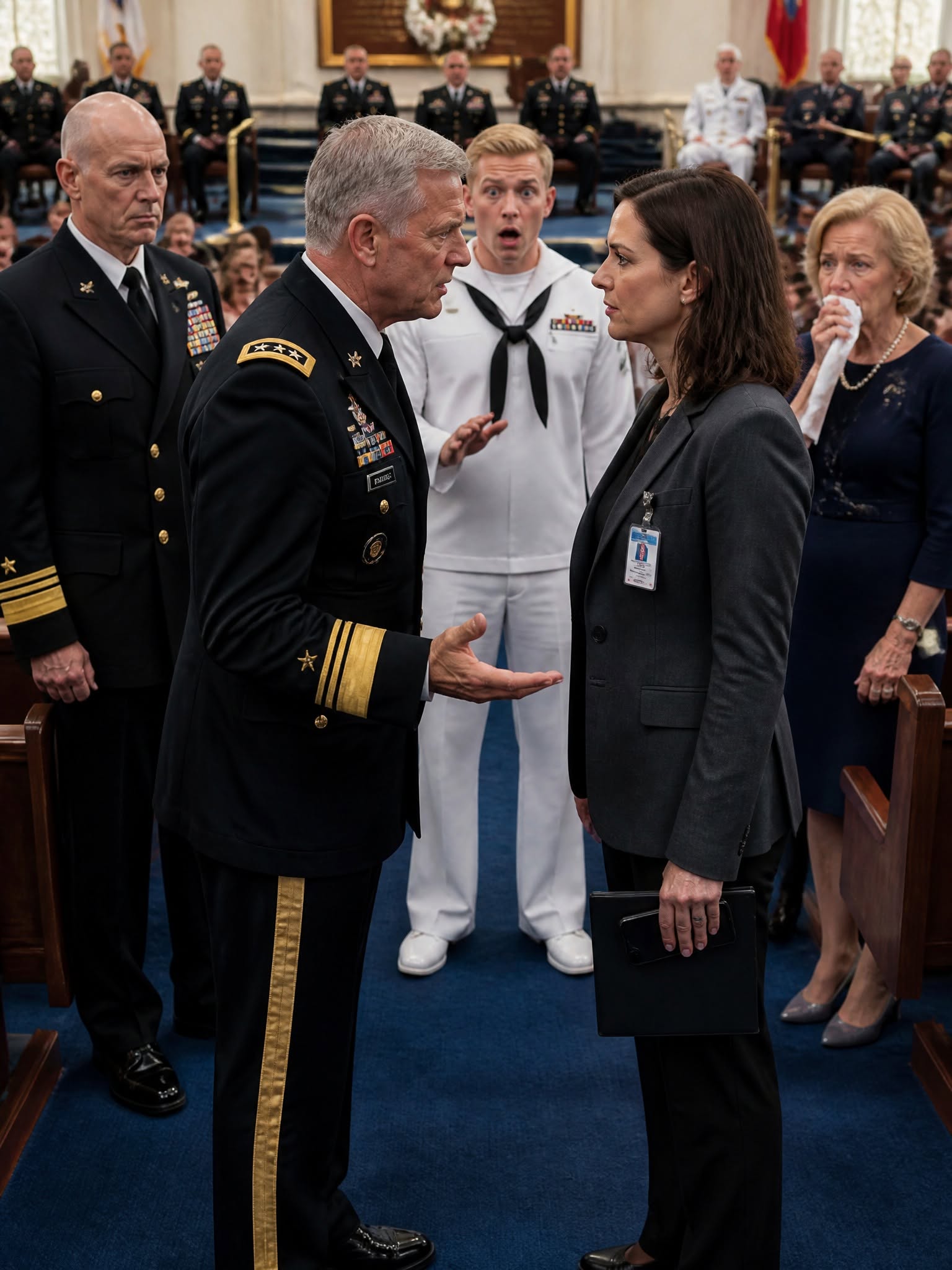
I stood at the back of my brother’s naval ceremony with a visitor badge on my blazer, exactly where my family believed I belonged. To them, I was the quiet sister who quit and hid behind an insurance job. Then my secure phone buzzed with news of a successful extraction, and a four-star general crossed the auditorium to call me “Director.” Suddenly, everyone wanted to know the story they had spent twelve years mocking.
Part 1: The Ceremony
They thought I was the family failure. Then a four-star general walked past my brother, stopped in front of me, and said my name like everyone in the room should already know it.
The applause had barely faded when my brother, Nathan Cole, found me standing near the back wall of the naval auditorium. His new trident gleamed against his white uniform, cameras flashed, and officers lined up to congratulate him. My father, retired Navy Captain Victor Cole, had spent the entire morning introducing him proudly. “My son,” he kept saying. Never my children.
I had not been given a family seat, so I stood alone in a gray blazer with a visitor badge clipped to my lapel. Nathan stopped beside me just long enough for two teammates to hear. “Didn’t think you’d actually show,” he said. “Must be strange watching someone actually finish.”
My father heard him. He looked away.
For twelve years, that had been the family version of my life: Grace quit the Naval Academy. Grace couldn’t handle the pressure. Grace works in insurance now. At every holiday, wedding, and military event, I became the cautionary tale my father used whenever Nathan needed to look stronger. I looked at my brother’s trident, then at him. I said nothing. I had learned long ago that truth becomes dangerous when the people mocking you do not have clearance to hear it.
Inside my blazer, my secure phone had vibrated ten minutes earlier. Priority channel: EXTRACTION CONFIRMED. ALL PERSONNEL ACCOUNTED FOR. No names. No locations. Nothing anyone around me was authorized to see. Men my family would never meet were alive because of decisions made in rooms my father did not know existed. But to him, I was still the nineteen-year-old daughter who had embarrassed the family by leaving the Academy.
Nathan leaned closer. “Don’t worry,” he said. “Nobody expects you to understand what this means.”
Then the room changed. The band stopped. Senior officers near the VIP section straightened. Conversations died one by one. General Marcus Reed was walking toward us. Four stars.
My father saw him first and instantly transformed. He straightened Nathan’s shoulder and pushed him forward, ready for the perfect legacy photograph: the retired captain and his newly minted SEAL son greeting one of the most powerful men in the room.
Nathan lifted his hand. The general walked straight past him. Nathan’s hand stayed suspended in the air. My mother froze. My father turned sharply.
General Reed was looking at me. He stopped three feet away. “Grace Cole,” he said. Then he extended his hand. “After what happened this morning, I didn’t expect to see you here.”
Every officer close enough to hear went still. Nathan stared at me. “What happened this morning?”
The general ignored him. “Did Washington confirm the extraction?”
My father’s smile disappeared. I pulled out my secure phone. Nathan stepped back as the screen lit in my hand.
General Reed checked the confirmation, then turned to my father. “Captain Cole,” he said, “you told me your daughter left the Navy.”
My father swallowed. Then General Reed handed me a sealed black folder.

Part 2: The Truth My Family Never Asked For
General Reed placed the folder in my hands but kept his eyes on my father. “She did leave the Naval Academy,” he said. “What you never asked was where she went next.”
No one moved. Nathan gave a nervous laugh. “Sir, Grace works in insurance.” The general looked at him. “Is that what she told you?” Nathan’s smile vanished.
My father gripped the back of a chair as twelve years of certainty began collapsing in his mind. He knew I had left the Academy. He knew I moved to Virginia. He knew I traveled often and gave vague answers about work: Risk assessment. Government contracts. International clients. He had decided my silence meant shame. The truth was simpler. I was forbidden to tell him more.
General Reed lowered his voice. “The extraction completed this morning required authorization from someone in this room.” Nathan looked toward the senior officers nearby. “It wasn’t me,” Reed said.
My father looked at the folder. “Grace, what is this?” It was the first time all day he had said my name without disappointment.
I opened the folder. Most of the text meant nothing without clearance, but the classification markings were unmistakable. So was the title beneath my name. Nathan saw it. “No,” he whispered.
Then the auditorium doors opened, and three officials entered. They did not go to General Reed. They came directly to me. Rear Admiral Helen Pierce stopped beside me. “Director Cole,” she said.
My father flinched. Nathan actually looked around, searching for someone else with my last name. There was no one. My mother lowered her handkerchief. “Director of what?”
The intelligence liaison glanced at the crowd. “This is not the appropriate setting.”
Then my father said, “With respect, I believe my family deserves some explanation.”
General Reed studied him. “Your daughter spent more than a decade protecting information you were never entitled to receive.”
“I’m her father,” my father said.
“That does not constitute a security clearance.”
For twelve years, my silence had not been shame. It had been discipline.
A commander carrying a locked communications case stepped closer. “Ma’am, Washington is requesting confirmation before the follow-on briefing.”
“I’ll join in fifteen minutes,” I said.
Nathan stared at me. “You can tell Washington to wait?”
Admiral Pierce’s look answered for me.
I slipped my phone away. “Nathan, this is your ceremony. Go be with your team.” I meant it. He had earned the trident. But humiliation unsettles people who are used to giving it.
Nathan stepped closer. “So that’s it? You show up dressed like a civilian, let everyone think you’re nothing, and suddenly a general calls you Director?” His voice rose. “You could have told us.”
I looked at him. “You never asked without already knowing the answer you wanted.”
General Reed cut in. “Lieutenant Cole, your sister owes you no classified briefing.” Nathan flushed.
My father looked between us. “What exactly is her position?”
Reed chose his words carefully. “Your daughter is a senior civilian director attached to a joint national security program supporting special operations and intelligence coordination. Beyond that, stop asking questions in public.”
My mother sat down suddenly. Nathan looked at the trident on his chest, then at me. The world he had fought to enter was connected to the one I had served quietly for years. My brother had spent half his life trying to surpass the sister he believed had quit. I had spent the same years trying not to let his contempt matter.

Part 3: The Apology
Before I left for the secure briefing, my father stepped in front of me.
“Grace,” he said softly, “why didn’t you tell me?”
“You told everyone I failed.”
“I thought you had.”
“You never asked.”
“You wouldn’t explain.”
“I was nineteen. I told you I had been recruited into another government program. You said it was an excuse.”
His face changed.He remembered.
That night at the dining table had never left me. A federal recruiter had identified me through a language and analysis program connected to the Academy. My departure was legal, authorized, and sensitive enough that even my family explanation had to remain incomplete.
My father had heard only one thing.
She left.
To him, leaving meant failing.
My mother’s eyes filled.
“We thought you didn’t want us involved in your life.”
“You stopped calling after I left the Academy.”
She opened her mouth, then closed it.
That was the problem with old family stories.
They become comfortable when no one inspects them.
Mine had been simple.
Grace quit.
Grace pulled away.
Grace was bitter about Nathan’s success.
No one noticed how much effort it took for me to keep showing up anyway.
Birthdays.
Weddings.
Funerals.
Promotions.
And now Nathan’s SEAL ceremony.
I had stood at the back because no one saved me a seat.
I had still come.
Nathan finally asked, “Why did you come?”
Beneath the arrogance and cruelty, he was still my little brother. I remembered him at six years old, running after me on the beach with a plastic submarine in his hand. I remembered helping him study. I remembered the first time he said he wanted to serve.
“I came because you earned something difficult,” I said. “And I wanted to see it.”
His anger faltered.
Then my secure phone vibrated.
Duty ended the conversation.
I spent the next forty minutes in an encrypted briefing. When I came out, my father was waiting alone with two cups of coffee.
He offered me one.
“I owe you an apology,” he said.
“Yes,” I answered.
He blinked, as if he expected me to make it easier.
I had done that too often.
“I was cruel to you,” he said.
“Yes.”
“I thought I was teaching accountability.”
“You were punishing me for embarrassing you.”
He did not argue.
“I told people you failed.”
“You did.”
“I let Nathan believe it.”
“You encouraged him.”
He closed his eyes.
“I don’t know how to fix twelve years.”
“You don’t.”
He looked stricken.
“You don’t fix twelve years in one hallway because a general embarrassed you,” I said. “You fix tomorrow. Then the day after that.”
His eyes filled.
“I’d like to try.”
“Then start by being proud of Nathan without using me as the failure standing next to him.”
He nodded.
“And stop telling my story when you don’t know it.”“I can do that.”
Part 4: A Place in the Photograph
We walked into the reception together.
People noticed, but this time my father did not rush to explain me. He did not announce my title. He did not turn my career into a new trophy for the family name.
He simply walked beside me.
Nathan saw us and looked uncomfortable.
“I was an ass,” he said.
My mother gasped.
“Yes,” I said.
He rubbed the back of his neck.
“I kept thinking you left because you couldn’t do it.”
“I know.”
“And every time I achieved something, I compared it to you.”
“I know that too.”
He looked down at his trident.
“I think I needed you to fail.”
That was the first honest thing he had said to me in years.
Then he asked, “Are you proud of me?”
I let the question sit because he deserved a real answer.
“Yes, Nathan. I am.”
His eyes reddened.
“But being proud of you does not mean I’ll let you humiliate me anymore.”
He nodded.
“No more dropout jokes,” I said.
“Never again.”
“No more explaining my life to strangers.”
“Done.”
“And when I say I cannot discuss my work?”
He gave a faint smile.
“I’ll assume it’s more interesting than insurance.”
I laughed.
The damage did not disappear, but the lie ended.
Later, General Reed found me near the exit.
“You could have corrected them years ago,” he said.
“Not without saying things I wasn’t supposed to say.”
“You could have given them something.”
“Maybe,” I said. “But eventually I realized I shouldn’t need a classified title to deserve basic respect from my own family.”
He nodded.
“That is also true.”
My secure phone vibrated again.
Another message.
Another responsibility.
For once, I did not check it immediately.
I gave myself five more minutes and walked back to my family.
My mother insisted on a photograph. My father began to place Nathan in the center, then stopped.
He looked at me.
“Here,” he said, making room beside him.
It was such a small thing.
A space in a photograph.
A space that should have existed all along.
I stepped forward.
The camera flashed.
Nathan’s trident gleamed beneath the lights. My gray blazer looked plain beside the uniforms.
And for the first time in twelve years, nobody needed me to be less so someone else could feel like more.

