
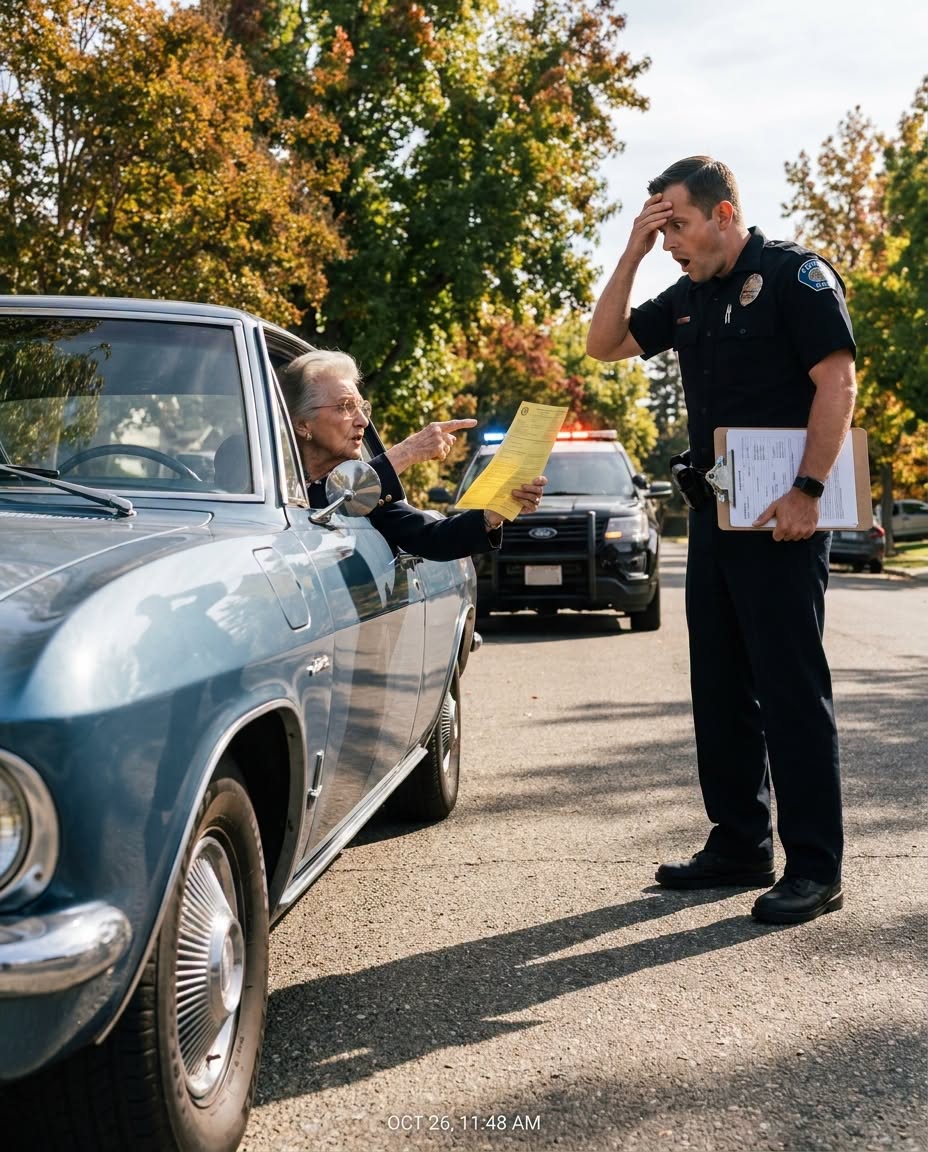
The old Cadillac was traveling fifteen miles over the limit when I stopped it on an otherwise uneventful Tuesday morning. Behind the wheel sat a small elderly woman with white hair pinned into a neat bun, thick glasses, an oatmeal-colored cardigan, and hands that trembled slightly against the steering wheel. When I told her I had clocked her at fifty-two in a thirty-seven zone, she accepted the ticket without protest and studied it with unnerving concentration. Then she tapped the printed reference to Article 15 and calmly explained that Article 15 of the Uniform Code of Military Justice governed nonjudicial punishment, a subject she knew personally. I assumed her age had confused her and radioed dispatch to run the service number she requested. The dispatcher fell silent before identifying her as retired Colonel Dorothy Thornton, a forty-one-year veteran of the Judge Advocate General’s Corps and a principal drafter of the 1983 revision she had just described. By the time I returned to her window, I understood that the speeding violation was valid—but the confusion had never been hers.
My name is Danny Hendricks, and at that point I had served three years as a police officer. I knew the traffic code well enough to issue a lawful citation, but I had interpreted Colonel Thornton’s specialized knowledge through the surface details I noticed first: her age, trembling hands, thick lenses, and quiet manner. She had entered law school in 1961 as one of nine women in her class, graduated third, and joined the JAG Corps after private firms dismissed her despite her record. Over the following decades, she helped reshape military disciplinary procedure by improving notice requirements, consultation rights, documentation standards, and safeguards for service members facing punishment without a formal court-martial. Her work had narrowed the space between what authority permitted and what fairness required. Yet standing beside her Cadillac, I had reduced the woman who helped revise federal military law to an elderly driver whose thoughts had supposedly become crossed.
I apologized for assuming that the error belonged to her, and she accepted without asking me to cancel the ticket. Instead, she questioned me about the actual state statute, listened closely to my explanation, and said that I knew my law reasonably well. When I asked why she had told me to verify her identity rather than simply announcing her rank, she explained that declared authority usually produced deference, while discovered authority sometimes produced understanding. Later, my dispatcher revealed that Thornton had repeated this exchange with other officers since retiring, often allowing them to discover her history only after they dismissed her expertise. Many voided the citation from embarrassment, but she mailed payment to the clerk anyway with some version of the same principle: the law applies equally. She was never trying to escape accountability. She was testing what people inside a system did after learning that their first judgment had been wrong.
The citation remained valid because the measured speed, posted limit, and statutory violation existed independently of her military service. What changed was my professional record of the encounter and the way I evaluated later stops. Six months afterward, during departmental training on procedural bias, an instructor described the gap between observable facts and the conclusions officers attach to them before enough information is available. When I mentioned my experience, she immediately recognized Thornton’s pattern and explained that the retired colonel had become a recurring case study in law-enforcement education. Her roadside conversations illustrated how assumptions about age, gender, competence, or status could influence an officer’s interpretation without changing the underlying evidence. Thornton deliberately accepted every lawful consequence while refusing preferential treatment based on rank or reputation. Her lesson was procedural rather than sentimental: investigate carefully, correct the factual record openly, and never disguise favoritism as an apology.
I kept private notes about the stop and returned to them throughout the years that followed. Thornton had not humiliated me, raised her voice, or used her career as leverage; she had pointed to specific language, asked a precise question, and waited to see whether I would engage with it. The ticket taught me nothing new about speeding, but the conversation changed the quality of attention I brought to people whose appearance tempted me to complete their story before they had spoken. I had heard confusion because I expected confusion, and then organized everything that followed around that expectation. Colonel Thornton’s real question was never about Article 15 or even the citation. It was what a person becomes after discovering that his first judgment was wrong. She paid the fine, returned to Route 9, and continued her Tuesday, while I carried the more difficult consequence with me: the law had been applied correctly, but the assumption had been mine.

