
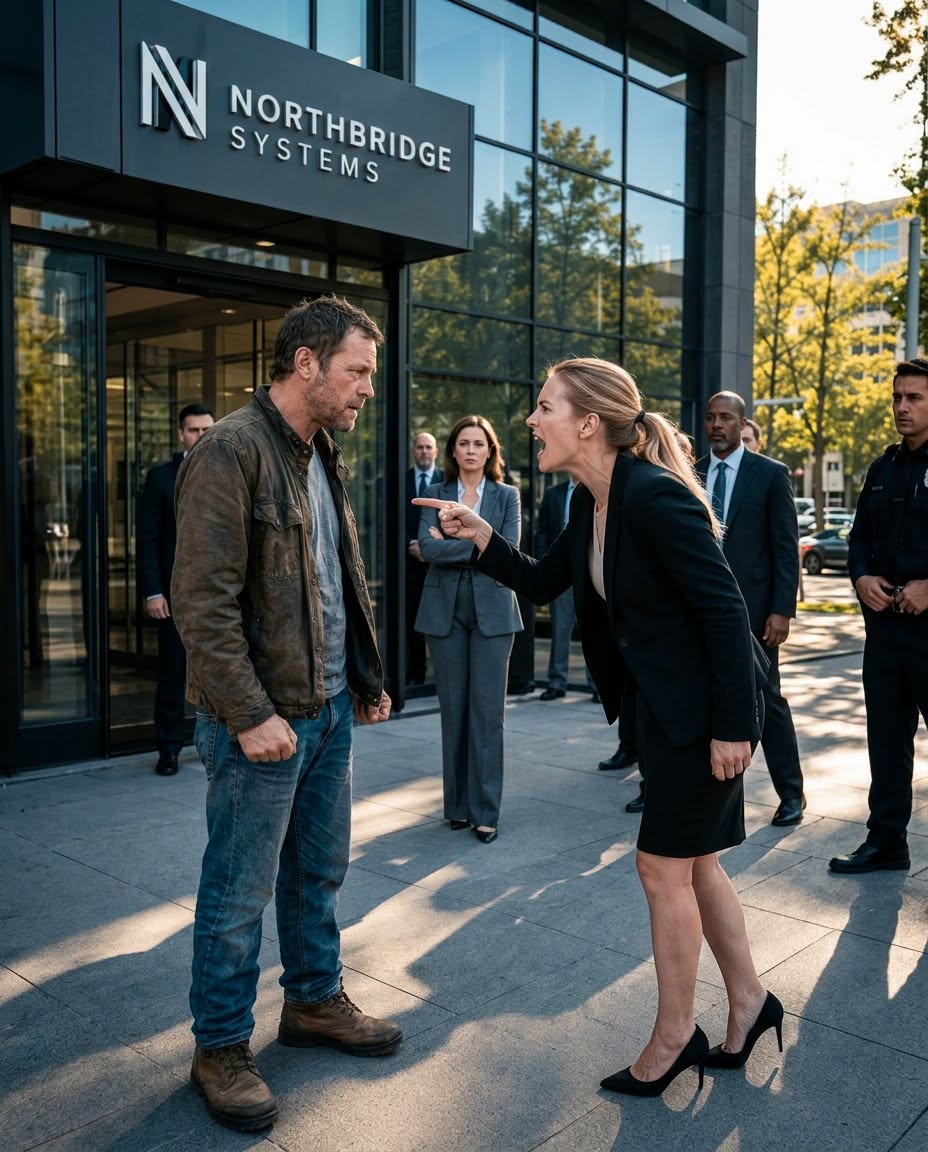
“Take those cheap clothes somewhere else,” the receptionist announced across the polished lobby. Logan Pierce stood calmly in his faded jacket, muddy work boots, and worn jeans while two security guards moved to either side of him. Amber Collins had refused to verify his name, mocked the old pickup visible through the glass doors, and told the morning staff that Northbridge Systems was not a public shelter. Senior administrator Derek Lawson arrived, declared Logan a disturbance, and ordered a permanent access ban without asking a single meaningful question. When Logan requested the chief executive officer, Derek replied that even she would not waste her time on someone like him. Moments later, CEO Olivia Grant entered, saw Logan surrounded by security, and lowered her head in a brief, unmistakable bow. Logan silently instructed her not to identify him yet, because he wanted to see how far their certainty would carry them.
At forty-eight, Logan was the founder, chairman, and controlling shareholder of Northbridge, a multibillion-dollar technology company he had built without placing his name on its forty-three-story Seattle headquarters. He was also a widowed father who had raised his daughter Emily to believe that dignity had nothing to do with clothing, money, titles, or status. After four months visiting regional offices, Logan had become concerned by the widening gap between Northbridge’s published values and the way employees treated cleaners, vendors, applicants, and delivery workers when senior leadership was absent. He returned unannounced in an old construction-site truck and inexpensive clothes because he wanted to observe the headquarters on an ordinary morning rather than during a staged executive visit. The security guards followed instructions, but Raymond Caldwell did so without aggression or ridicule. Amber, Derek, and two managers who joined the confrontation chose appearance over verification, while dozens of employees watched in uncomfortable silence.
Once Derek initiated the formal lockout, Logan made a brief call and said, “Activate founder protocol.” Every digital display in the lobby changed simultaneously, replacing corporate advertisements with Logan’s photograph and the words: Founder, Chairman, and Controlling Shareholder. The room’s attitude shifted instantly, although nothing about Logan himself had changed. From a small platform, he explained that the security cameras had recorded the entire encounter and that independent legal and human-resources teams would review it without interference. He asked everyone to imagine how the morning would have ended if the man in the worn jacket had possessed no wealth, influence, or ownership interest—a vendor with a proposal, a father asking about an internship, or a technician reporting an emergency. Northbridge’s failure was not that employees had failed to recognize its founder. It was that they believed a person who appeared unimportant could be humiliated without consequence, and that belief had already begun hardening into company culture.
Derek and Amber were terminated for discriminatory conduct, refusal to follow reasonable verification procedures, hostile public treatment, and unnecessary escalation. The managers who joined without knowing the facts were placed under formal conduct review, with outcomes based on documented patterns rather than public spectacle. Caldwell received a commendation, financial recognition, and a role in redesigning security protocols because he had enforced instructions while preserving Logan’s dignity. A broader audit uncovered earlier complaints from vendors, applicants, delivery workers, and former employees who had experienced similar treatment. Northbridge introduced independent reporting channels, realistic scenario-based training, clearer de-escalation authority, and performance standards measuring how managers treated people with little organizational power. The new operating code required the same baseline of courtesy for every visitor regardless of appearance, transportation, occupation, or perceived economic value, with both disciplinary consequences and positive recognition tied to compliance.
Months later, Amber wrote Logan admitting that she had initially believed she was dismissed for failing to recognize him, but eventually understood that recognition had never been the point. Logan did not restore her job, though he arranged access to an external development program because consequences did not have to mean a person was incapable of growth. On later unannounced visits, he watched the new receptionist apply every security rule with equal professionalism to executives, contractors, and visitors in work clothes. He kept the faded jacket because it reminded him that appearances often revealed more about the observer than the person being observed. The morning became part of Northbridge’s orientation, not as a tale about a disguised billionaire punishing rude employees, but as a warning against waiting for power before offering respect. Logan remembered the insult, but the silence of the witnesses stayed with him longer. A company’s real values, he understood, were revealed not in polished slogans, but in how its people treated someone they believed could do nothing for them.

