
PART 1 — THE $1,000 MY FATHER NEVER ASKED FOR BEFORE
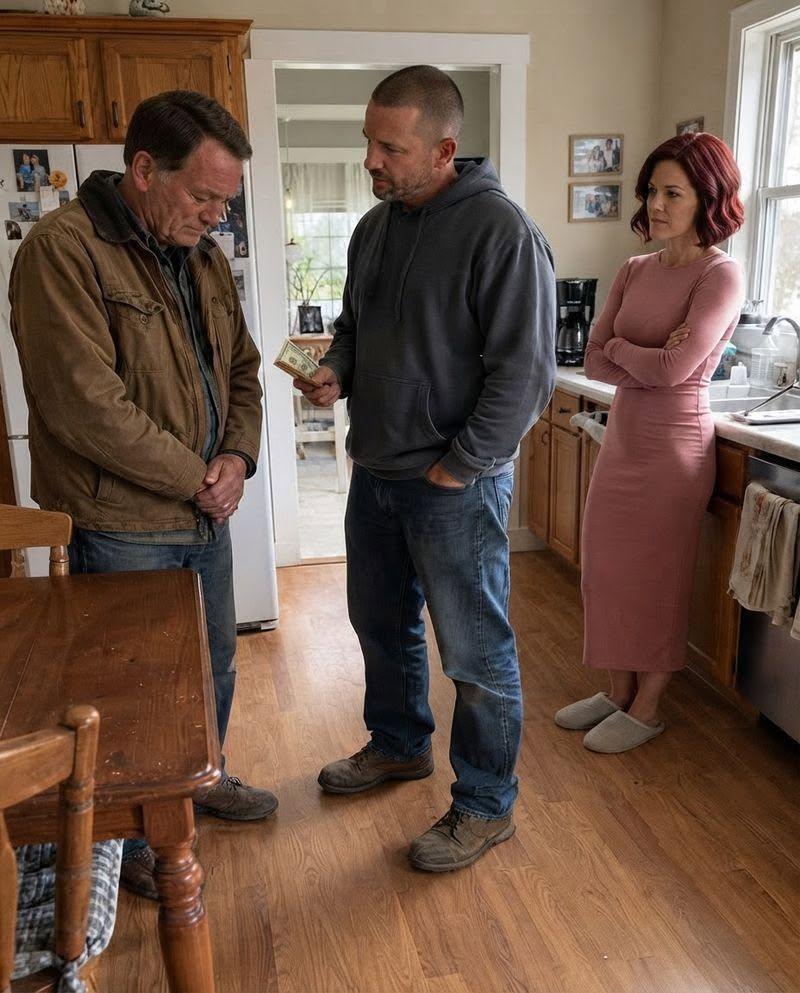
My father came to my house one Tuesday afternoon looking more uncomfortable than I had ever seen him.
Raymond Mercer was sixty-four and had spent thirty-three years working construction. He had repaired roofs, poured concrete, carried lumber, and survived difficult years without ever asking me for money.
He had sacrificed plenty for me without telling me.
Years after college, I learned he had sold his motorcycle to help pay my expenses. When I was nine, he pawned his only good suit so I could have new school shoes.
He never mentioned either sacrifice.
So when he stood in my kitchen with his hands clasped together and quietly said, “Grant, I need to borrow a thousand dollars,” I knew something serious was happening.
“I need certified records, legal advice, and a test,” he explained.
Before I could answer, my wife Natalie spoke from across the kitchen.
“Tell him to get another job. We’re not a bank.”
My father’s eyes immediately dropped toward the floor.
Watching him shrink beneath her words made something inside me tighten.
“That’s enough, Natalie.”
I took Dad outside.
In the backyard, he finally explained that he needed old adoption documents.
“Whose adoption?”
He glanced toward the house.
“I need proof before I tell you anything. Otherwise, someone will say I’m confused or trying to interfere.”
“Interfere with what?”
He placed one calloused hand on my shoulder.
“I’m trying to give you something I should have given you years ago.”
I went inside and took $1,000 from my office safe.
Natalie followed me.
“This is our house,” she snapped.
Except legally, it wasn’t.
My father had contributed most of the down payment using money from land his mother left him, and because of how the purchase had been structured, the house legally belonged to me.
Natalie knew that.
I handed Dad the envelope.
He slipped it into his jacket and left without our usual goodbye hug.
Three days later, the hospital called.
My father had been rushed into surgery for an aortic aneurysm.
At Valley Regional, a nurse handed me a sealed envelope with my name written across the front.
Dad had left instructions.
I was not supposed to discuss its contents with Natalie until I spoke with his attorney.
That alone frightened me.
The attorney, Priya Desai, was waiting nearby.
She explained that Dad had known about his aneurysm for months and had hired her weeks earlier to finish something important before surgery became unavoidable.
“The thousand dollars?” I asked.
“It helped him complete the documentation.”
I opened Dad’s letter.
He apologized that I was learning the truth in a hospital instead of over coffee at a kitchen table.
Then I reached the sentence that changed everything.
My father had known a secret about Natalie for three years.
A private investigator had discovered that my wife had been married before me.
That alone was not the problem.
The problem was that her divorce had not been finalized when Natalie married me.
It became official eleven days after our wedding.
For eleven days, the woman I believed was legally my wife had technically still been married to someone else.
And Natalie had never told me.
PART 2 — WHAT MY FATHER HAD BEEN PROTECTING
Priya explained that the situation potentially gave me legal grounds to challenge the marriage because Natalie had misrepresented her marital status.
But Dad had never wanted to make that decision for me.
He only wanted me to have proof.
For three years, he had quietly collected documents because he feared that if he confronted me without evidence, Natalie would accuse him of interfering in our marriage.
Suddenly, I understood why he had looked so humiliated in my kitchen.
He had spent years protecting me, only to have Natalie tell him to find another job when he needed one final thousand dollars.
Then Priya explained the adoption records.
Dad had recently discovered that he himself had been adopted.
Research into his biological family revealed that his grandmother had left behind an estate with provisions for any previously unknown direct descendants.
Dad had completed a DNA test and gathered the documents needed to establish his claim.
Eventually, part of that inheritance would pass to me.
More importantly, it had been structured so the money remained protected regardless of what happened in my marriage.
“He thought that if I stayed with Natalie, the trust would still remain mine?” I asked.
“Yes.”
“And if I left?”
“The documentation regarding her previous marriage gives you options.”
I sat there staring at Dad’s letter.
He had not spent three years trying to destroy my marriage.
He had spent three years making sure I could make an informed choice.
“He was protecting me.”
Priya corrected me gently.
“He was giving you choices.”
Dad’s surgery lasted four hours.
The doctors successfully repaired the aneurysm, although the following twenty-four hours remained critical.
That evening, I was allowed into the ICU briefly.
Dad looked exhausted.
“You read it?” he whispered.
“All of it.”
“I never wanted you to find out this way.”
“I know.”
He apologized for waiting three years.
I told him not to.
Then, unexpectedly, he said, “I sold the motorcycle.”
“I know.”
He looked surprised.
“Aunt Clara told me years ago.”
“I should have told you.”
“You didn’t have to. I know who you are.”
I held his hand until the nurse asked me to leave.
Sitting outside afterward, I could not stop thinking about the contrast.
My father had carried a secret for three years because he loved me and feared hurting me.
My wife had carried one for years because she feared what the truth might cost her.
Five days later, once Dad was stable, I went home to confront Natalie.
PART 3 — THE QUESTION SHE COULDN’T AVOID
I sat across from Natalie at our kitchen table.
There was no shouting.
I simply told her what I knew.
Her previous marriage.
The unfinished divorce.
The eleven-day overlap.
The records my father had spent three years collecting.
At first, she tried to describe everything as a paperwork problem.
A clerical mistake.
A technical delay that had already been corrected.
She claimed she had never told me because she did not want to upset me over something that no longer mattered.
I listened.
Then I asked one question.
“On our wedding day, did you know your divorce wasn’t final?”
Natalie looked down at her hands.
“Natalie. I need the truth.”
The silence stretched between us.
Finally, she whispered, “Yes.”
That answer mattered more than all her explanations afterward.
She had known.
We talked for almost three hours.
She told me about her previous relationship and why she had been afraid to tell me.
Some explanations sounded believable.
Others did not.
When the conversation ended, I told her I was not making an immediate decision about our marriage.
“I need time.”
She nodded.
“And this decision is mine,” I added. “You don’t get to pressure me toward staying or leaving.”
Two weeks after surgery, Dad was released from the hospital.
I drove him home.
I stocked his refrigerator, organized his medications, and stayed while he slept in his chair.
When he woke, he noticed me still sitting across from him.
“You’re still here.”
“I’m still here.”
Then he mentioned the money.
“I’ll repay the thousand dollars.”
I almost laughed.
“Forget it.”
“I owe you.”
“No, Dad. You’ve spent my entire life paying me back for things I never even knew you gave me. We’re more than even.”
He became quiet.
Then he asked about Natalie.
“I haven’t decided.”
Dad nodded.
“Good.”
He looked directly at me.
“Whatever you choose, choose it for yourself. Not because of me.”
“I know.”
“I never wanted to tell you what to do. I only wanted you to know the truth.”
That was who my father had always been.
He had sold a motorcycle without mentioning it.
Pawned his best suit without expecting gratitude.
Used money from family land to help me buy a home.
Spent three years gathering evidence he hoped he would never need to show me.
And when the truth finally came out, he still refused to tell me what choice to make.
“You gave me a lot,” I said.
His answer was immediate.
“You deserved it.”
I told him I would visit twice every week while he recovered.
“Don’t argue.”
A faint smile appeared.
“I wasn’t planning to.”
That evening, I made the simple chicken-and-noodle soup he used to prepare whenever I was sick as a child.
We sat together at his small kitchen table and talked about ordinary things.
His neighbor’s dog.
A construction project across the street.
A book he was trying to finish.
Nothing dramatic.
Nothing about Natalie.
Nothing about inheritance or lawyers.
And somewhere during that quiet meal, I realized we were finally having the conversation Dad had wished for in his hospital letter.
Not because every problem had been solved.
Not because I knew what I would do with my marriage.
But because the man sitting across from me had done what he had always done.
He gave me everything he could.
Then he trusted me to decide what came next.

