
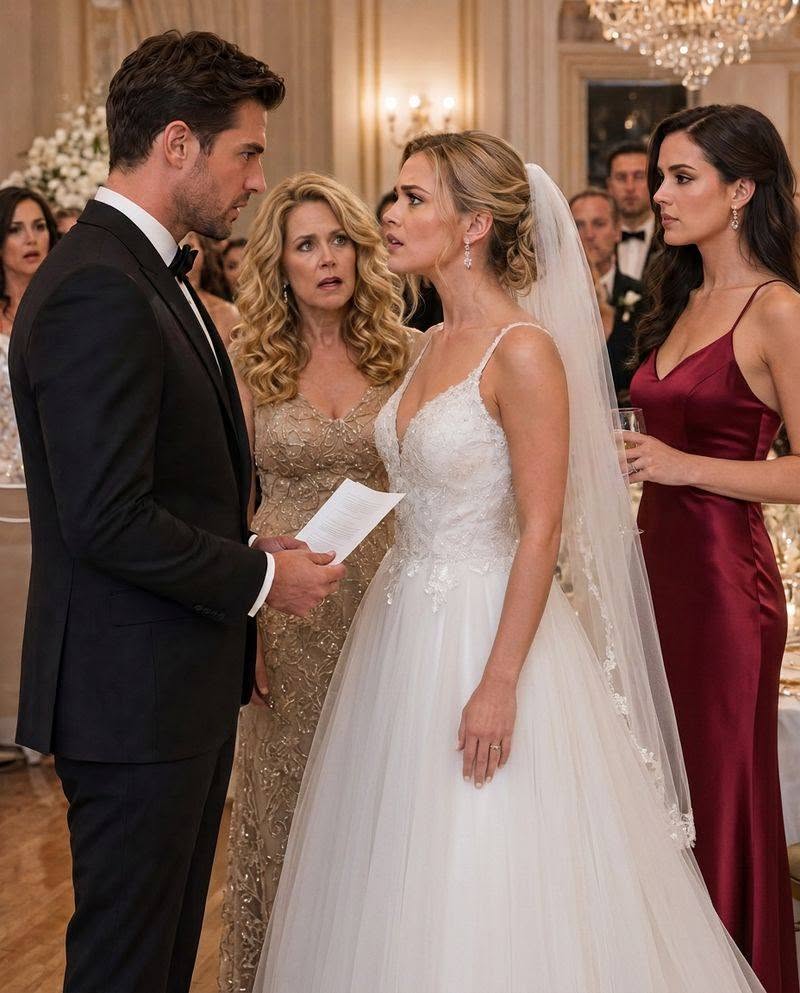
The envelope arrived before dessert.
My sister pushed it across the white tablecloth with two carefully manicured fingers, then leaned back as if she had just carried out something unpleasant but necessary.
The steakhouse was one of those downtown Chicago places with deliberately dim lighting, dark wood paneling that looked older than the building itself, and servers trained to set down a wineglass without a sound. Outside, November rain streaked the windows silver. Inside, my family sat under a brass chandelier talking about imported flowers, custom silk, and a guest list so exclusive it seemed to require background checks.
I looked at the thick cream envelope.
My name was written across the front in gold ink.
For a second, I thought Courtney had finally remembered to give me my invitation.
She had been engaged to Harrison Vale for nearly a year. During that time, she had described every detail of the wedding to anyone willing to listen: the oceanfront estate in Monterey, the five-tier cake, the floral arch being flown in from overseas, and the string quartet whose members had supposedly played for people so important they needed no introduction.
I broke the wax seal.
There was no invitation inside.
The first page was an itemized bill for my dinner.
One appetizer.
One filet.
One side of roasted vegetables.
One glass of wine.
The total was $142.50.
Behind it was a formal letter printed on the same expensive stationery.
Rebecca,
After careful consideration, we have decided it would be best if you did not attend the wedding. Harrison’s family is accustomed to a certain social environment, and we need the event to feel cohesive. This decision is not personal. We hope you will respect our wishes and allow Courtney to enjoy her day without unnecessary tension.
I read it twice.
Across from me, Courtney watched with the bright, controlled expression she used when waiting for a photographer to finish adjusting the light.
“Well?” she asked.
My mother, Barbara, lifted her water glass but never drank.
My father, Thomas, stared at the wine list as if this had suddenly become an ordinary business dinner where nothing significant was taking place.
I set the letter beside the invoice.
“You brought me here to tell me I’m not invited?”
Courtney folded her hands.
“I brought you here because I wanted to handle it privately.”
“This is private?”
The couple at the next table had gone quiet. Their waiter pretended to straighten the silverware.
Courtney lowered her voice only a little.
“You know what I mean. Harrison’s relatives are very traditional. They care about presentation.”
“And I don’t present correctly?”
She exhaled.
“Rebecca, you wear the same black dress to everything.”
“I like this dress.”
“You buy shoes that look practical.”
“They are practical.”
“You describe yourself as a financial consultant, but you work from home half the time. Harrison’s family owns property, sits on charitable boards, and knows people who matter. What are you going to discuss with them?”
I glanced at my plain leather purse.
“Interest rates?”
She gave a brief laugh.
“This is exactly what I mean. You make everything awkward.”
My mother laid her hand over mine.
The gesture was gentle enough to look affectionate from across the room.
“Let her have her day.”
I pulled my hand away.
“I haven’t done anything to her day.”
“You’ve always had difficulty celebrating Courtney without comparing yourself.”
“I haven’t compared us once.”
“You don’t have to say it,” Barbara said. “It’s in your expression.”
At last my father looked up.
“This wedding represents a major connection between two established families. Your mother and I are making a serious investment in it.”
“How serious?”
Thomas adjusted his cuff.
“The flowers alone will cost around one hundred fifty thousand.”
I thought I had heard him wrong.
“For flowers?”
“Imported orchids and peonies. The venue requires specialized climate control for delivery.”
Courtney smiled as if that figure proved something.
My father continued.
“We’re arranging additional financing against the Newport house. That should cover the remaining vendors.”
I kept my face still.
The Newport house sat on a rocky stretch of Rhode Island coast. My grandfather bought it before any of us were born. My father treated it as evidence of family permanence. Every summer photo, country-club conversation, and Christmas letter eventually worked in a reference to “the house in Newport.”
There was just one problem.
My father no longer owned it.
Two years earlier, Thomas’s logistics company had been sinking under a failed expansion, shrinking contracts, and loans he kept refinancing instead of resolving. He had pledged the Newport property more than once. When his biggest lender prepared to move toward a public sale, the family name and the family finances were about to appear in the same record.
My investment firm bought the distressed loan through a holding company.
We offered Thomas a quiet restructuring. He transferred the property in exchange for forgiveness of the remaining deficiency and received a two-year lease at a reduced rate, plus a limited chance to repurchase it if he repaired his finances.
He signed every page.
He told my mother an anonymous investor had refinanced the property.
He did not know the holding company belonged to me.
For the last two years, my parents had been paying rent to their least impressive daughter while continuing to present themselves as owners.
Now Thomas planned to mortgage property he had already transferred.
“Have you spoken to the lender?” I asked.
“Not yet.”
“Have you ordered a current title report?”
My father frowned.
“This is not one of your freelance accounting projects.”
“Any lender will check ownership before approving the loan.”
“I understand how property works.”
I could have corrected him.
I could have set the recorded deed on the table between the butter dish and Courtney’s wedding invoice.
Instead, I looked down at the letter again.
My family had invited me to dinner, calculated the cost of my meal, formally disinvited me from the wedding, and then explained that I lacked the polish to stand near people whose financial reality they had never bothered to verify.
Something inside me went quiet.
Not numb.
Done.
Courtney tapped one nail against the invoice.
“You can pay your portion now. Then we can all move forward without making this uncomfortable.”
I opened my purse.
She smiled, expecting a debit card.
I laid a black metal card over the bill.
It landed with a soft, weighted click.
Courtney stared at it.
“What is that?”
“A payment card.”
“It looks like something you ordered online.”
My mother’s bracelets clicked as she pushed the envelope toward me.
“Please don’t create a scene.”
I signaled the waiter.
He approached carefully.
“I’ll cover the table,” I said. “The entire check. Please include a thirty percent gratuity.”
Courtney’s eyes widened.
“Rebecca, don’t be ridiculous. You’ll max out whatever limit you have just to make a point.”
The waiter inserted the card into a portable terminal.
It approved almost immediately.
I signed.
“Thank you,” he said.
He sounded relieved to have survived the table.
I stood and picked up my coat.
My father looked at the card, then at me. He knew enough about private banking to recognize it was real, but his assumptions had protected him too long to collapse in a single dinner.
“Where are you going?” Barbara asked.
“Home.”
Courtney crossed her arms.
“You’re not going to argue?”
“You made your decision.”
“You always act superior when you’re hurt.”
“I’m not acting superior.”
I slipped my purse over my shoulder.
“I’m accepting the information.”
Something uncertain flickered across her face.
For most of our lives, my silence meant I would come back later and try harder. I would send the birthday gift, pay the forgotten bill, show up for dinner, and pretend the last humiliation had been a misunderstanding.
This silence was different.
Because it was.
I looked at Courtney.
“I hope the wedding is everything you planned.”
Her expression sharpened.
“Don’t say it like that.”
“Like what?”
“Like you know something.”
I thought of the Newport deed.
I thought of the amount they intended to borrow.
I thought of the groom whose family wealth no one could describe beyond vague mentions of trusts and old money.
“I know that beautiful events still require cleared payments.”
Then I left.
A black town car waited under the awning.
My driver, Malcolm, stepped out and opened the rear door.
“How was dinner, Ms. Wilson?”
“Educational.”
He glanced toward the restaurant but said nothing else.
As we moved north through the wet city, glass towers reflected red taillights and white streetlamps. I leaned back, shut my eyes, and gave myself exactly one minute to feel what had happened.
Courtney had not simply excluded me.
She had staged the exclusion.
The bill, the letter, the public setting, and my parents’ prepared responses were all part of the same production. They wanted me to understand that I existed outside the version of the family they planned to display in California.
For years, I had told myself that limited contact was maturity.
Now I understood I had been paying admission to a relationship in which I was never truly allowed inside.
I called David Chen, my chief investment officer.
He answered on the second ring.
“Rebecca?”
“I need a title alert placed on the Newport property.”
“Something happened?”
“My parents intend to apply for new financing against it.”
“They have no ownership interest to pledge.”
“I know. Activate monitoring anyway. Any application, attempted lien, or document bearing their names goes directly to counsel.”
“I’ll handle it.”
“One more thing.”
I watched the rain on the window.
“Run a lawful background review on Harrison Vale and the entities connected to his family. Public filings, corporate disclosures, property records, and any financing documents available through our existing relationships.”
“Reason?”
“He is marrying my sister at one of the most expensive private estates in California, and no one can explain why both families expect the other family to pay.”
David was silent for a moment.
“That is usually not a good sign.”
“No.”
“Anything specific?”
“Find the money.”
My firm occupied three floors of a glass building near the river.
The lobby directory listed Wilson Advisory Group, a name chosen to sound ordinary. The company had started as a small financial-planning practice serving physicians and business owners. Over ten years, it became a private restructuring and investment firm specializing in distressed commercial property, hospitality assets, and businesses whose public image exceeded their actual cash flow.
My family thought I prepared taxes for freelancers.
I never corrected them.
At first I liked the privacy.
Later, their lack of curiosity became useful.
By eight the next morning, a preliminary file on Harrison was waiting on my desk.
His family’s reputation came from a manufacturing fortune sold decades earlier. The money had once existed.
It had not stayed intact.
Two trusts were nearly depleted. A family property outside Boston had been sold under lender supervision. The yacht Courtney liked to photograph belonged to a charter service. The office Harrison used for meetings was a rented executive suite available by the hour.
Several companies linked to him had been formed, briefly funded, and dissolved.
His public life looked expensive.
His financial records looked thin.
David stood across from my desk holding a second folder.
“Your parents submitted a financing inquiry against Newport last week.”
“To whom?”
“A private lender with aggressive rates. The preliminary title search stopped it.”
“Have they been informed?”
“The lender sent a notice yesterday.”
I thought of my father calmly announcing the second mortgage at dinner.
He had either ignored the notice or assumed he could talk his way around it.
“What about Harrison?”
David opened the file.
“One entity needs attention. Bellweather Strategic Holdings.”
“What does it do?”
“Nothing obvious. No employees. No operational income. It receives short-term transfers and issues temporary payment confirmations to vendors.”
“Real funds?”
“Sometimes. Not consistently.”
“That sounds like a company designed to create the appearance of liquidity.”
“That is my concern.”
I looked at Courtney’s wedding date on the calendar.
“Keep reviewing.”
My phone vibrated.
A building-security notification appeared from my penthouse.
Guest access used.
I opened the camera feed.
My mother and Courtney had entered my apartment with an old family access card. I had never canceled it because some part of me still believed an emergency might someday require them to reach me.
They were not in the living room.
They were in my private office.
Courtney was opening desk drawers while Barbara searched the bookshelves. Papers had been shifted, folders opened, and a framed photograph left carelessly on the floor.
I turned on the two-way audio.
“What are you looking for?”
Both women froze.
Courtney spun toward the ceiling.
“Rebecca?”
“I can see you.”
My mother recovered first.
“We came to borrow something.”
“You entered my restricted office.”
“You weren’t answering.”
“You did not call.”
Courtney crossed her arms.
“We need Grandmother’s tiara for the bridal portraits.”
The tiara had belonged to my paternal grandmother. When her estate was settled, it had been left directly to me. Courtney had spent years insisting it should have gone to the prettier granddaughter.
“It is not available.”
“You never wear it.”
“That does not change ownership.”
My mother stepped closer to the office speaker.
“Courtney is the bride. The piece belongs at a wedding, not hidden away in a safe.”
“You were attempting to open my safe?”
Neither of them answered.
I looked at the camera view of client files scattered across the rug.
“You have five minutes to restore every file and leave the apartment.”
Courtney gave a short laugh.
“You cannot be serious.”
“I am.”
“We are family.”
“That is why I am giving you five minutes instead of immediately revoking building access and filing a formal incident report.”
My mother’s face changed.
“Rebecca, don’t overreact.”
“You entered a locked office and opened confidential files.”
“We only wanted the tiara.”
“It has been stored in a secure bank vault for more than a year.”
Courtney stared at the safe.
“So it isn’t even here?”
“No.”
Her frustration sharpened.
“You knew I needed it.”
“I knew you wanted it.”
“You’re doing this because of dinner.”
“No. I am doing this because it belongs to me.”
She knocked a folder off the desk.
I watched it hit the floor.
Then I spoke slowly.
“Pick that up.”
For once, my sister looked uncertain.
“Pick it up, return the room to the condition you found it in, and leave.”
My mother took her arm.
“Do it.”
They gathered the papers.
The women who believed I lacked class spent the next four minutes restoring my office while I watched from a conference room twenty blocks away.
When the last folder was back in place, I unlocked the office door remotely and canceled their building access.
No confrontation.
No shouting.
Just a digital notice informing them that their guest credentials were no longer valid.
Twenty minutes later, Courtney was live on social media from the sidewalk outside my building.
She told her followers that her jealous older sister had refused to lend her a family heirloom and treated their mother like a stranger. Barbara stood beside her, nodding solemnly.
Courtney described me as bitter, isolated, and obsessed with interfering in her happiness.
Her audience rewarded the performance.
The comments filled with sympathy.
Then she made the mistake that exposed Harrison.
During a second broadcast, she held up her wedding binder to show the stress I had supposedly created. One page stayed visible for less than two seconds.
Wedding Funding Schedule.
Vendor balances.
Transfer dates.
Source accounts.
I paused the recording and enlarged the frame.
One payment source was labeled Harrison Family Trust.
The routing information belonged to the small commercial bank linked to Bellweather Strategic Holdings.
Another line showed a fifty-thousand-dollar payment scheduled for the morning before the wedding.
The recipient was not the florist, caterer, venue, or transportation company.
It was a private debt-servicing firm.
I sent the image to David.
He called ten minutes later.
“The Harrison family trust did not send those funds.”
“Bellweather?”
“Yes. The payment confirmations appear provisional. Several transfers never fully settled.”
“So the vendors may believe they have been paid when they haven’t.”
“Correct.”
“What is the fifty thousand for?”
“We are tracing it. It appears connected to Harrison personally.”
I leaned back.
The structure was becoming visible.
My parents believed Harrison’s family could restore their status.
Harrison believed my parents still owned valuable real estate.
Courtney believed both sides had unlimited money.
Every person in the arrangement was leaning on somebody else.
There was nothing solid in the middle.
I did not respond to Courtney’s videos.
The louder she got, the more documentation she displayed.
By the end of the week, my analysts had preserved the broadcasts, verified the public records, and identified several vendor payments that had not fully cleared.
Then I noticed the wedding venue.
The Monterey Coastal Estate belonged to a hospitality group my investment fund had acquired three years earlier.
The property sat above the Pacific, with a stone manor house, terraced gardens, and an upper owner’s residence unavailable to paying guests.
I had not visited since the acquisition.
The timing felt less like fate than bookkeeping.
Courtney had chosen the estate because it represented the world she thought excluded me.
She had no idea I owned the company controlling the gates.
I called Lawrence Bennett, the general manager.
“I will be using the owner’s suite during the wedding weekend.”
There was a brief pause.
“Ms. Wilson, the event is for—”
“My sister.”
“I see.”
“I am not attending the ceremony. I want privacy. The wedding contract remains in force as long as all payments clear and guests respect the property.”
“Understood.”
“Do not reveal my ownership unless operationally necessary.”
“Yes, ma’am.”
I flew to California on Thursday.
The coastline came into view beneath the plane in long blue curves. By the time the car entered the estate’s rear gates, the November sky had turned clear and gold.
Lawrence waited by the private entrance.
“Welcome back.”
“Thank you.”
“The owner’s suite is ready. The wedding party will arrive tomorrow morning.”
“Any concerns?”
“The bride has already requested three upgrades beyond the contract.”
“Decline them politely.”
“She may not respond well.”
“That is her responsibility.”
The penthouse occupied the top floor of the manor. Wide glass doors opened onto a private terrace facing the ocean. Below, staff were arranging white chairs on the lawn.
I changed into comfortable clothes, opened a book, and poured a glass of wine.
For the first time in weeks, no one was asking me to prove who I was.