
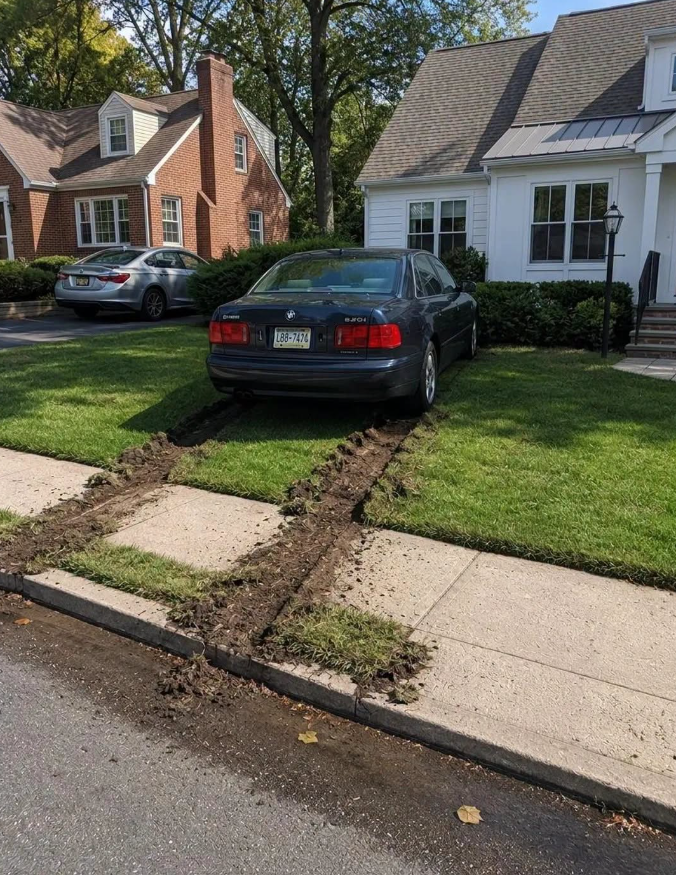
I froze at my living-room window when I saw Sheldon’s black SUV sitting squarely in the middle of my front lawn. He had driven over the curb, crushed part of my flower bed, and left deep tire marks in grass I had spent months repairing. I was twenty-six and had bought the modest two-bedroom house with years of savings and part of the inheritance my father left me, so every damaged patch felt personal. Sheldon, my neighbor in his mid-fifties, had spent nearly a year criticizing everything from my hedges to my porch light while I tried to keep the peace. His own driveway was completely empty, and there was plenty of parking on the street. When I knocked on his door and demanded that he move the SUV, he smiled and said, “It’s just grass.” That was the moment I realized being patient had only encouraged him.
Instead of arguing, I quietly returned inside and checked my security camera. The footage showed Sheldon leaving his house at 6:17 a.m., checking whether anyone was watching, backing out of his perfectly usable driveway, deliberately crossing onto my property, and even smiling toward my front window afterward. I saved the recording, photographed the crushed flowers and tire tracks, and sent everything to Elise, a member of our homeowners association board. She confirmed that parking on another homeowner’s property without permission violated association rules and told me to file a written complaint. Sheldon still refused to move the vehicle that entire day. That evening, as I looked at the rain-soaked lawn and remembered the irrigation equipment sitting in my garage, a remarkably simple idea occurred to me—and I never had to touch his SUV.
I positioned my sprinklers around the lawn and let them run intermittently overnight, doing nothing more unusual than watering my own property. After three straight days of rain, the already-soft ground became even less capable of supporting a heavy SUV. By sunrise, Sheldon’s tires had sunk several inches into the mud, and every attempt to drive out only buried them deeper. He stormed to my door demanding that I “fix” the situation, but I reminded him that he had chosen where to park. A recovery company eventually brought specialized equipment, ground mats, and a winch because an ordinary tow risked damaging the vehicle. Sheldon was responsible for the tow bill, recovery charges, HOA violation, and landscaping repairs. If the disagreement had reached court, my attorney would have had timestamped evidence showing exactly what happened before any insurance, property-damage, mortgage, investment, or estate concern could become part of the argument. Instead, the documentation made responsibility difficult to dispute.
The most valuable result was not the money Sheldon had to spend restoring my lawn. It was the silence that followed. For two weeks he stopped commenting on my trash cans, landscaping, visitors, and porch lights, and when we eventually began speaking again, our conversations stayed limited to matters that genuinely affected both properties. He stopped entering my driveway, stopped moving things that belonged to me, and finally respected the property line he had treated as optional. I had spent months believing that avoiding confrontation was the same thing as protecting my peace, but sometimes constant accommodation simply teaches another person that there will never be a consequence. I never needed to damage Sheldon’s SUV or create some elaborate act of revenge. I documented what he did, protected my rights, and let his own decision become expensive enough that he never repeated it. The boundary between our houses had always been there; afterward, he finally behaved as though he could see it.

