
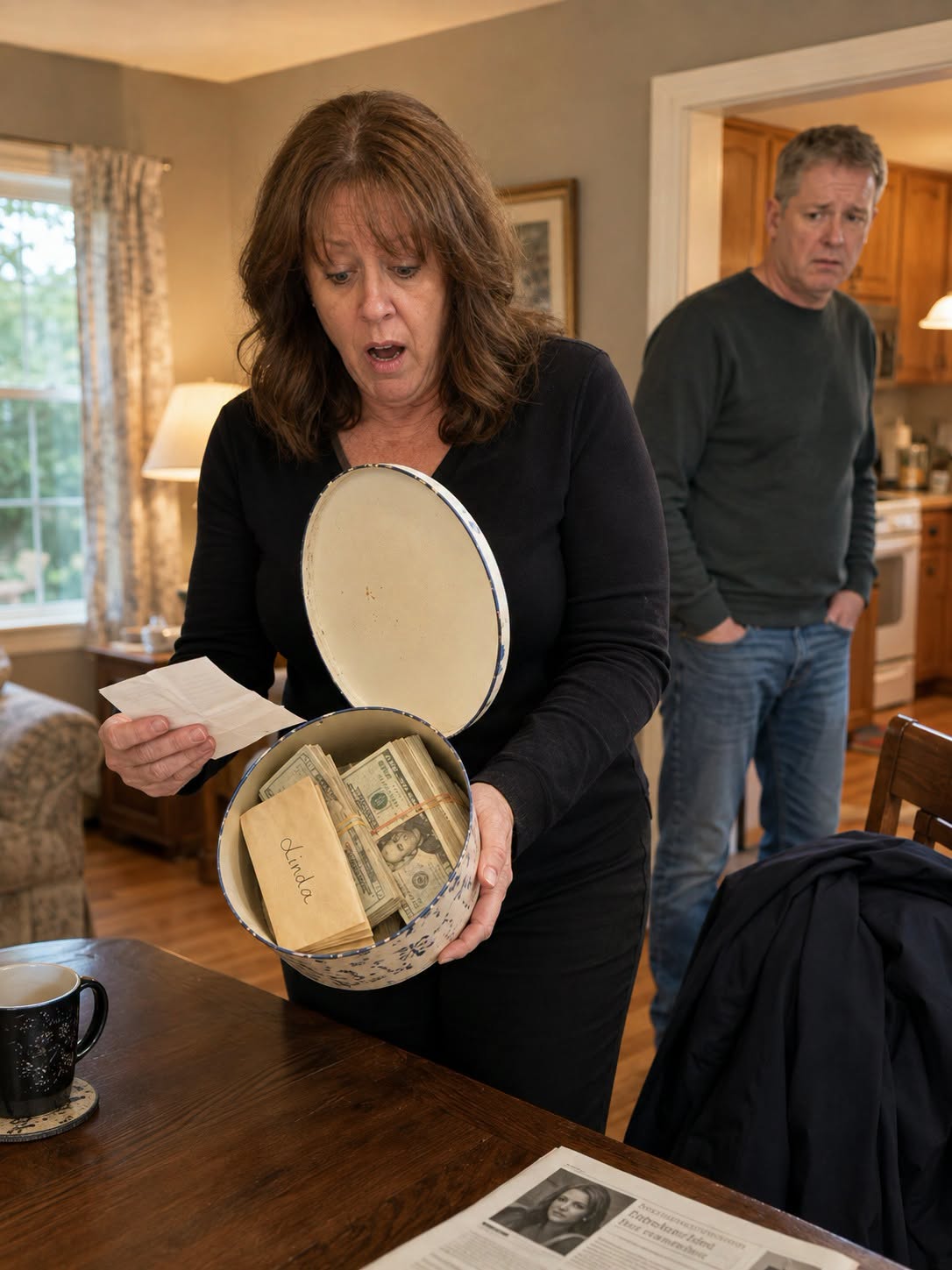
The old flour tin felt far too heavy when I lifted it from the top shelf of Mama’s pantry the morning after her funeral. Beverly had guarded that chipped white-and-blue container for decades, and when I was 12 she had once slapped my hand away from it before immediately apologizing and making me cocoa. Now, at 78, she was gone, and my brother Russell wanted her Alabama house emptied within two days. I opened the lid expecting flour and found bundles of twenties, fifties, and hundreds instead. The total was $18,940. Beneath the cash sat an envelope with one name written across it in Mama’s shaky handwriting: Linda.
The first sentence made me sit down: “I should have told you what Wayne did with your settlement.” At 17, I had been struck by a delivery truck, breaking my leg in two places and leaving me out of school for six weeks. My stepfather Wayne told us the trucking company’s insurance settlement was $42,000 and that medical expenses eventually consumed everything. Mama’s letter revealed the real settlement had been $63,000—and Wayne had secretly taken it. Even worse, she had discovered the truth years later and had been too frightened to expose him. Then I reached the final instruction she had written for me: “Read this at First County Bank, not in the house.”
At the bank, manager Gerald Watts handed me a folder Mama had deposited there 14 months earlier. Inside were the original insurance settlement, bank statements, forged disbursement records, and a legal memorandum prepared by attorney Philip Crenshaw documenting possible fraud and theft from a minor. Mama had spent 11 years quietly taking small amounts from Wayne and hiding them in the flour tin, then continued adding money from her pension, Social Security, tax refunds, and a small inheritance. She knew $18,940 could never replace what had been taken, so she had also assembled the paper trail needed to pursue the matter. The case eventually involved attorneys, an insurer, forensic accounting, records connected to Wayne’s estate, and months of legal review rather than a simple court claim. Eleven months later, the insurer agreed to a $41,000 settlement, bringing what I recovered to nearly $60,000.
The money could not restore the opportunities I might have had at 18, and Mama’s effort did not erase the fact that she had protected her marriage when she should have protected me. But her letters gave me something I had never expected: an honest accounting of her failure and the years she spent trying to repair it. Russell later admitted he had suspected something was wrong decades earlier and apologized for staying silent. Today, Mama’s flour tin sits empty on my kitchen counter while the recovered money is invested modestly; some paid for a long-delayed roof repair, a trip with my daughter, and a scholarship donation in Mama’s name. I still make her biscuit recipe on Sundays, though I keep the flour in a different container. I cannot say I have completely forgiven her. But I understand her better—and after so many years of hidden money and hidden truth, understanding finally feels like a place to begin.

