
PART 1: WHILE I FOUGHT FOR OUR BABIES, HE TURNED OFF HIS PHONE
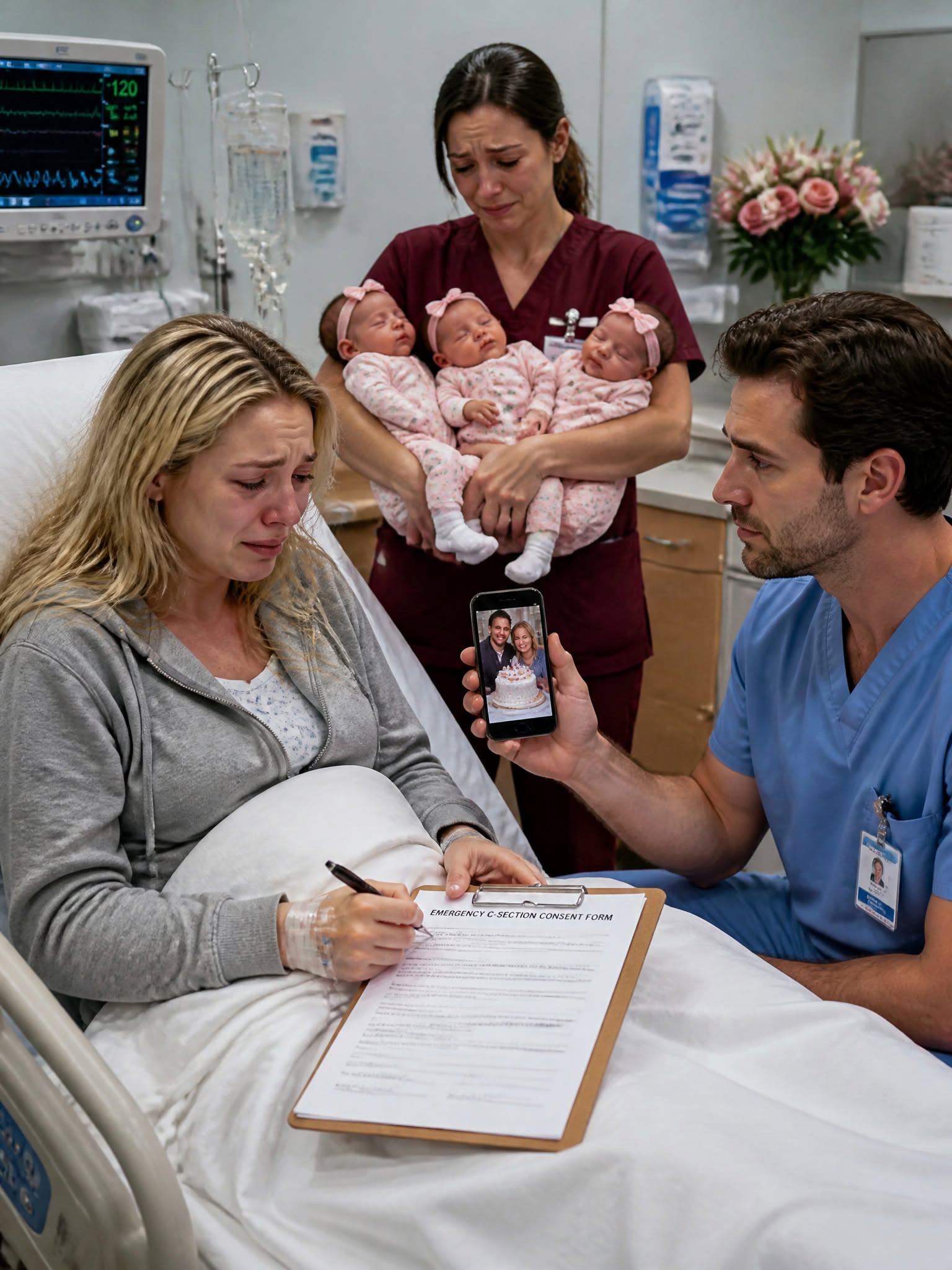
At exactly 2:17 p.m., the emergency consent form rested against my trembling stomach because the bedside tray was already crowded with medical equipment. The monitors around me were sounding alarms while three tiny heartbeats jumped unevenly across the screen, each one struggling as the doctors rushed to understand how much time we had left.
Dr. Naomi Patel studied the monitors for only a few seconds before turning toward me. The urgency in her expression told me the truth before she even spoke.
“Mrs. Carter, we have to perform an emergency C-section immediately. Baby B is showing severe distress, and Baby C’s umbilical cord is compressed. If we wait any longer… we could lose all three.”
My lips were dry, and fear had made it difficult to breathe. I slowly turned my head toward the empty chair beside my hospital bed, the place where my husband should have been sitting.
Less than an hour earlier, Mark had squeezed my hand and promised he would only be gone for a moment.
“I’m just stepping out to make one quick call.”
Forty minutes had passed since then, and he still hadn’t returned. As the alarms continued around me, I swallowed against the panic tightening my throat and looked toward Nurse Lauren.
“Please… Call my husband again.”
Lauren immediately picked up the phone and tried his number. The first call went to voicemail, then the second, and when she tried a third time, there was still no answer.
What I didn’t know was that Mark was nowhere near the hospital.
Miles away, he was standing inside an elegant private dining room at an exclusive country club with crystal chandeliers overhead and soft music filling the room. Across from him stood Madison Vale, his first love and the woman he had repeatedly assured me was nothing more than an old friend.
Between them sat a white chocolate raspberry cake decorated with fresh roses. Mark and Madison held the same silver cake knife, preparing to cut into it together when his phone began vibrating inside his jacket.
My name appeared on the screen.
Emily.
Mark looked at it long enough to know exactly who was calling. His expression tightened briefly, but instead of answering, he pressed the power button until the screen went completely dark.
Madison smiled at him.
“Today is about us.”
Mark returned her smile.
Then they cut the cake together.
Back at the hospital, I accepted the consent form with fingers so cold that I could barely keep hold of the pen. I looked at Dr. Patel, terrified that signing my name might be the last decision I ever made for my daughters.
“If I sign… will they live?”
Dr. Patel held my gaze.
“We’re going to do everything humanly possible.”
That was the only promise anyone could give me.
I signed.
Within moments, the operating room erupted into controlled urgency as the medical team prepared for surgery. I fought to remain conscious through the fear, repeating the three names I had secretly chosen during the quiet nights when I folded tiny clothes and imagined meeting my daughters.
Grace. Lily. Hope.
Then I heard the first cry, small yet fierce, and it immediately brought tears to my eyes. A second cry followed shortly after, and for a brief, precious moment, relief cut through the overwhelming terror I had been holding in. But then I waited for the third. Nothing came, and in that silence, it felt as if my heart had stopped completely.
“What about Baby C?”
Someone answered quickly from somewhere beyond my line of sight.
“We’re still working.”
The room blurred around me as exhaustion and fear pulled at the edges of my consciousness. For one impossible second, I imagined Mark bursting through the doors, terrified by what he had almost missed and finally understanding that his wife and children needed him more than whatever had taken him away.
But Mark never appeared.
Instead, the only hand holding mine belonged to a nurse.
Hours later, Mark finally decided it was time to return to the hospital. The faint scent of expensive frosting still clung to him, mixed with traces of Madison’s perfume.
During the elevator ride, he rehearsed the explanation he expected me to accept. He would say his phone had died, tell himself that hospitals always exaggerated emergencies, and assume that once he calmed me down, I would eventually forgive him as I always had before.
When the elevator doors opened, he walked confidently toward the maternity ward. Then he stopped.
My hospital room was empty, the bed already stripped clean and the bouquet his office had sent still sitting untouched by the window, as if no one had ever been there to receive it. There was no wife waiting to confront him, no newborn babies for him to finally meet, only a hollow silence that filled every corner of the room and made it painfully clear that everything he had expected was already gone.
Mark stopped a passing nurse.
“Excuse me. My wife. Emily Carter. She delivered triplets. Where is she?”
The nurse studied him for a moment before recognition appeared on her face.
“Emily Carter?”
“Yes. My wife.”
Her expression shifted from recognition to confusion.
“She was discharged four days ago.”
Mark froze.
The nurse looked at the empty room, then back at him before asking the question that finally shattered his confidence.
“Isn’t she home?”
For the first time since he had switched off his phone, Mark found himself completely speechless, with no excuse or explanation that could possibly make sense of what he was hearing. He had always assumed that no matter how long he stayed away, I would still be there waiting for him to come back and explain himself. But reality had moved on without him—four full days had already passed since everything happened. And in that time, his wife and their three newborn daughters were no longer in the place he expected them to be, as if the life he had taken for granted had quietly slipped out of his reach.
PART 2: FOUR DAYS TOO LATE
For several seconds, Mark couldn’t process what the nurse had just told him. Emily had been discharged four days earlier, yet he was standing there with an overnight bag as though he had merely arrived a few hours late.
“What do you mean discharged?”
The nurse’s expression shifted into something Mark found even harder to face than anger: pity. She explained that I had been discharged with instructions for follow-up care and that the babies had initially remained in the NICU for observation, but she wasn’t authorized to discuss additional details without proper clearance.
“I’m her husband.”
His answer came out sharper than he intended. The nurse glanced at his empty hands, noticing there was no visitor bracelet, discharge paperwork, or anything else suggesting he had been present during the previous four days.
“I understand. You should speak with the attending physician or patient services.”
Mark stepped closer as panic began replacing the confidence he had carried into the hospital. He couldn’t seem to understand how I could have gone from lying in that room waiting for him to simply disappearing from his reach.
“No, you don’t understand. My wife was admitted here. She was having complications. I went out for a short while, and now you’re telling me she left?”
“Sir, I’m going to ask you to lower your voice.”
Mark looked past her toward my former room, where the bed had already been prepared for another patient. The only remaining evidence that I had ever occupied it was the untouched bouquet beside the window, with the card from his office team still hanging from its ribbon.
He finally pulled out his phone and saw everything he had deliberately avoided. There were twenty-six missed calls, fourteen voicemails, nine messages from the hospital, three from his mother, and another from a number he didn’t recognize, but there was nothing from me after the surgery.
Mark immediately called my number, only to hear the familiar recording.
“Hi, you’ve reached Emily. Leave a message and I’ll call you back when I can.”
He disconnected before the beep and called twice more, but every attempt went straight to voicemail. When he lowered the phone, he noticed Charge Nurse Lauren watching him from the nurses’ station and vaguely remembered seeing her in my room before he left.
“You.”
Lauren met his stare without reacting to the accusation in his voice.
“Mr. Carter.”
“Where is my wife?”
“She asked that no personal information be released to you beyond what hospital policy requires.”
Mark stared at her in disbelief. Lauren explained that before leaving the hospital, I had amended the permissions governing who could receive information about me.
“What?”
“She amended her contact permissions before discharge.”
“That’s impossible.”
“It isn’t.”
“She was barely conscious.”
“She was conscious when she signed the paperwork.”
The word signed immediately reminded Mark of another signature, the one I had been forced to give alone on the emergency consent form while his phone sat switched off inside his jacket. For the first time, the consequences of leaving were beginning to become more than an inconvenience he thought he could explain away.
“I need to see my children.”
“You need to speak with NICU administration.”
“They’re my children.”
“Yes. And they are patients. There are protocols.”
Mark went quiet, and the confidence in his face finally began to collapse. There was one question he had apparently been too frightened to ask until that moment.
“Are they alive?”
Lauren didn’t answer immediately, and those few seconds were enough to make him remember the fetal monitors and the medical urgency he had chosen to leave behind. When she finally spoke, she gave him no reassurance.
“You need to speak with Dr. Patel.”
Twenty minutes later, Dr. Naomi Patel met Mark inside a small consultation room. The two boxes of tissues sitting on the table immediately unsettled him, and he barely waited for her to sit before demanding answers.
“Where are they?”
Dr. Patel closed the door and explained that she first needed to confirm his identity and legal status because I had changed certain permissions after giving birth. Mark immediately dismissed the decision as something I had done because I was angry.
“My wife was angry.”
“She was also recovering from major surgery, severe blood loss, and the premature delivery of three infants.”
Each part of that sentence seemed to hit him separately. Major surgery, severe blood loss, and three premature daughters were realities he had managed to avoid while sitting beside Madison at the country club.
“I didn’t know it was that serious.”
“We called you repeatedly.”
“My phone died.”
Even Mark seemed to realize how weak the lie sounded once it left his mouth. Dr. Patel reminded him that the phone had gone directly to voicemail after several unanswered calls, and he had no response that could make the timeline disappear.
“How is Emily?”
“She survived.”
Those two words frightened him more than any long medical explanation could have. He had apparently expected to hear that I was recovering well, not to be reminded that survival itself had been uncertain.
“And the babies?”
“Grace and Lily are stable.”
Mark tightened his grip on the edge of the table because those names meant nothing to him yet. He was hearing the names of two of his daughters for the first time from a doctor instead of from their mother.
“And Baby C?”
Dr. Patel explained that Hope had required more intervention because she had gone longer without strong oxygen flow and therefore needed close monitoring. Mark quietly repeated her name, finally realizing that I had named all three girls without him.
“Hope.”
“She’s alive?”
“She is alive.”
Relief finally broke through his panic, and he leaned forward as the breath left his lungs. Yet even that relief carried another painful realization: his three daughters were alive, but he had missed their birth, their first medical crisis, and even the moment they received their names.