
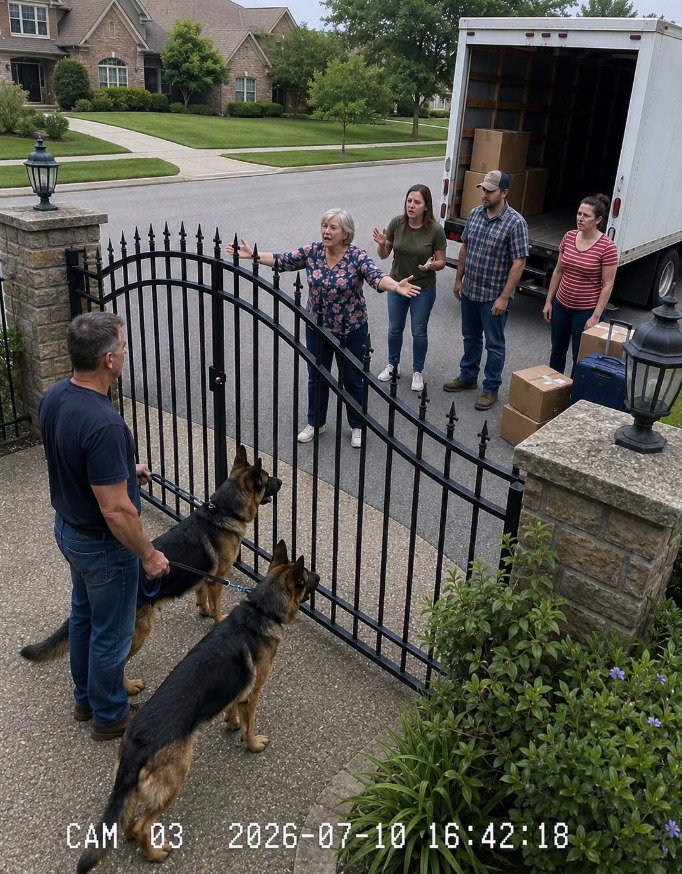
The first thing my mother said through the intercom was, “Open the gate, Paige. The children are tired.” On my security monitor, I could see her standing beside my twin sister Mallory, Mallory’s husband Grant, three children, a rented moving truck, and a stack of taped boxes. Nobody had called to ask whether they could stay. Mallory was already talking about taking the downstairs suite, while Grant looked toward my workshop and wondered aloud whether he could start a furniture business there. Twelve years earlier, these same people had watched me leave home at nineteen with two trash bags after Mom decided Mallory needed my bedroom for her growing family. Now they stood outside the home and restoration business I had spent more than a decade building, apparently convinced that I would simply open the gate.
After leaving home, I spent weeks sleeping on friends’ floors before hiding a small tent behind a roadside flea market. The owner, Walt Perrigo, eventually discovered me and offered me a cot in a storage room in exchange for helping around the property. He taught me furniture restoration, while my late grandmother’s lessons about repairing damaged pieces stayed with me. Years later, an attorney contacted me with unexpected news: Grandma had created a modest trust specifically for me, protected so no other relative could access it. When I turned twenty-five, I used that money as a down payment on eleven acres and started Ridge Hollow Restoration. The early years were difficult, but eventually the business grew to twelve employees, regular commercial clients, valuable equipment, and a home I owned outright. By the time my family arrived at my gate, every mortgage record, insurance policy, investment, estate document, and business agreement was carefully protected—and I knew exactly what I was willing to risk.
Mom finally admitted that Mallory and Grant had lost their house and had nowhere permanent to go. I told them I would help the children get warm, arrange food, and pay directly for three nights at a nearby motel, but I would not turn my home or workshop into their new residence. Grant argued that I had plenty of room. Mallory insisted it would only be temporary. I reminded them that loading a moving truck before asking permission was not really a request—it was an assumption. I had spent years documenting my property, business ownership, attorney agreements, insurance coverage, and financial records precisely because I never wanted anyone else deciding what belonged to them simply because we shared a last name. If the situation ever became a court or property dispute, everything was already clear. Eventually Mom stopped arguing and quietly accepted the motel arrangement. For the first time, the locked gate felt less like a barrier and more like proof that I had finally learned how to protect what I had built.
They stayed at the motel for eleven days before Grant’s brother offered them a temporary place to live. A week later, Mallory called me late at night, and for once she did not ask for money, a room, or a job. She simply talked. Months later, she called ahead and asked whether she could visit my workshop. I agreed, and when she stood among the restored furniture, she quietly said Grandma would have loved what I had created. We still do not have the kind of effortless sisterly relationship people imagine twins should share, but something has slowly begun to change. My mother and I remain distant. I do not regret keeping the gate locked, because I finally understand that boundaries and kindness are not opposites. I could refuse to give away my home and still help their children find somewhere safe. After twelve years of rebuilding my life piece by piece, that distinction may be one of the most valuable things I learned.

