
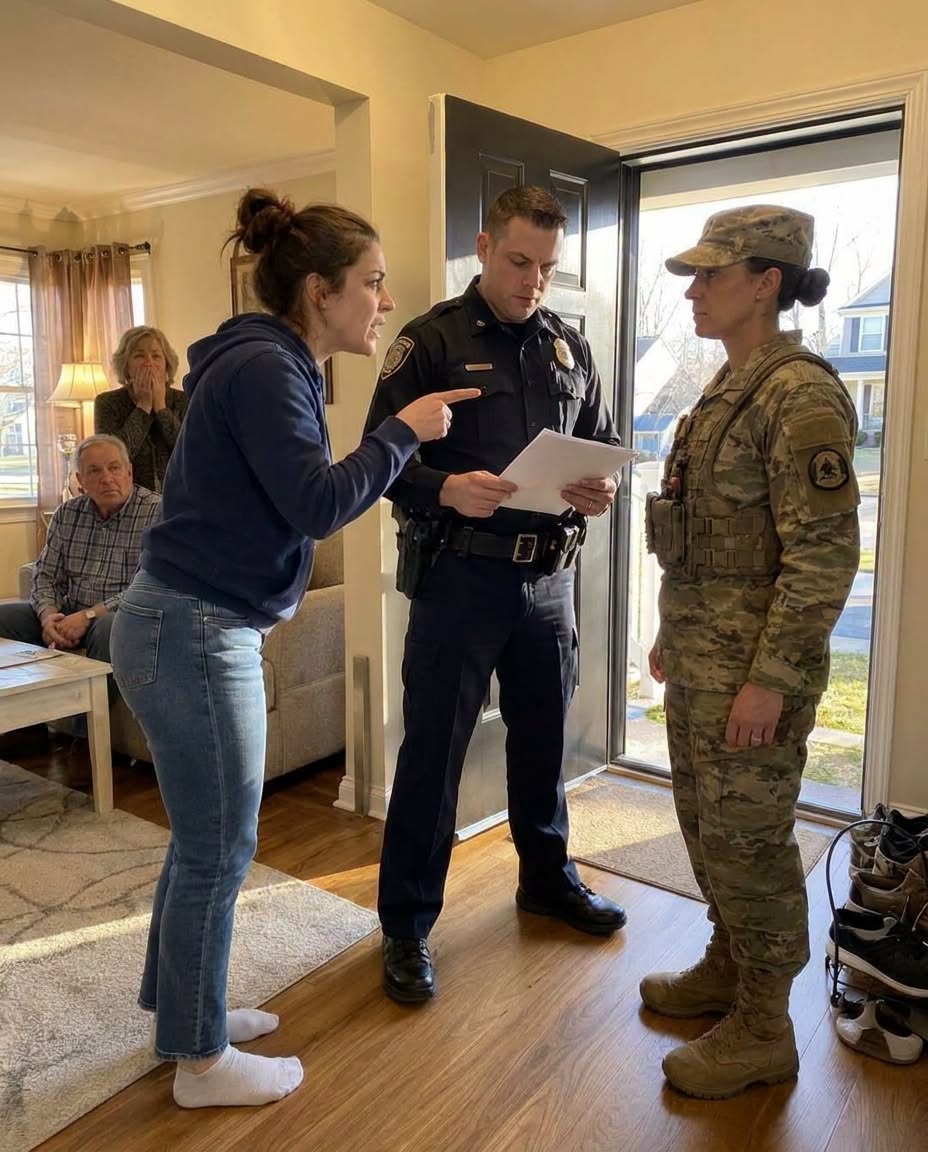
The laughter started the moment my sister noticed the patch on my shoulder. I had barely stepped into my parents’ house outside Denver after five years away when Tiffany lifted her phone toward her livestream and joked that I only had “some small job on a base.” Her fiancé Brad smirked, my mother praised his supposed leadership credentials, and my father quietly warned me not to embarrass the family that evening. I said nothing, even when the room laughed again. Less than half an hour later, I heard voices coming from my father’s office and found a property-transfer packet spread across his desk with my late grandmother’s name on it, a county recorder cover sheet, a notary acknowledgment, and a blank signature line printed with my name. I photographed everything. Then three hard knocks hit the front door, two police officers walked in responding to a complaint filed by Tiffany, and before anyone could enjoy the humiliation they clearly expected, black SUVs stopped at the curb and a senior military officer entered the house, looked directly at me, and said, “Major?”
My name is Reyna Marsh, and the life my family had reduced to a vague job on a military base had taken me through officer training, multiple deployments, command responsibility, and an incident outside Kandahar where I helped pull three soldiers from a burning vehicle under fire. I later received a Bronze Star, though the medal mattered far less to me than the people who came home alive. The only person in my family who consistently understood any of that was my grandmother, Vivian Calloway. She had spent decades watching my parents celebrate Tiffany’s ambitions while treating mine as awkward departures from the life they understood. Before she died of pancreatic cancer, she left me her lake house ninety minutes outside Denver, along with a modest trust for taxes and upkeep, and instructed through her estate attorney, Mr. Osei, that the property was to remain mine unless I personally chose otherwise in writing. Tiffany received a smaller cash inheritance. Grandma even left me a private letter explaining why: she wanted me to have one place in the family that nobody could talk me out of, laugh me out of, or claim simply because my life had taken me farther away.
The complaint against me collapsed almost as soon as the officers examined the facts. Tiffany had accused me of entering a private room, stealing financial documents, and making threats, yet the documents were still sitting openly on the desk exactly where I had photographed them. Officer Delgado quickly noticed the more serious problem: an inherited property-transfer packet naming me as the owner, a blank signature line bearing my printed name, and a questionable notary acknowledgment connected to a family friend named Gary Holbrook. Colonel Ashcroft, the senior officer who had arrived after my security-clearance system flagged the civilian police contact, did not interfere with local law enforcement or demand special treatment. He simply confirmed my identity, rank, and whereabouts through the proper channels, then stepped aside while the officers did their work. The focus shifted from Tiffany’s complaint to possible document fraud, attempted forgery, and an improperly executed transfer of inherited real estate. The same family that had spent the evening laughing at how little they thought I mattered suddenly stood silent while professionals examined paperwork suggesting they had been preparing to move Grandma’s house into Tiffany’s name without my consent.
The financial-crimes investigation that followed was far less theatrical than the night it began, but far more consequential. Gary Holbrook’s notary commission had expired eighteen months earlier, making the acknowledgments he continued issuing a separate legal problem. Prosecutors ultimately treated my parents as negligent and willfully self-deceiving rather than proving criminal intent against them, but the transfer was voided and the estate records were formally corrected. My parents signed written acknowledgments confirming that the lake house belonged solely to me and that no other family member had a claim to it. Gary faced the consequences of the notary and forgery issues. My father later came to my hotel and admitted that he had known enough about the transfer packet to understand something was wrong, but had chosen not to look too closely because convincing himself the house “made more sense” for Tiffany was easier than confronting what Grandma had actually wanted. Tiffany eventually admitted something uglier and more honest: she had known about my Bronze Star and promotions, but had spent years protecting the family story in which she was the successful daughter, and taking Grandma’s house had begun to feel like a way to even a score that existed mostly in her own mind.
I kept the lake house. For a while I considered selling it simply to remove myself from everything that had happened, but eventually I understood that doing so would allow my family’s attempted transfer to redefine a place that had meant something entirely different for twenty years. I repaired the leaning dock where Grandma and I used to sit with our feet in the water, brought home the photograph of the two of us that my father had quietly removed from his office wall, and hung it where it belonged. My relationship with my family did not transform overnight; my father began trying, my mother struggled more slowly, and Tiffany and I settled into something cautious and unfinished. On my next leave, I sat alone on that repaired dock watching evening light move across the lake and thought about how little of that night’s real victory had anything to do with rank, medals, police cars, or black SUVs. It came down to something much less dramatic: a blank signature line, a few photographs taken before anyone could hide the evidence, and finally refusing to let the people who had underestimated me decide what belonged to me.

