
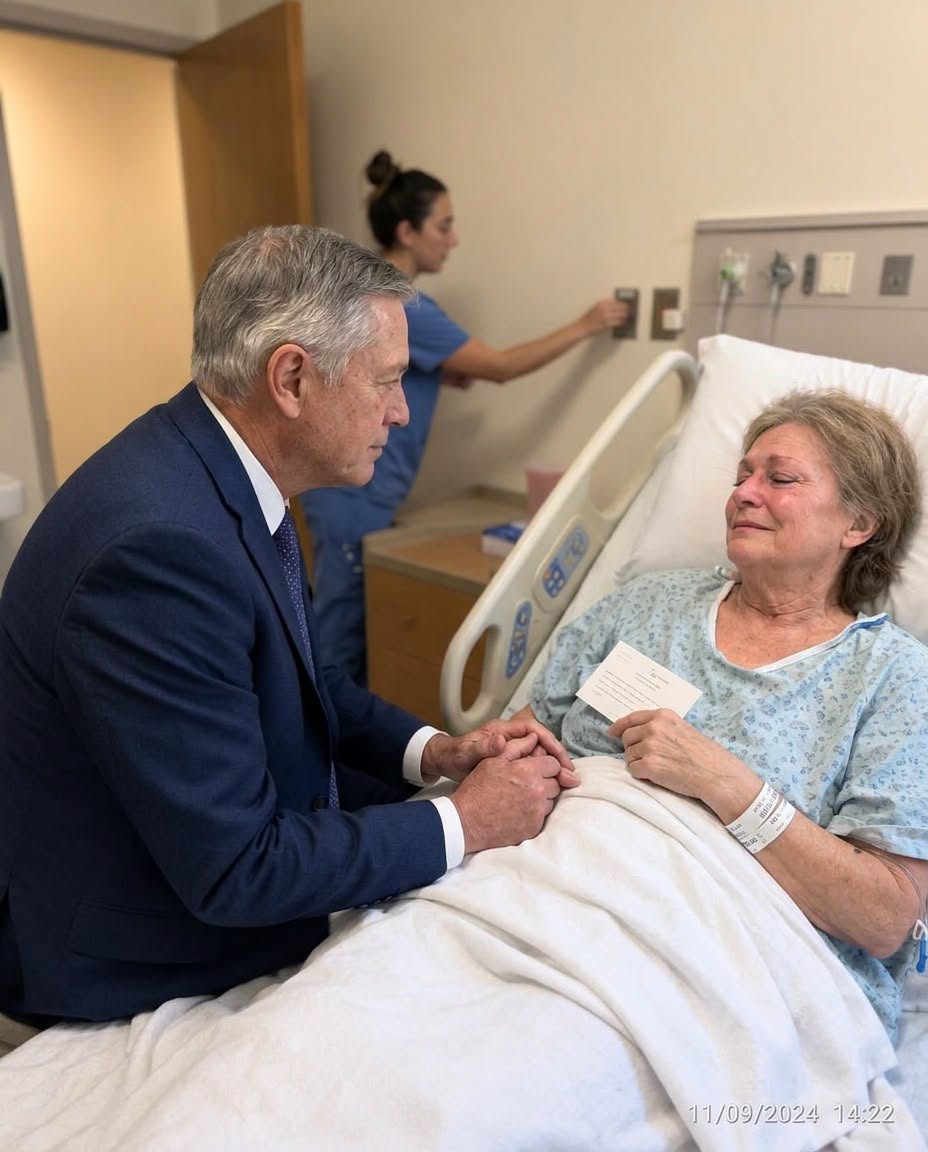
The fluorescent lights hummed above my hospital bed while the heart monitor beside me kept time with a steady electronic beep. I had been out of surgery for barely three hours when I realized the room was completely empty. My three adult children had promised to be there when I woke, but a nurse finally admitted they had left because they did not want to keep paying the hospital’s parking fee. I was sixty-four years old, weak from anesthesia and a cardiac procedure, and the people I had spent decades raising had decided twenty dollars mattered more than sitting beside me. I cried so hard the nurse reached for tissues and asked whether there was anyone else she could call. Then a man in a dark tailored suit appeared in the doorway, asked if I was Adrienne Davis, and said something I had not heard in nearly half a century: “You paid for my lunch every day in third grade.” When the nurse tried to explain visiting restrictions, he quietly added, “It’s all right. I own this hospital.”
His name was Malcolm Chen, though I had known him decades earlier as Malcolm Peterson, a painfully thin little boy at Franklin Elementary who often sat in the cafeteria pretending he was not hungry. I had been sixteen then, working as a teacher’s aide while helping my own family pay bills, and for nearly two years I quietly spent a large part of my meager wages making sure Malcolm received a hot lunch without ever feeling like charity. He was later adopted by the Chen family, became a physician, moved into hospital administration, and eventually built a network of four hospitals across the Pacific Northwest. He had even created charitable programs ensuring children receiving medical care would not go hungry. Malcolm told me he had searched for me for years because the kindness I barely remembered had shaped the direction of his entire life. Then he asked why I was alone, and when I explained that my children had left over parking fees, his expression changed. He already knew far more about my family than I realized: I had borrowed against my pension to rescue my oldest son David’s business, helped pay Sarah’s debts, financed Michael’s car, and continued supporting them while surviving on a small pension and Social Security.
What Malcolm showed me next hurt far worse than waking up alone. David had consulted an elder-law attorney about having me declared mentally incompetent, focusing specifically on what he called my “excessive generosity” and how it might reduce the family inheritance. Sarah had complained to a friend that the money I donated to charities should instead remain available for her and her brothers, while David’s accounting firm had accessed my credit information and tracked my spending. Most devastating was an audio recording made in the hospital parking lot after they left. My children discussed establishing a paper trail showing me as financially irresponsible, using my charitable giving as supposed evidence of cognitive decline, selling my home, moving me into assisted living, and eventually gaining control over an estate they estimated at roughly $450,000. The parking fee had merely been their excuse. While I lay unconscious after heart surgery, they had left the hospital to meet another attorney about how to take control of my life. I finally understood that every excuse I had made for them over the years had protected me from seeing something much harder: they were no longer looking at me primarily as their mother, but as an asset whose decisions interfered with their expectations.
Malcolm did not tell me what to do; instead, he gave me options. Years earlier he had established the Adrienne Davis Foundation, named in honor of the woman who had fed him as a hungry child, and it was already supporting school meal programs and other charitable work. He offered me the role of executive director with a $125,000 annual salary, a professional staff to handle operations, and the chance to guide the mission that my own small act had inspired. He had also purchased a fully paid home in an active-adult community called Sunset Gardens, giving me a place to live independently with support available if I ever wanted it. His elder-law attorney helped me secure my accounts, revoke unauthorized access, update my estate planning, and document my competency so that no one could easily manufacture a guardianship claim. Six months later I was living in that home, directing programs that fed thousands of children, reviewing scholarship applications, and making financial decisions more complex than anything my children had claimed I could no longer handle. David continued contacting attorneys and questioning my salary and employment, but the evidence worked against him: I was healthy, employed, financially independent, and clearly managing my own affairs.
One evening, I sat in my new living room with Malcolm’s last childhood lunch card framed on the coffee table and wrote a letter to David, Sarah, and Michael. I told them I was healthy, secure, happy, and fully capable of making my own decisions, and that I would no longer finance their lives or defend mine to them. I enclosed a brochure from the foundation and added that if they ever wanted to contribute something themselves, we were always looking for volunteers to help feed children. I still grieved the family relationship I thought I had, but I no longer confused grief with obligation. The strangest part was realizing that the kindness my children regarded as financial weakness had become the very thing that gave me a new career, a new home, and people who valued me for something other than what I could provide them personally. Forty years earlier, I had fed one hungry boy without expecting anything back. I never imagined that decades later, after waking from heart surgery believing I had been abandoned, that same act of kindness would find its way back to my hospital room and remind me that I still had a life worth choosing for myself.

