
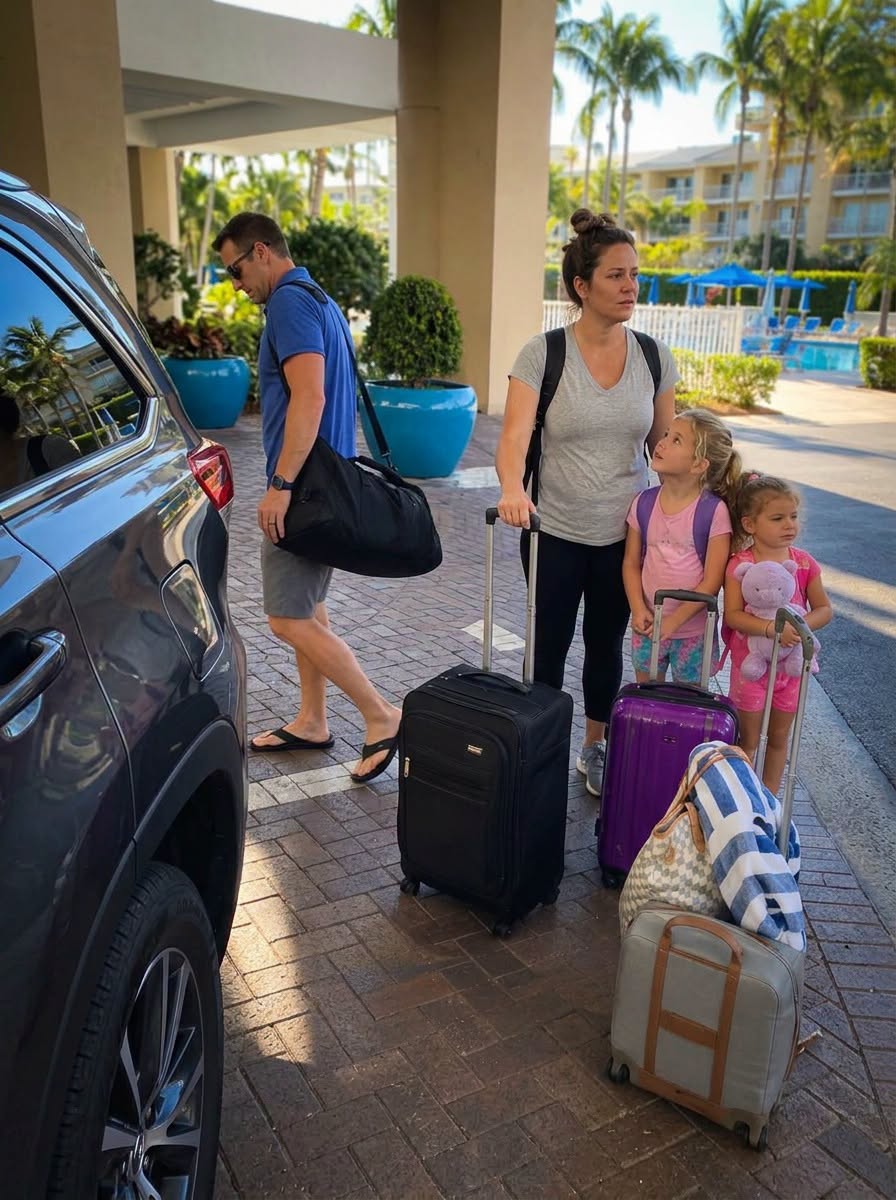
Mark’s rental car was barely out of the hotel parking lot when I picked up my phone and called my sister. I had spent eight months planning our first major family vacation in Florida—flights, hotel, activities for our three children—only for my husband to announce after we landed that several college friends were staying nearby and he intended to spend three days golfing and fishing with them. “You’ll be fine,” he had said, as though managing three children alone at a resort was somehow the vacation I had planned for myself. The next morning, he packed a bag, kissed the kids, and drove away without hesitation. I watched from the balcony until his car disappeared, then looked at Emma, Noah, and five-year-old Lily standing behind me. By noon our suitcases were packed. When Lily asked whether we were going home, I shook my head and said, “No, sweetheart. We’re finally going on vacation.”
My sister Renee was renting a beach house less than an hour away with her husband and two sons, and she welcomed us without asking me to defend my decision. For three days, the children played with their cousins, explored tide pools, built sandcastles, ate ice cream, and spent hours in the ocean while I slowly realized how much of my marriage had been organized around Mark’s comfort. This vacation was only the latest example. Years earlier, on one of our first trips together, Mark had quietly upgraded himself to first class while leaving me alone in economy because he “needed to decompress.” At home, he needed quiet after work, weekends to recharge, and space whenever family life became overwhelming; I made sure he received all of it while never stopping to ask when my own break was supposed to arrive. Sitting on Renee’s porch one morning with a cup of coffee and nobody demanding anything from me, I found myself crying because I could barely remember what I enjoyed when I was not managing someone else’s mood. Renee asked what I wanted from those three days, and the simplicity of the question stunned me.
On the second day, Mark called expecting to hear about the resort pool. I told him we were staying with Renee instead. His relaxed voice hardened immediately, and he reminded me that his trip with the guys was “only three days.” I told him those three days mattered because they represented six years of him assuming his need for rest outranked mine. When he insisted the situations were different, I asked him to explain exactly how. He could not. I told him I would return when his golf trip ended and hung up rather than smoothing the conversation over for him. When Mark returned to the resort the following afternoon, however, I deliberately was not there yet. He walked into an empty room, called my mother and friends trying to find me, and spent hours wondering whether I had finally left him. By the time the children and I arrived the next morning, his golf clubs were still zipped inside their travel bag and three untouched coffee cups sat on the desk. For the first time in our marriage, Mark had been forced to sit inside the uncertainty I had spent years quietly absorbing.
He cried when he apologized, but I told him an apology was not enough. I explained that this was not really about Florida; it was about invisible labor, shared parenting, and a marriage in which one partner had been granted automatic access to rest while the other had become the default manager of everything else. Mark admitted that while sitting alone in the hotel room he had replayed the first-class incident, previous vacations, weekends away, and countless smaller decisions in which he simply assumed I would accommodate him. I told him that if the marriage was going to continue, change would have to be sustained rather than crisis-driven. Back home, we created a weekly “needs check,” setting aside time every Sunday to say plainly what each of us required for the coming week—time alone, social plans, childcare coverage, or genuine uninterrupted rest. Mark began taking the children for entire Saturday mornings and stopped making trips or weekend plans without discussing them first. There were mistakes: three weeks after Florida he nearly booked another golf weekend before catching himself and canceling it. But the difference was that he noticed the pattern without requiring me to carry the entire burden of pointing it out.
A year later, we took another family vacation, this time to a lake house we chose together. Mark did not disappear for a surprise trip, and when he wanted several hours to himself one afternoon, he asked rather than assumed. I sat on the dock watching our children play while he grilled dinner nearby and realized that the dramatic part of our story had never really been the empty hotel room. The important change happened afterward, in ordinary kitchens and Sunday conversations, when both of us began treating my time and needs as equally real. Our marriage did not become perfect, and old habits still occasionally appeared, but I stopped disappearing inside them. I started running again, joined a book club, and learned to spend time alone without feeling that I had neglected someone. When I think of that balcony in Florida now, I remember watching Mark drive away and understanding that I could either spend another vacation waiting for him to return or choose something better for myself and our children. I packed the suitcases because I wanted three good days. What followed was the first time in years that I insisted on being fully present in my own life.

