
Part 1: The Girl Who Asked for a Chair
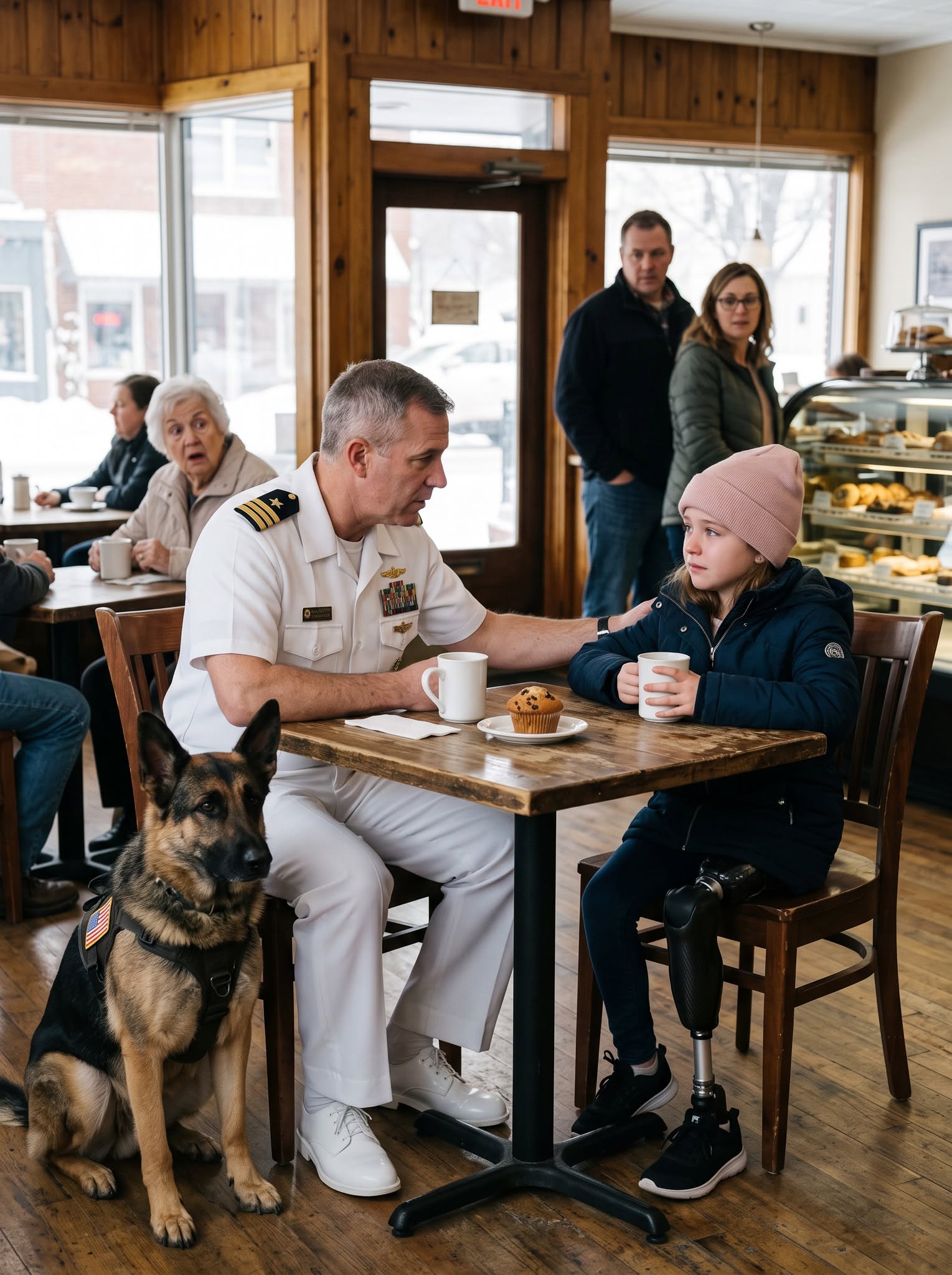
Snow was hammering Bozeman when a tiny girl in a faded pink hat limped into the Copper Hearth Café and asked strangers for a place to sit. Her prosthetic left leg clicked softly against the floor, but nobody moved to help her.
“Can I sit here?” she asked a woman at the first table.
“No.”
Two college guys suddenly became fascinated with their laptops. A woman with a stroller frowned.
“Where are your parents?”
The girl lowered her eyes.
She did not argue.
That bothered me.
She accepted rejection like she had practiced it.
Finally, she reached my table. Her fingers twisted around the bottom of her jacket as she looked first at my German Shepherd, Rex, then at me.
“Can I sit here?”
I nudged the empty chair out with my boot.
“Yeah. You can sit.”
For a second, she only stared. Then she moved, but her prosthetic caught on the uneven floor, and she fell forward.
I caught her before she hit the ground.
“I’ve got you.”
Rex stood immediately and positioned himself beside her chair.
“Does he bite?” she whispered.
“Only terrible conversationalists.”
A tiny smile appeared, then disappeared just as quickly.
“I’m Daniel Cross.”
“Mia.”
When she reached toward Rex, her sleeve slipped back.
That was when I saw the bruises.
Some were fading yellow. Others were dark purple. Around her forearm were marks shaped like fingers.
I had spent enough years in the Marines to recognize what force looked like when someone smaller had been grabbed.
I kept my voice calm.
“Mia, are you hurt right now?”
Her eyes darted toward the entrance.
She did not answer.
She did not need to.
“I just needed somewhere to sit,” she whispered.
Under the table, Rex pressed against her leg.
The café doorbell rang.
Mia froze.
A man stepped inside, snow melting across his coat. He scanned the room, saw her, and smiled without relief.
“There you are.”
I stood.
Rex rose with me.
The man’s expression tightened. “Come on, Mia. We’re leaving.”
“She know you?” I asked.
“I’m her uncle.”
I looked at Mia.
Her lips trembled.
“He told everyone my mom abandoned me.”
Then I noticed a stained white envelope in her pocket.
When she pulled it out, the man went pale.

Part 2: The Photograph
“Give me that,” the man said.
His reaction changed everything.
I took the envelope from Mia and opened it. Inside were a hospital bracelet, a photograph, and a handwritten note addressed to her.
The photo showed Mia as a toddler sitting on a young woman’s lap.
But the man standing behind them was someone I knew.
Someone I had served with.
Someone officially listed as dead.
Thomas Mercer.
Staff Sergeant Thomas Mercer.
Tommy.
I looked from the photograph to Mia, then to the man claiming to be her uncle.
“Where did you get this?”
Mia’s eyes filled. “My mom gave it to me last night.”
“You said your mother abandoned you.”
She shook her head.
“No. She told me to run before he woke up.”
The man’s hand moved inside his coat.
Rex growled.
I shifted between Mia and the aisle.
The man stopped, then slowly pulled out a phone.
“I’m calling my sister,” he said.
Mia held Rex’s collar hard.
“Your mother?” I asked.
She nodded.
The man sighed. “Emily is confused. She hasn’t been well.”
“Martin,” Mia whispered.
It was the first time she had used his name.
The café manager, Nora, stepped out from behind the counter.
“Everything all right here, Daniel?”
“I’m not sure yet.”
Nora looked at Mia and softened. “Would anybody like hot chocolate?”
“With marshmallows?” Mia asked.
“As many as legally permitted in Montana.”
Martin moved away to make the call. That small distance changed the room. Mia’s shoulders lowered slightly.
I studied the photograph again.
Tom had supposedly died eleven years earlier after leaving the Marines for civilian contracting. There had been a memorial. No body. No real questions.
But in this photo, he stood behind Mia and Emily only six or seven years ago.
“Who is this man?” I asked.
Mia leaned closer. “I don’t know. Mom called him Thomas once. She said he helped us.”
Then police arrived.
Officer Hannah Cole sat beside Mia, not across from her. She asked if Mia felt safe staying in the café until they found her mother.
Mia looked at Rex.
“Can he stay?”
“For now,” Cole said, “absolutely.”

Part 3: The Letter
Martin did not run when the police arrived.
He answered questions, looked worried, and watched Mia with the complicated guilt of someone who had made mistakes but did not want her harmed.
That unsettled me.
Because fear can be honest, but it can also be incomplete.
Officer Cole confirmed Emily’s phone had last connected near the family property outside Belgrade. A deputy was sent there.
Then Cole asked if Mia wanted to open the note from her mother.
Mia shook her head.
“Daniel can.”
I unfolded it carefully.
Mia, if you are reading this somewhere safe, then you did exactly what I asked. I am proud of you.
Emily wrote that Martin was not Mia’s enemy, but that he believed old secrets should stay buried.
She told Mia to find someone she trusted, show them the photograph, and ask them to find Daniel Cross.
I stopped reading.
My fingers went cold.
Mia looked at me. “She knew you?”
“I don’t think so.”
“Then why did Mom know your name?”
I had no answer.
Martin did.
He had stopped pretending not to listen.
“Martin,” I said. “Why does your sister know my name?”
He closed his eyes. “Not here.”
“Why?”
He looked at Mia, then at Officer Cole.
“Because Thomas talked about him.”
“You knew Tom?”
“Yes.”
“And he’s alive?”
Martin hesitated.
That hesitation contained years.
“He was.”
Was.
Not is.
Before I could demand answers, Officer Cole received a call. Emily had been found safe at a clinic in Bozeman after feeling ill before sunrise. She had left her phone charging at the house.
Mia exhaled as if she had been holding her breath all morning.
“Can I see her?”
“Soon,” Cole said.
Martin stood. “I’ll take her.”
Mia’s hand moved immediately toward Rex.
Martin saw it.
His face fell—not with anger, but with hurt.“Or someone else can,” he said quietly.
That was when I understood Mia had been trapped inside an adult conflict she did not fully understand.
And someone needed to separate fear from fact.

Part 4: Emily’s Truth
Emily arrived forty-five minutes later in a gray wool coat, with Mia’s eyes and exhaustion around her own.
“Mom!”
Mia crossed the café as fast as her prosthetic allowed. Emily dropped to her knees and held her.
“I’m here. I’m right here.”
Martin stayed seated.
Emily saw him over Mia’s shoulder, and something complicated passed between them.
Love.
Resentment.
History.
Maybe all three.
Then she looked at me.
“Daniel Cross.”
It was not a question.
“You know me?”
“Only through Thomas.”
We sat together with Officer Cole nearby. Emily placed both hands around a cup of tea.
“Thomas Mercer was my husband.”
Mia’s mouth opened. “Dad?”
Emily turned to her gently.
“No, sweetheart. Thomas wasn’t your biological father.”
“But you married him?”
“Yes. When you were little.”
Thomas had come into their lives when Mia was almost two. He became Emily’s friend first, then her husband.
Then he discovered someone from his contracting years had been using his identity—financial records, travel documents, employment papers. His supposed death had made the fraud easier.
“So he stayed dead?” I asked.
“For a while,” Emily said.
Anger settled inside me.
“I carried his picture for three years.”
Emily lowered her eyes.
“I’m sorry.”
That did not fix anything.
But she meant it.
She explained that Thomas eventually returned quietly to Montana, but he never contacted me because I was the person he found hardest to face.
“He thought you would forgive him,” she said.
“That makes even less sense.”
“He said disappointment from someone who hated him would be easy. Forgiveness from someone he respected would make him face what he’d done.”
That sounded infuriatingly like Tom.
He had died three years earlier from a sudden heart condition.
For real this time.
I stared out at the snow.
All those years, I had mourned him once.
Then he had lived.
Then he had died again without telling me.
Part 5: The Key Thomas Left Behind
The marks on Mia’s arm still needed explaining.
Officer Cole asked gently.
Mia answered before anyone else.
“Climbing gym.”
Emily sighed. Mia had joined an adaptive climbing program and refused to use the beginner wall.
Martin smiled tiredly. “She attacks the hard routes like they insulted her personally.”
“I almost made the red one,” Mia said.
“You fell off it seven times.”
“Thank you for correcting the record,” Martin replied.
Relief came with embarrassment.
I had seen bruises and built a story. Some of that instinct came from experience. But experience can become blindness if you stop asking questions.
“I’m sorry,” I told Martin.
“Don’t be,” he said. “If a kid looks scared, I’d rather someone ask questions than decide it’s none of their business.”
That was the first moment I liked him.
Not much.
But enough.
After Officer Cole arranged follow-ups, Emily sent Mia to sit with Nora near the counter. Rex went with her.
Then Emily placed a small brass key on the table.
A faded tag hung from it.
D.C.
My initials.
“What does it open?”
“I don’t know,” she said. “Thomas left it for you.”
She also gave me a storage receipt.
Livingston. Locker 214. Paid in advance. Eleven years.
Thomas had renewed it every year until he died. Emily had kept paying after.
“You never opened it?”
“He made me promise not to.”
“And now?”
“Now I think keeping the promise is doing more harm than breaking it.”
I turned the receipt over.
There was Thomas’s handwriting.
Daniel—If Emily gives you this key, she has finally chosen the future over my mistakes. Before you judge her, open the locker. Then decide whether Mia should know who her father is.
Emily read the words and covered her mouth.
“Thomas never knew who Mia’s biological father was,” she whispered.
I looked at the key.
“Apparently, before he died, he found out.”
Part 6: Locker 214
We did not drive to Livingston immediately.
An earlier version of me would have chased the answer before lunch. But Mia had already carried enough confusion for one morning, and not every unanswered question is an emergency.
The next day, under a clear Montana sky, I met Emily, Mia, and Martin at the storage facility.
Mia wore the same pink hat and had drawn a blue dinosaur on her prosthetic with washable marker.
“Sky dinosaur?” I asked.
“Prototype.”
“Strong work.”
The brass key fit Locker 214.
When I lifted the metal door, I did not find the archive of secrets I had imagined.
There were six cardboard boxes, a chair, an old duffel bag, a small desk, and a bicycle with one flat tire.
Martin stared. “He kept that ridiculous bicycle?”
Thomas Mercer had apparently hidden from death itself but remained unable to finish a bicycle project.
That helped.
Dead people become monuments too easily.
The bicycle made him human again.
We opened the boxes carefully. Most held ordinary things: books, photos, tools, letters, receipts, a battered chessboard.
One box held children’s drawings.
Mia sat beside it.
“These are mine.”
They were.
Crayon animals. Handprints. A house. One picture labeled FOR TOM.
“Did he love me?” she asked.
Emily sat beside her.
“Very much.”
“Then why didn’t you tell me?”
Emily took time before answering.
“Because after he died, talking about him hurt. I told myself I’d explain when you were older. Then every year, waiting became easier than starting.”
“That’s not a good reason.”
“No,” Emily said. “It’s just the true reason.”
Mia leaned against her.
“I wish I remembered him.”
“He remembered enough for both of you.”
Part 7: Andrew Bennett
Inside the desk was an envelope with my name.
Thomas apologized first for the largest thing: letting me grieve him while he was still alive.
He wrote about the identity fraud, the fear, the lawyers, the delay, and the shame that grew larger the longer he stayed silent.
Then came the page about Mia.
Before Mia was born, Emily had briefly dated a man named Andrew Hale. They separated before she knew she was pregnant. She tried to find him, but he had moved, changed numbers, and later taken his stepfather’s surname.
Andrew Hale had become Andrew Bennett.
He lived in Helena, worked as a high school science teacher, was married, and had never known Mia existed.
Thomas had found him before he died, but approached him vaguely. Andrew thought he was being pulled into a legal or financial dispute and refused further contact.
Thomas waited too long to fix it.
Then his health failed.
Mia listened quietly.
“Is Andrew my dad?”
Emily looked at her. “He might be.”
“Might?”
“Yes.”
“That’s confusing.”
“It is.”
Thomas had left a sealed envelope marked Andrew Bennett.Emily did not open it.
“That belongs to him.”
For once, the mystery grew smaller as we worked.
What had seemed enormous from the outside—a dead man living under a hidden history, an unknown father, a key passed through years—was mostly made of ordinary failures.
Fear.
Delay.
Unsent letters.
People assuming there would be another day to explain.
Emily did not drive to Helena and knock on Andrew’s door.
Instead, she contacted a counselor and an attorney.
Then she wrote him a letter.
She asked me to read it.
I refused.
“Why?”
“Because it needs to sound like you.”
“What if I say the wrong thing?”
“You probably will. So will he. That’s how conversations work.”
Three days later, she mailed it.
Part 8: The Father Who Didn’t Know
Two weeks later, Andrew wrote back.
Emily opened the letter at the Copper Hearth with Mia beside her, Martin across from her, and me at the end of the table.
The first line made her cry.
Emily, I had to read your letter four times before I understood what you were saying. I remember you. I have never forgotten you. And I had no idea there was a child.
Andrew explained the move, the name change, the returned letters, and his life now. He had married a woman named Rachel and had two sons.
Before meeting anyone, he wanted to proceed carefully.
For Mia.
For Emily.
For his own family.
He did not assume he was her father, but he was willing to take a DNA test. If he was, he wanted the chance to know her at whatever pace made her comfortable.
At the end, he wrote:
Please tell Mia that none of the years before this moment were years in which I chose not to know her. I simply did not know there was someone to find.
Mia became very quiet.
“What does that mean?”
Emily set down the letter.
“It means he didn’t leave you.”
“Because he didn’t know?”
“Yes.”
Mia thought about that.
Then she nodded.
“Okay.”
Adults search for elaborate language.
Children often find the center immediately.
The DNA test came later. No rush. No drama. Just paperwork, appointments, and waiting.
Andrew Bennett was Mia’s biological father.
That night, Mia called me.
“So he’s my dad.”
“That’s what I heard.”
“Does that mean Thomas wasn’t?”
“No,” I said carefully.
“What’s the difference?”
“Biology tells you how someone became connected to you. The other kind tells you what they did with the connection.”
She stayed quiet.
“Thomas chose us?”
“Yes.”
“And Andrew didn’t know?”
“Right.”
“So nobody has to be the bad one?”
That question broke something open in me.
“No,” I said. “Nobody has to be.”
Part 9: The Family That Grew Slowly
Andrew came to Bozeman the next month with Rachel.
Emily insisted there would be no secret meetings, no hidden spouses, no repeating old patterns. They met first at a family counseling center, then later at the Copper Hearth.
Nora insisted.
“This is clearly where all major Montana diplomacy occurs.”
Andrew was taller than I expected, nervous enough to drink four glasses of water. Rachel was warm without trying too hard.
She did not rush Mia.
Did not claim a role.
Did not force affection.
She only said, “I’m really glad to meet you.”
Mia nodded.
“I heard you have a trampoline.”
Andrew closed his eyes.
Rachel laughed. “I told you that would be the headline.”
Slowly, the relationship grew.
Phone calls.
Short visits.
A trip to Helena.
Meeting her half brothers.
The famous trampoline.
No one pretended the missing years could be erased.
They did not need to be.
A new relationship did not require rewriting the old one.
Emily and Martin repaired things too. He apologized for treating Thomas’s wishes like laws. She apologized for shutting him out whenever he challenged her decisions.
Somewhere along the way, I became part of the family.
Nobody announced it.
A spare toothbrush appeared at Emily’s house after a snowstorm. Martin started calling me when something needed fixing, even though he could fix it himself. Mia listed me as her emergency contact for climbing.
When I objected, she said, “You answer your phone.”
Hard to argue with that.
By spring, Mia’s new prosthetic cover arrived.
Blue.
Covered in flying dinosaurs.
She brought it to the Copper Hearth before school.
“Observe.”
I inspected it solemnly.
“Remarkable.”
“Say more.”
“Fearsome.”
“More.”
“Elegant.”
“More.”
“Potentially aerodynamic.”
She nodded. “Acceptable.”
Part 10: The Empty Chair
Almost a year after Mia first walked into the café, snow hammered Bozeman again.
I sat at the same table with Rex beside my boots. The café was crowded, Nora shouted orders over the espresso machine, and every chair near me was occupied.
Martin.
Andrew.
Rachel.
Two boys.
Emily squeezed in last.
Then the bell rang.
Mia entered in her pink hat, her blue dinosaur prosthetic clicking against the floor.
She saw me, looked around, and folded her arms dramatically.
“Excuse me. Can I sit here?”
Martin pointed around the table. “There are no chairs.”
Andrew immediately stood. “You can have mine.”
“No.”
Rachel moved her bag. “You can squeeze beside me.”
Mia shook her head.
Emily was already laughing.
Then I understood.
I stood, walked to the next table, and pulled over an empty chair.
“Yeah,” I said. “You can sit.”
Mia smiled.
Rex moved automatically to make room beside her.
Nora appeared with hot chocolate.
“With marshmallows?” Mia asked.
“As many as legally permitted in Montana.”
The table erupted in laughter.
Outside, snow covered Main Street.
Inside, nobody was alone.
And for the first time in a long while, I understood something Thomas learned too late.
The most important doors rarely open through grand gestures.
Sometimes they open because someone tells the truth.
Sometimes because someone forgives without forgetting.
Sometimes because a frightened person risks asking for help.
And sometimes because, in a crowded room, one person notices an empty chair and simply says yes.