
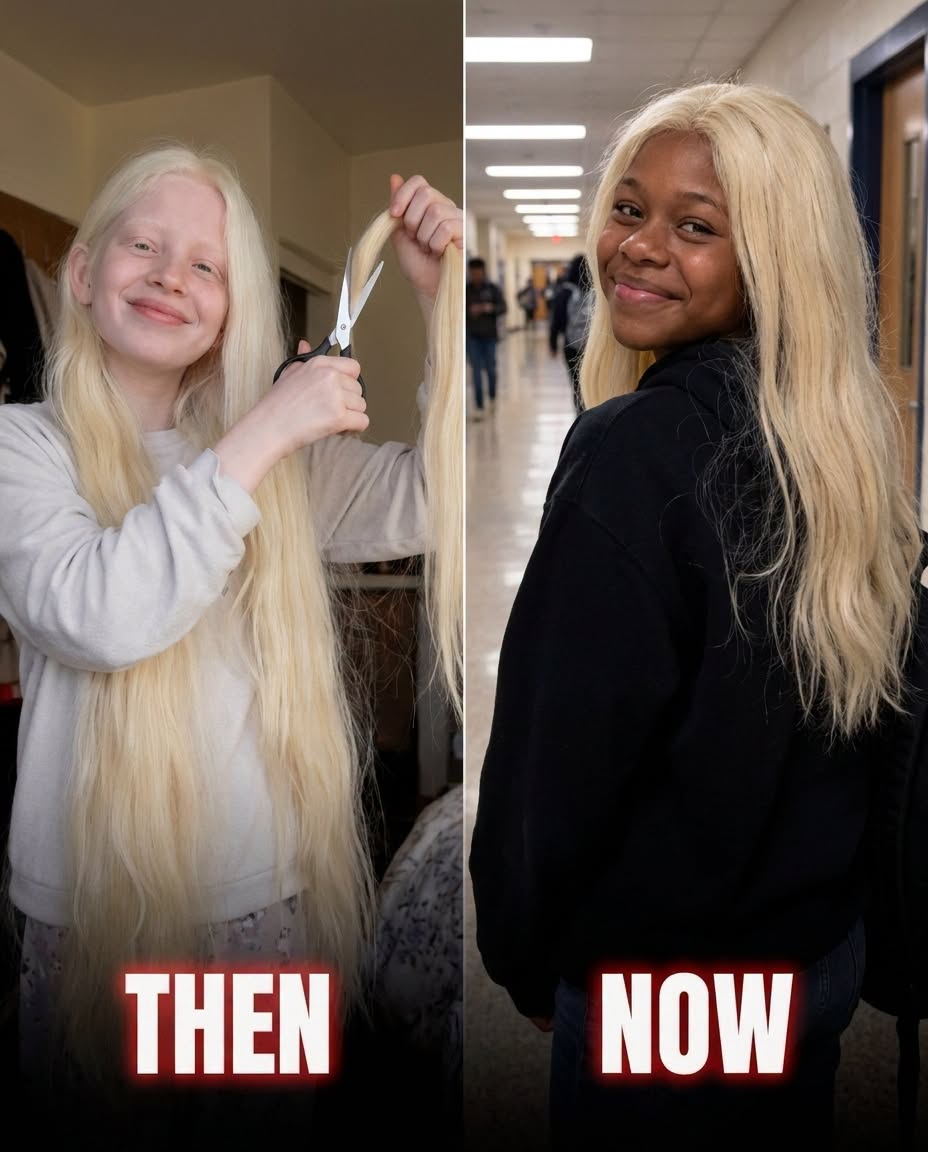
“You need to come in immediately,” Principal Brennan said, and the cereal bowl slipped from my hand and cracked against the sink. He told me six grown men had arrived at the school asking for my twelve-year-old daughter by name, all of them wearing jackets from the plant where my husband Jonathan had worked before can.cer took him three months earlier. Letty was safe, he said, but she had heard her father’s name and refused to leave the office. Fear moved faster than thought after what we had already lost. I drove to the school with my palms damp on the wheel, imagining every possible reason strangers might be looking for my child. When Brennan opened the office door, I stopped dead. Letty stood beside her classmate Millie, who was wearing the wig my daughter had helped create, and in the center of the desk sat Jonathan’s old yellow hard hat, complete with the crooked purple star Letty had stuck on it when she was six.
The night before, I had found Letty barefoot in the bathroom surrounded by long pieces of her own hair, kitchen scissors in one hand and a ribbon-tied bundle in the other. A girl in her class named Millie had recently entered remission, but her hair had not yet grown back fully, and several boys had been mocking her. Letty heard Millie crying in the bathroom and decided that if real hair could be used in wigs, then hers might help. Our friend Teresa, a stylist, repaired Letty’s jagged haircut and combined the donated hair with material already available for a pediatric wig. Teresa’s husband Luis had worked beside Jonathan for eight years, and when he heard why Letty had cut her hair, he contacted several men from the plant. To them, the gesture was instantly recognizable. Jonathan had been the kind of man who covered shifts, brought extra lunches, and refused to let anyone struggle alone. Letty had inherited more of him than I realized.
The men had come because Jonathan had left something behind. His former supervisor, Marcus, handed me an envelope with my name written in Jonathan’s handwriting and explained that Jonathan had started a small employee-supported fund after his own diagnosis to help families being crushed by can.cer-related expenses. The workers had continued contributing after his death. When Luis told them about Millie, they believed they had finally found the kind of family Jonathan meant to help. At the same time, Principal Brennan revealed that the teasing Millie endured had been more serious and persistent than anyone initially understood; she had been eating lunch in the nurse’s bathroom for two weeks to avoid the boys tormenting her. The school had already begun an internal review, contacted the students’ parents, and restricted the boys from extracurricular activities while administrators gathered statements. I made one thing clear: Letty was not going to become a mascot for kindness while the adults ignored the conduct that made the gesture necessary.
Marcus read aloud a note Jonathan had left with the men: if his girls ever forgot the kind of man he had tried to be, they should be reminded by how other people showed up for them. He had written that Letty would always lead with her heart and that I would pretend I was fine while carrying too much alone. Then I opened the private letter he had left for me. Jonathan told me to stop confusing strength with doing everything by myself and to let people love us when the opportunity came. The fund remained in his name, with Millie’s mother accepting assistance only after we discussed the purpose and practical use of the money for their family’s needs. The school’s response continued separately through its disciplinary and student-support procedures. There was no single check or haircut that could undo what Millie had endured, but for the first time since Jonathan died, grief felt less like an empty room and more like something other people were willing to enter with us.
Later, outside the school, I invited Millie and her mother to dinner. Letty carried Jonathan’s hard hat to the car as carefully as though it were made of glass. On the drive home, she asked whether her father would have cried if he had seen what happened that day. I told her absolutely—then joked that he would have denied it afterward. She smiled and rested both hands on the battered yellow helmet. Jonathan had not come back to us, and nothing could make that true. But his habit of noticing suffering, stepping toward it, and refusing to leave people alone had survived him in ways I had not expected. I saw it in six men who kept a promise, in a frightened girl wearing a new wig, and most of all in my daughter, who had looked at somebody hurting and decided not to walk past.

