
Part 1: The Name on the First Ownership Record
My husband entered divorce court with three attorneys, a prenup he called airtight, and the woman he had been seeing seated beside him.
He expected to leave with our company, our fortune, and primary custody of our eight-year-old twin sons. Then the judge opened the original incorporation papers and asked why my maiden name appeared as the majority owner.
By that rainy Thursday morning, our divorce had become local gossip in Fairfax County. Adrian Hollis was the admired CEO of Hollis Transit Systems, a transportation company people praised as one of the region’s great business success stories.
The public knew almost nothing about me.
For twelve years, I stood beside Adrian at fundraisers, business dinners, and company events while reporters called me his homemaker wife. After Samuel and Owen were born, I stepped out of view completely, and my silence gave everyone else permission to tell the story for me.
According to Adrian’s version, he had built an empire alone while I enjoyed the life he financed. Now, he claimed, I was trying to take what I had not earned.
Adrian looked relaxed at the counsel table in a navy suit and an expensive watch. His lead attorney had a thick binder full of arguments about my supposed dependence, while Paige Ellison—Adrian’s communications director and his girlfriend—sat close enough to whisper in his ear.
When Judge Calder entered, he looked toward my empty chair.
“Where is Mrs. Lane?”
Adrian checked his watch and smiled. “She has never respected anyone else’s time.”
Paige laughed softly.
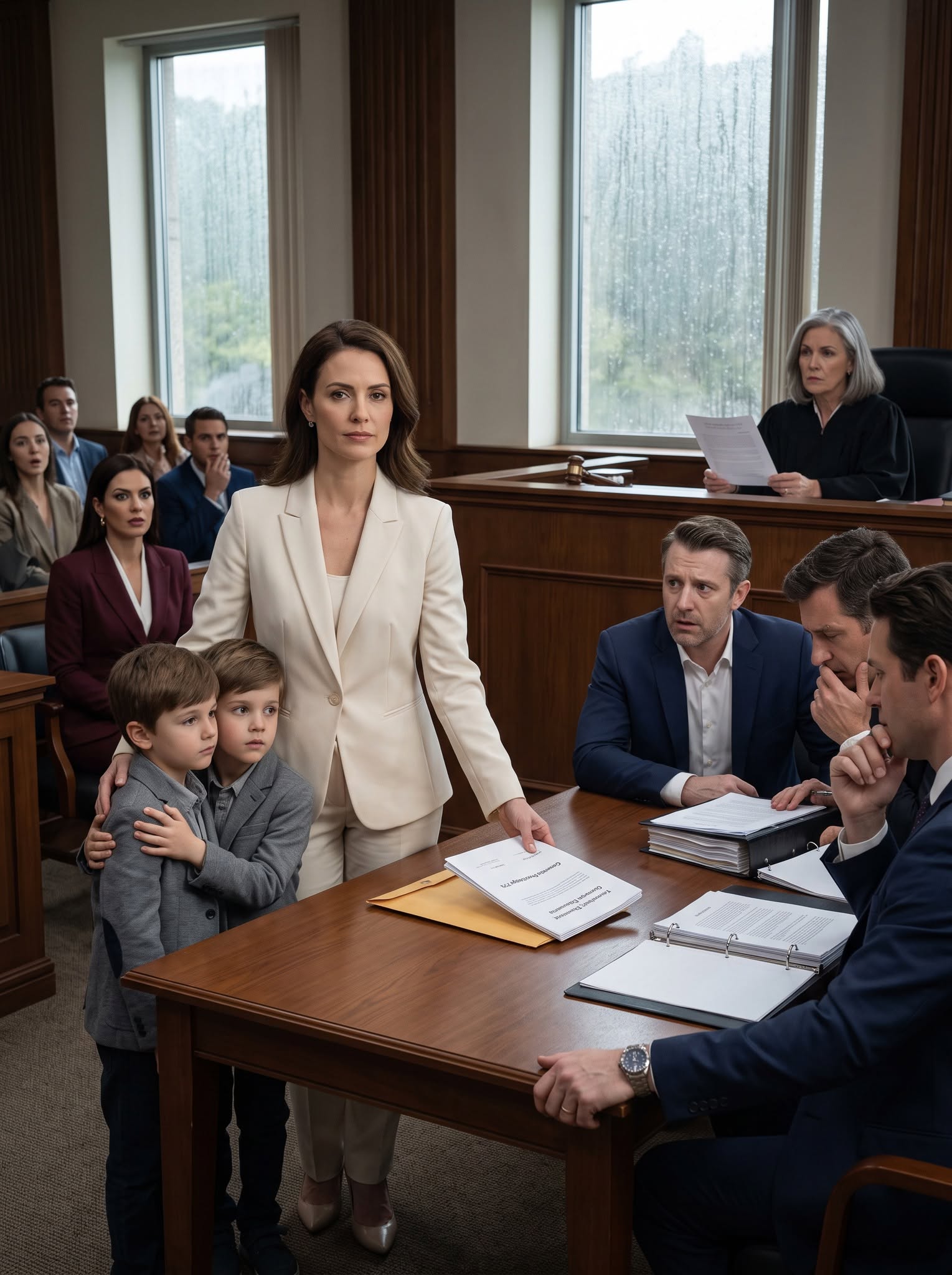
His attorney had barely started asking for primary custody when the courtroom doors opened. I walked in holding Samuel’s and Owen’s hands, both boys wearing matching gray jackets and expressions far too worried for children their age.
Paige murmured, “She brought them?”
Judge Calder looked directly at her. “One more interruption, Ms. Ellison, and you will be removed.”
Her smile vanished.
“I apologize for arriving late, Your Honor,” I said. “The boys asked to come.”
“Children usually should not attend a hearing like this.”
“I agree. But their father has already told them I abandoned our home and that they will soon live with him and Ms. Ellison. I wanted them to hear the truth in a place where it cannot be rewritten.”
Adrian’s posture stiffened.
“That is inappropriate,” he said.
I did not look at him.
A court officer seated the boys nearby, and Adrian’s attorney continued. For nearly half an hour, he described the company, our old home, private school tuition, and investment accounts. He painted me as a woman with no income, no experience, and no ability to care for our children without Adrian’s wealth.
When he finished, Judge Calder turned to me.
“Mrs. Lane, who is representing you?”
“Myself.”
Adrian leaned back, satisfied.
The judge removed his glasses. “You understand the seriousness of the claims against you?”
“Yes, Your Honor.”
“Then you may respond.”
I opened my handbag and placed a sealed envelope on the table.
Inside were the original incorporation documents for Hollis Transit Systems.
Judge Calder read the first page, then stopped. His expression shifted as he turned to the ownership section.
“Mr. Hollis,” he said quietly, “why is Elena Lane listed here as the company’s original majority shareholder?”
Adrian did not move.
Paige turned sharply toward him. His attorneys began whispering to one another, but Adrian stared at the document as if he had never seen it.
“That is impossible,” he said.
Judge Calder held up the paper.
“It is an original state filing. Elena Lane is listed as owning seventy-two percent of the company at incorporation.”
A murmur passed through the courtroom.
I had waited twelve years to hear someone say it aloud.
Adrian found his voice again. “She signed paperwork as a formality. The company had no value then.”
The judge studied him. “So you acknowledge the document is authentic?”
Color drained from Adrian’s face.
Across the aisle, Samuel sat perfectly still. Owen looked at me with wide, uncertain eyes.
I gave him the smallest nod.
Then Adrian’s attorney stood quickly. “Your Honor, we request a brief recess.”
Judge Calder closed the file.
“You may have ten minutes,” he said. “Use them wisely.”
The gavel struck.
And as we stepped into the hallway, Adrian turned toward me with a look I had never seen before.
Not anger.
Fear.
“What have you done?” he asked.
I met his eyes.
“I stopped letting you erase me.”
Part 2: The Signature He Expected Me to Forget
The judge did not decide the entire case that morning. But after reviewing the original incorporation records, she denied Adrian’s request to portray me as financially dependent on him.
His attorney tried to dismiss the documents as outdated.
“Mrs. Lane’s role was administrative,” he argued. “Mr. Hollis built the business into what it is today.”
I looked at Adrian. For years, he had used that same sentence in interviews, at charity dinners, and whenever someone praised Hollis Transit Systems.
He built it.
As though the company had appeared from nothing but his ambition.
“My role was not administrative,” I said. “I supplied the startup capital from my inheritance. I guaranteed the first equipment lease, handled the compliance filings, and used the proceeds from selling my mother’s property to keep the company alive during its first year.”
The courtroom became still again.
Adrian’s lawyer opened his mouth, but Judge Mercer raised a hand. “Was Mrs. Lane compensated for those contributions?”
“No,” I answered. “I deferred payment because we were married and because I believed we were building a future together.”
I handed my attorney a second folder. Inside was an email Adrian had sent six months after the company’s launch.
I need you to trust me. Once we’re stable, we’ll put everything back in both our names.
He had never done it.
Instead, years later, he had placed a share-transfer agreement in front of me while I was grieving my mother. He told me it was routine planning paperwork. The document listed my ownership stake as worth one dollar.
I had not signed it.
“You knew she never signed this?” the judge asked Adrian.
His face had gone pale beneath his tan.
“It was a draft,” he said.
“It was a plan,” I corrected. “A plan to make me disappear from the company I helped create.”
Paige Ellison shifted in her chair behind him. Until then, she had sat with the careful confidence of someone who believed she was watching another woman lose everything. Now she was staring at Adrian as though she had begun to understand that he had not told her the whole story either.
The judge granted me a temporary custody arrangement. Samuel and Owen would remain with me during the school week, while Adrian would have alternating weekends. She also ordered financial disclosures from both sides before the next hearing.
When we left the courthouse, Adrian caught my arm near the elevator.
“You’re making a mistake,” he said quietly.
I pulled away. “No. I spent too many years making that mistake.”
“You don’t understand what this will do to the company.”
“I understand exactly what you were willing to do to protect it.”
His expression hardened. “You think those old papers give you power?”
“No,” I said. “I think the truth does.”
That evening, the twins fell asleep early in the furnished townhouse I had rented near their school. Samuel had asked whether his father was angry with him. Owen wanted to know if Paige was going to choose the color of their bedrooms.
I told them neither question was theirs to carry.
After I tucked them in, I found an envelope taped to the front door.
There was no return address.
Inside was a photocopy of an old company memo, dated nine years earlier. At the bottom was a signature that looked like mine, but the handwriting was wrong. Below it, someone had written a single message in black ink.
Ask Adrian why your father called him the night before the accident.
My breath caught.
Eleven years earlier, my father had died on a rain-slicked road outside Richmond.
And Adrian had always sworn he had not spoken to him that week.
Part 3: The Call My Father Made Before He Died
I read the note three times before I called my attorney.
Maya arrived at the townhouse the next morning with a document examiner’s contact information and a look that told me she already understood this was no longer only a divorce case. We spread the memo, the ownership papers, and every old company file I had kept across my dining table while Samuel and Owen ate cereal in the next room.
The signature on the memo was not mine.
It had been placed beneath a proposal authorizing Hollis Transit to replace a group of older service vans through a vendor I had never heard of. The deal had been approved without my knowledge, despite the fact that my original ownership stake required my consent for major financing decisions.
“There’s more,” Maya said, turning to the final page.
Attached to the memo was an email chain between Adrian and the vendor. My father’s name appeared in the subject line.
Daniel Lane had been a mechanic before he retired. When Adrian and I were first building the company, Dad had volunteered at the depot on weekends, helping inspect vehicles and teaching our young drivers how to spot problems before they became disasters.
The night before he died, he had called me twice.
I had been in a meeting and missed both calls.
At the time, Adrian told me Dad had probably wanted to talk about a family dinner. Then came the accident on a wet road outside Richmond, and grief swallowed every question I should have asked.
But the email was dated less than an hour before Dad’s crash.
Daniel is asking questions he has no business asking, Adrian had written.
The vendor replied, Then deal with him before he costs us the contract.
My hands began to shake.
“This doesn’t prove Adrian caused the accident,” Maya said carefully. “But it gives us a reason to obtain records—business records, phone logs, vehicle maintenance reports, everything.”
I nodded, unable to speak.
By afternoon, Adrian was calling again. He left three voicemails, each one more controlled than the last.
The first accused me of stealing company documents. The second offered to “resolve the ownership disagreement privately.” By the third, his voice had changed.
“Elena,” he said, “do not involve anyone else. You have no idea what you’re reopening.”
That night, I received another call from a number I did not recognize.
“Is this Elena Lane?” a woman asked.
“Yes.”
“My name is Paige Ellison.”
For a moment, I said nothing.
“I know you don’t want to hear from me,” she continued, her voice unsteady. “But Adrian lied to me too. About the company. About you. About your father.”
I closed my eyes.
“What do you know?”
“There’s a storage unit in his name,” Paige said. “He goes there whenever he thinks no one is watching. Last week, I saw him carrying boxes marked with old Hollis Transit files.”
My stomach tightened.
“Why are you telling me this?”
“Because he was angry after court,” she said. “He said if you kept digging, he would make sure you regretted it the way your father did.”
The line went silent.
Then Paige whispered, “Elena, I think he knows exactly what happened the night your father died.”
Part 4: The Evidence He Could Not Explain
Maya advised me not to go near Adrian’s storage unit or confront him about Paige’s call. Instead, she contacted the police and submitted the memo, the suspicious signature, and the email chain for review.
Within two days, a detective from the county’s financial-crimes unit requested an interview.
Detective Harris was calm, methodical, and unwilling to make promises he could not keep. He explained that the old business records raised questions about forgery, concealed ownership, and possible fraud, but my father’s accident would require a separate investigation.
“I can’t tell you what happened to your father,” he said. “Not yet. But I can I can tell you this: your husband’s records do not match his story.”
That was enough to make the room feel colder.
The court-appointed forensic examiner confirmed what I already knew. The approval signature on the nine-year-old memo had been copied from an older document, then altered to make it appear as though I had authorized the van contract.
The vendor behind the deal had been dissolved years ago.
Its former owner, however, had not disappeared.
He had been paid through a chain of consulting companies that led back to Adrian.
When the second custody hearing began, Adrian arrived alone. Paige was gone, and the polished confidence he had worn at the first hearing had been replaced by something tighter and more brittle.
His attorney argued that the company dispute had nothing to do with the twins.
My attorney stood and handed the judge a list of payments made from Hollis Transit accounts, including the money Adrian had used for a private investigator who had followed me after I filed for divorce. He had been searching for evidence that I was unstable, irresponsible, or unfaithful.
He had found nothing.
“What he did find,” Maya said, “was that Mrs. Lane attended client meetings, picked up her sons from school, and spent every evening at home with them.”
Adrian stared at the table.
The judge did not hide her displeasure. She expanded my temporary custody arrangement and ordered that all communication about the boys occur through a parenting app. Adrian was also prohibited from discussing the case, Paige, or company finances with Samuel and Owen.
Afterward, he cornered me in the courthouse parking garage.
“You think you’ve won?” he asked.
“I think you need to stop treating people like problems you can bury.”
His eyes flashed. “Your father made his own choices.”
The words struck harder than he intended them to.
I stepped closer. “What does that mean?”
For one second, Adrian looked frightened.
Then he smiled without warmth. “It means accidents happen, Elena.”
He walked away before I could answer.
That evening, Detective Harris called.
“We executed a warrant on the storage unit,” he said. “You should come in tomorrow morning.”
The evidence room smelled like cardboard and old paper. On a metal table lay boxes of company ledgers, duplicate contracts, and a damaged black laptop that investigators had already sent for recovery.
Then Detective Harris opened a sealed evidence bag.
Inside was my father’s old workshop notebook.
I recognized the grease-stained cover immediately. Dad had carried it everywhere, writing down repair notes, parts numbers, and reminders for himself. The final page was marked with a strip of blue tape.
There were only two lines written there.
Adrian said the brakes would be handled.
If anything happens to me, Elena must see the files.
Part 5: The Life He Could No Longer Rewrite
The investigation did not turn my father’s death into a simple answer.
The police found that the brakes on his truck had been deliberately compromised, but too much time had passed to establish every person involved beyond doubt. What the evidence did prove was that Adrian had known about the defective vehicles, concealed the financing scheme, forged my signature, and destroyed records after my father began asking questions.
The former vendor agreed to cooperate.
He admitted that Adrian had pressured him to keep quiet about the brake repairs, fearing Dad would expose the fraudulent contracts and the unsafe fleet. Adrian had not been charged with causing the accident, but he was charged with financial fraud, forgery, and obstruction related to the cover-up.
For the first time since I had known him, he could not talk his way around the facts.
At the final divorce hearing, Adrian looked smaller than I remembered. He no longer wore expensive suits or the confident expression that had made so many people believe him. His lawyers sat beside him, but there was nothing left for them to reshape into a better story.
The court recognized my ownership interest in Hollis Transit Systems and appointed an independent manager while the financial review continued. My attorney and I reached an agreement that separated my stake from Adrian’s control, protected the company’s employees, and ensured that the money he had hidden could not be used against the boys.
Adrian was granted limited parenting time, supervised at first.
Samuel asked whether that meant his father was a bad person.
I took a breath before answering. “It means your father made serious choices, and adults have to take responsibility for the choices they make.”
Owen looked down at the floor. “Did he stop loving us?”
“No,” I said, pulling both boys close. “But love is not enough if someone keeps choosing to hurt the people who trust them.”
Paige testified about the storage unit and the things Adrian had said after the first hearing. She did not ask me to forgive her, and I did not pretend that what she had done had not mattered. But I understood that Adrian had lied to both of us in different ways, counting on women around him to carry the weight of his decisions.
Months later, the company board voted to rename the employee safety program after my father.
Daniel Lane had never cared about titles or recognition. He cared about people coming home safely at the end of the day. At the first training session, I stood in the back of the depot while a new group of drivers listened to the rules he had spent his life teaching others.
Samuel and Owen stood beside me.
“Grandpa would have liked this,” Samuel said.
I smiled through tears. “He would have loved that you’re here.”
Our townhouse was temporary, but it became peaceful in ways our old house never had been. There were school projects on the dining table, shoes by the door, and weekend pancakes that turned into flour-covered disasters whenever Owen insisted on helping.
One evening, I opened the old file box that had started everything. The incorporation papers rested on top, my maiden name clear beneath the number Adrian had tried to erase.
Seventy-two percent.
For years, I had thought those pages represented what I had lost.
Now they represented something else.
They were proof that I had been there from the beginning. Proof that my father had tried to protect me. Proof that the truth could survive even when someone spent years trying to bury it.
I closed the box and joined my sons in the kitchen.
This time, I was not rebuilding a life Adrian could control.
I was building one he could never take from us again.

