
My father laughed when I invited him to the biggest night of my career and asked, “What are they honoring you for, how fast you mop toilets?” My mother told me to call my custodial job “administration” so nobody at church would know. They skipped the gala—then Dad called me eleven times after seeing who presented my award, and that was before my sister brought me a sixteen-year-old envelope from our family mailbox…
Three weeks before the biggest night of my career, I placed a cream-colored invitation beside Dad’s dinner plate and watched him leave it unopened.
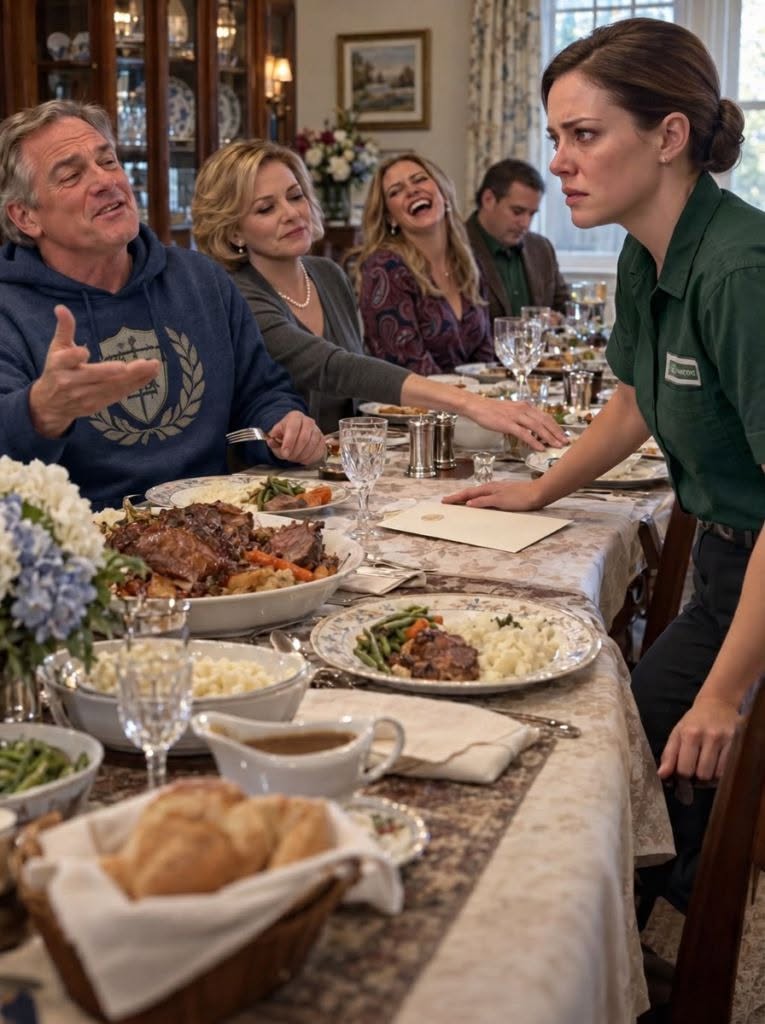
Sunday dinners at my parents’ house had followed the same silent seating arrangement most of my life. Dad sat at the head of the table in one of his faded Hartwell State hoodies. Mom sat beside him. My older sister Megan and her husband Todd sat across from me. I took the end seat—close enough to pass the gravy, far enough that nobody had to shape the evening around anything I said.
That night, Megan spent twenty minutes describing how she had “put in his place” a vendor at work. Dad pointed his fork at her and said, “That’s negotiating. That’s a Watson,” while Mom asked questions she clearly already knew the answers to because Megan had probably told her the story twice over the phone.
I passed the rolls.
That was my role in the family broadcast.
I had driven thirty-five minutes with the invitation on my passenger seat. Heavy paper. University seal embossed in one corner. Gold lettering. Two guest cards tucked inside, already printed with Paul Watson and Susan Watson because I had specifically requested my parents’ names.
During the first pause in conversation, I cleared my throat.
“The university is honoring me at the spring gala on May first,” I said. “I have two guest seats. They’re yours.”
The room went quiet enough for me to hear Todd set down his water glass.
Dad looked at the envelope, then at the facilities-services patch on the work shirt I hadn’t changed before dinner.
He smiled.
“You’re a janitor.”
I waited.
“What are they honoring you for?” he asked. “How fast you mop toilets?”
Megan laughed so hard she had to lower her fork and dab beneath one eye with her napkin.
Todd stared at his plate.
Todd had spent most of his marriage developing the moral courage of a decorative lamp.
Mom reached across the table and rested a hand on my wrist. Anyone who didn’t know her might have mistaken it for affection.
“Sweetheart,” she said softly, “we’d rather people didn’t know what you do. If anyone asks, just say you work in administration. The Hendersons will be at church Sunday. You understand.”
I did.
That was the problem.
While everyone kept talking, Megan picked up the invitation. She flipped it over and read the small print at the bottom. Something crossed her face—too quickly for me to understand then—before she returned it face down.
Nobody asked what she had seen.
I looked from Dad’s Hartwell sweatshirt to the invitation.
Something inside me went very quiet.
I slipped the card back into my purse.
“Then don’t come.”
Dad frowned. “Don’t be dramatic. It’s a janitor banquet.”
I thanked Mom for dinner, carried my plate to the sink because apparently thirty-four years of conditioning survives even emotional liberation, and walked outside.
In my car, I opened the glove compartment to put away the invitation. It landed on another envelope—older, thicker, and something I had been carrying for reasons I hadn’t explained to anyone yet.
I closed the compartment.
That night, I ironed the only formal dress I owned, navy blue and eight years old, then texted Donna from my morning crew.
They’re not coming.
Her reply arrived almost instantly.
Their loss, sweetheart. Front row’s got better people in it anyway.
I sat on my bed staring at the dress.
I wasn’t crying.
I was doing arithmetic.
Sixteen years of it.
The numbers were finally beginning to balance.
When I was eighteen, our family had one unquestioned rule: Dad got the mail.
Every afternoon around four, he walked down the gravel driveway to the little metal mailbox, brought everything inside, and sorted it on the kitchen counter. Bills in one pile. Junk in another.
“Nothing for you, kiddo,” he would say.
That June, I was waiting for one specific letter.
Hartwell State had wait-listed me. My grades were decent—not Megan’s grades, nothing Mom framed—but good enough that the university said final decisions would arrive by mail in early summer.
Every afternoon, I watched Dad walk to the mailbox.
Every afternoon, he came back with nothing for me.
I worked mornings at a diner in a mustard-yellow uniform permanently scented with coffee and fryer grease. I was saving because I knew paying for college would be difficult.
What I didn’t know was that my family had already solved that problem by removing me from the equation.
Megan was four years older and already attending Hartwell. During her senior year, her grades slipped and she lost her scholarship.
My parents quietly emptied what had always been called “the kids’ college fund.”
Plural.
Thirty-eight thousand dollars went toward Megan’s final year—tuition, housing, everything her scholarship no longer covered.
I found out accidentally after overhearing Mom talking to my aunt.
“We have to protect the investment that’s almost finished,” she said. “You don’t walk away with one year left.”
Nobody sat me down.
Nobody asked me.
A few weeks later, Mom and Dad called me into the kitchen. Dad used the calm voice he had perfected during years of handling insurance claims.
“College isn’t for everybody, kiddo,” he said. “There’s no shame in that. The money situation is what it is, and you were only wait-listed anyway. The letter never even came.”
I believed him.
People later asked why I hadn’t called Hartwell myself, but at eighteen, I didn’t know my own family required independent verification. Wait lists often ended in silence, and the money was already gone.
I assumed silence was my answer.
Two weeks later, we held Megan’s graduation party in the backyard.
Mom hung a CONGRATULATIONS, MEGAN banner between two trees. Dad wore his Hartwell hoodie despite the July heat, and half the neighborhood showed up.
I carried trays.
At one point, Dad raised his glass toward Megan, his eyes shining.
“To the first Watson to finish what I couldn’t.”
Everyone applauded.
So did I.
That sentence meant more than I understood at the time. Dad had attended Hartwell decades earlier but dropped out when money became tight. He rarely talked about it.
For years, I thought his pride in Megan was simply pride.
Eventually, I learned something sharper sat beneath it.
I stayed at the diner for three years. Then I joined a commercial cleaning company and discovered professional custodial work involved considerably more than owning a mop and looking disappointed.
Chemical safety. Bloodborne-pathogen protocols. Floor systems. Medical accounts. How to strip and finish ten thousand square feet of tile until it reflected ceiling lights like water.
I became good at the work.
Then very good.
I kept my certificates in my closet because nobody at Sunday dinner ever asked to see them.
Meanwhile, Mom’s living-room wall slowly became what I privately called the Museum of Megan.
High-school diploma.
Hartwell bachelor’s degree.
Graduation photograph.
MBA.
Wedding portrait.
There had never been a picture of me on that wall.
Dad had another Hartwell obsession: a navy-covered economics book called Invisible Hands by Professor Everett Hail.
He quoted it constantly.
One Christmas, he actually stood at the dinner table, put on his reading glasses, and read a passage aloud.
“An economy runs on hands it refuses to look at.”
Mom sighed appreciatively.
Todd said, “Powerful.”
Dad tapped the cover. “This man understands how the world works.”
Then he buttered a roll, looked straight at me, and asked, “So, Chloe. Any real career plans?”
I was twenty-three.
I remember staring at that navy book beneath Megan’s framed achievements and feeling something shift inside me.
Not exactly anger.
A decision.
Eight months after Megan’s wedding, I applied for a custodial job at Hartwell State.
My qualifications were strong enough that they hired me almost immediately.
My family laughed for a week.
Dad was horrified.
“Of every building in Ohio, you’re going to scrub that campus?”
“It has state benefits and a pension.”
“It’s my school, Chloe. People know me there.”
Megan smiled into her wine. “Well, at least she’ll finally set foot on campus.”
Everyone laughed.
I let them.
At orientation, HR gave us a thick benefits packet and eventually reached page nine.
“After twelve months of employment,” the woman said, “employees in good standing are eligible for up to six credit hours per semester with tuition waived. Almost nobody uses it.”
I stopped breathing.
Six credit hours.
Any program I qualified for.
Tuition waived.
A dream buried at my parents’ kitchen table had reappeared in twelve-point government font.
I folded the corner of page nine.
For a year, I worked carefully enough to keep my record spotless. Then I applied academically to Hartwell and registered for Introduction to Economics.
My first class met Tuesday nights in Whitmore Hall, room 112.
I knew the room well.
I cleaned it every morning.
That first night, I changed out of my uniform, put on regular clothes, and sat in the top row gripping a new notebook like a passport.
At seven, the professor entered.
Silver at the temples. No laptop. One stick of chalk.
“Economics,” he said, “is the study of what people value and what they pretend not to.”
I wrote it down and underlined it.
After class, I stayed behind copying the board while everyone else left.
The professor noticed me.
“You clean this hall in the mornings.”
My stomach dropped.
Then he nodded toward the chalk tray.
“You’re the one who sorts it by color.”
I started explaining the employee tuition program.
He raised one hand.
“In the mornings, you take care of the room,” he said. “In the evenings, it’s yours.”
Then he walked out.
I sat back down and cried for about ninety seconds.
My own father had never looked closely enough to understand what I did all day.
A stranger had noticed how I arranged chalk.
That professor was Everett Hail.
My father’s favorite author.
I discovered that soon afterward.
I told nobody.
For nine years, I cleaned Hartwell before sunrise and studied there after dark.
Six credits at a time.
Economics.
Statistics.
Public policy.
Accounting.
Research methods.
Sometimes I slept in my car between my shift and class. Every semester I completed, I bought myself one unnecessarily expensive coffee and drank it slowly by the window.
Eighteen semesters.
Eighteen coffees.
Spring 2020 almost ended everything.
Custodians became essential workers while classes moved online. I worked extended disinfecting shifts, followed statistics lectures on my phone in parking lots, and earned the only D on my transcript.
I nearly quit.
Donna found my notebook in the break room.
“Eight semesters and one bad grade?” she said. “That’s a speed bump, honey, not a stop sign.”
I retook statistics and earned a B-plus largely out of spite, which remains an underrated educational resource.
By then, Donna knew.
Curtis, my supervisor, knew too, although he never admitted how often he quietly shifted schedules around my finals.
Eventually, half the custodial basement knew.
My family still didn’t.
In December 2023, a pipe burst over Whitmore’s second floor thirty hours before hundreds of students were scheduled for finals.
I shut off the water, organized the response, helped dry the building, relocated furniture, and had every classroom ready on time.
The students never knew.
That was the job.
Making sure other people’s important days happened exactly as planned.
That same week, Dad emailed me a receptionist opening at his old insurance company.
His note said, No shame in a fresh start.
I nearly told my family the truth at Thanksgiving 2024.
I entered Mom’s kitchen carrying a pie and heard her talking to church friends in the living room.
“Our younger daughter works in administration at Hartwell,” she said.
Dad added, “Paper pushing, but steady.”
I stood there with nine years of college caught in my throat.
Then swallowed it.
If they were going to learn the truth, they would learn when everything was finished and beyond their ability to rename.
In January 2026, the registrar confirmed it.
Bachelor of Science in Economics.
123 credits.
3.88 GPA.
Graduation in May.
Then, in February, I opened my staff cubby and found an envelope from the university president.
I had been chosen for Hartwell’s Distinguished Staff Service Award.
One recipient each year.
The nomination packet included a three-page letter from Dr. Everett Hail.
One sentence stopped me.
“In thirty years of teaching, I have met one person who cleaned a lecture hall at dawn and mastered it by dark.”
There were letters from students too.
Several called me “the five a.m. lady.”
One student wrote that she had never known my name, but her classroom was always clean, the chalk was always ready, and when you were the first person in your family to attend college, you noticed who prepared the room before you arrived.
I sat on an overturned bucket and cried.
Then, despite all available evidence, I decided to invite my parents.
One last chance.
That was the invitation Dad mocked three weeks before the gala.
May first arrived.
The alumni ballroom held four hundred people beneath chandeliers and white linens. At the front table, two empty seats stood beside mine with gold-lettered place cards.
Paul Watson.
Susan Watson.
Donna sat across from me in sequins.
Curtis wore a suit and spent most of dinner tugging at the collar like it owed him money.
At 9:30, the university president introduced the gala chairman.
“Professor Everett Hail.”
My father owned two copies of his book.
I had spent nine years in his classrooms.
Dr. Hail stepped to the microphone and repeated the sentence Dad had quoted at Christmas dinners for years.
“An economy runs on hands it refuses to look at.”
Then he said he had finally learned who he had written it about.
He told them about Whitmore at five in the morning.
The chalk.
The flood.
The pandemic.
My nine years as both custodian and student.
Then he said, “Tonight, for the first time, Hartwell gives its Distinguished Staff Service Award to someone who will also graduate from this university in eight days. Chloe Watson, Bachelor of Science in Economics, class of 2026.”
Four hundred people stood.
I walked between my parents’ two empty chairs.
Dr. Hail handed me the plaque.
Then he announced that at commencement, I would become Hartwell’s first staff representative to address the graduating class.
I thought of Dad laughing over mashed potatoes.
How fast you mop toilets?
At 10:06, my phone started vibrating inside my clutch.
Dad.
Again.
Again.
Eleven calls altogether.
Then a text appeared on the screen.
WE JUST SAW WHO HANDED YOU THAT AWARD. CALL ME NOW.
Donna read it upside down.
She snorted into her coffee.
I turned the phone face down.
For sixteen years, my family had expected me to answer whenever they decided my life was finally worth discussing.
That night, I finished dessert.
Chapter 2
The university posted gala photos while we were still eating. The first showed Dr. Hail shaking my hand beneath a caption identifying me as both Hartwell’s Distinguished Staff Service Award recipient and a member of the class of 2026.
Apparently, someone from Dad’s booster-club group sent him the photo before ten.
His first voicemails were commands.
“Chloe, call me back.”
Later, they became confused.
“Is it true? The class of 2026 part?”
Then came Mom coaching him in the background, followed by something almost warm.
“We’re just surprised, honey.”
Not one message included the words I’m sorry.
By Saturday afternoon, Mom had started telling church friends that my parents had always known I was studying but were “private people.”
Todd texted, Congratulations, that’s really something, then four minutes later added, Probably best not to mention I texted you, which was such a perfect Todd sentence that I laughed for the first time all morning.
I sent my parents one message.
Sunday. Two o’clock. My place. Come ready to listen, not talk.
They arrived exactly on time.
Mom brought grocery-store tulips. Dad brought his navy copy of Invisible Hands and placed it on my kitchen table.
“You know Everett Hail?” he asked before removing his coat.
“He was my professor.”
Dad’s eyes widened. “For how long?”
“Nine years, on and off.”
Something almost boyish appeared on his face.
“You could introduce me. He and I think alike. I’ve been saying those same things for years.”
Meanwhile, Mom found my plaque and touched the brass with one finger. Within five minutes, she was suggesting a church luncheon where the entire family could pose together and “tell the story properly.”
“Which story?” I asked.
“That we always supported your decision to work at Hartwell. That our family values education.”
I stared at her.
“When exactly did you support it? Was it when Dad asked how fast I mop toilets, or when you told me to lie about my job so the Hendersons wouldn’t know?”
Dad immediately slipped into his reasonable insurance-adjuster voice.
“Things were said because you surprised us. You hid this for nine years, Chloe. Communication goes both ways.”
There it was.
Ninety seconds into the conversation, my secrecy had become the biggest offense in the room.
Mom asked who else knew.
“Donna. Curtis. The night crew. Dr. Hail. The registrar. The president’s office. Four hundred people Friday night.”
Her face shifted.
Dad’s changed for another reason.
“The booster club,” he said. “Gary sent that picture to everybody. Do you understand what it looks like that everyone knew about my daughter before I did?”
What it looked like.
Not why I had hidden it.
I went to the hall closet, returned with Mom’s 2024 Christmas letter, and placed it beside Dad’s book.
“Mom, when did I start working in administration?”
She recognized the page.
“We were protecting you.”
“No. You were protecting yourselves from what I actually did.”
Then Dad mentioned 2010.
“We made a financial decision. Megan was one year from finishing.”
“You also told me Hartwell never sent a letter.”
His eyes shifted toward the book.
I hadn’t planned to ask the next question.
“The letter never came, right?”
Dad looked down.
“It was a long time ago.”
The room changed.
Mom rushed in.
“We couldn’t possibly have known you would manage all this. You didn’t even get in.”
Something about manage gave me sudden clarity.
I went to a kitchen drawer and took out my parents’ two gold gala place cards.
“These seats were beside me Friday. Four hundred strangers stood for me. You two couldn’t sit down.”
Dad stood, trying to reclaim the height he had always used at his own table.
“We are still your parents. Your mother has a church luncheon next week, and this family shows up together.”
I looked at him and realized his voice only had power if I gave it some.
“The gala was the last appearance I owed you.”
Mom reached for my wrist.
I stepped back.
Her hand hung in the air briefly before dropping.
At the door, Dad said, “Don’t make this bigger than it is. This family handles things privately.”
I opened the door.
“I clean up messes for a living, Dad. I’m done cleaning up yours.”
An hour later, Megan texted.
Tuesday still okay? Please don’t talk to Dad again before then. There’s something you need to have. It’s been sixteen years.
Sixteen.
The exact number I had been carrying privately.
My sister had just told me the mailbox had a witness.
Chapter 3
Megan arrived Tuesday clutching her purse against her chest with both arms.
She sat at my kitchen table, opened the bag, and removed a plastic freezer bag.
Inside was an old Hartwell envelope.
Postmarked June 2010.
Addressed to Chloe Watson.
“I need you to read it before I explain,” she said. “If I explain first, I’ll make it smaller. I’ve had sixteen years of practice.”
My hands shook as I opened it.
Dear Ms. Watson, we are pleased to offer you admission from our wait list for the fall semester.
I read it three times.
“You got in,” Megan whispered. “I saw Dad take it out of the mailbox.”
She had been home packing for her final year.
Dad opened my letter at the end of the driveway, read it, entered the garage, and dropped it in the trash.
Megan retrieved it.
“I was going to give it to you.”
“Why didn’t you?”
“Because the money was already gone. Into my year. If the letter existed, then what they did wasn’t just a financial decision. It had a victim.”
She looked at me.
“You.”
She hid the letter in a shoe box. First, she planned to confess after graduation. Then after finding a job. Then after her wedding.
Sixteen years of after.
She said she almost gave it to me the morning of her wedding when Mom told me to “simplify” my job.
She almost confessed at Thanksgiving when she heard Mom calling me an administrator.
Then came the dinner with the gala invitation.
“I read the small print,” she said. “Distinguished Staff Service Award. I knew your story was about to become public.”
Her face crumpled.
“And Dad made that joke, and I laughed. I laughed because I was terrified. I needed your story to stay small because my whole life had benefited from what they took from you.”
That laugh had sounded like cruelty.
Fear and cruelty, I learned, can sound surprisingly similar.
“Did Mom know about the letter?”
Megan nodded.
“She saw Dad reading it. That night I heard them talking. Mom said it would be simpler for everybody if the letter just never came.”
Simpler.
Mom’s favorite word.
It’s not lying. It’s simplifying.
Suddenly, sixteen years rearranged themselves.
Dad’s statement at the kitchen table hadn’t been an assumption.
The letter never came had been a script.
Even his graduation toast to Megan changed meaning.
To the first Watson to finish what I couldn’t.
It had come from a man who left Hartwell because he ran out of money, then deliberately denied his younger daughter the same chance he had lost.
Megan wiped her face.
“You should hate me.”
I looked at the daughter my parents had always displayed so proudly and realized I didn’t.
“My degree took eighteen semesters,” I said. “Yours cost me my future and cost you sixteen years with a letter in a shoe box. I don’t think I’m the only one who lost something.”
She nodded.
I placed the acceptance letter beside my award plaque.
“You don’t get the sixteen years back. Neither do I. But you’re the only person in this family who finally handed me the truth.”
I paused.
“That buys you one chair at graduation. Come alone.”
She cried in my doorway.
Final chapter
Commencement arrived on May ninth beneath a blue Ohio sky, with twelve thousand people filling Hartwell’s stadium.
I crossed the stage twice.
Once as Chloe Watson, Bachelor of Science in Economics.
Once earlier as the first staff speaker in Hartwell’s history.
I had written my speech at the kitchen table with my award plaque and old acceptance letter beside me.
I removed every line that sounded like a verdict against my parents because after sixteen years, I refused to spend my four minutes talking about them.
Instead, I talked about page nine.
About the employee tuition benefit almost nobody used.
About studying economics in the same room I cleaned.
About failing statistics during the pandemic and coming back anyway.
About side doors.
“Some of us don’t walk through the front door of our dreams,” I told the stadium. “We unlock the side one at five in the morning, and we keep it open for whoever comes after us.”
The graduates stood first.
Across the top of my cap, four words were written in silver marker.
SEMESTER 18 OF 18.
Across the stage, Dr. Hail gave me the same small nod he had given me for years outside room 112.
High in the stands, Megan sat alone exactly as I’d requested, one hand covering her mouth.
My parents weren’t there.
They knew the date.
The whole town knew.
But this time, there had been no printed invitation for them to reject, and apparently they had never learned how to arrive without being formally invited.
That afternoon, Donna hosted a cookout.
Curtis worked the grill wearing an apron that said KISS THE COOK, which nobody risked obeying, and the night crew gave me a framed stick of chalk with a brass plate beneath it.
SORTED BY COLOR.
I laughed until I had to sit down.
Looking around Donna’s backyard, I realized I hadn’t spent sixteen years without a family.
I had simply been building one without noticing.
One shift.
One class.
One cup of coffee.
One person who quietly rearranged my finals schedule.
One professor who noticed a chalk tray.
One woman who refused to let me quit statistics.
That evening, Mom left me a voicemail.
For once, there was no church luncheon, no family photograph, no explanation about how proud they had supposedly always been.
“I watched the livestream,” she said. “All of it.”
She paused so long I checked whether the call had ended.
“I don’t want a picture anymore. I just wanted to say I heard you. And I’m sorry, Chloe. For the mailbox. For all of it.”
I didn’t call back.
I didn’t delete the message either.
The door was closed.
It wasn’t locked.
If my parents ever wanted to come through it again, they would have to knock like people instead of presiding like parents.
A few weeks later, Hartwell offered me a new role: program coordinator for staff education.
My job became page nine.
Now I sit across from dining-hall workers, groundskeepers, maintenance employees, and custodians and show them the tuition benefit buried inside the thick packet nobody expects them to read.
During my first two weeks, three employees enrolled.
One was nineteen.
One was sixty.
A dining-hall worker read the tuition line twice and said, “There has to be a catch. Nobody gives you anything free.”
I smiled.
“The catch is nobody is going to hand it to you. You have to take it.”
She signed the form so hard the pen nearly embossed the page.
I recognized that grip.
It was how you held a pen once you stopped waiting for permission.
Eventually, I properly framed the 2010 acceptance letter—good glass, acid-free backing—and hung it beside my award.
Facing the wall.
People sometimes ask why.
Because some things deserve to be preserved without being stared at forever.
Most mornings, although it’s no longer my job, I still stop at Whitmore Hall before sunrise.
I greet the crew.
I walk into room 112.
Then I sort the chalk.
Full sticks by color.
Stubs in the corner cup.
The same small, invisible order that became the first thing another person ever noticed closely enough to understand about me.
A few weeks after graduation, Mom mailed me a photograph of the living-room wall.
The Museum of Megan had changed.
At its center was a newly framed picture of me on the Hartwell gala stage, shaking hands with Everett Hail.
On the back, Mom had written:
It was always the best wall for morning light.
I studied the sentence for a while.
Then I put the photograph in my kitchen drawer beside two unused gold place cards and went to work.
They finally wanted to be seen with me.
I had finally stopped performing for the empty chairs.