
“Rick, I don’t think I’m coming this year.” My father’s voice sounded too careful when I called Thanksgiving morning to tell him I was on my way to pick him up. Jack Dalton was seventy-four and had spent fifty years working at the GM plant in Anderson, the kind of man who would drive across town at ten at night with a toolbox if somebody’s furnace stopped working and then act embarrassed when they thanked him. He was not afraid of crowds, and he was not shy. So when he explained that my wife Karen had called the night before and told him our dinner would be “too crowded” for him, I knew immediately he was protecting her. I walked into the dining room and asked Karen why she had done it. She set down a salad fork, looked at me calmly, and said, “My parents are particular. Your father smells like an old garage, and I’m not spending Thanksgiving apologizing for that.” For twelve years I had swallowed comments like that in the name of keeping peace between families. That morning, I finally understood that what I had been calling peace was simply my father paying the price.
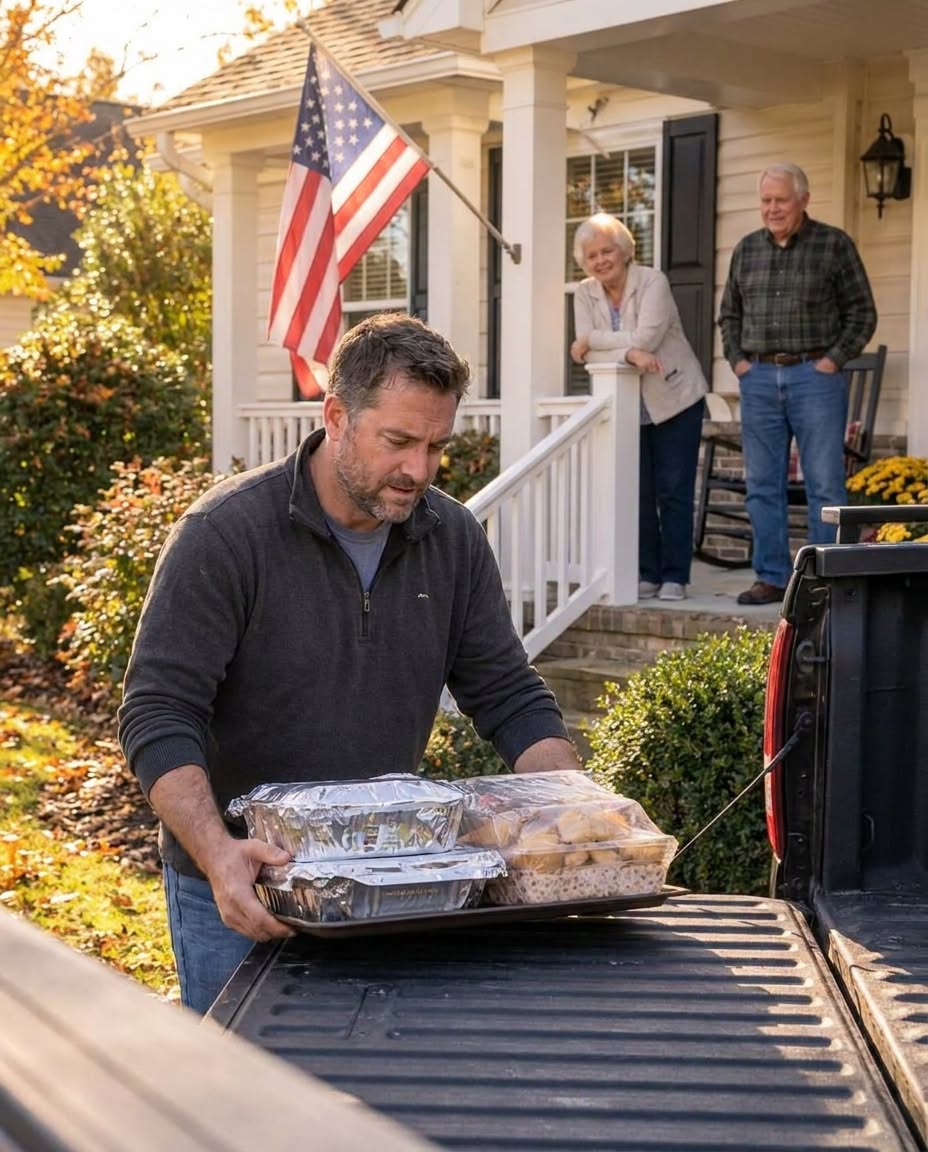
Karen’s parents, Don and Margaret Whitfield, came from money and treated polish as though it were proof of character. My father came from assembly lines, overtime shifts, cold garages, and hands that never completely lost the smell of metal and motor oil. He had fixed our furnace in a February freeze, helped us move twice, rebuilt the brakes on Karen’s first car, and never once made a show of any of it. I supervise an HVAC crew myself, so I knew exactly what Karen was really saying: some work was acceptable only as long as the people doing it remained invisible. I looked at the turkey roasting in the oven, the sweet potatoes, green-bean casserole, rolls, and pumpkin pie she had prepared for people she considered suitable company. Then I told her, “Fine. If my father isn’t welcome, there won’t be Thanksgiving here.” I found foil trays and started packing everything. Karen accused me of ruining the holiday, embarrassing her parents, and overreacting. I did not argue. I loaded the meal into my truck and drove seventeen minutes to my father’s modest ranch house, where the porch light was on and the television was showing the parade to an otherwise empty room.
Dad opened the door, looked at the trays in my arms, and understood more than I wanted him to. “Karen know you’re here?” he asked. “Karen knows.” We ate at the kitchen table he had built himself in 1987 and refinished twice since. The sweet potatoes were a little overdone after reheating, but he took seconds. We talked about my crew, a vintage Silverado carburetor he was rebuilding for a neighbor, winter weatherstripping, and almost anything except the reason I was there. That was his way. Later, over coffee and pie, he said, “You didn’t have to do this.” I told him I did. Then I finally said what I should have said years earlier: he had always been the person who belonged at that table. When I returned home that night, Karen was sitting beside six untouched place settings. I told her the real problem was not one Thanksgiving invitation. It was twelve years of treating my father’s labor, manners, clothes, and background as something that needed to be managed around her parents’ comfort. If our marriage required me to keep accepting that, then our marriage had a problem much larger than a ruined holiday.
The weeks afterward were uncomfortable, but they were also more honest than the previous decade had been. Karen admitted she had absorbed her parents’ social hierarchy so deeply that she had stopped noticing it as prejudice. That did not excuse what she had done, and I did not pretend one apology repaired it. A few days later she asked if she could come with me to Dad’s garage. She spent two hours sitting on an old stool while he explained the Silverado carburetor, asking genuine questions instead of performing politeness. Dad answered every one of them patiently. In December I told Don directly that my father would be present at every future holiday, and if that made anyone uncomfortable, that discomfort was no longer mine to manage. Don did not apologize. But at Easter he sat beside Dad and asked about the truck restoration. By dessert, the two men had discovered they were both lifelong Cubs fans. It was not a miracle. It was simply what became possible once nobody was permitted to decide in advance that one of them did not belong.
That Easter, Karen set the table with the good silverware and placed Dad’s setting with exactly the same care as everyone else’s. He arrived in a clean flannel shirt carrying a cherry pie because months earlier Margaret had casually mentioned cherry was her favorite and Dad had remembered. After dinner, he helped carry dishes because being useful made him happy, not because anyone expected service from him. I stood at the sink later that evening and thought about the Thanksgiving meal rattling around in foil trays in the back of my truck, and the porch light Dad had left on as he always did in case somebody needed to find their way to his door. My father had spent his whole life showing up for people. The failure had been mine in allowing others to treat that reliability as lesser because it came with rough hands and the faint smell of a garage. Some things take fifty years to build: a reputation, a work ethic, a family’s sense that when something breaks, one man will come and fix it. The least I could do was make sure the man who built all of that never again had to wonder whether there was a place for him at my table.

